Half-Speed Commentaries

A couple dozen commentaries on Half-Speed mastering.

A Fun and Easy Test for Abbey Road: MoFi Versus Apple

More of the Music of The Beatles

There is a relatively simple test you can use to find out if you have a good Mobile Fidelity pressing of Abbey Road. Yes, as shocking as it may seem, they actually do exist, we’ve played them, but they are few and far between (and never as good as the best Brits).

The test involves doing a little shootout of the song Golden Slumbers between whatever MoFi pressing you have and whatever British Parlophone pressing you have. If you don’t have both LPs, this shootout will be difficult to do.

The idea is to compare aspects of the sound of both pressings head to head, which should shed light on which one of them is more natural and which is more hi-fi-ish sounding.

The Golden Slumbers Test

I’ve come to realize that this is a Key Track for side two, because what it shows you is whether the midrange of your pressing — or your system — is correct.

At the beginning Paul’s voice is naked, front and center, before the strings come in.

Most Mobile Fidelity pressings, as good as they may be in other areas, are not tonally correct in the middle of the midrange.

The middle of the voice is a little sucked out and the top of the voice is a little boosted.

It’s really hard to notice this fact unless one plays a good British pressing side by side with the MoFi.

Then the typical MoFi EQ anomaly become obvious. It may add some texture to the strings, but the song is not about the strings.

Having heard a number of audiophile systems (especially recently) that have trouble getting this part of the spectrum right, it would not be surprising that many of you do not find the typical MoFi objectionable, and may even prefer it to the good British copies. The point I’m belaboring here is that when it’s right, it’s RIGHT and everything else becomes more obviously wrong, even if only slightly wrong.

The Heart of the Midrange

For a while in my record reviewing system many years ago I had a relatively cheap Grado moving magnet cartridge. The midrange of that cartridge is still some of the best midrange reproduction I have ever heard. It was completely free of any “audiophile” sound. It was real in a way that took me by surprise. I played Abbey Road with that cartridge in the system and heard The Beatles sound EXACTLY the way I wanted them to sound.

(more…)

Frank Sinatra – The Ideal Audiophile Pressing

Hot Stamper Pressings of the Music of Frank Sinatra Available Now

Mobile Fidelity may have made the perfect record for you.

This, of course, depends on who you are. More precisely, it depends on whether you care about having better sound, and whether you know how to go about acquiring pressings with better sound.

As for the MoFi you see pictured, our audition notes checked off some of its strengths, which boil down to these: it’s quiet, it’s tonally correct, and on the equipment most audiophiles will probably use to play it back, it does not seem to be especially veiled, opaque or compressed compared to many of its fellow audiophile pressings.

If you’re the kind of audiophile who doesn’t want to do the work required to find a top quality vintage pressing on his own, or buy one from us, this is actually a very good sounding record and a good way for you to go.

In that sense it is the ideal pressing for most audiophiles. If you want to know if you fit into the category of “most audiophiles,” here is one way to find out:

Ask yourself these three questions:

  1. Do you want the expense and hassle of finding a nice original stereo copy?
  2. Do you want to invest in proper record cleaning equipment to restore the glorious sound of the original’s 50-plus year old vinyl?
  3. Do you want to spend the time (decades) and money (many tens of thousands of dollars) to build and tweak a top quality analog playback system?

If you don’t want to do these things, you are not alone.

In fact, you are clearly in the majority, part of that enormously tall, fat bulge right in the middle of the bell curve. As the quintessential audiophile record lover, a big part of the mass of the mass-market, Mobile Fidelity has made the perfect record for you.

Without a better pressing to play against it, you will have no reason to suspect that anything is wrong with it.

More precisely, you will have no way to know that anything is wrong with it.

(more…)

Some Questions Just Don’t Have Good Answers

Yes, that is indeed a real puzzler all right!


Further Reading

To learn more about records that sound dramatically better than any Half-Speed mastered title ever made (with one exception, John Klemmer’s Touch), please go here.

People sometimes ask us how come we don’t like Half-Speed mastered records?

Below you will find our breakdown of the best and worst Half-Speed mastered records we have auditioned over the years.

(more…)

Did Carlos Santana want to make music or produce fireworks?

Hot Stamper Pressings of the Music of Santana Available Now

Our good customer Aaron has lately been putting a great deal of time and money into the pursuit of perfect sound. His progress in audio since he discovered Hot Stampers and the kind of high quality vintage equipment we’ve recommended he use to play them has been remarkable.

In 2022 he wrote to tell us that the Super Hot Stamper Abraxas we had sent him and the Mofi One-Step he already owned were comparable in sound quality. Knowing what an awful label Mobile Fidelity is, and what a foolish idea Half-Speed Mastering is, you can imagine that we might have been a wee bit skeptical of this estimation, and we asked him to clarify his position.

Aaron also has made many improvements to his system since then. He carefully listened to both versions of Abraxas again and reported his findings. We believe that there is much to be learned from the kind of shootout that Aaron did for the album.

Hey Tom,

Oh, it’s a fascinating comparison! Here’s some data points, with the final one being the most relevant to your question.

I did another series of shootouts yesterday with my new vintage amp and speakers, and I included Abraxas in it. The bass on the onestep is monstrous and unreal. Sometimes the cymbals and chimes leap out of the speakers. I understand why people go gaga for this record. If you listen for sound, it doesn’t get any better than this.

Then I put on the hot stamper. The bass was back under control. Driving, but not dominating. The overall character was lighter and less ponderous. It was more listenable, more musical, and overall it was a relief to be less distracted by the fireworks. The vocals are back in front where they belong, and more palpable.

But, the hot stamper simply doesn’t grab ahold of you the way the one-step does.

When you describe the sound of the MoFi One-Step of Abraxas, with bass that’s “monstrous and unreal. Sometimes the cymbals and chimes leap out of the speakers,” all I hear in my head is a classic case of smile curve equalization, the kind MoFi has been using since the day they produced their first rock record in 1978, Crime of the Century. Years ago we noted:

We get these MoFis in on a regular basis, and they usually sound as phony and wrong as can be. They’re the perfect example of a hyped-up audiophile record that appeals to people with lifeless stereos, the kind that need amped-up records to get them to come to life.

I’ve been telling people for years that the MoFi was junk, and that they should get rid of their copy and replace it with a tonally correct version, easily done since there is a very good sounding Speakers Corner 180g reissue currently in print which does not suffer from the ridiculously boosted top end and bloated bass that characterizes the typical MoFi COTC pressing. [Of course, we no longer recommend anyone buy Crime of the Century on Speakers Corner. The better our system gets, the less we like them.]

That’s the sound of MoFi all right. The Hot Stampers we offer would never have those “qualities,” if you care to call them that.

Leaping cymbals and chimes? Are they supposed to do that?

Also, the bass on our early pressing would have to be “back under control” or we wouldn’t have sold it to you as a Hot Stamper.

Unsurprisingly, without all that extra added bass, the sound is “lighter and less ponderous.” Saints be praised.

Smile Curve Redux

With the smile curve adding to the top and the bottom, what suffers the most? The midrange. There’s less of it relative to the  now-boosted frequency extremes. We described the effect here:

The Doors first album they released was yet another obvious example of MoFi’s predilection for sucked-out mids. Scooping out the middle of the midrange has the effect of creating an artificial sense of depth where none belongs. Play any original Bruce Botnick engineered album by Love or The Doors and you will notice immediately that the vocals are front and center.

The midrange suckout effect is easily reproducible in your very own listening room. Pull your speakers farther out into the room and farther apart and you can get that MoFi sound on every record you own. I’ve been hearing it in the various audiophile systems I’ve been exposed to for more than 40 years.

Nowadays I would place it under the general heading of My-Fi, not Hi-Fi. Our one goal for every tweak and upgrade we make is to increase the latter and reduce the former.

Or as Aaron might have phrased it, “The vocals are back in front where they belong, and more palpable.” You sure got that right.

Musicality

Aaron was impressed with how much more musical our pressing is, noting: “It was more listenable, more musical, and overall it was a relief to be less distracted by the fireworks.”

Then he concludes with this, sending my head into a spin: “But, the hot stamper simply doesn’t grab ahold of you the way the onestep does.”

(more…)

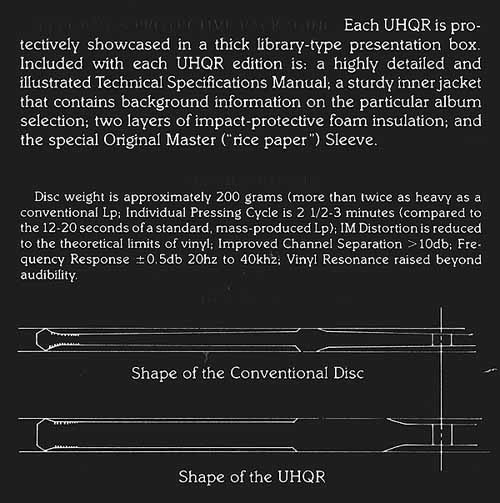
“Ultra High Quality Records” or “Lipstick on a Pig”?

Hot Stamper Pressings of Audiophile Recordings Available Now

Today’s vinyl-loving audiophile seems to be making the same mistakes I was making more than forty years ago. Heavy Vinyl, the 45 RPM 2 LP pressing, the Half-Speed Limited Edition — aren’t these all just audiophile fads, each with a track record of underperformance that seems to worsen with each passing year? Would you really want to defend this piece of junk in 2023?

In my formative years in audio, starting in the mid-70s, it would never have occurred to me to buy more than one copy of a record. I didn’t need to do a head-to-head comparison in order to find out which one sounded better. I approached the subject Platonically, not scientifically: the record that should sound better, would sound better.

uhqrb

Later on in the decade, a label by the name of Mobile Fidelity would come along claiming to actually make better sounding pressings than the ones the major labels put out, and cluelessly I bought into that nonsense too. (To be fair, sometimes they did — Waiting for Columbus and American Beauty come to mind if you don’t have properly-pressed, properly-mastered originals, but my god, Katy Lied, Year of the Cat and Sundown have to be three of the worst sounding records I’ve ever played in my life.)

And isn’t it every bit as true today as it was in the past that the audiophiles who buy these “special” pressings, like the ones I bought back in the 70s and 80s, rarely seem to notice that many of them don’t actually sound good? (Some of the worst can be found here, the worst of the worst here.)

CofAEasy Answers and Quick Fixes

Turns out there are no easy answers. There are no quick fixes. In audio there’s only hard work and more hard work. That’s what gives the learning curve its curvature — the more you do it, the better you can do it.

And if doing all that work is also your idea of fun, you just might get really good at it.

If you actually enjoy playing five or ten or even fifteen copies of the same album to find the few that really sound good, and the one that sounds amazing — because hearing your favorite music the way it was meant to be heard is a positive thrill — then you just might end up with one helluva record collection, worlds better than one filled with audiophile pressings from any era, most especially the present.


Further Reading

Letter of the Week – “I did not know this was a well known example of a below-standard re-issue…”

More of the Music of Paul Simon

Reviews and Commentaries for the Music of Paul Simon (and Art Garfunkel)

A new customer writes:

Tom,

I read about your experience with the re-issue of Paul Simon’s Graceland.

I did not know this was a well known example of  a below-standard re-issue, but your experience reflects my own  a few years ago,  over here in the Netherlands. Being very disappointed about the sound quality, I have returned my copy to the shop and asked my money back.  As I told you, I have done this more often, but always because of excessive surface noise – that does not belong on a new record at a price of €30+ .  This was the first and only time I have done this because of sound quality – apparently it was that obvious.

Peter

Peter,

This is NOT a well known example of a below standard reissue. We are the only critics of this record that I know of. The audiophile reviewers loved it!

A famously clueless audiophile reviewer even visited the hack who remastered it, that hack being a Mr. Ryan Smith, so he could learn more about the man’s approach to mastering.

Perhaps he wants to stop writing reviews for bad audiophile records and learn how to make them. If so, he is studying at the feet of a master.


A Short History of the Remastered Audiophile LP

Older audiophile records, typically those made by Mobile Fidelity in the ’70s and ’80s, suffered from a common group of problems on practically every record they released:

boosted top, a bloated bottom, and a sucked-out midrange.

Nowadays that phony sound is no longer in vogue. A new, but equally phony sound has taken its place.

What seems to be in vogue these days, judging by the Heavy Vinyl Reissue pressings we’ve played over the last few years, is a very different sound, with a very different suite of shortcomings.

These newer records, with few exceptions, tend to be compressedthickdullopaque, veiled, recessed and lacking in ambience.

These are currently the hallmarks of the Heavy Vinyl LP. Whether made by Speakers Corner, DCC, AP or any other label, starting at some point in the mid-’90s, the sound these labels apparently preferred had an infuriating tonal balance problem we noted in practically every record we played — sound that was just too damn smooth.

(more…)

Should We Tell This Guy the MoFi of Kind of Blue Is a Joke?

Hot Stamper Pressing of Miles’s Albums Available Now

The MoFi of KOB may be a joke, but don’t bother telling this guy, who appears to be rather new to this whole “reviewing” thing.

He has a record store in Phoenix and a youtube channel called The “In” Groove, wherein he proffers advice to audiophiles about records. Unsurprisingly, he tends to favor audiophile pressings. No doubt he sells lots of them in his store.

To quote the man himself, “I do a review of the best sounding copy’s [sic] of Miles Davis – Kind Of Blue. What are the copy’s [sic] you should own?”

Obviously, literacy is not his strong suit, so writing about records is out, replaced by endless talking about records on another one of these insufferable content-light videos.

Everything of interest this gentleman has to say could be written on the back of a napkin and read in the span of the average TV commercial, but that would require stringing together lots of words and arranging them so that they make some kind of sense. It’s so much easier to chat about vinyl while seated in front of some very expensive and no doubt awful sounding (judging by the results of this “shootout”) McIntosh electronics. (I am on record as being opposed to this approach to audio, and have been proselytizing for the benefits of low power amps for more than twenty years.)

Regardless of what he thinks he is doing, in no way does this fellow actually review the best sounding copies, because he’s too inexperienced and ill-informed to even bother with the ’70s Red Label reissue pressings, some versions of which happen to be among the best pressings we’ve heard, a subject we discuss here.

Our Kind of Blue Obsession

KOB is an album we have been obsessed with for a very long time, along with a great many others.

(more…)

Facing Some Hard Truths in Phoenix

Advice on Making Audio Progress

Or kicking them while they’re down. Pick whichever one you like best, they both work for me.

For those of you who have not been following this story, here is the best place to start.

Although it’s behind a paywall, you can get a free test drive easily enough. (In September there will be a long-form video of me going about a Hot Stamper shootout and discussing the world of audiophile records, which you do not want to miss!)

Now that you are up to date on the overall contours of this mess, here is another one of the many thoughts I have had concerning the revelation that Mobile Fidelity has been secretly sourcing at least some of their masters digitally since 2015.

Before we start talking about where the blame lies in this mess — with Esposito, Fremer, Jim Davis, or the so-called “engineers” who work for Mobile Fidelity — I would like bring up a couple of ideas that you have no doubt seen before, mostly because they are discussed endlessly on this blog.

We Make Mistakes

The first is that anyone who has been on an audio journey for very long has made a lot of mistakes along the way.

Uniquely among reviewers and record dealers, we go out of way to admit when we were wrong. You might say we are even proud of the fact that we used to get so many things wrong about records and audio.

Our experimental, evidence-based approach, requiring that we not only make mistakes but that we embrace them, is surely key to the progress we have made in understanding recordings and home audio. One of our favorite quotes on the subject is attributed to Alexander Pope.

“A man should never be ashamed to own he has been in the wrong, which is but saying… that he is wiser today than he was yesterday.”

To say that few audiophiles have followed our approach is not to admit defeat. Rather it is simply to say that the approach we use to find better sounding pressings involves a great deal of tedious, sometimes expensive, always time-consuming work, work that few audiophiles seem interested in doing.

Instead, the approach that most audiophiles these days take is to buy ready-made audiophile pressings. They convince themselves — how, I cannot begin to imagine — that these pressings are superior to all others because of the exceptional skills and superior methods of those tasked with mastering and pressing them. Also I think I remember reading that their hearts were in the right place or something to that effect.

(more…)

Letter of the Week – “You were too kind to the MoFi – yours destroyed it.”

More of the Music of Neil Diamond

One of our good customers had this to say about some Hot Stampers he purchased recently:

Hey Tom,   

The Neil Diamond Live is one the best I’ve ever bought from you. You were too kind to the Mofi: yours destroyed it.

My stock copy is worthless. An unusually well recorded live album. You are so right.

And your copy is awesome.

Regards

Will

Thanks, Will!

Glad you liked our copy as much as we did. The MoFi, in our opinion, is not a bad record, but the phony EQ they use causes Neil’s voice to sound unnatural, and an unnatural sounding Neil Diamond is not something that holds much appeal for us.

When the voice is wrong on a Neil Diamond record, you have yourself a completely worthless piece of vinyl.

If any of you out there in audio land are still buying these remastered pressings, take the advice of some of our customers and stop throwing your money away on Heavy Vinyl and Half-Speed masters.

At the very least let us send you a Hot Stamper pressing — of any album you choose — that can show you what is wrong with your copy. And if for some reason you disagree that our record sounds better than yours, we will happily give you all your money back and wish you the best.

Master Tape? Yeah, Right

Skeptical Thinking Is Key to Finding Better Sounding Records

UPDATE 2025

This commentary was written about 15 years ago. Since then, many companies have seen fit to post pictures of the master tapes or master tape boxes on their site and in accompanying materials.

We will stipulate that they have real master tapes to work with. That is really not the issue, as the commentary below takes pains to point out.


Let me ask you one question.

If so many of the current labels making Heavy Vinyl reissues are using the real master tapes — the real two-track stereo masters, not dubs, not cutting masters, not high-resolution digital copies, but the real thing — then why do so many of their records sound so bad?

If you’re honest you’ll say “I Don’t Know…” because, and here I want you to trust me on this, you don’t know. I don’t know either. Nobody does.

Records are mysterious. Their mysteries are many and deep. If you don’t know that you clearly haven’t spent much time with them, or don’t have a very revealing stereo, or don’t listen critically, or something else, who knows what — yet another mystery.

mastertapebox

They’re mysterious. If anything is true about records, that is.

There is no shortage of records that say “Made From the Original Master Tapes” that simply aren’t. I know this dirty little secret for a fact. I would never say which ones those are for one simple reason: it would make it seem as though others must be, when in fact we have little evidence that very many of them are.

We want them to be — I’m all for it — but how can we know if they are or not? Face it: we can’t.

We must make do — heaven forbid — with actually opening up our own ears and engaging the sound of whichever Heavy Vinyl Reissue we may find spinning on our turntable.  Judging the quality of the sound — no doubt imperfectly — coming out of the speakers.

Good Luck

If you want to believe the press releases (made from Ian Anderson’s secret master tape!), the hype, the liner notes, the reviews and all the rest of it, that’s your business. Good luck with that approach; you’re going to need it. When you reach the dead end that surely awaits you, come see us. After 35 years in the record business there is a good chance we will still be around.

Our approach, on the other hand, revolves around cleaning and playing as many records as we can get our hands on, and then judging them on their merits and nothing but their merits, calling them as we see them as best we can, without fear or favor.

Our judgments may turn out to be wrong. Tomorrow we may find a better sounding pressing than the one we sell you today. It doesn’t happen very often, but it does happen.

We don’t know it all and we’ve never pretended we did. All knowledge is provisional. We may not be the smartest guys in the room, but we’re sure as hell smart enough to know that much.

If somehow we did know it all, there would not be a hundred entries in our live and learn section. We regularly learn from our mistakes and we hope you do too.

But we learn things from the records we play not by reading about them, but by playing them. Our experiments, conducted using the shootout process we’ve painstakingly developed and refined over the course of the last twenty years, produces all the data we need: the winners, the losers, and the ranking for all the records in-between.

We’ve learned to ignore everything but the sound of the records we’ve actually played on our reference system.

What of value could anyone possibly tell us about a record that we’ve heard for ourselves? The question answers itself.

(more…)