Advice-WTLF, Audiophile

What to listen for on audiophile records in order to spot their shortcomings.

Tea for the Tillerman – This Is Your Idea of Analog?

Dear Record Loving Audiophiles of Earth,

I’m afraid we have some bad news. [This was written back in 2011 when the record came out so it’s hard to imagine that what I am about to say is news to anyone after all these years.]

Regrettably we must inform you that the 2011 edition of Tea for the Tillerman pressed by Analogue Productions on Heavy Vinyl doesn’t sound very good. We know you were all hoping for the best. We also know that you must be very disappointed to hear this unwelcome news.

But the record is what it is, and what it is is not very good. Its specific shortcomings are many and will be considered at length in our review below.

Yes, we know, the folks over at Acoustic Sounds, in consultation with the late George Marino at Sterling Sound, supposedly with the real master tape in hand, and supposedly with access to the best mastering equipment money can buy, labored mightily, doing their level best to master and press the Definitive Audiophile Tea for the Tillerman on Vinyl of All Time.

It just didn’t come out very good, no matter what the reviewers say. And what do they say? Allow me to quote one.

…superbly dynamic, spacious and detailed…The attack of the pick on the guitar strings is astonishingly clean and detailed.

Depth is pronounced…

…the resolution of low level detail reveals a host of details that are either buried or glossed over on the other versions I’ve heard…

Uh-oh, wait a minute, here’s a blindingly red flag:

If you have the edition, you’ll find this similar in one way: there’s nothing “mellow” about the overall production and when the music gets loud (and Marino lets it get so) it can get a bit hard, but better that than to soften it and lose the clarity, focus and detail of this superb recording, especially in the quieter passages where the resolution of low level detail is astonishing.

More about that later.

(more…)

MoFi Sure Added Plenty of Sparkle to These Acoustic Guitars

Hot Stamper Pressing of the Music of Ry Cooder Available Now

This review is from many years ago. Hard to imagine I would not still agree with it though.

As you probably know, the MoFi of Jazz goes for big bucks nowadays — $500 and up. Is it worth it? 

You’ve got to be kidding. It’s a nice record as far as it goes, but it suffers from the same shortcomings as just about every Mobile Fidelity pressing we bother to play these days (with some obvious exceptions of course).

We have a test pressing, and knowing that the MoFi is the standard against which many audiophiles prefer to judge our Hot Stampers, we listened to it first before going about our comparison test.

Our MoFi copy is actually tonally correct, which was a bit of a surprise. (Yours of course could very well be otherwise.)

Right away we could hear exactly what people like about it, the same thing that has always impressed audiophiles about half-speed mastered records: their often outstanding transparency.

Jazz on MoFi has zero-distortion, utterly clear, spacious, see-through sound.

But listen past that and what do you hear?

Don’t those guitars seem to have that MoFi Tea-for-the-Tillerman “sparkly” quality you hate: all pluck and no body, all detail and no substance?

Nothing has any weight.

Nothing has any solidity.

Nothing has any real life.

It’s pretty, maybe, but it sure ain’t right.

It’s the kind of sound that shouts out to the world “Hey, look at me, I’m an audiophile record! See how I sound? So clear! So clean!”

Which isn’t bad for about two minutes, and then it’s positively insufferable.

(more…)

On Dark Side of the Moon, “Breathe” Is a Good Check for Midrange Tonality

Hot Stamper Pressings of the Music of Pink Floyd Available Now

Breathe is my favorite test track for side one for any version of Dark Side Of The Moon, Half-Speed or otherwise. When the voices come in about halfway through the song, you can tell that most copies are too bright simply by listening to the vocals on this track. The cymbals might sound wonderful; lots of other instruments might sound wonderful; and there might be plenty of ambience, detail and transparency.

But all of that counts for nothing if the voices don’t sound right.

And far too many copies have the voices sounding bright, aggressive, grainy and transitory. (This is unfortunately the case with the 180 gram 30th anniversary edition. That pressing will wake up a sleepy stereo, but my stereo hasn’t been sleepy enough to play that recut for a very long time, and I hope you can say the same.)

The discussion below may shed light on some of the issues involved in the remastering of Dark Side.

Of course, most audiophiles are still under the misapprehension that Mobile Fidelity, with their strict ‘quality control’, which they spend hundreds of words explaining on their inner sleeves, eliminates pressing variations of these kinds.

Isn’t that the reason for Limited Edition Audiophile Records in the first place? The whole idea is to take the guesswork out of buying the Best Sounding Copy money can buy.

But it just doesn’t work that way. I hate to be the bearer of bad news, but our entire website is based on the proposition that nothing of the sort is true. If paying more money for an audiophile pressing guaranteed the buyer better sound, 99% of what we do around here would be a waste of time.

(more…)

Speakers Corner Peer Gynt Reviewed, with Handy VTA Advice

Hot Stamper Pressings of the music of Edvard Grieg Available Now

Sonic Grade: C+

The Fjeldstad has long been one of our favorite performances of Peer Gynt here at Better Records. 

This record is handy for VTA set-up as well, a subject discussed below in our listing from 2010.

The sound is excellent for a modern reissue*, but in the loudest sections the orchestra can get to be a bit much, taking on a somewhat harsh quality. (The quieter passages are superb: sweet and spacious.)

So I adjusted the VTA a bit to see what would happen, and was surprised to find that even the slightest change in VTA caused the strings to lose practically all their rosiny texture and become unbearably smeared.

This is precisely why it’s a good heavy vinyl pressing for setting up your turntable.

If you can get the strings to play with reasonably good texture on this record you probably have your VTA set correctly.

VTA

Correct VTA adjustment for classical records (as well as all other kinds of records) is critical to their proper reproduction. If you do not have an arm that allows you to easily adjust its VTA, then you will just have to do it the hard way (which normally means loosening a set screw and moving the arm up and down until you get lucky with the right height).

Yes, it may be time consuming, it may in fact be a major pain in the ass, but there is no question in my mind that you will hear a dramatic improvement in the sound or your records once you have taken the time to correctly set the VTA, by ear, for each and every record you play.

We heard the improvement on this very record, and do on all the classical LPs (and all other kinds of records) we play.

The Big Caveat

As for the asterisk (*) above, it concerns the caveat “…for a modern reissue…” What exactly do we mean by that? Allow us to reprint what we wrote about another Heavy Vinyl classical pressing, one that we actually used to like.

(more…)

Why Is It So Hard for Mobile Fidelity to Get the Midrange Right?

Hot Stamper Pressings of the Music of Joni Mitchell Available Now

We recently auditioned the Mobile Fidelity One-Step pressing of Blue and made the notes regarding the sound you see below.

We focussed on the quality of their pressing’s vocal reproduction, for the simple reason that a Joni Mitchell album that gets the vocals wrong is a Joni Mitchell album that no music lover and certainly no audiophile  would ever want to play.

The fact that some audiophiles do want to play this record speaks poorly of their ability to reproduce it properly. Accurate playback will reveal the problems with Joni’s voice described in detail below. The post-it for side one is on the left, for side two on the right.

We try to be very specific about the shortcomings of these records, which is why we reproduce our notes whenever they are available.

Side One

  • Tonally not far off, a bit too stringy and flat. Not awful. Congested vocals at peaks, harsh. 1+

Side Two

  • Vocal peaks like “traveling, traveling, traveling…” or “California” get squashed and harsh, lacking the real dynamics, presence and space of the vocals. No grade. (Awful in other words.)

(more…)

Music from Big Pink on MoFi – Bad Bass Like This Is Just Annoying

Hot Stamper Pressings of Music by The Band Available Now

In 2012 the “new” MoFi put out another remastered Big Pink. Since their track record at this point is, to be honest, abysmal, we have not felt the need to audition it.

It’s very possible, even likely, that they restored some of the bass that’s missing from so many of the originals.

But bad half-speed mastered bass — poorly defined, never very deep and never punchy — is that the kind of bass that would even be desirable?

To us, it is very much a problem. Bad bass is just plain annoying.
Fortunately for all, it is a problem we have to deal with much less often now that we’ve all but stopped playing Half-Speed mastered records.

Here are some other records with exceptionally sloppy bass. If the bass on these records does not sound sloppy, you have your work cut out for you.

Some of our favorite records for testing bass definition can be found here.

Sucked Out Mids

The Doors first album was yet another obvious example of MoFi’s predilection for sucked-out mids. Scooping out the middle of the midrange has the effect of creating an artificial sense of depth where none belongs.

Play any original Bruce Botnick-engineered album by Love or The Doors and you will notice immediately that the vocals are front and center. 

(more…)

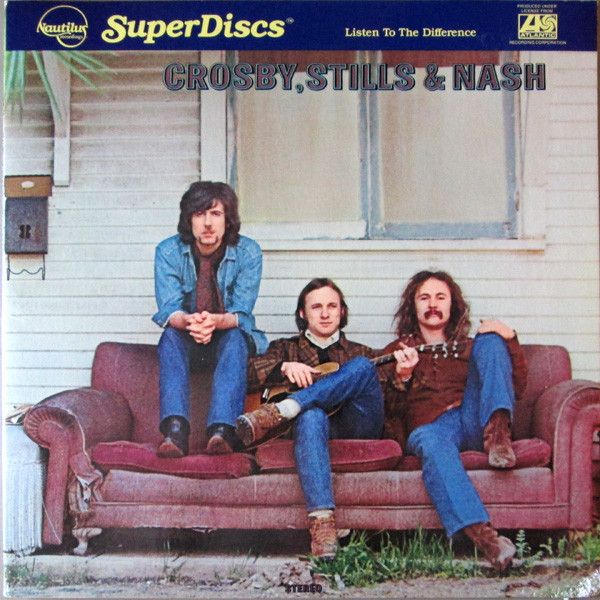
This Nautilus LP Has the Most Bloated, Ill-Defined, Overblown Bass in the Sad, Sordid History of Half-Speed Mastering

Hot Stamper Pressings of the Music of Crosby, Stills and Nash Available Now

An audiophile hall of shame pressing and a Half-Speed mastered disaster if there ever was one.

An audiophile record dealer (of course; who else?) once raved to me about Crosby Stills and Nash on Nautilus. I said “What are you talking about? That version sucks!” He replied “No, it’s great. Helplessly Hoping sounds amazing.” 

Now one thing I know about the Nautilus is this: although it is wonderfully transparent in the midrange, it may very well take the cake for the most bloated, out of control bass in the history of Half-Speed mastering.

What song on that album has almost no bass, just lovely voices in the midrange? You guessed it. Helplessly Hoping.

The Nautilus got one track right, and ruined the rest.

Using that track for comparison will fool you, and when it comes time to play a side of the album, you will quickly hear what a disaster it is.

(more…)

A Cosmo’s Factory Shootout from Way Back When

Hot Stamper Pressings of the Music of Creedence Clearwater Revival Available Now

UPDATE 2020

This is a very old commentary describing a shootout we had done more than a decade ago. Some of what you see below would probably still be true. The cutting system used to make the AP pressing no doubt lacked Tubey Magic. It’s also true that many of the records mastered on it were as lifeless and boring as we describe.

The only way to be clear about what is going on with the audiophile pressings in this group is to do another shootout with them, and we just can’t see taking the time to do that when there are so many good vintage pressings we don’t have time to play as it is.

There are only so many hours in the day, why waste them playing this crap?

We do occasionally throw the modern remastered pressings we manage to get hold of into our shootouts when time permits. You can read all about the half-speeds we’ve reviewed here and some of the Heavy Vinyl pressings we’ve played here.

Our latest thinking about this Analogue Productions repress can be found here.


Now, on to our old shootout.

Years ago a customer sent me his copy of the Analogue Productions LP (mastered by Hoffman and Gray) in order to carry out a little shootout I had planned among the five copies I could pull together: two MoFi’s, the Fantasy ORC reissue, a blue label original, the AP, and another reissue. 

Let’s just say there were no real winners, but there sure were some losers.

My take on the Hoffman version is simply this: it has virtually no trace of Tubey Analog Magic. None that I can find anyway.

It sounds like a clean, tonally correct but fairly bass-shy CD.

No pressing I played managed to be so tonally correct and so boring at the same time.

The MoFi has plenty of weird EQ colorations, the kind that bug the hell out of me on 98% of their crappy catalog, but at least it sounds like analog. It’s warm, rich and sweet.

The AP copy has none of those qualities.

More pointless 180 gram vinyl sound, to my ear anyway. I couldn’t sit through it with a gun to my head.

You would need a lot of vintage tubes in your system to get the AP record to sound right, and then every properly-mastered record in your collection would sound worse.

(more…)

Steppenwolf Gold – Their Great (But Awful Sounding) Hits

Record Collecting for Audiophiles – A Guide to the Fundamentals

There is an interesting story behind how I got my mitts on this particular Heavy Vinyl pressing.

Months ago [now years], a fellow contacted us to buy some of our Hot Stamper pressings.  We sent him one or two, and he soon wrote back to say he was not happy with the sound. We exchanged emails with him for a while, trying to rectify the situation in the hopes that we could get him some records that he would be happy with.

In the middle of all this back and forth, we thought it would be worthwhile knowing what this gentleman thought was a good sounding record, seeing as how ours were not meeting his standards. Our discussion soon crossed over into Heavy Vinyl territory. We asked, “Were there any that he liked the sound of?”  Why yes, there were.

You guessed it. The above-pictured album from Analogue Productions is one he recommended. (There was another he also said we should try, but after playing this one we decided against buying any more records he recommended, for reasons that will soon be evident.)

So we bought a copy. Soon enough we found ourselves playing our newly remastered Heavy Vinyl LP.

Right from the get-go, thick, murky, compressed, lifeless, ambience-free, dead-as-a-doornail sound was now coming out of my speakers. Like sludge from a sewer you might say. The stereo had sounded fine moments before. What the hell was happening?

I quickly grabbed a Super Hot copy of the album off the shelf and put it on the table.

Here was the energy, clarity, presence, space and more that had been missing mere moments ago while the Heavy Vinyl pressing played. Now, coming out my speakers was everything that makes a good vintage pressing such a joy to listen to.

I felt like turning it up and rocking out. The first song is Born to Be Wild. Who doesn’t love to blast Born to Be Wild?

What a difference. Night and Day. Maybe more!

If this Steppenwolf LP isn’t the perfect example of a Pass/Not-Yet record, I can’t imagine what would be.

As I was thinking about the turgid, compressed, veiled, overly smooth but not tonally incorrect sound coming out of my speakers, I thought back about the kinds of stereo systems that can produce that sound on command. They often look like the one you see below.

(more…)

Let It Be on Heavy Vinyl – The Gong Rings Once More

Hot Stamper Pressings of Let It Be Available Now

At the end of a shootout for Let It Be back in June of 2014, we decided to see how the 2012 Digitally Remastered Heavy Vinyl pressing would hold up against the 12 (yes, twelve!) British copies we had just critically auditioned.

Having evaluated the two best copies on side two, we felt we knew exactly what separated the killer copies (White Hot) from the next tier down (Super Hot). Armed with just how good the recording could sound fresh in our minds, we threw on the new pressing. We worked on the VTA adjustment for the thicker record for a couple of minutes to get the sound balanced and as hi-rez as possible, and after a few waves of the Talisman we were soon hearing the grungy guitar intro of I’ve Got a Feeling.

My scribbled first notes: not bad! Sure, there’s only a fraction of the space and three-dimensionality of the real British pressings, but the bass seemed to be there, the energy seemed decent enough, the tonality was good if a bit smooth and dark — all in all not a bad Beatles record.

Then we played One After 909 and the sound just went off a cliff. It was so compressed! The parts of the song that get loud on the regular pressings never get loud on the new one. The live-in-the-studio Beatles’ rock energy just disappeared.

We couldn’t take more than a minute or two of the song, it was that frustrating and irritating. What the hell did they do to make this record sound this way? We had no idea.

Didn’t matter. It was game over. The gong from The Gong Show had rung. The record had to go.

We had played twelve British copies, all with stampers that we knew to be good on side two. Two or three of those copies did not merit a Hot Stamper sonic grade. Nothing new there, happens all the time.

Yet even the worst copy we played of the twelve had more jump-factor, more life and more dynamic energy than the new Heavy Vinyl pressing.

Which means that there’s a very good chance that any copy you pick up on British vinyl will be better sounding — maybe not a 100% chance but easily a 90+% chance. Which makes buying the new Heavy Vinyl LP — not to mention playing it — entirely pointless.

(more…)