Advice-WTLF, Audiophile

What to listen for on audiophile records in order to spot their shortcomings.

Midrange Suckout? I Have a Theory

These Titles Are Good for Testing Presence in the Midrange

Many audiophile records suffer from a bad case of midrange suckout.

Vocals and other instruments seem to be so far back in the soundfield that they might as well be coming from another room.

Yet somehow there are still audiophiles who defend the records put out by the ridiculous label that single-handedly created and produced that sound. What is wrong with these people?

(On a side note, yes, I was one of the audiophiles who fell for their phony EQ trickery in the 70s and 80s. In my defense, that was a long time ago.)

I Have a Theory

Actually, I have a good idea why so many so-called audiophile records have a sucked-out midrange.

A midrange suckout creates depth in a system that has difficulty reproducing it.

Imagine that instead of having your speakers pulled well out from the back wall the way you should, you instead have your speakers shoved flat up against that wall.

This arrangement has the effect of seriously limiting your speakers’ ability to reproduce the three-dimensional space of the recordings you play.

Kind of Blue on MoFi

I hinted back in 2022 I was going to discuss their pressing down the road, and like most things that I was supposed to write about down the road, we’re still waiting to see it.

The short version of that future commentary will note that the drums in the right channel of All Blues are about five feet further back in the soundfield than they are on our reference too-noisy-to-sell Six-Eye pressing, or any other pressing of the album we’ve played for that matter.

At the time I could not wrap my head around how Mobile Fidelity could have gotten hold of the multi-tracks in order to remix the album and place the drums further back in the mix.

(more…)

Bernie Grundman’s Modern Standard Operating Procedure Strikes Again

Hot Stamper Pressings of the Music of Bruce Springsteen Available Now

If you own the Classic Records reissue of this album from the early 2000s, hearing a Hot Stamper pressing is almost sure to be a revelation.

The Classic pressing was dead as a doornail.

It was more thick, it was more opaque, and it was more compressed than most of the originals we played, originals which we noted often had problems in all three areas to start with.

Bernie did the album no favors, that I can tell you.

Head to head in a shootout, our Hot Stampers will be dramatically more lively, solid, punchy, transparent, open, clear and just plain REAL sounding, because these are all the areas in which Heavy Vinyl pressings tend to fall short.

(more…)

You Say the Budget Stereo Treasury Has Better Sound than the Speakers Corner?

Hot Stamper Pressings of the Music of Borodin Available Now

The Borodin album you see pictured is a decent enough Speakers Corner Decca repress.

The Heavy Vinyl reissue of this title is not bad, but like a number of reissues, it lacks the bottom end weight found on the early London pressings.

(Classic Records pressings rarely had that problem. Just the opposite in fact. The bass was boosted most of the time, especially the deep bass, but for some reason the lower strings are never rich the way the best vintage pressings can be.)

I remember this Speakers Corner pressing being a little flat and bright.

Since I haven’t played it in years, there is some chance that I could be wrong. I have never had trouble admitting to the possibility, a fact that makes us practically unique in the world of audiophile reviewers.

The glorious sound I hear on the best London pressings is simply not the kind of thing I hear on 180 gram records by Speakers Corner, or anybody else for that matter.

They do a good job some of the time, but none of their records can compete with a vintage pressing when that vintage pressing is mastered and pressed properly. 

The best pressings of this UK London Stereo Treasury from the Seventies will beat the pants off of it. That ought to tell you something, right?

(more…)

The Fantasy Film World of… “Did MoFi bother to listen to this before they ruined it?”

Hot Stamper Pressings of the Music of Bernard Herrmann Available Now

Sonic Grade: F

Obviously our customers know by now that a Hot Stamper London or Decca pressing is going to be far better than the Anadisq that MoFi cut in the mid-90s.

How much better?

Words fail me.

Their record was a complete disaster. Perhaps some of the MoFi collectors didn’t notice because they had nothing to compare it to. 

God forbid they would ever lower themselves to buy as common a pressing as a London. Had they done so, what they would have heard is huge amounts of musical information that is simply nowhere to be found on the MoFi.

There is a place on this album, I failed to note exactly where, in which a group of tubas play a descending scale that is somewhat buried in the mix. On the London, they can clearly be heard and recognized as tubas. On the MoFi, I don’t think they can be heard except as some general group of low notes, and anyone thinking that they were tubas would be guessing, the sound is that murky, muddy, and ill-defined.

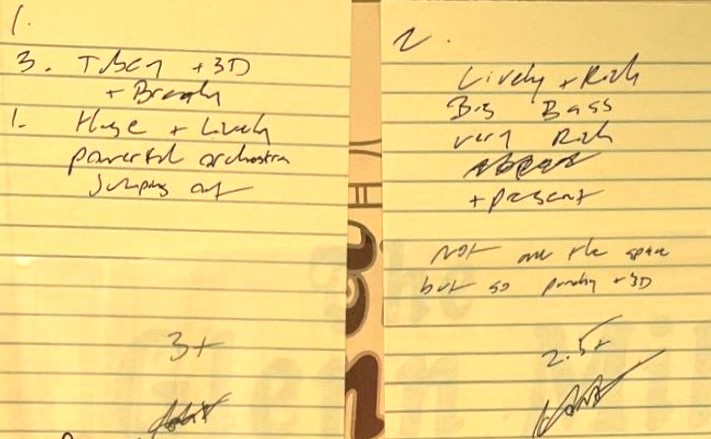
Robert Pincus once left a Post-It note stuck to the MoFi jacket of a copy he was playgrading for me that summed up our thoughts on the quality of their mastering to a “t”:

“Did MoFi bother to listen to this before they ruined it?”

It’s positively shameful. This music is so good. On top of that, it’s custom made for audiophiles. Audiophiles are the ones who can appreciate the new colors Herrmann created, using what a wise man once called the single greatest instrument ever invented: the symphony orchestra.

If this Mobile Fidelity LP isn’t the perfect example of a pass/not-yet record, I can’t imagine what would be. To find a more poorly remastered record, you would really have to work at it.

(more…)

Letter of the Week – “…I am surprised at how muddy the bass sounds on the new one.”

Hot Stamper Pressings of the Music of Sting and The Police Available Now

One of our good customers had this to say about a record he read about on the blog, the Nautilus pressing of Ghost in the Machine.

Hey Tom,   

Did you write something about the Nautilus record… I thought so, but I couldn’t find it.

[This Ghost in the Machine link will take you to it.]

This is one of my favorites from my teenage years and so I decided to do my own little test… Sterling vs. Nautilus vs. Half Speed Abbey Road reissue… it feels pretty clear the Sterling is tops with Nautilus close but I am surprised at how muddy the bass sounds on the new one. And just how tamped down the record sounds. Which is I guess your point.

Geoff

Geoff,

You now know a great deal more about this album than most of the audiophiles expressing their opinions on audiophile forums.

You conducted a shootout, something most of them can’t be bothered to do.

You should not be surprised about muddy bass on Half-Speed mastered records, they all have it.

And tamped down? Tell me about it.

Compressed and lifeless are two qualities the audiophile record can be guaranteed to deliver. How these companies get away with producing one shitty remaster after another is beyond me. They’ve been making this junk for more than forty years and they apparently haven’t learned anything about records in all that time.

Welcome to the upside-down world of the modern audiophile record. The worse they sound, the more audiophiles seem to like them.

Your shootout provided you with a good lesson to learn right from the start. It has set you on a better path.

Try this experiment: Take four or five UK pressings, clean them up and then compare them to any of the ones you played — the sound should be night and day better. And, after doing that shootout, one of the four or five would be a truly Hot Stamper pressing.

(more…)

Classic Records 45 RPM Recut – This Is Your Idea of a Great Firebird?

Hot Stamper Pressings of the Music of Igor Stravinsky Available Now

Many years ago, a customer alerted me to a review Wayne Garcia wrote about various VPI platters and the rim drive, and this is what I wrote back to him:

Steve, after starting to read Wayne’s take on the platters, I came across this:

That mind-blowing epiphany that I hadn’t quite reached with the Rim Drive/Super Platter happened within seconds after I lowered the stylus onto the “Infernal Dance” episode of Stravinsky’s Firebird (45 rpm single-sided Classic Records reissue of the incomparable Dorati/LSO Mercury Living Presence recording).

That is one of my half-dozen or so favorite orchestral recordings, and I have played it countless times.

This is why I have so little faith in reviewers. I played that very record not two weeks ago (04/2010) against a good original and the recut was at best passable in comparison. If a reviewer cannot hear such an obvious difference in quality, why believe anything he has to say?

The reason we say that no reviewer can be trusted is that you cannot find a reviewer who does not say good things about demonstrably mediocre and even just plain awful records. It’s the only real evidence we have for their credibility, and the evidence is almost always damning.

I want a reviewer who knows better than to play such an underwhelming pressing and then waste my time telling me about it. He should tell us what a good record sounds like with this equipment mod. Then I might give more credence to what he has to say.

Reviewer malpractice? We’ve been writing about it for more than 25 years.

P.S.

This is one of the Classic Records titles on Harry Pearson’s TAS List of Super Discs(!)

P.P.S.

Allow me to quote a writer with his own website devoted to explaining and judging classical recordings of all kinds. His initials are A.S. for those of you who have been to his site.

Classic Records Reissues (both 33 and 45 RPM) – These are, by far, the best sounding Mercury pressings. Unfortunately, only six records were ever released by Classic. Three of them (Ravel, Prokofiev and Stravinsky) are among the very finest sounding records ever made by anyone. Every audiophile (with a turntable) should have these “big three”.

Obviously we could not disagree more. I’ve played all six of the Classic Mercury’s. The Chabrier, Ravel and Prokofiev titles are actually even worse than the Stravinsky we reviewed.

This same reviewer raved about a record we thought had godawful sound, Romantic Russia on MoFi, a label that never met an orchestral string section it didn’t think needed brightening.

Find me a Mobile Fidelity classical record with that little SR/2 in the dead wax that does not have bright string tone. I have yet to hear one.

What is it with audiophile record reviewers? They seem to be taken in by the most unnatural sounding pressings. The world is full of wonderful vintage pressings that have no such problems. If you are an audiophile who feels himself qualified to write about records, shouldn’t you at least be able to hear the difference between a phony audiophile pressing and the vintage pressings it supposedly improved?

(more…)

Mobile Fidelity’s Approach to Mastering – I Have a Theory

Hot Stamper Pressings of the Music of Little Feat Available Now

I have a theory about why MoFi’s mastering approach tended to work for the Waiting for Columbus album when it failed so miserably for so many others. It goes a little something like this. 

Back in their early days, MoFi tended to add bass and treble to practically every record they mastered, regardless of whether or not the master tape they were using needed a boost.

A little extra sparkle up top and a little extra kick down low was what the audiophile public seemed to want.  We call this the smile curve and lots of audiophile records have a case of it.

Truth be told, I was a member of that group and I know I did.

Fortunately for them, Waiting for Columbus is an album that can ofteny use a little at both ends. Rarely did The Mastering Lab supply it, making the original domestic pressings somewhat bass-shy and dull on the extreme top. The MoFi clearly corrected the poor EQ choices The Mastering Lab had often made. 


UPDATE 2024: Poor EQ Choices?

Or perhaps it could have been one or more of the following:

  • Perhaps the band liked it better that way.
  • Perhaps The Mastering Lab found it easier to cut that way.
  • Perhaps the cause of the records lacking extension on both ends comes from some other factors that cannot be known.

Or, if you don’t like those three, just make up some other reasons that sound plausible, or ones that fit in with other ideas you may have, even though there is probably not an iota of evidence to support any of it.

This is the way of the audiophile record collector — theories galore, but not much experimental evidence to back them up (or falsify them as the case may be). We are more inclined to the No Theory approach to finding good records, which you can read about here. We believe it has served us well and can do the same for you.

(more…)

MoFi’s Pictures at an Exhibition Is as Wrong as Wrong Can Be

moussmofiHot Stamper Pressings of the Music of Mussorgsky Available Now

If you like orchestral spectaculars, have we got the record for you.

It’s the same recording of the works, but the one you want is on the real EMI label and pressed on UK import vinyl, not this awful Half-Speed recut from Japan.

The record you see pictured is awful sounding, a true hall of shame pressing.

And why are the colors of the album jacket so washed out? Compare their cover to the real thing below. As we often find ourselves asking after reviewing one of these MoFi records: What were they thinking?

The MoFi mastering of Pictures at an Exhibition and The Firebird here are a bad joke played on credulous audiophiles. And yes, I bought them both back when they came out. I was as credulous as everybody else buying these so-called superior pressings.

All that phony boosted top end makes the strings sound funny and causes mischief in virtually every other part of the orchestra as well. Not surprisingly, those boosted highs are missing from the real EMIs.

These appear to be the unbearably bright strings that Stan Ricker favors — why, we have no idea.

The proof? Find me a Mobile Fidelity classical record with that little SR/2 in the dead wax that does not have bright string tone. I have yet to hear one.

The last time I played a copy of the MFSL I found the sound so hi-fi-ish I couldn’t stand to be in the room with it for more than a minute. Of course the bass is jello as well.

The EMI with the right stampers is worlds better.

(Warning: The domestic Angel regular version and the 45 are both awful.)

MoFi had a bad habit of making bright classical records. (More reviews here.) I suppose you could say they had a bad habit of making bright records in general. A few are dull, some are just right, but most of them are bright in one way or another.

(more…)

Powerful People on MoFi – What Was I Thinking?

More Entries in the Mobile Fidelity Hall of Shame

UPDATE 2024:

I just found my old review notes from 2014! They can be seen below. Please to enjoy.

At the time of our last shootout in 2014, I still had the MoFi pressing of Powerful People in my personal, very small (at that point) record collection.

Almost all the best sounding records from my collection had been sold off long before, going to good homes that I can only assume would play them more than I had in the last ten years.

If it’s a record you see on our site, chances are good I’d have listened to it until I’d practically turned blue in the face.

But I had kept my Powerful People Half-Speed these 30+ years because the domestic pressings I’d played were just too damn midrangy to enjoy.

At least the MoFi had bass, top end and didn’t sound squawky or hard on the vocals.

Well, let me tell you, played against the best domestic pressings, the MoFi is laughable. (In that respect it shares much with the current crop of audiophile reissues.)

It’s unbelievably compressed, a problem that is easily heard on the biggest, most exciting parts of the tracks. They never get remotely as big or as loud on the MoFi as they do on the lowly A&M originals.

It’s also sucked out in the midrange, like most MoFis, and, like most MoFis and Half-Speeds in general, the bass is not well-defined, punchy, and it never goes very deep.

There is also the issue of the MoFi 10k boost on the top end — it’s clearly audible and as bothersome as ever.

In summation, like most of the better audiophile records — from long ago as well as those being produced today — the most you can hope for from these reissues is that they can fix a few problems you might be saddled with on the particular pressing you own.

(more…)

This MoFi Makes My Head Hurt

Hot Stamper Pressings of the Music of Richard Strauss Available Now

Is the painting on the cover that of a man whose head is suffering from the ridiculously shrill string tone of this MoFi?

Doubtful. Impossible actually. But that’s exactly how my head feels when I play one of these awful MoFi classical LPs.

Their rock, pop and jazz remasters were hit and miss in the old days, with some real winners hidden amongst the junk, but their classical releases that I’ve played, without exception, was a dog.

Want a good way to know you’re dealing with bad records and collector mentality?

When you find one of these records in your local used record store, it is almost guaranteed to be pristine.

Good records get played. MoFi’s classical releases, like plenty of other classical records audiophiles found attractive, got collected and spent most of their days sitting on a shelf, out to pasture so to speak.

(more…)