Month: December 2025

Our Top Copy of Broken Barricades Was Amazing Sounding

Hot Stamper Pressings of Art Rock Albums Available Now

Our recent Shootout Winning early UK pressing was described this way:

Looking for some proggy music that falls somewhere between Jethro Tull and Supertramp, with sonic credentials to match the recordings of those two very well-recorded bands? Well, look no further.

This early UK press is full of the Tubey Magic and studio space that makes the band’s recordings the joy they are to play on a heavily-tweaked audiophile rig.

If you’re a Prog Rock or Art Rock fan, this is a classic from 1971 that belongs in your collection. This also just happens to be our pick for the best sounding recording by the band. Others of similar stature can be found here.

And here are the notes that back up everything we had to say about the copy that knocked us out.

We LOVED playing this album, both for the music and the sound. These guys don’t get the respect they deserve among audiophiles, but we’re doing our best to try to change that.

Side one kicks off with the hit track Simple Sister, and you won’t believe how hard it rocks. Some copies are overly clean — they have the kind of clarity you might hope to find, but lacked the richness and fullness that makes ’70s analog so involving. Those “clean” copies simply do not earn very high grades from us. We leave that sound to the Heavy Vinyl and CD crowd; they seem to like it.

Punter and Thomas

John Punter engineered and Chris Thomas produced. They have worked on many of our favorite — and best-sounding – albums by British artists.

(more…)

Rossini-Respighi / La Boutique Fantasque / Solti

More of the Music of Respighi

  • An early London pressing of Solti and the Israel Phil’s performance of this wonderful ballet suite, here with seriously good Double Plus (A++) grades or close to them from first note to last
  • It’s also remarkably quiet at Mint Minus Minus, a grade that even our most well-cared-for vintage classical titles have trouble playing at
  • An abundance of energy, loads of rich detail and texture, superb transparency and excellent clarity (particularly on side one) – the very definition of Demo Disc sound
  • After trying a few years ago, we knew the best copies had the potential to be knockouts in the Decca canon – after that it was only a matter of finding enough clean copies
  • No other performance or recording we played could hold a candle to this one – the Fiedler we used to like years ago was especially disappointing this time around
  • The best sides were always the biggest, clearest and most three-dimensional, assuming they were able to retain the rich, natural, balanced tonality that is inherently key to a good record, or a great one in this case
  • There are about 150 orchestral recordings we think offer the best performances with the highest quality sound. This record is certainly deserving of a place on that list.

(more…)

Listening in Depth to Emerson, Lake & Palmer

Hot Stamper Pressings of the Music of Emerson, Lake and Palmer Available Now

If you’ve got the system to play this one loud enough, with the low end weight and energy it requires, you are in for a treat with Emerson, Lake and Palmer’s debut.

The organ that opens side two will rattle the foundation of your house if you’re not careful. This music really needs that kind of megawatt reproduction to make sense. This is bombastic prog that wants desperately to rock your world. At moderate levels it just sounds overblown and silly. At loud levels, it actually will rock your world.

To play this record right, you should have, at a minimum:

  • Big dynamic speakers, and they should be pulled out well into the room to create a three-dimensional presentation, in this case of a live rock concert. If the speakers are too big for the room, or stuck in the corners, you haven’t got a chance with a recording as powerful as this one.
  • A large room. (Our new studio has a 12 foot ceiling, a big help with a blockbuster recording such as this one.)
  • Strong walls with no windows, and, if possible, a concrete floor to keep the bass from leaving the room.
  • Seating for a single listener far from any boundary, especially the back wall (a common problem with small-ish rooms).
  • Extensive room treatments to deal with the loud levels this music requires.
  • Enough amplifier power driving speakers with big enough woofers to move all the air in the listening room with authority.
  • And, finally, high quality electricity, a heavily tweaked front end and all the rest of the audio stuff we discuss endlessly on this blog.

Without all of these things, it’s hard for us to imagine anyone could hear this record sound the way the artists and engineers wanted it to. Playing a record like this in a small room at moderate levels practically guarantees that the listener will not be able to hear what makes the best copies of this album so special.

(more…)

Problem Solving in Audio

Robert Brook runs a blog called The Broken Record, with a subtitle explaining that his blog is:

A GUIDE FOR THE DEDICATED ANALOG AUDIOPHILE

We know of none better, outside of our own humble attempt to enlighten that portion of the audiophile community who love hearing music reproduced with the highest fidelity — and are willing to go the extra mile and pay the extra dollar to make that happen.

PROBLEM SOLVING in AUDIO

We have a section on the blog under the heading Making Progress that digs into the kinds of issues that audiophiles tend to run into, especially when they are first getting started. They’re the ones Robert Brook writes about in his commentary above, and they’re the ones that tripped me up over and over for decades after I first got started in this hobby sometime in the mid-70s.

It wasn’t until around 2005 that I stumbled upon, mostly through luck and audiophile friends, the elements that make up my current system.

Imagine being so clueless that you actually had to spend thirty years in a hobby before you figured out. That was me!

Of course I thought I had it all figured out right from the start. I was the proud owner of monstrously-large, ridiculously-expensive speakers, tube equipment (also expensive, and the latest and greatest cutting edge technology back in those days), Half-Speed mastered records, records made live directly to disc, fancy cables — you name it, I had everything required to play music at nearly-live levels with near-perfect fidelity.

All the most important boxes I was told about had been checked off right from the get-go in the 70s. I was all in, and for the next thirty years I did everything the audiophiles I knew liked to do: find and evaluate better gear, try new tweaks, and, more than anything else, learn to appreciate music that I had never heard before — some of it new, some of it very old.

These are all stories that have been told here on the blog in hundreds and hundreds of posts.

Everything changed when I started doing audio and records in ways that nobody I knew had ever done them before. (That also is a story that has been frequently told here.)

Taking the approach to audio and software that audiophiles tend to take — the bulk of the story Robert Brook tells in his commentary — can only get you so far. That’s the lesson I learned after spending my first thirty years in the hobby.

It’s why this blog is devoted to one concept above all others — the importance of being skeptical.

Requiring empirical evidence to back up whatever I might choose to believe was the shock that my system — my nervous one, as well as my audio one — needed to jolt it out of its comfort zone and force it to come up with a better way.

At the start I believed what I was told — hey, it seemed to be working, and who was I to argue with the “experts” anyway? I went along with the crowd, and I got the average results crowds tend to get.

This blog, as well as Robert’s, is simply trying to help you circumvent the bad ideas that we run into everywhere in audio these days. We’ve tried lots of them, most of them didn’t work, or didn’t work very well, and the good news for you, dear reader, is that we found others that we know do work.

(more…)

Letter of the Week – “It is in a whole different league to the best I have ever managed to find…”

Hot Stamper Pressings of the Music of David Bowie Available Now

One of our good customers had this to say about some Hot Stamper pressings he purchased recently:

Hey Tom,   

I want to thank you so much for the Diamond Dogs I received from you.

It is in a whole different league to the best I have ever managed to find and it is so satisfying to hear something how I always thought it should sound and at a very reasonable price. This is my favourite Bowie album.

Interestingly I bought a Hunky Dory recently that is out of this world. I know one is not supposed to give away stamper numbers and such (blame my compulsive honesty on my Aspergers!) and you probably know this already but the pressing is German RCA International with E 0014A -2 II and E 0014 B 1 II. It is seriously one of the best records I have and by far the best Bowie.

Thanks again Tom and everyone at Better records!

Cheers, Peter

Peter, glad to hear you liked our Diamond Dogs! Those are indeed very special pressings.

Best, TP

P.S.

We happen to know the German pressing of Hunky Dory referenced above. It can be good but not great. They are not competitive with the copies we sell. We do not buy them nor do we sell them. Ours get rave reviews like this one.

(more…)

Another Amazing Mercury Dropped from the TAS Super Disc List?

Hot Stamper Pressings of TAS List Records Available Now

We have a preference for Dorati’s work with the London Symphony Orchestra over those he recorded elesewhere. A record like this will show you exactly why.

The Love of Three Oranges (SR 90006) is a killer recording — the kind of orchestral spectacular that is guaranteed to put your stereo through its paces and then some.

If you’re a fan of 20th century orchestral showpieces such as these, Robert Fine and Wilma Cozart have here produced a very special record containing two of the best.

We hope you like your sound big and bold, because that is the sound they were obviously going for, based on the sound we were hearing from the best early pressings.

I have to admit I was not a fan of this album until recently when I finally got my hands on a clean copy with the right stampers and heard the powerful sound of the London Symphony come blasting out of my speakers – what a thrill!

(more…)

Port’s Rule and The Song of the Volga Boatman

More Records that Helped Me Make Progress in Audio

The track that started us down the road to our first Sauter-Finegan shootout is, to this very day, our Number One Test Track of All Time, a little ditty known as the Song of the Volga Boatman.

We first heard it back in the 90s on Bob and Ray Throw a Stereo Spectacular, which is still the version we test with, but this album of forward-looking big band contains that track  as well as 10 others, all with truly amazing sound.

Why is the Song of the Volga Boatman our ultimate test track?

The simplest way to understand it is that all the instruments are being played live in the studio, and all of them in the huge soundfield are real and acoustic — string bass, drums, horns of every size and type, woodwinds, percussion, tubular bells, etc.

In addition, the arrangements given to this roomful of players is so complex and lively that if anything sounds “funny,” to use the precise audiophile nomenclature, it really calls attention to itself.

Port’s Rule states: If it isn’t easy for your Test Discs to sound wrong, they are not very good Test Discs.

Wrong is the natural order of things.

Getting it right is where the work comes in to play.

And it should seem more like play than work or you are unlikely to get very far with it. (That’s another one of Port’s Rules, sometimes referred to as music does the driving.)

When the stereo is right from top to bottom, this song is right from top to bottom, and every other record we know the sound of will have the sound it’s supposed to have.

It seems simple and in some ways it is.

We’ve been getting the Song of the Volga Boatman to sound bigger and better now for years, through scores and scores of changes. At our current stage of audio evolution, at the very loud levels we play it at, it’s shocking how big, powerful and real it seems. It has more of the “live music” qualities we prize than almost any other studio recording I can think of.

(more…)

Speakers Corner Has a “Winner” in Espana

Hot Stamper Pressings of the Music of Chabrier Available Now

Sonic Grade: B

One of the better Speakers Corner Deccas.

We haven’t played a copy of this record in years, but back in the day we liked it, so let’s call it a “B” with the caveat that the older the review, the more likely we are to have changed our minds. Not sure if we would still agree with what we wrote back in the 90s when this record came out, but here it is anyway.

This is a Speakers Corner Decca 180 gram LP reissue of the famous Argenta performance, a recording which can sound positively amazing on the right original London, but only about 2 out of 10 copies actually do sound amazing.

And where in the world are you going to find 10 clean copies of a record that’s almost 40 years old?

This pressing gets you most of the way there, on reasonably quiet vinyl, for a lot less money.


UPDATE 2025

This Speakers Corner title may be good, but our Hot Stamper classical and orchestral pressings will be dramatically more transparent, open, clear and just plain REAL sounding, because these are all the areas in which Heavy Vinyl pressings tend to fall short in our experience.  For more on that subject, see here and here.

(more…)

Baskets of Recordings and Facets of Reproduction

Hot Stamper Pressings of the Music of Rickie Lee Jones Available Now

Ideally you need a basket of roughly five to ten well known recordings with which to test your equipment, tweaks, room, cleaning regimen and the like.

Don’t rely on any single recording to be The Truth. None of them are. (I found this out the hard way when tweaking the setup in our new studio in 2022.)

To illustrate this idea, imagine your stereo as a huge diamond. Every recording you play is showing you a different facet of that diamond, corresponding to a different strength or weakness of your system’s reproduction.

Audiophile X will play a record and say it has bad bass. His bass reproduction is excellent when playing other recordings, so record X, which he thinks has bad bass, is clearly at fault.

If you have been in audio for very long, you should easily recognize the conclusion this person has drawn as a case of mistaken audiophile thinking. 

Audiophile Y plays the same record and says it has good bass. Assuming the record has good bass for a moment, what is in fact happening in Audiophile X’s system is that most facets of his bass are good, but some facet of his bass is bad, and this record is showing him some shortcoming in his bass reproduction that his other records are not capable of showing him. 

If Audiophile X makes some changes to his stereo, and the record in question now has better bass, and, importantly, other records still sound as good or better than they used to, then some measure of success has most likely been achieved, and another step forward has been taken on that very long and often frustrating journey that we are on.

Flaws in the Diamond

The diamond has many flaws. We find them and fix them by regular tweaking and tuning, both of which have the added benefit of improving one’s critical listening skills.

To help you improve your stereo, room, electricity and the like, we have scores of records that are good for testing a great many aspects of audio reproduction.

Rickie Lee Jones’ first album is what we would call a bad test disc, for one very simple reason:

It can sound good on a system with a great many problems. It doesn’t expose sonic flaws as much as it hides them.

Port’s Rule states: If it isn’t easy for your test discs to sound wrong, they are not very good test discs.

If you are looking for tougher test discs, we have you covered there, with more than two dozen ballbusters guaranteed to bring any stereo to its knees. If you like a challenge, and own some of these records, preferably Hot Stamper pressings you bought from us (because we know those have the right sound; we played them), we invite you to have at ’em.

(more…)

The Best Pressings of Brothers in Arms Are Not Hard to Recognize

We try to be upfront with our customers that the Hot Stamper pressings of Brothers in Arms on our site have many nice qualities, but some of the best qualities of analog recordings from the 50s, 60s and 70s are not among them.

It would be foolish to pretend otherwise. We want our customers to know what to expect when they buy a modern recording, and, having played copies of this album (as well as Love Over Gold) by the score, we are qualified to tell them what even the best pressings do not do as well as we might like. In a recent listing we introduced one of the best sounding pressings from our last shootout this way:

  • Tonally correct from start to finish, with a solid bottom and fairly natural vocals (for this particular recording of course), here is the sound they were going for in the studio
  • Drop the needle on “So Far Away” – it’s airy, open, and spacious, yet still rich and full-bodied
  • We admit that the sound may be too processed and lacking in Tubey Magic for some
  • When it comes to Tubey Magic, there simply is none — that’s not the sound Neil Dorfsman, the engineer who won the Grammy for this album, was going for
  • We find that the best properly-mastered, properly-pressed copies, when played at good loud levels on our system, give us sound that was wall to wall, floor to ceiling, glorious, powerful and exciting — just not Tubey Magical

The notes you see below catalog the qualities of our 2025 Shootout Winner.

Side One

Track One (So Far Away)

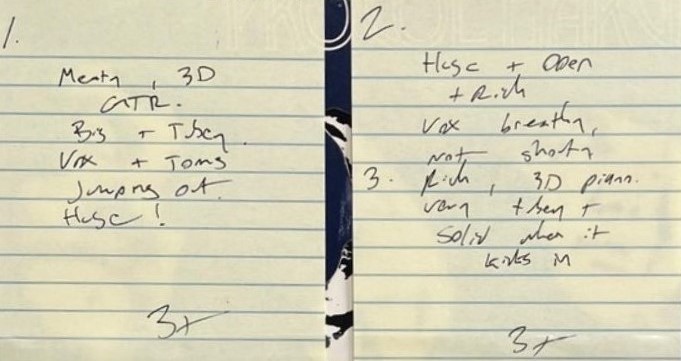
  • Meaty guitar and bass
  • Big, weighty and present

Track Two (Money for Nothing)

  • Wide, full and weighty
  • Lots of punch

Side Two

Track One (Ride Across the River)

  • Tight, deep and weighty [bass]
  • Vocals are sweet and present
  • Most space yet
  • Rich too

Note that the person doing the listening confined himself to what the record was doing right. In the case of this Shootout Winning Top Shelf 3/3 pressing, there really wasn’t any aspect of the sound to find fault with. As far as we were concerned, the record was doing what the record was trying to do, and doing it better than any of the other copies we played, hence the high grades.

If you have five or ten early domestic pressings of Brothers in Arms, you can judge them accurately by limiting yourself to the qualities only found on the best of them. For any copy you might play, you could ask:

  • How big is it?
  • How big does it get when loud?
  • How weighty is it?
  • How present is it?
  • How wide is the soundstage?
  • How full-bodied is the sound?
  • How punchy is it?
  • How tight, deep and weighty is the bass?
  • How sweet and present are the vocals?
  • How much space does the recording have?
  • How rich is the sound?

If your equipment, room, electricity, etc. are good enough, and your front end is properly set up, all these questions can be answered with relatively little effort. You could even create a checklist of them after playing a few copies and hearing what the best of them did well.

(more…)