 Hot Stamper Pressings of TAS List Records Available Now
We have a preference for Dorati’s work with the London Symphony Orchestra over those he recorded elesewhere. A record like this will show you exactly why.
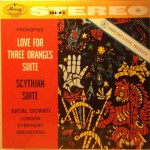
The Love of Three Oranges (SR 90006) is a killer recording — the kind of orchestral spectacular that is guaranteed to put your stereo through its paces and then some.
If you’re a fan of 20th century orchestral showpieces such as these, Robert Fine and Wilma Cozart have here produced a very special record containing two of the best.
We hope you like your sound big and bold, because that is the sound they were obviously going for, based on the sound we were hearing from the best early pressings.
I have to admit I was not a fan of this album until recently when I finally got my hands on a clean copy with the right stampers and heard the powerful sound of the London Symphony come blasting out of my speakers – what a thrill!
This record seems to have been dropped from the TAS Super Disc list*, which is only fitting since the current crop of nitwits running the show there has been watering it down with one crappy title after another since HP passed in 2014. A clearer case of bad records driving out good ones would be hard to imagine.
In the 90s, when these records were all the rage, a minty early pressing would have sold for as much as $1000 and maybe even more. And the copy that sold for that would have been very unlikely to sound as good as this one, if only for the fact that cleaning technologies have advanced so much over the last twenty years or so (and no, I do not mean ultrasonic cleaning. I mean scrubbing using the right fluids and the right machines to vacuum them off).
Side One
Suite from “The Love for Three Oranges”
Side Two
Our Difficulty of Reproduction Scale
This album is especially difficult to reproduce. Do not attempt to play it on anything but the highest quality equipment.
Classical music is unquestionably the ultimate test for proper turntable / arm / cartridge setup. The Pines of Rome would be a superb choice for adjusting tracking weight, VTA, azimuth and the like.
One of the reasons $10,000+ front ends exist is to play large scale, complex, difficult-to-reproduce music such as these two tones poems. You don’t need to spend that kind of money to play this record, but if you choose to, it would surely be the kind of record that can show you the sound your tens of thousands of dollars has bought you.
It has been my experience that cheap tables (anything under $2k I would guess) more often than not collapse completely under the weight of a mighty record such as this. If you have one of those, this is probably not the record for you.
*The TAS List, which I only learned about when I was still just starting out in the mid-70s, comprised a great many excellent recordings that were not widely known to the general public since many of them had been out of print for decades.
To be honest, most of what could be found there was way over my head, including what HP was saying in his commentaries regarding the strengths of the recordings he found to be so super. There was endless talk of depth, soundstaging, the sound of one concert hall compared to another, etc., none of which meant anything to me at the time.
Back then the record that was most likely to make my Super Disc list would have been something like Crime of the Century on MoFi. Eventually I discovered that some of the records on the TAS List had the potential to teach me a great deal, records like this one. For that I owe HP a great debt of gratitude.
(Not to be unduly harsh, but no other audiophile reviewer I can think of would get even a single word of praise. No group has done more harm to the audiophile community than the crop of record reviewers who came of age starting in the early-90s, heaping praise on one ridiculously bad reissue after another.)
Back to The List
Once the remastered pressings of the great Living Stereo recordings put out by Classic Records started showing up on the list in the 90s, we knew the standards of the old days were gone forever.
To be fair, there were always plenty of questionable titles on the list, but putting any Golden Age title released by Classic Records on a Super Disc list was hitting a low that The Absolute Sound would be very unlikely to recover from. Sure enought, nowt the list is populated by one Heavy Vinyl mediocrity after another, a sad state of affairs if you ask me.
There are probably more records on the current list that do not qualify as Super Discs than those that do, but I can’t say I am inclined to see the point in calculating the ratio. Now it’s hardly more than an incentive for record labels to buy ad space.
And many of these albums contain music that is much too esoteric to be taken seriously by most music lovers. Harry always said the list was about sound, not music, so we have no trouble admitting that this criticism is not fair. We happily concede that many of the titles on the list have the potential for excellent sound. We just couldn’t care less and we suspect our customers feel the same way. We do shootouts for some esoteric recordings, but they’re the ones we like, not the favorites of the audiophiles running the TAS List.
As long as the music holds no appeal for us, we surely can find better records to play. We like discovering amazing sounding pressings of music that will stand the test of time. At our prices it had better.
As purveyors of albums commanding prices well into the hundreds of dollars, we do not have the luxury of considering only the sound quality of the records we offer.
However, there is still one uniquely valuable service we can offer those who are still fans of The Absolute Sound Super Disc List.
We can join in the fun and offer the TAS-head a fairly good selection of Hot Stamper pressings of TAS List titles that actually have audiophile sound quality, every one of which is 100% guaranteed or your money back.