Month: September 2025

Grover Washington, Jr. – All The King’s Horses

More of the Music of Grover Washington

  • An early Kudu pressing of Washington’s sophomore release with seriously good Double Plus (A++) grades from top to bottom
  • There’s so much life in these grooves – the sound jumps out of the speakers and right into your lap
  • Credit must go to Rudy Van Gelder for recording and mastering this album so well, and to Bob James for his brilliant big group arrangements
  • We cannot recommend this album highly enough – if you have the big speakers a big group of musicians need to perform live in your listening room, his record is going to be nothing less than a thrill
  • 4 stars: “. . . this set has assumed its proper place in Washington’s catalog: as one of his more ambitious and expertly performed sessions.”
  • This is a Must Own jazz album from 1972, one that deserves a place in any audiophile’s collection

Both sides of this original Kudu pressing are OUT OF THIS WORLD. The sweetness and transparency of Grover Washington Jr.’s breathy sax went beyond any copy we’ve ever played. Who knew it could sound like this? We sure didn’t!

It’s spacious and full of life with virtually no distortion. Of special note, this copy has amazingly articulate bass which brings out the undeniable funkiness of the music in a way that no other copy did.

The early 70s were a good time for Rudy Van Gelder. All the King’s Horses from 1972 is an amazing Demo Disc for a large group. But it only sounds good on the copies that it sounds good on, on the pressings that were mastered, pressed and cleaned right, a fact that has eluded most jazz vinyl aficionados interested in good sound.

But not us. We’ve played the very special pressings that prove the album can sound amazing.

Yer Average Copy

The sound we most often find on original pressings (the only ones that ever sound any good; the later pressings are awful) is full of compression, and suffers as well from the kind of high-frequency restriction that prevents the top end from extending in a harmonically correct way. The result: Grover’s horn often will take on a somewhat sour quality. Our better Hot Stampers are both uncompressed and open up top.

I’m a Big Fan

I’ve been a big fan of this record since I first heard it all the way back in High School. I only found out later that this is not what most people would consider “real” jazz — it’s CTI jazz, more in the pop jazz or soul jazz vein. But I love the music more with each passing year and would not hesitate for a moment to recommend it to any jazz lover or audiophile. If the first track doesn’t knock you out, this album may not be for you. Without a doubt, in my book it’s the best thing Grover Washington ever did.

The really good RVG jazz pressings sound shockingly close to live music — uncompressed, present, full of energy, with the instruments clearly spread out and surrounded by the natural space of the studio.

As our stereo has gotten better, and we’ve found better pressings and learned how to clean them better, his “you-are-there” live jazz sound has impressed us more and more.

(more…)

The Who By Numbers – How Did We Know Side Two Was Slightly Veiled?

Hot Stamper Pressings of the Music of The Who Available Now
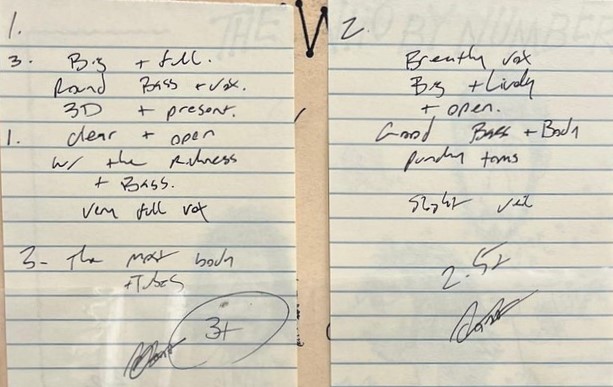

Here is how we might typically describe one of our Shootout Winning copies:

Who By Numbers returns to the site for only the second time in over three years, here with KILLER Shootout Winning Triple Plus (A+++) sound or close to it on both sides of this vintage Polydor import pressing – fairly quiet vinyl too.

Glyn Johns‘s magic is on display here, with open mics in a big studio space creating the 3D soundscapes we love.

Features two of their most iconic songs, “Slip Kid” and “Squeezebox,” and both sound incredible on this copy.

To back it all up, here are the notes for that very copy.

We started playing track three on side one, Squeeze Box, and returned to that track when we had two top copies to play against each other in the final round. Which one won? The one with “the most body and tubes.”

Note that side two of this copy was slightly veiled compared to the side two of the best copy we played, the one that would go on to earn 3+.

We don’t like veiled records — records where there is a curtain, no matter how transparent, in front of the musicians. Heavy Vinyl pressings are typically quite veiled and recessed in the midrange compared to their vintage vinyl counterparts, and that sound is simply not going to cut it with us. (Other folks may prefer a different sound it seems.)

Midrange presence is one of the most important qualities of any rock or pop recording we evaluate. You want Roger Daltry to be front and center, neither recessed nor behind a veil.

(more…)

Letter of the Week – “These days I don’t believe sh*t until my ears hear it, which is quite different than in the past.”

Our good customer Michel wrote to tell us — again — just how much he likes his Peter Gabriel Hot Stamper pressing of So.

I remember when I bought a 2+ copy of So. I had always thought that the UK’s would be the way to go, but even though I had a first press, ear fatigue set in quickly.

My US copy was not very good, so I wound up with the Classic gatefold … kind of cool packaging … so when I first listened to the 2+ I was besides myself, goosebumps and all.

Fast forward and I purchased a 2.5/2.5 Nearly White Hot Stamper copy. What a pleasure to be able to hear the improvement in the sound to yet another level. Bliss!

You guys have totally revolutionized my ears and my listening capabilities, which is utterly fantastic. Many thanks for that.

These days I don’t believe sh*t until my ears hear it, which is quite different than in the past.

Question … when you guys do shootouts for a particular LP, do you just compare the copies you have just procured, or do you have a +3/+3 house copy to compare to during your shootout?

What I like about the write-ups you do is it always gets me to thinking and going back to my LPs and relistening to them with my ‘new’ ears.

This process has been quite revealing.

Michel

Michel,

Thanks for your letter. As for your thinking that the Brit copies would be the way to go on So — and finding out otherwise — that’s precisely what happened to us about fifteen years ago:

We did a shootout many years ago that taught us a few things. The most surprising finding? The Brit copy I had in my own collection sucked — how about that! As a rule, I like the Brit pressings best for PG, but that rule got broken after playing all these domestic copies, some of which really sound good, clearly better than the Brits we had on hand.

Are rules made to be broken?

Yes they are.

This is a digital recording, and most of the time it is BRIGHT, SPITTY and GRAINY the way digital recordings tend to be, which plays right into the prejudices of most audiophiles for the “100% analog” approach they favor.

After hearing a bad copy, what audiophile wouldn’t conclude that all copies will have these bad qualities?

After all, it’s digital. It can’t be fixed simply by putting it on vinyl.

Ah, but that’s where logic breaks down. Proper mastering can ameliorate many if not most of a recording’s shortcomings. When we say Hot Stampers, we are talking about high-quality mastering doing exactly that.

But of course the mastering is only one part of the puzzle. I have multiple copies with the same stampers. Some of them are terrible, some of them are wonderful — you just can’t rely on the numbers to guide you with a piece of mass-produced plastic like this. You have no choice but to play the record to know what it sounds like. (And that’s a good thing. Keeps you honest. There’s no “cheating” when you have nothing to go by but the sound.)

The Classic Records pressing is at best mediocre — like most of the mid-fi junk they put out, we never bothered to write a review of it. We did manage to write more than 90, which means that as far as we’re concerned, we went beyond the call of duty and then some.

We did however happen to review the 2 LP 45 RPM Numbered Limited Edition that came out in 2016. We found it to be one of the worst sounding pressings of the album ever made. Of course it went right into our audiophile hall of shame with others of its ilk where it belonged.

As for the question of having a 3+ reference copy on the shelf to keep around for the next shootout, we have some, but not that many, probably less than a hundred.

Since we do more than a thousand different titles over the course of a decade, it would be nice to have more, but they aren’t really needed. It’s easy to hear when a record is doing everything right. When a record has one side that is not quite up to snuff, it’s the shootout that shows us in what area it may be lacking.

(more…)

For a Better Approach to Finding Higher Quality Pressings, Sweat the Details

Please Consider Taking Some of Our Audio Advice

When it comes to doing shootouts, half the battle is just being able to play the record right.

Our approach is simple enough. We precisely adjust the arm and cartridge for every title by ear, then compare the various pressings — properly cleaned of course — under carefully controlled, blinded conditions, with as much scientific rigor as we can bring to the proceedings.

In some ways it may in fact be analogous to rocket science, which we would define as the process of discovering all the details that need to be sweated and then sweating the hell out of them.

It’s the opposite of theoretical physics. One doesn’t need to be a novel thinker or have big ideas to do audio well.

Obsessively working through the basics of table setup, tweaks, room treatments and electrical quality will take your system to levels beyond those you have ever imagined.

And, you sure don’t need a bloody microscope to check your stylus rake angle, unlike some audiophile reviewers who insist that such devices are essential.

Your ears, if they are any good at all, will do the job just fine, and probably much better.

(more…)

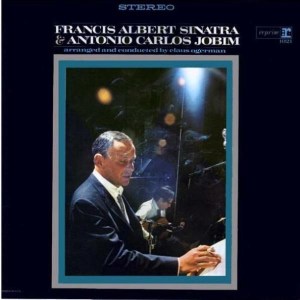
Frank Sinatra – Francis Albert Sinatra & Antonio Carlos Jobim

More of the Music of Frank Sinatra

  • With outstanding Double Plus (A++) sound or close to it from start to finish, this vintage stereo pressing of Sinatra and Jobim’s sublime collaboration will be very hard to beat
  • A Must Own for Sinatra fans, but one that has a marked tendency to be noisy, as many of the owners of the album loved it and played it to death, but no such problems here
  • The presence and three-dimensional space of the recording have the power to transport the Chairman of the Board and his Brazilian buddy right into your listening room (particularly on side two)
  • This is a magical album from start to finish, one of a handful of a Must Own Sinatra releases, and my personal favorite of all his recordings
  • 4 1/2 stars: “After a few plays, the album begins to slowly work its way underneath a listener’s skin, and it emerges as one of his most rewarding albums of the ’60s.”
  • We’ve recently compiled a list of records we think every audiophile/music-lover should get to know better, along the lines of “the 1001 records you need to hear before you die,” with less of an accent on morbidity and more on the joy these amazing audiophile-quality recordings can bring to your life. This is a good example of a record audiophiles should make an effort to get to know better

This is, in our opinion, one of the two best sounding Sinatra album on Reprise (the other being September of My Years from 1965). The recording is so rich, sweet, and Tubey Magical, you would think it was prime Capitol-period Sinatra — but it’s not, obviously; it just sounds that way.

If you like romantic music, you will be hard-pressed to find a better album than this one. The song “Quiet Nights Of Quiet Stars” perfectly encapsulates the mood of this album. My favorite track here is “Dindi.” Sinatra is the king of lost loves, and the song “Dindi” offers him another opportunity for regret. Nobody does it better than Frank. It’s a cliche to say he wears his heart on his sleeve, but the man made a career out of it. If the cliche fits…

Whatever you do, don’t waste your money on Kevin Gray’s mediocre cutting of the album. I gave it a C- years ago for sound, but these days I suspect it might get an F. A lot of his stuff does.

(more…)

This London from 1961 Didn’t Make the Grade

Hot Stamper Classical and Orchestral Imports on Decca & London
1961 just happens to be one of the greatest years for high quality analog recordings. Just check out this amazing group of albums, all recorded or released that year.

This London LP was released in 1961, right in the heart of the Golden Age, so we figured it had a good chance of displaying the kind of relaxed, immersive, smooth, rich, Tubey Magical Decca sound we absolutely cannot get enough of here at Better Records.

As we were preparing to do the shootout with the six copies of CS 6202 we had amassed over the years, we suddenly ran into a big problem.

(Cue sound effect of record being scratched here.)

(more…)

The Byrds – Mr. Tambourine Man (360 Label)

More of the Music of The Byrds

xxx.jpg

  • With KILLER Shootout Winning Triple Plus (A+++) sound or close to it from start to finish, this Stereo 360 pressing is guaranteed to blow the doors off any other Mr. Tambourine Man you’ve heard
  • Lively, balanced and vibrant, with boatloads of the Tubey Magical richness these recordings need in order to work
  • Listen to how amazingly breathy Jim (later Roger) McGuinn’s vocals are – his vocals are key to the best sounding Byrds records
  • 5 stars: “One of the greatest debuts in the history of rock … nothing less than a significant step in the evolution of rock & roll itself, demonstrating that intelligent lyrical content could be wedded to compelling electric guitar riffs and a solid backbeat.”
  • If you’re a fan of the Byrds, this is a Classic from 1965 that belongs in your collection.
  • The complete list of titles from 1965 that we’ve reviewed to date can be found here.

Want to hear exactly what I’m talking about? Play Chimes of Freedom, one of the best sounding tracks on side two, if not THE best. Listen to how breathy Jim (later Roger) McGuinn’s vocals are. Byrds records almost never sound like that.

I Knew I’d Want You is another one that sounds amazingly Tubey Magical on the best pressings.

By the time you get to track two on side one you’re hearing one of my favorite Byrds song of all time: I’ll Feel A Whole Lot Better. It’s energetic and very present on this copy.

Notice that Gene Clark’s vocals usually sound better than Roger McGuinn’s. For some reason they tend to brighten up McGuinn’s vocals, and the last thing you ever want to do with a Byrds recording is make it brighter.

But having said that, most of the reissues are too thin and bright compared to the best originals. (more…)

How Good Are the Robert Ludwig-Mastered Pressings of Alchemy?

Hot Stamper Pressings of the Music of Dire Straits Available Now

The best domestic pressings we played, the ones cut by Robert Ludwig at Masterdisk, were simply not competitive with any of the early British LPs.

The evidence is pretty clear that the master tapes stayed in England and that only the British pressings are made from them. If you’ve played as many records as we have, it’s not hard to recognize dubby sound when you hear it.

As a general rule, this domestic pressing will fall short in some or all of the following areas when played head to head against the imported pressings we offer. Much like the records linked here:

(more…)

Richard and Linda Thompson – Hokey Pokey

More of the Music of Richard Thompson

  • Superb sound for this classic Richard and Linda Thompson album, with both sides earning solid Double Plus (A++) grades – exceptionally quiet vinyl too
  • Clearly one of the better copies from our most recent shootout, with much more body, punchier bass and more detail than most others we played
  • Everything you want in the sound of a good British Folk Rock album is here in abundance on this original UK Island pressing – enjoy!
  • Marks in the vinyl are sometimes the nature of the beast with these vintage LPs – there simply is no way around them if the superior sound of vintage analog is important to you
  • 4 stars: “The Thompsons, from the opening Irish fiddle derivation of a Chuck Berry riff, through Linda’s exquisite performance of ‘A Heart Needs a Home,’ to their cover of Mike Waterson’s ‘Mole in a Hole’ which closes the record, once again create a timeless amalgam of folk and rock…”

This is one of Richard and Linda Thompson’s better releases, their second in fact, following the luminous I Want to See the Bright Lights Shine from a year earlier. Rich and full-bodied, with big bass and gobs of studio ambience, this pressing presents the music the way it was meant to be heard (more…)

Neil Young – Old Ways

More of the Music of Neil Young

  • A vintage pressing with KILLER Shootout Winning Triple Plus (A+++) grades or close to them on both sides
  • Big, full-bodied and energetic, with remarkably present vocals – this kind of rich, analog sound is positively shocking for a recording from 1985, although it should not come as a surprise since Neil Young has often gone against the grain
  • Neil’s unabashed country album is guaranteed to make your MoFI pressing sound like the bad joke it was when it came out in 1996, and you can be sure that it has not aged well
  • “… this turns out to be his most carefully crafted album since Comes a Time… Pretty amazing.” – Rolling Stone
  • “Old Ways [is]…cut in the style of Harvest and Comes a Time, but with a stronger country leaning.”

This is Neil heading out to the sticks with his buddies, authentic country greats such as Willie Nelson, Waylon Jennings and others (nice friends to have), doing what Neil loves to do — making the music that HE wants to make, not the music that anyone else wants him to, including David Geffen and his lawyers. Old friend Ben Keith (a huge part behind the sound of Harvest) shows up with his pedal steel guitar on a couple of tracks.

This probably wasn’t anyone’s favorite Neil Young album, but when it sounds like it does here it sure makes a lot more sense than it did when we heard it on the more mediocre pressings. The MoFi is a muckfest, as was to be expected from a record mastered during the Anadisq era, the darkest chapter in the dark and disgraceful history of Mobile Fidelity.

Copies with rich lower mids and nice extension up top (to keep the string arrangements from becoming shrill) did the best in our shootout, assuming they weren’t too veiled or smeary, of course. (more…)