Month: April 2025

Letter of the Week – “The instruments fill my room like they would in a live performance.”

Hot Stamper Pressings of the Music of Crosby, Stills, Nash and (Sometimes) Young

One of our good customers had this to say about some Hot Stampers he purchased recently: 

Hey Tom, 

I have really been enjoying the Neil Young “After The Gold Rush” and CSN&Y “So Far.” They are like the “Workingman’s Dead” LP. Just a thrill to hear. The instruments on “After The Gold Rush” fill my room like they would in a live performance. Addictive.

AJ

Dear AJ,

Addiction is the name of the game!

If you’re an audiophile who is not addicted to good sound and good music, you may not be one for long.

And if you have been in this game for a very long time like I have, you have no doubt met self-identified audiophiles with systems that haven’t been improved in twenty years, and appear to be rarely used.

I like to think those are the audiophiles who own lots of audiophile records, the ones that are designed to show off stereo equipment and typically hold little interest from a musical standpoint.

The TAS Super Disc List is full of these records. We have no use for most of them and we suspect our customers don’t either.

Audiophiles with vintage pressings of real music rarely abandon the hobby in my experience.

And if you have Hot Stamper pressings, why would you ever give up on hearing music that sounds as good as our records sound?

Thanks for your letter.

TP
Kevin Gray’s Version of Waltz for Debby Is Really Something

Hot Stamper Pressings of the Music of Bill Evans Available Now
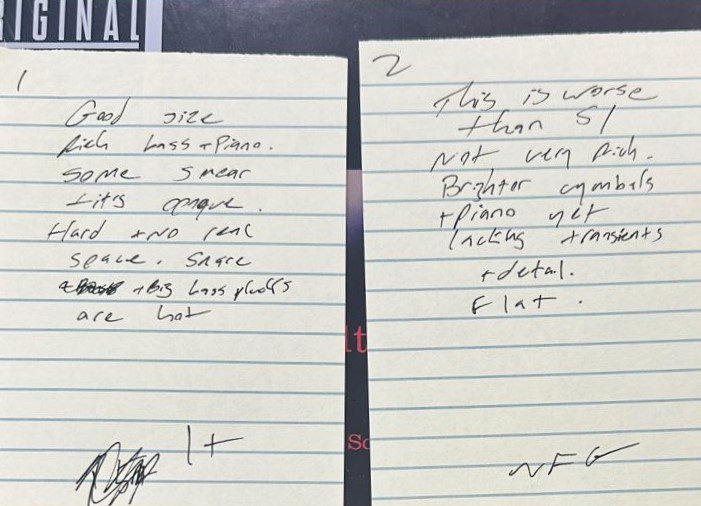
During our most recent shootout for Waltz for Debby we took the opportunity to play the 2023 Craft pressing cut by Kevin Gray.

It seems to have a nice list of features, among them AAA mastering using the Original Master Tape.

What could go wrong?

  • Craft Original Jazz Classics Series
  • 180g Vinyl LP
  • (AAA) Lacquers Cut from the Original Tapes by Kevin Gray at Cohearent Audio
  • Pressed at RTI
  • Tip-On Jacket with OBI

Plenty could go wrong, and did, especially on side two.

Nice features apparently are not enough to make a good sounding record.

Below are our listening notes cataloging the problems with this remastered pressing. If you own this version of the album, listen for the shortcomings we describe. The better your stereo and room, the more obvious they will be.

And of course the opposite is true for those of you who have trouble hearing them.

Now, if you already bought this sorry excuse for an audiophile pressing and just like collecting records, and don’t really care what they sound like, you can stop reading right here, put the record on and just enjoy the music.

(more…)

Alan Sides Sure Likes a Dead Studio

Hot Stamper Pressings of Pablo Recordings Available Now

Many of Allen Sides‘ recordings suffer from a lack of ambience. The musicians do not seem to have much room around them. In audiophile parlance, his recordings often lack “air.”  I can’t say all his recordings are made in a dead studio, but some of them sure are.

Many audiophile recordings, especially direct-to-disc recordings from the ’70s, are insufferable in this respect, with too much multi-miking and not enough studio space.

This Bach recording on Crystal Clear is a good example of the sound some audiophile labels were going for. Back in the 70s, audiophile producers and engineers were using state-of-the-art high-tech recording equipment, but they seemed to lack experience as well as knowledge of the recordings of the past. They regularly ended up producing records that are not remotely the equal of those that were commonly made only twenty years before.

For Duke is the poster boy for that sound. The instruments are dynamic as all get out, but no one ever imagined that the ideal approach to recording Ellington’s music would be to cram a big group of players into the equivalent of a heavily carpeted and draped livingroom.

Miller and Kreisel created a completely new, strange and inappropriate sound for Duke’s music, and it has been rubbing me the wrong way since I first heard it demoed in the audio showrooms I frequented back in the 70s.

(more…)

Cat Stevens – Mona Bone Jakon

More of the Music of Cat Stevens

  • Incredible sound throughout this UK Island pressing of Cat Stevens’s brilliant third album, with both sides earning Shootout Winning Triple Plus (A+++) grades or close to them
  • So transparent, open, and spacious, nuances and subtleties that escaped you before are now front and center
  • When you play “I Wish, I Wish” and “I Think I See The Light” on this vintage pressing, we think you will agree with us that this is one of the greatest Folk Rock albums of them all
  • One of the most underrated titles on the site – you owe it to yourself to see just how good the album that came out right before Tillerman can be when it sounds this good
  • 4 stars: “A delight, and because it never achieved the Top 40 radio ubiquity of later albums, it sounds fresh and distinct.”

So many copies excel in some areas but fall flat in others. This side one has it ALL going on — all the Tubey Magic, all the energy, all the presence and so on. The sound is high-rez yet so natural, free from the phony hi-fi-ish quality that you hear on many pressings, especially the reissues on the second label.

Right off the bat, I want to say this is a work of GENIUS. Cat Stevens made three records that belong in the Pantheon of greatest popular recordings of all time. In the world of Folk Pop, Mona Bone Jakon, Teaser and the Firecat and Tea for the Tillerman have few peers. There may be other Folk Pop recordings that are as good but we know of none that are better.

Mike Bobak was the engineer for these sessions from 1970. He is the man responsible for some of the best sounding records from the early ’70s: The Faces’ Long Player, Rod Stewart’s Never a Dull Moment, The Kinks’ Lola Versus Powerman And The Moneygoround, Part One, (and lots of other Kinks albums), Carly Simon’s Anticipation and more than his share of obscure English bands (of which there seems to be a practically endless supply).

Tubey Magical acoustic guitar reproduction is superb on the better copies of this album. Simply phenomenal amounts of Tubey Magic can be heard on every strum, along with the richness, body and harmonic coherency that have all but disappeared from modern recordings (and remasterings). (more…)

The Alan Parsons Project – I Robot

More Alan Parsons

  • An early UK pressing (and the first copy to hit the site in over three years) with seriously good Double Plus (A++) sound throughout
  • Many copies tend to be overly smooth, but this one has the kind of clarity that allows the natural textures of the instruments to come through
  • Transparency is key to the sound of the better copies, and that is precisely where the dubby domestic pressings fall short
  • 4 1/2 stars: “. . . that sense of melody when married to the artistic restlessness and geeky sensibility makes for a unique, compelling album and the one record that truly captures mind and spirit of the Alan Parsons Project.”

If you’re a fan of this album who has been playing a typical copy, or — even worse — one of the MoFi versions, you are sure to be impressed with the kind of sound this superb copy delivers. You get a strong, solid bottom end setting the foundation, which is exactly what you need to make a funky tune like I Wouldn’t Want To Be Like You come to life. (more…)

Here’s How You Know You Have a Hot Stamper of Songs in the Attic

joelsongs600Hot Stamper Pressings of the Music of Billy Joel Available Now

It’s the side you play through to the end.

When the sound is right you want to hear more.

Since the opening track of this record is one of the keys to knowing whether it’s mastered and pressed properly, once you get past the sibilance hurdle on track one, the next step is to find out how the challenges presented by the rest of the tracks are handled on any given pressing. Some advice follows.

Actually, what you really want to know is how good each song can sound — what it sounds like when it’s right.

Once the quality of the mastering has been established, the fun part is to play the rest of the album, to hear it really come alive.

Side One

Miami 2017

This is usually the brightest cut on the first side, commonly found with some sibilance problems. On the high-res copies the sibilance is lessened, and the sound of the sibilance itself is much less transistory and spitty, with more of a silky quality, which is simply another way of saying it’s less distorted.

Of course one wouldn’t want the sibilance to be lessened by having a dull top end, but few of these pressings are dull. Most of them suffer from a brightness problem. The best copies keep the sibilance under control and balance the upper mids with extended highs. Without extension on the highs the sound will tend to be aggressive.

(more…)

The Beach Boys – Little Deuce Coupe

More of The Beach Boys

  • This original Capitol Stereo pressing boasts excellent Double Plus (A++) grades from first note to last
  • Both of these sides are surprisingly rich and smooth, with excellent bass and the kind of breathy immediacy to the vocals that only vintage vinyl can offer
  • The sound is big, open, full-bodied and spacious, and the boys’ voices are as clear and sweet as you could ever wish for

What’s magical about The Beach Boys? Their voices of course, what else could it be? It’s not a trick question. They revolutionized the popular music of their day with their genius for harmony. Any good pressing must sound correct on their voices or it has no practical value whatsoever. A Beach Boys record with bad sound in the midrange — like most of them — is to us a worthless record.

When you drop the needle on a copy with gritty, spitty, harsh, shrill vocals, give up and move on. You have a bad pressing and no amount of cleaning or adjusting of the table can ever fix it.

(more…)

Dvorak / Symphony No. 2 – Hard to Recommend on Living Stereo

Hot Stamper Pressings of Living Stereo Titles Available Now
I have never heard a copy of LSC 2489 sound better than decent. We would say the sound quality of this Dvorak title is most likely to be passable at best. True, we haven’t played all that many copies, but the copies we did play were either unimpressive or not good at all.

It certainly is very unlikely to have the wonderful sound of the best Living Stereo pressings that you can find on our site, each of which has been carefully evaluated to the highest standards.

If you can get one for cheap, under five bucks say, go for it. Otherwise we recommend that you pass if what you are looking for is audiophile quality sound.

Perhaps the poor recording quality (I’m guessing; obviously I’ve never heard the master tape) explains the poor sound of the Classic Records remastered version from 1994.

Not that that stopped anybody from buying those awful 180 gram pressings! They may have been mastered by one of the greats, Bernie Grundman, but he was well past his prime when he was working for that awful label, as we explain here.

Have You Noticed?

If you are a fan of Living Stereo pressings, have you noticed that many of them – this one for example – don’t sound good?

If you’re an audiophile with good equipment, you should have. But did you? Or did you buy into the hype surrounding these rare LSC pressings and just ignore the problems with the sound?

I would say RCA’s track record during the 50s and 60s is a pretty good one, offering (potentially) excellent sound for roughly one out of every three titles or so.

But that means that odds are there would be a lot of dogs in their catalog. This is definitely one of them.

(more…)

Now That’s the Way a Piano Should Sound!

On the best copies the rich texture of the strings is out of this world — you will have a very hard time finding a DG with better string tone.

The best pressings of this recording have none of the shortcomings of the average DG: it’s not hard, shrill, or sour.

DG made plenty of good records in the 50s and 60s, then proceeded to fall apart, like most labels did. This is one of their finest. It proves conclusively that at one time — 1962 to be exact — they clearly knew exactly what they were doing.

Without question this is a phenomenal piano recording in every way.

I don’t know of another recording of the work that gets the sound of the piano better. On the better copies, the percussive quality of the instrument really comes through.

It’s amazing how many piano recordings have poorly-miked pianos.

These bad sounding pianos are either too distant, lack proper reproduction of the lower registers, or somehow smear the pounding of the keys into a blurry mess.

Are they badly recorded?

Or perhaps it is a mastering issue?

Maybe a pressing issue?

To be honest, it’s probably all three.

Lately we have been writing quite a bit about how good pianos are for testing your system, room, tweaks, electricity and all the rest, not to mention turntable setup and adjustment.

  • We like our pianos to sound natural (however one chooses to define the term)
  • We like them to be solidly weighted
  • We like them to be free of smear, a quality that is rarely mentioned in the audiophile reviews we read

Other records that we have found to be good for testing and improving your playback can be found here.

(more…)

Squeeze – East Side Story

More Squeeze

  • With solid Double Plus (A++) grades or close to them throughout, this original British A&M pressing is guaranteed to handily beat any other East Side Story you’ve heard – fairly quiet vinyl too
  • The sound on side two of this superb import is rich, full-bodied, lively, and warm, with solid bass and breathy, clear vocals, and side one is not far behind in all those areas
  • Don’t waste your money on whatever dead-as-a-doornail Heavy Vinyl record they’re making these days – if you want to hear the Tubey Magic, size and energy of Squeeze’s fourth studio album, a vintage 80s pressing like this one is the only way to go (particularly on this side two)
  • 5 stars: “…it stands as Squeeze’s tour de force, the best pop band of their time stretching every one of its muscles.”

(more…)