smear-free

These pressings impressed us with their smear-free sound.

You Simply Cannot Record a Piano Better than Roy DuNann

The piano sounds uncannily lifelike right from the start, a beautiful instrument in a natural space, tonally correct from top to bottom. I can’t think of any record off the top of my head that gets a better piano sound than this one.

Listen to the tambourine on the third track on side one. Shelly Manne messes about with lots of percussion instruments on this album and all of them are recorded to perfection.

Not to leave Red Mitchell out, check out the bass; it’s deep and note-like throughout the album.

Better Than a Dream, the second track on side two, has one of the best sounding jazz pianos I have ever heard. My notes say “you cannot record a piano any better” and I stand behind that statement one hundred percent.

There is not a modern reissue on the face of the earth that can hold a candle to the sound of this record.

For any of you out there who doubt my words please take this record home and play it against the best piano jazz recordings you own. If it doesn’t beat them all we are happy to pay the domestic shipping back.

Even our amazing sounding 45 RPM pressing of The Three does not present the listener with a piano that sounds as real as the one on this record.


(more…)

Fatha – Now That’s a Dynamic Piano

More Direct to Disc Recordings

Reviews and Commentaries for Direct to Disc Recordings

This review is from 2012, the first time we did a shootout (two copies!) for the album.

Of course, no shootout we would do these days would involve only two copies of an album. If we were to scold ourselves today for this silly exercise from back in 2012, it would look something like this: 

We encourage any audiophile who wants to improve the quality of his record collection to do some shootouts for himself. Freeing up an afternoon to sit down with a pile of cleaned copies of a favorite LP (you won’t make it through any other kind) and play them one after another is by far the best way to learn about records and pressing variations. Doing your own shootout will also help you see just how much work it is.

They are a great deal of work if you do them right. If you have just a few pressings on hand and don’t bother to clean them rigorously, that kind of shootout anyone can do. We would not consider that a real shootout. (Art Dudley illustrates this approach, but you could pick any reviewer you like — none of them have ever undertaken a shootout worthy of the name to our knowledge.)

With only a few records to play you probably won’t learn much of value and, worse, you are unlikely to find a top copy, although you may be tempted to convince yourself that you have. As Richard Feynman so famously remarked, “The first principle is that you must not fool yourself – and you are the easiest person to fool.”

Our 2012 Review for the Winner

This M&K Direct to Disc SMOKED the copy we played it against — the difference was NIGHT and DAY! The sound is smoother, sweeter, and richer than we are used to hearing for this album. There’s lots of space around the drums, and the tuba sounds awesome.

You aren’t going to believe how DYNAMIC this copy is — when Fatha’s really pounding on the keys, you’re gonna jump out of your chair. The overall sound is clean, clear, lively, and super transparent.

The edgy, hard piano sound that plagued our lesser copy is nowhere to be found.

This is especially good jazz piano music; Earl Hines plays up a storm on this album. The opening track, Birdland, with just a high hat, a tuba and Fatha on piano is worth the price of the disc alone.

Piano Testing

Lately we have been writing quite a bit about how pianos are good for testing your system, room, tweaks, electricity and all the rest, not to mention turntable setup and adjustment.

  • We like our pianos to sound natural (however one chooses to define the term).
  • We like them to be solidly weighted.
  • We like them to be free of smear, a quality that is rarely mentioned in the audiophile record reviews we read.

(more…)

Years Ago the Piano on a Copy of Blue Really Took Us Aback

More of the Music of Joni Mitchell

About ten years ago we played a copy of Blue that showed us a piano we had never heard on the album before. We found it on the track The Last Time I Saw Richard.

This is not the thin and hard-sounding instrument that accompanies Joni on every pressing you have ever had the misfortune to audition, hoping against hope that someday you would find that “elusive disc” with sound worthy of such extraordinary music.

No, this piano had real weight; it has body; and it was surrounded by real, three-dimensional studio space. No vinyl pressing we had ever played up to then has managed to capture the sound of the piano on this record any better. Exactly no copies.

For those of you with a certain Heavy Vinyl pressing in your collection, we can only say that the piano on this copy will show you everything that is wrong with the piano on that one.

The piano had no smear, allowing both the percussive aspects of the instrument and the extended harmonics of the notes to be heard clearly and appreciated fully.

Pianos are very good for testing your system, room, tweaks, electricity and all the rest, not to mention turntable setup and adjustment.

A great many more records that are good for testing and improving your playback can be found here.

(more…)

An Exceptionally Natural Piano Recording of Pictures at an Exhibition

More of the music of Modest Mussorgsky (1839-1881)

This original London pressing of the solo piano version of Pictures has uncannily natural piano reproduction, which is why we are awarding this side one our highest sonic grade, A Triple Plus.

The fact that the recording takes place in Kingsway Hall in 1967 no doubt plays a large part in the natural sound. The hall is bigger here than on other copies, the piano even more solidly weighted, yet none of this comes at the expense of the clarity of the playing.

The piano has no smear, allowing both the percussive aspects of the instrument and the extended harmonics of the notes to be heard clearly and appreciated fully.

Pianos are very good for testing your system, room, tweaks, electricity and all the rest, not to mention turntable setup and adjustment. More records that are good for testing and improving your playback can be found here.


Side two has Mehta’s performance of the orchestrated work squeezed onto side two, which is never a good idea if one is looking for high quality orchestral sound. The performance itself is mediocre as well.

We are not, and never have been, big fans of Mehta’s work with the Los Angeles Philharmonic on London Records.

The exceptionally rare copy of Mehta’s Planets can sound good, but 90% of them do not — just don’t make the mistake of telling that to the average audiophile who owns one. Harry told him it was the best, he paid good money for it, and until someone tells him otherwise it had better be “the one Planets to own.” (Why audiophiles need someone to tell them what recordings are the best is a mystery. Can’t they just play them and listen for themselves?)

We see one of our roles here at Better Records as being the guys who actually will “tell you different,” and, more importantly, can back up our opinions with the records that make our case for us.

(more…)

“Yessir, That’s My Baby” – Two Pianos and No Smear on Either?

More of the Music of Count Basie

More of the Music of Oscar Peterson

There was not a trace of smear on the pianos, which is unusual in our experience, although no one ever seems to talk about smeary pianos in the audiophile world other than us.

With 176 keys on hand, this recording presents the audiophile with a great piano test.

The Piano

If you have full-range speakers, some of the qualities you may recognize in the sound of the piano are WEIGHT and WARMTH. The piano is not hard, brittle or tinkly. Instead the best copies show you a wonderfully full-bodied, warm, rich, smooth piano, one which sounds remarkably like the ones we’ve all heard countless times in piano bars and restaurants.

In other words like a real piano, not a recorded one. This is what we look for in a good piano recording. Bad mastering can ruin the sound, and often does, along with worn out stampers and bad vinyl. But some copies survive all such hazards.

They manage to reproduce the full spectrum of the piano’s wide range (and of course the wonderful performance of the pianist) on vintage vinyl, showing us the kind of sound we simply cannot find any other way.

Analogue Productions Heavy Vinyl

AP did another one of the Basie Peterson collaborations on vinyl, a longtime favorite of ours, The Timekeepers. Considering their dismal track record — an unbroken string of failures, with not one success of which I am aware — I’m quite sure the Hot Stamper we are offering here will blow the doors off anything they will ever do on vinyl.

AMG Review

From the same week that resulted in Night Rider and Timekeepers, this is the fifth album that documents the matchup of Count Basie and Oscar Peterson. The two pianists (backed by bassist John Heard and drummer Louis Bellson) play five standards and three blues with predictable swing, finding much more in common with each other than one might have originally suspected.


Further Reading

Rachmaninoff / Favorite Classics for Piano / Pennario

More of the music of Franz Liszt (1811-1880)

More Classical ‘Sleeper” Records We’ve Discovered

We found White Hot Stamper sound on side two of this solo piano recording.

It’s big, rich and above all REAL sounding, with natural studio space. The legendary soloist Leonard Pennario is presented here at the height of his powers.

Superb choice of material, from Clair De Lune to Liebestraum to the Hungarian Rhapsody No . 2.

On the rare Stereo pressing of course — we want to hear all that studio space reproduced, just as your two ears would have heard it (more or less).

Side One

Graded Super Hot for the huge, solid-sounding piano, played with such verve and skill. The musical power on this side is stupendous. 

Side Two

Even better! No smear, with incredible clarity, and no sacrifice in weight or richness.

All of which adds up to a top quality piano recording in every way.

(more…)

Ravel / Piano Concertos / Haas – A Real Sleeper on Philips

More of the music of Maurice Ravel (1875-1937)

More “Sleeper” Top Quality Recordings

This Philips recording from 1970 on exceptionally quiet Dutch vinyl has SUPERB Super Hot Stamper sound on side one for one of Ravel’s best known piano works, the Piano Concerto in G. Most Philips records are much too thick, dull and opaque to be taken seriously, by us anyway. (In this respect they have many sonic attributes in common with Londons from the ’70s and ’80s.)

Dropping the needle on this pressing, however, was a pleasant surprise. It’s big and spacious on side one, with zero smear on a piano that is both full and clear.

This is a difficult combination to achieve in our experience, and the kind of sound we do not hesitate to praise highly here at Better Records.

To us it sounds right, and when the sound is as right as it is here, the wonderful piano music of Ravel can really work its magic. (more…)

Shostakovitch / Piano Concerto Nos. 1 and 2 – Another Amazing Piano Concerto Discovery

More of the Music of Dmitri Shostakovich

  • This stunning classical release finally makes its Hot Stamper debut here with Shootout Winning Triple Plus (A+++) sound or very close to it throughout
  • Westminster is not a label that we typically associate with top quality sonics, but I knew from the moment I dropped the needle on an audition copy that the sound of this Hidden Gem could not be faulted
  • What made this the clear winner was not complicated – it’s solid and weighty like no other, with virtually no smear, situated in the biggest space, with the most energetic performances
  • Clear and transparent, with huge hall space extending wall to wall and floor to ceiling, this is a sound that the modern reissue, of any music, from any era, fails to reproduce utterly
  • A truly superb recording with huge, spacious, dynamic, lively sound – Tubey Magical richness is a big plus too
  • This to a top quality classical piano recording in every way

(more…)

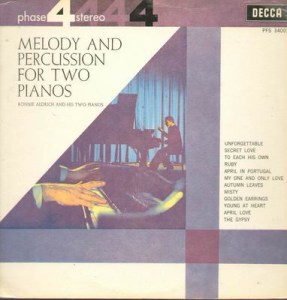
Ronnie Aldrich / Melody and Percussion For Two Pianos – Reviewed in 2012

This Decca Phase 4 record from 1962 has Demo Disc sound of a sort on side one. Super Hot sonics, coupled with the Super Phase 4 “jumping out of the speakers” recording techniques that were employed, mean that this is one LIVELY record!

The pianos can get to be a bit much, but when they are under control, the huge stage and the effect of all the percussion that jumps out of the soundfield is really quite something to behold.

Zero smear on this side too, which is what makes it work — the blunting of all those transients would quickly ruin the fun.

Which is what happens on side two; the smear and hardness of the typical Phase 4 pressing are evident and do spoil all the fun.

Try tracks 1, 2, 4 and 6 – talk about immediacy and explosive dynamics.


This is an Older Review.

Most of the older reviews you see are for records that did not go through the shootout process, the revolutionary approach to finding better sounding pressings we developed in the early 2000s and have since turned into a fine art.

We found the records you see in these older listings by cleaning and playing a pressing or two of the album, which we then described and priced based on how good the sound and surfaces were. (For out Hot Stamper listings, the Sonic Grades and Vinyl Playgrades are listed separately.)

We were often wrong back in those days, something we have no reason to hide. Audio equipment and record cleaning technologies have come a long way since those darker days, a subject we discuss here.

Currently, 99% (or more!) of the records we sell are cleaned, then auditioned under rigorously controlled conditions, up against a number of other pressings. We award them sonic grades, and then condition check them for surface noise.

As you may imagine, this approach requires a great deal of time, effort and skill, which is why we currently have a highly trained staff of about ten. No individual or business without the aid of such a committed group could possibly dig as deep into the sound of records as we have, and it is unlikely that anyone besides us could ever come along to do the kind of work we do.

The term “Hot Stampers” gets thrown around a lot these days, but to us it means only one thing: a record that has been through the shootout process and found to be of exceptionally high quality.

The result of our labor is the hundreds of titles seen here, every one of which is unique and guaranteed to be the best sounding copy of the album you have ever heard or you get your money back.