opaque-sound

The audiophile pressings listed here tend to be opaque, lacking clarity and especially transparency.

Even on highly resolving equipment, they make it difficult to “see” all the players and hear “into” the recording.

With these pressings you can’t relax and get lost in the music. Instead you are fighting to break through the barriers created by the substandard quality of the the mastering and/or pressing.

Transparency is one of the key qualities that the best vintage pressings have, often in abundance, and one that modern pressings lack, sometimes badly.

Transparency is especially important to the sound of orchestral recordings, a subject we often discuss on the blog often. Live orchestral music is uncannily transparent.

Records lack transparency to one degree or another, but live, unamplified music never does.

Capriccio Italien on Classic Records and How Badly I Missed the Boat

More of the Music of Peter Ilyich Tchaikovsky

More of the Music of Nikolai Rimsky-Korsakov

Years ago, around 2005 if memory serves, I played a copy of the Classic Records pressing of LSC 2323 and thought it was pretty good.

I thought it was better than the Shaded Dog copies I had compared it to, which, based on hundreds of other Classic Records titles I had auditioned, was unexpected to say the least.

Little did I know that the Shaded Dog pressings on this title are not remotely competitive with the early reissues.

The best of the Shaded Dog pressings we could find, which just happened to have a 1s side one, came in tied for last with the one 70s Red Seal pressing we thought sounded good enough to make the shootout.

(Some inside baseball: most of the Shaded Dogs and Red Seals were needle-dropped, and all but two were eliminated before the shootout. It takes time and wastes money to clean and play pressings that sound hopeless, so a quick elimination round often precedes the cleaning process.)

Back then it was tough to wrap my head around the idea that a Classic Record classical title could actually be better sounding than a Shaded Dog — it had never happened, so I knew there had to be more to the story.

Finding the time to do the serious investigation of LSC 2323 that would be necessary to get to the bottom of it was not in the cards, so I shelved the project for close to the next twenty years.

The title would have to wait until 2025 to go through a proper shooout, and when it did, naturally the Classic was part of the mix, which is the way we do things here at Better Records. Every record gets the chance to show us what it can do, to be evaluated fairly without the listener having any way to know which pressing is playing.

It turns out that side one of the Classic was passable, but side two — the side I had probably never played — was every bit as bad as most of their other classical offerings.

Side One, Second Movement (Tchaikovsky)

  • Big, but bright and compressed
  • Gets loud but opaque and hot
  • Good weight

Side One, First Movement

  • Bright and blurry bells
  • Sort of tubey but a mess
  • Grade: 1+ (passable, but no Hot Stamper)

Side Two (Rimsky-Korsakov)

  • Big but boomy and smeary
  • Brass is edgy and opaque
  • No top end or space
  • Peaks are hot and congested
  • Grade: NFG

To recap: In 2005 I was impressed with Classic’s pressing of LSC 2323. That was only twenty years ago, yet I could not have been more wrong. I thought my stereo was great — I’d owned top quality equipment since 1975 by then — thirty sodding years — so my audiophile credentials would surely dwarf those of the vast majority of forum posters who write about audiophile pressings today. How reliable should we expect their reviews to be?

(more…)

How Does the Heavy Vinyl Rubber Soul Sound?

Hot Stamper Pressings of Rubber Soul Available Now

This review was originally written in 2015.


We are so excited to tell you about the first of the Heavy Vinyl Beatles remasters we’ve played! As we cycle through our regular Hot Stamper shootouts for The Beatles’ albums we will be of course be reviewing more of them*. I specifically chose this one to start with, having spent a great deal of time over the last year testing the best vinyl pressings against three different CD versions of Rubber Soul.

The short version of our review of the new Rubber Soul vinyl would simply point out that it’s awful, and, unsurprisingly, it’s awful in most of the ways that practically all modern Heavy Vinyl records are: it’s opaque, airless, energy-less and just a drag.

I was looking forward to the opportunity to take Michael Fremer, the foremost champion of thicky vinyl, to task in expectation of his usual rave review, when to my surprise I found the rug had been pulled out from under me — he didn’t like it either. Damn!

MF could hear how bad it was. True to form, he thinks he knows why it doesn’t sound good:

As expected, Rubber Soul, sourced from George Martin’s 1987 16 bit, 44.1k remix sounds like a CD. Why should it sound like anything else? That’s from what it was essentially mastered. The sound is flattened against the speakers, hard, two-dimensional and generally hash on top, yet it does have a few good qualities as CDs often do: there’s good clarity and detail on some instruments. The strings are dreadful and the voices not far behind. The overall sound is dry and decay is unnaturally fast and falls into dead zone.

It strikes me as odd that the new vinyl should sound like a CD. I have listened to the newly remastered 2009 CD of Rubber Soul in stereo extensively and think it sounds quite good, clearly better than the Heavy Vinyl pressing that’s made from the very same 16 bit, 44.1k remixed digital source.

If the source makes the new vinyl sound bad, why doesn’t it make the new CD sound bad? I can tell you that the new CD sounds dramatically better than the 1987 CD I’ve owned for twenty years. They’re not even close. How could that be if, as MF seems to believe, the compromised digital source is the problem?

Lucky for me I didn’t know what the source for the new CD was when I was listening to it. I assumed it came from the carefully remastered hi-rez tapes that were being used to make the new series in its entirety, digital sources that are supposed to result in sound with more analog qualities.

Well, based on what I’ve heard, they do, and those more analog qualities obviously extend to the new Rubber Soul compact disc. At least to these ears they do.

It’s possible my ignorance of the source tape allowed me to avoid the kind of confirmation bias — hearing what you expect to hear — that is surely one of the biggest pitfalls in all of audio and a pit that Fremer falls into regularly.

(more…)

I’m Starting to Get a Bad Feeling About Record Store Day

Hot Stamper Pressings of the Music of Neil Young Available Now

For some reason, don’t ask me why, they keep hiring Chris Bellman to make Heavy Vinyl reissues of Neil Young’s albums, even though he has shown again and again that he has no idea what these recordings are supposed to sould like.

So far he’s ruined After the Gold Rush and Neil Young’s Greatest Hits, and there may be others he’s remastered to death, but no copies of those have come our way so we really don’t know, or care to know, to be honest.

If this is your idea of analog, you are most likely in the wrong hobby and should consider finding a different one. At the very least you are wasting your time and money on worthless crap vinyl pressings put out by the legion of Heavy Vinyl Grifters who emerge from the bowels of the earth on Record Store Day, targeting their rip-off LPs at the low- to mid-fi vinyl collector types who have yet to figure out what a giant scam the whole thing is.

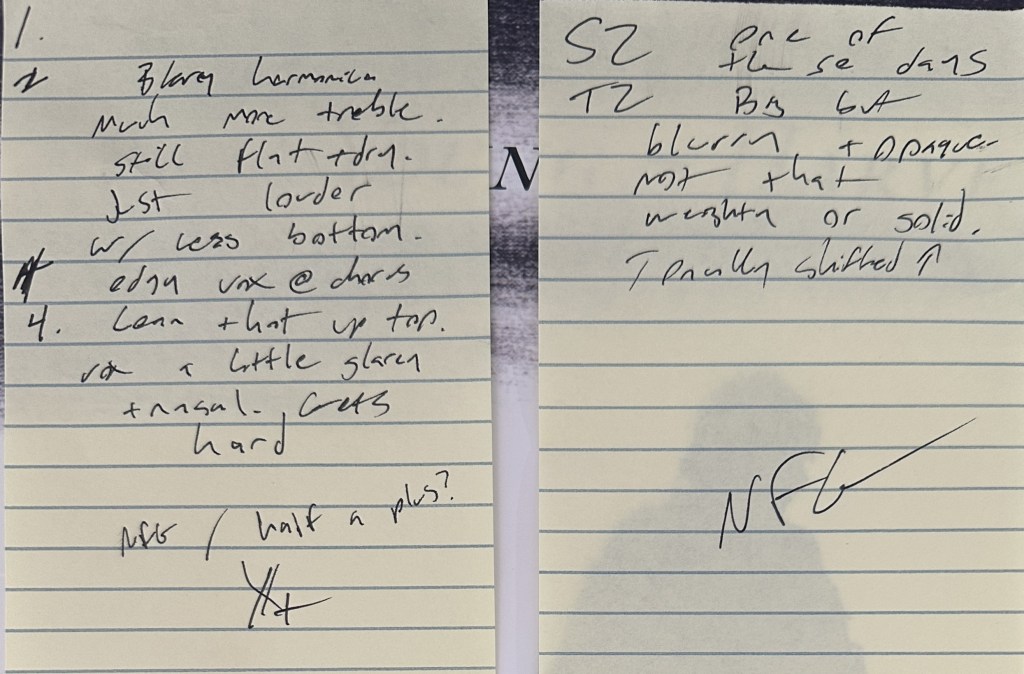
These records have virtually no redeeming features, none that we could find anyway. Allow us to catalog the shortcomings of the three sides that comprise the 2017 Record Store Day release of Harvest Moon.

For the first time in five years we had finally been able to do a shootout for the imports we like, so we knew exactly how good the best pressings could sound. Long story short, they sure don’t sound like this!

Side One

Track Two (From Hank to Hendrix)

  • Blary harmonica
  • Much more treble
  • Still flat and dry
  • Just louder with less bottom
  • Edgy vocals in the chorus

(more…)

The 2013 OJC of Brilliant Corners Has a Problem Many OJCs Do

Hot Stamper Pressings of Top Quality Jazz Recordings Available Now
Brilliant corners on the 2013 OJC pressing is not a bad record. At $20, roughly the price they sell for on Discogs, you are getting a decent LP for your money, which is not the case with a lot of what’s produced these days, the worst of which can be found here.

The sound is nice and meaty, which is all to the good, but where this pressing falls apart is in the area of transparency, as in, there isn’t much.

In simple language, it is opaque.

This is a very common shortcoming of the new OJC pressings. When they manage to get the tonality right — which is about  half the time — they still come across as crude and underwhelming. They require too much effort from the listener to become involved and stay that way.

If you see this OJC pressing in your local record store, and you don’t have a good CD player (a dirty little secret: the standard CD is likely to be better sounding). buy it for cheap, but don’t pay much money for it. You may find that, after a spin or two, playing it is more trouble than it’s worth.

(more…)

Kevin Gray’s Version of Waltz for Debby Is Really Something

Hot Stamper Pressings of the Music of Bill Evans Available Now
During our most recent shootout for Waltz for Debby we took the opportunity to play the 2023 Craft pressing cut by Kevin Gray.

It seems to have a nice list of features, among them AAA mastering using the Original Master Tape.

What could go wrong?

  • Craft Original Jazz Classics Series
  • 180g Vinyl LP
  • (AAA) Lacquers Cut from the Original Tapes by Kevin Gray at Cohearent Audio
  • Pressed at RTI
  • Tip-On Jacket with OBI

Plenty could go wrong, and did, especially on side two.

Nice features apparently are not enough to make a good sounding record.

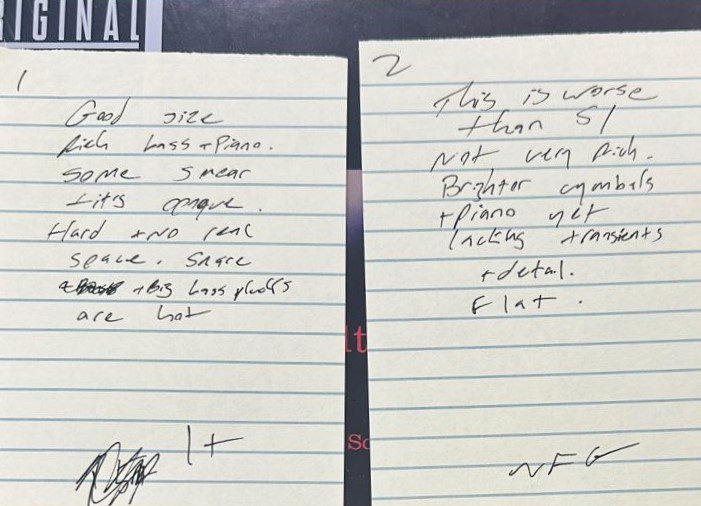
Below are our listening notes cataloging the problems with this remastered pressing. If you own this version of the album, listen for the shortcomings we describe. The better your stereo and room, the more obvious they will be.

And of course the opposite is true for those of you who have trouble hearing them.

Now, if you already bought this sorry excuse for an audiophile pressing and just like collecting records, and don’t really care what they sound like, you can stop reading right here, put the record on and just enjoy the music.

(more…)

Bernie Grundman’s Modern Standard Operating Procedure Strikes Again

Hot Stamper Pressings of the Music of Bruce Springsteen Available Now

If you own the Classic Records reissue of this album from the early 2000s, hearing a Hot Stamper pressing is almost sure to be a revelation.

The Classic pressing was dead as a doornail.

It was more thick, it was more opaque, and it was more compressed than most of the originals we played, originals which we noted often had problems in all three areas to start with.

Bernie did the album no favors, that I can tell you.

Head to head in a shootout, our Hot Stampers will be dramatically more lively, solid, punchy, transparent, open, clear and just plain REAL sounding, because these are all the areas in which Heavy Vinyl pressings tend to fall short.

(more…)

Moondance on Heavy Vinyl Is a Disgrace to Audiophiles and Record Lovers All Over the World

Hot Stamper Pressings of the Music of Van Morrison Available Now

The original grade I gave out in 2015 when I last played this remastered version as part of a shootout was “D.” I explained at the time:

Just listen to how strange Van’s voice sounds, so lean, hard and sour. That alone qualifies it for an “F,” but considering how bad most pressings of this album are, let’s be fair, if not downright generous, and call it a “D.”

I just revisited the record in a current shootout, and after giving it some thought I have decided that the right grade is in fact “F.” It cannot be any other, for reasons I discuss below.

In 2014 I had written:

Where is the Tubey Magic of the originals? The sweetness? The richness? And why is there so little ambience or transparency? You just can’t “see” into the studio on this pressing the way you can on the good originals, but that’s fairly consistently been the knock on these remastered Heavy Vinyl records. We noted as much when we debunked Blue all the way back in early 2007, so no surprise there.

Having just played a marvelous shootout-winning early pressing, this time around I found the reproduction of Van’s voice on the reissue to be so leaned-out, artificial and unpleasant that I could hardly stand to listen to it.

We had reset the VTA correctly; the overall tonal balance of the recording from top to bottom was correct. It was only the voice that sounded so off. All the other shortcomings I had mentioned before were still true of course, but none of that mattered. The singer on this record just sounded awful.

As you know, we are constantly making improvements to our playback system. The real Moondance we had just played sounded better than ever. The fake Moondance, however, was sounding worse than ever. That’s what higher quality playback can do for you. It makes your good records sound better than they’ve ever sounded, and shows you just how bad your bad records really are.

Do I have a bad copy of the Heavy Vinyl pressing? Maybe, can’t say I don’t. If any of you out there in the real world have a copy of this pressing that you like, and would be willing to send it to me to hear for myself, I would be more than happy to give it a listen and report my findings on this blog.

Short of that I’m not sure what more I can do. I certainly do not feel the least bit inclined to waste a nickel of my hard-earned money on another copy of this ridiculously badly-mastered crap vinyl.

If you want to read about other records that have these same shortcomings, there are links below to the ones we’ve auditioned and identified to date. Our advice would be to avoid them, and if you own some of these pressings, perhaps now is the time to give them another listen and see if you don’t hear the same faults we did.

And, of course, the Hot Stamper pressings we offer, when played side by side with any of these Heavy Vinyl remasters, can help you to see more clearly just where these new records are going wrong, or, in the case of Moondance, completely off the rails.

(more…)

Music From Peer Gynt – Another Cisco Disaster

Hot Stamper Pressings of the Music of Edvard Grieg Available Now

An audiophile hall of shame pressing from Cisco / Impex /  Boxstar / Whatever.

Pretty bad, on a par with the transistory, shrill crap Classic Records had been dishing out for years, but in the opposite direction tonally: it’s dull and dead as a doornail.

I often mention on this blog that Cisco’s releases (as well as DCC’s) had to fight their way through Kevin Gray’s transistory, opaque, airless, low-resolution cutting system. We discuss that subject in more depth here.

Our favorite recording of Peer Gynt is the one by Otto Gruner-hegge and the Oslo Philharmonic from 1959.

(more…)

Chad and Bernie Step on Another Rake

Hot Stamper Pressings of the Music of Art Pepper Available Now

Just in time for Record Store Day — what could be better?

In the interest of streamlining the process of getting reviews like this up on the blog, we’ll try to stick mostly to the facts and let the description of the strengths and weaknesses of the pressings speak for themselves.

One quick note: the sonic qualities you see described below are the ones we heard with the mono switch on our EAR 324P phono stage activated.

Without the switch set to mono, the sound is even thicker and darker.

Yes, as bad as this pressing sounds, you can make it worse if you don’t switch your preamp or phono stage to mono. Hard to believe but it’s true!

The notes for side one can be seen below. For side one we started with the second track.

Side One

Track Two / Red Pepper Blues

  • Boomy low end
  • Sax is stuck [in the speakers]
  • And lacking in breath and space

(more…)

How Can Sound This Bad Possibly Earn a 10?

Hot Stamper Pressings of the Music of Bob Dylan Available Now

Maybe if the scale goes from 1 to 100, sure, I could see it. Yeah, 10 out of 100 sounds about right.

But the scale goes to 11, which makes a grade of 10 risible to anyone who has played this seriously flawed pressing. Here is how we described its sound many years ago:

We found this mono reissue to be flat as a pancake and dead as a doornail, like most of the Sundazed records we’ve played, starting way back in the early 2000s. No, they never got any better.

In our experience, Sundazed is one of the worst record labels of all time. This pressing is simply more evidence that backs up our low opinion of them.

Obviously we may have a low opinion of them, but a famous audiophile reviewer seemed to find the sound to his liking. He wrote:

Sundazed’s reissue gives the original a run for the money and remains true to the original, though it suffers in the bass, which while deep and reasonably well defined, is not as tightly drawn or focused. The upper mids on the original also bloom in a way that the reissue’s don’t, giving the reissue a slightly darker, recessed sound, but there’s still sufficient energy up there since Dylan’s close-miked vocals pack an upper midrange punch. If the vocals or harmonica sound spitty and unpleasantly harsh, it’s your system, not the record [!] – though there’s plenty of grit up there. On the plus side, the overall clarity and transparency of the reissue beats the original. [!] A really fine remastering job.

Of course we find every word of this review arrant nonsense, except the discussion of the qualities he praises in the original relative to the reissue. It’s been twenty years since this remastered pressing came out, does anybody still like the sound of it? Anybody? Let’s hope not.

(more…)