natural-piano-test

Listening in Depth to Emerson, Lake & Palmer

Hot Stamper Pressings of the Music of Emerson, Lake and Palmer Available Now

If you’ve got the system to play this one loud enough, with the low end weight and energy it requires, you are in for a treat with Emerson, Lake and Palmer’s debut.

The organ that opens side two will rattle the foundation of your house if you’re not careful. This music really needs that kind of megawatt reproduction to make sense. This is bombastic prog that wants desperately to rock your world. At moderate levels it just sounds overblown and silly. At loud levels, it actually will rock your world.

To play this record right, you should have, at a minimum:

  • Big dynamic speakers, and they should be pulled out well into the room to create a three-dimensional presentation, in this case of a live rock concert. If the speakers are too big for the room, or stuck in the corners, you haven’t got a chance with a recording as powerful as this one.
  • A large room. (Our new studio has a 12 foot ceiling, a big help with a blockbuster recording such as this one.)
  • Strong walls with no windows, and, if possible, a concrete floor to keep the bass from leaving the room.
  • Seating for a single listener far from any boundary, especially the back wall (a common problem with small-ish rooms).
  • Extensive room treatments to deal with the loud levels this music requires.
  • Enough amplifier power driving speakers with big enough woofers to move all the air in the listening room with authority.
  • And, finally, high quality electricity, a heavily tweaked front end and all the rest of the audio stuff we discuss endlessly on this blog.

Without all of these things, it’s hard for us to imagine anyone could hear this record sound the way the artists and engineers wanted it to. Playing a record like this in a small room at moderate levels practically guarantees that the listener will not be able to hear what makes the best copies of this album so special.

Our system evolved over the decades to play these kinds of records, primarily for two reasons:

  1. We love music and want to hear our favorite recordings sound their best, and
  2. With this much money on the line, we have to be right about the superior sound of the vintage Hot Stamper pressings we offer if we want to stay in business.

Side One

The Barbarian
Take a Pebble

Superb sound! Big, spacious and effortlessly alive. So dynamic too.

(more…)

Now That’s the Way a Piano Should Sound!

On the best copies the rich texture of the strings is out of this world — you will have a very hard time finding a DG with better string tone.

The best pressings of this recording have none of the shortcomings of the average DG: it’s not hard, shrill, or sour.

DG made plenty of good records in the 50s and 60s, then proceeded to fall apart, like most labels did. This is one of their finest. It proves conclusively that at one time — 1962 to be exact — they clearly knew exactly what they were doing.

Without question this is a phenomenal piano recording in every way.

I don’t know of another recording of the work that gets the sound of the piano better. On the better copies, the percussive quality of the instrument really comes through.

It’s amazing how many piano recordings have poorly-miked pianos.

These bad sounding pianos are either too distant, lack proper reproduction of the lower registers, or somehow smear the pounding of the keys into a blurry mess.

Are they badly recorded?

Or perhaps it is a mastering issue?

Maybe a pressing issue?

To be honest, it’s probably all three.

Lately we have been writing quite a bit about how good pianos are for testing your system, room, tweaks, electricity and all the rest, not to mention turntable setup and adjustment.

  • We like our pianos to sound natural (however one chooses to define the term)
  • We like them to be solidly weighted
  • We like them to be free of smear, a quality that is rarely mentioned in the audiophile reviews we read

Other records that we have found to be good for testing and improving your playback can be found here.

(more…)

Pictures at an Exhibition – Uncannily Natural Piano Reproduction

More of the music of Modest Mussorgsky (1839-1881)

In a recent listing for a shootout winning pressing, we noted:

This original London pressing of the solo piano version of Pictures at an Exhibition has uncannily natural piano reproduction, which is why we are awarding this side one our highest sonic grade, A Triple Plus.

The fact that the recording takes place in Kingsway Hall in 1967 no doubt plays a large part in the natural sound. The hall is bigger here than on other copies, the piano even more solidly weighted, yet none of this comes at the expense of the clarity of the playing.

The piano has no smear, allowing both the percussive aspects of the instrument and the extended harmonics of the notes to be heard clearly and appreciated fully.

Side two has Mehta’s performance of the orchestrated work squeezed onto side two, which is never a good idea if one is looking for high quality orchestral sound. The performance itself is mediocre as well.

We are not, and never haver been, big fans of Mehta’s work with the Los Angeles Philharmonic on London.

The exceptionally rare copy of Mehta’s Planets can sound good, but 90% of them do not — just don’t make the mistake of telling that to the average audiophile who owns one. Harry told him it was the best, he paid good money for it, and until someone tells him different it had better be “the one Planets to own.” (Our favorite performance of The Planets can be found here.)

We see one of our roles here at Better Records as being the guys who actually will “tell you different,” and, more importantly, can back up our opinions with the records that make our case for us. (more…)

Azimuth – A Little Can Make a Lot of Difference

Robert Brook runs a blog called The Broken Record, with a subtitle explaining what the aim of his blog is:
A GUIDE FOR THE DEDICATED ANALOG AUDIOPHILE

We know of none better, outside of our own humble attempt to enlighten that portion of the audiophile community who love hearing music reproduced with higher fidelity and are willing to go the extra mile to make that happen.

Here is Robert’s latest posting. He recently spent some time with our favorite recording of the Beethoven First Piano Concerto, and needless to say, he’s glad he did.

AZIMUTH: A LITTLE Can Make A LOT of Difference!

You may enjoy our piece on azimuth and other aspects of turntable setup in this posting from many years ago.

Lately we have been writing quite a bit about how pianos are good for testing your system, room, tweaks, electricity and all the rest, not to mention turntable setup and adjustment.

(more…)

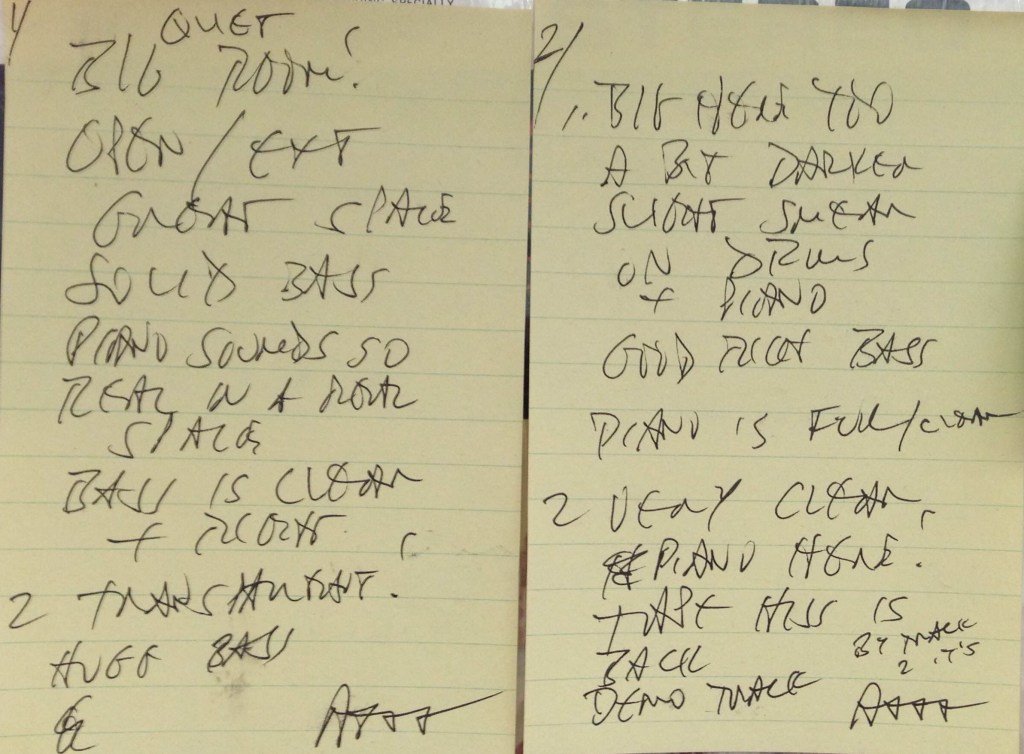
You Simply Cannot Record a Piano Better than Roy DuNann

The piano sounds uncannily lifelike right from the start, a beautiful instrument in a natural space, tonally correct from top to bottom. I can’t think of any record off the top of my head that gets a better piano sound than this one.

Listen to the tambourine on the third track on side one. Shelly Manne messes about with lots of percussion instruments on this album and all of them are recorded to perfection.

Not to leave Red Mitchell out, check out the bass; it’s deep and note-like throughout the album.

Better Than a Dream, the second track on side two, has one of the best sounding jazz pianos I have ever heard. My notes say “you cannot record a piano any better” and I stand behind that statement one hundred percent.

There is not a modern reissue on the face of the earth that can hold a candle to the sound of this record.

For any of you out there who doubt my words please take this record home and play it against the best piano jazz recordings you own. If it doesn’t beat them all we are happy to pay the domestic shipping back.

Even our amazing sounding 45 RPM pressing of The Three does not present the listener with a piano that sounds as real as the one on this record.


(more…)

Piano and Snare Testing with Dire Straits

More of the Music of Dire Straits

Telegraph Road does something on this copy that you won’t hear on one out of twenty pressings: It ROCKS. It’s got ENERGY and DRIVE.

Listen to how hard Allan Clark bangs on the piano on side one — he’s pounding that piano with all his might. No other copy managed to get the piano to pop the way it does here, clear and solid.

Wow, who knew? Maybe this is the reason HP put the record on the TAS Super Disc List. (I rather doubt he’s ever heard a copy this good, but who’s to say?)

Best test for side two?

The snare drum on Industrial Disease. Play five copies of the album and listen for how much snap there is to the snare on each of them. It will be obvious which ones get the transient attack right and which ones don’t. (If none of them do, try five more copies!)

One Way To Know

This modern album (1982) can sound surprisingly good on the right pressing. On most copies the highs are grainy and harsh, not exactly the kind of sound that inspires you to turn your system up good and loud and get really involved in the music. I’m happy to report that both sides here have no such problem – they rock and they sound great loud.

We pick up every clean copy we see of this album, domestic or import, because we know from experience just how good the best pressings can sound.

What do the best copies have? REAL dynamics for one. And with those dynamics you need rock solid bass. Otherwise the loud portions simply become irritating.

A lack of grain is always nice — many of the pressings we played were gritty or grainy.

Other copies that were quite good in most ways lacked immediacy and we took serious points off for that.

(more…)

Side One of Ritual Fire Dance Had Tubey Colorations Missing from Side Two

Hot Stamper Pressings of Vintage Columbia Albums Available Now

An undiscovered gem from 1967 on the 360 Columbia label.

Side two of this record blew our minds with its White Hot Stamper sound.

Musically and sonically this record is nothing short of wonderful.

Who knew? You could play fifty vintage piano recordings and not find one as good as this.

Tchaikovsky, Liszt, Beethoven, Debussy, Mozart — these shorter pieces and excerpts were composed by those with the greatest gift for melody, men who’ve produced works that have stood the test of time, enchanting audiences over the centuries with works of such beauty and charm.

Here at Better Records we have never been fans of Columbia classical LPs. Years ago we noted that:

Columbia classical recordings have a tendency to be shrill, upper-midrangy, glary and hard sounding. The upper mids are often nasally and pinched; the strings and brass will screech and blare at you in the worst way. If Columbia’s goal was to drive the audiophile classical music lover screaming from the room (or, more realistically, induce a strong desire to call it a day record-playing wise), most of the time one would have to grant they’ve succeeded brilliantly. Occasionally they fail. When they do we call those pressings Hot Stampers.

To be clear, the fault more often than not has to be in the mastering, not the recording. We’ve raved about so many great copies of titles in the past, only to find that the next three or four LPs we pick up of the very same titles sound just godawful. There are some amazing Bernstein recordings out there, but the the amount of work it takes to find the one that sounds good is overwhelming — how can such great recordings be regularly mastered so poorly?

Side One

A++, with a huge, rich, sweet, natural sounding piano. The more you listen, the more apparent it becomes that, as natural as it may seem at first blush, there are still some old school tubey colorations that make the sound not quite as lifelike and real as one might wish.

And the confirmation of that finding comes as soon as you flip the record over.

(more…)

What to Listen for on Time Further Out

Hot Stamper Pressings of the Music of Dave Brubeck Available Now

The best copies demonstrate the big-as-life Fred Plaut Columbia sound at its best (even better than Time Out in our opinion).

These vintage recordings are full-bodied, spacious, three-dimensional, rich, sweet and warm in the best tradition of an All Tube Analog recording.

If you want to hear big drums in a big room, these Brubeck recordings will show you that sound better than practically any records we know of. 

The one standout track on this album for audiophiles is surely Unsquare Dance, with its uncannily real sounding handclaps in 7/4. The copies that did the best job of reproducing that “flesh on flesh” sound of actual human hands clapping scored very well in our shootout.

More to Listen For

For starters, listen for a fat snare and rich piano on the first track of side one. When you hear that, assuming you do, you should know you are in for a treat. Our best copies captured those two sounds brilliantly.

On the second track the clarity of the brushed snare is key to how resolving and transparent any copy is. The rich, smooth sound of Desmond’s sax balanced against the clarity of the brushes will help you make sure that the overall sound is tonally correct from top to bottom.

On side two the first track has the Wall to Wall Big Drums in a Big Room sound that positively blows our minds. If you’re a fan of  with jump out of the speakers sound, this is the album for you.

Note that in some places it sounds like the piano is overdriving its mic. We heard that sound on practically every copy we played, so we’re pretty sure it’s on the tape that way.

(more…)

On This Recording of Concerto No. 1, Transparency and Piano Weight Are Key

More of the Music of Ludwig van Beethoven

Notes from a recent shootout.

This pressing has the real Living Stereo magic in spades, but unlike most of the RCA concerto recordings, Richter, the brilliant soloist featured here, is not overly spotlighted, hence the much more immersive “concert hall” sound.

The piano is part of the orchestra, and properly sized, allowing the contributions of the other musicians in the orchestra to be heard more clearly, laid out as they are elegantly across a huge and deep Boston Symphony Hall stage.

All of which adds up to a top quality piano concerto recording in every way.

When it comes to clarity in orchestral music, there is nothing that comes close to the sound of a live performance.

However, some records, this one especially, give you the sense that you are hearing it all.

Audio may be an illusion but it can be a very convincing one.

The spaciousness and three-dimensionality of the recording are also exceptional. Through the efforts and skill of the RCA engineers, that striking openness in the recording is somehow combined with an electrifying immediacy in the sound of the piano, no mean feat. One rarely hears both, except of course live (and not always even then).

There may be other performances of merit, but I know of no recording of this music with better sound. If you are demonstrating naturalistic sound, not bombastic Hi-Fi spectacularity, this pressing more than qualifies as a DEMO DISC.

What to Listen For

What typically separates the killer copies from the merely good ones are qualities that we often look for in the records we play: transparency. Transparency allows you to hear into the recording, reproducing the ambience and subtle musical cues and details that high-resolution analog is known for.

(Note that most Heavy Vinyl pressings being produced these days seem to be seriously Transparency Challenged. Lots of important musical information — the kind we hear on even second-rate standard-weight pressings — is simply not to be found.)

Solid weighty sound for a piano concerto recording is critically important as well. The piano has to be big, powerful, and solid, as massive as a boulder, just the way it can be in the concert hall. In this respect it helps to have Sviatoslav Richter pounding away on the instrument of course.

Side One

Amazing – big and rich without a touch of smear on the strings or the percussive piano. The piano is right sized and that is unusual indeed in our experience.

Dynamic as all get out, with lively horns and a piano that is clear and present. Tonally correct, in a big hall, the sound is Hard To Fault.

The piano is so clear, yet the orchestra is as rich and smooth as one could possibly ask for. No smear, no congestion, no bandwidth limitations – this is the sound of the master tape. No modern reissue — digital or analog — will ever be able to reproduce more than a fraction of the sound found on this pressing.

Side Two

Big, lively and less congested that most of the copies we played. Side one had no smear, this side has a touch, but the sound is wonderful nevertheless.

Listen to the woodwinds on this side; they are glorious. You will have a hard time finding better sound for that section of the orchestra on other recordings.

An Exceptionally Natural Piano Recording of Pictures at an Exhibition

More of the music of Modest Mussorgsky (1839-1881)

This original London pressing of the solo piano version of Pictures has uncannily natural piano reproduction, which is why we are awarding this side one our highest sonic grade, A Triple Plus.

The fact that the recording takes place in Kingsway Hall in 1967 no doubt plays a large part in the natural sound. The hall is bigger here than on other copies, the piano even more solidly weighted, yet none of this comes at the expense of the clarity of the playing.

The piano has no smear, allowing both the percussive aspects of the instrument and the extended harmonics of the notes to be heard clearly and appreciated fully.

Pianos are very good for testing your system, room, tweaks, electricity and all the rest, not to mention turntable setup and adjustment. More records that are good for testing and improving your playback can be found here.


Side two has Mehta’s performance of the orchestrated work squeezed onto side two, which is never a good idea if one is looking for high quality orchestral sound. The performance itself is mediocre as well.

We are not, and never have been, big fans of Mehta’s work with the Los Angeles Philharmonic on London Records.

The exceptionally rare copy of Mehta’s Planets can sound good, but 90% of them do not — just don’t make the mistake of telling that to the average audiophile who owns one. Harry told him it was the best, he paid good money for it, and until someone tells him otherwise it had better be “the one Planets to own.” (Why audiophiles need someone to tell them what recordings are the best is a mystery. Can’t they just play them and listen for themselves?)

We see one of our roles here at Better Records as being the guys who actually will “tell you different,” and, more importantly, can back up our opinions with the records that make our case for us.

(more…)