 Hot Stamper Pressings of Contemporary Jazz Albums Available Now
Of the three early OJC pressings of West Coast Sound we played recently, only one met our standards. At 2+/1.5+, the sound was good, not great.
One copy earned grades of 1+/1+, which means the sound was passable. The last copy had an NFG side two, which means it was just awful.
(Many of the Heavy Vinyl disasters we’ve been cataloging lately have earned that notorious grade. The unacceptably lo- to mid-fi sound even the better ones offer doesn’t seem to bother the audiophiles who rave about them, however.)

So does side two of the OJC pressing have fairly good sound, merely passable sound, or is the sound hopelessly bad?
In the case of this Shelly Manne album, all three, and the only way we were able to discover that is by cleaning up three of them and playing them head to head with real Contemporary pressings in a blinded experiment.
Obviously we were hoping for better results from our OJCs — only one of the copies we played will turn out to be saleable.
Why did we bother? That old bugaboo the profit motive was all that was needed to make us give the OJC pressings a try. We thought we could make money on them but it turns out that the opposite will happen. Oh well, nothing ventured, noting gained.
More importantly, we are not the least bit shy about coming clean and sharing the results with our readers and customers, especially the part about three identical looking copies with the same stamper numbers all sounding very diffferent from each other.
An added bonus is that side two was worse than side one most of the time. That happens often enough, but nobody but us ever seems to want to talk about it.
If we had had ten OJC pressings to play, we probably would have be able to find at least one or two with a grade of 2+/2+, meaning that George Horn probably did a creditable job mastering the album back in 1984 when he cut it for Fantasy, to sell for the very affordable price of $5.98. It’s most likely the pressing plant that let listeners down.
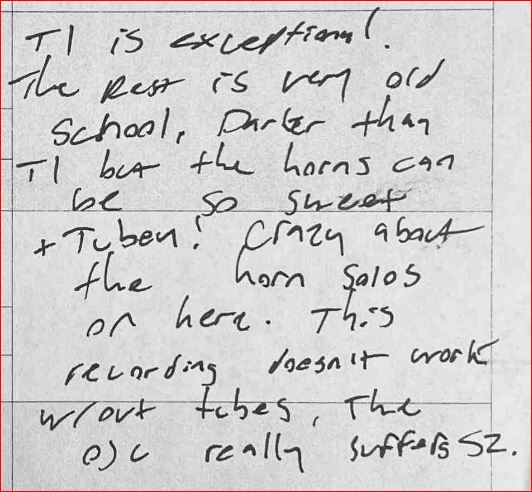 Needs Tubes
The problem here is that this title needs tubes, or, at the very least, the sound of tubes, and George apparently did not have them, or enough of them, in his mastering chain.
Our specific notes can be seen on the left. We mention that the first track has the best sound (1956 dates), the rest falling short for being darker and more crude (“old school,” some dating from 1953).
The West Coast horn players are the reason to buy this title, with horns that are “sweet and tubey,” but of course to hear that kind of sound you will need a real Contemporary pressing, not an OJC — or anything made in the modern era for that matter.
Speaking of OJCs
OJC pressings tend to be brighter and thinner than even the worst of the real Contemporary pressings.
This is decidedly not our sound.
We have to admit that we used to find the sound of many of these OJC pressings much more tolerable in the past.
More than tolerable. Enjoyable. Recommendable. Saleable even.
Nothing to be ashamed of, that was many years ago. As you may already know, live and learn is our motto. Getting it wrong is a feature, not a bug, of collecting if your goal is to find the best sounding pressings of the music you love.
(If you have some other goal, this may not be the right blog for you. Definitely steer clear of this website. The prices there are ridiculous!)
It’s true: our system from the late-80s and all through the 90s was tubier, tonally darker and dramatically less revealing, which strongly worked to the advantage of leaner, brighter, less Tubey Magical titles such as this one.
That was thirty or more years ago. Pretty much every dynamic speaker system I ran into had that sound. And I was never a fan of screens or horns. Like most audiophiles, I thought my stereo sounded great. It sure sounded right to me at the time.
And the reality is that no matter how hard I worked or how much money I spent, I would never have been able to achieve substantially better sound for one simple reason: most of the critically important revolutions in audio had not yet come to pass. It would take many technological improvements and decades of effort until I would have anything like the system I do now.
Overview
Some OJC pressings are great — even some of the new ones — some are awful, and the only way to judge them fairly is to judge them individually, which requires actually playing a large enough sample.
Since virtually no record collectors or audiophiles like to do that, they make faulty judgments – OJC’s are cheap reissues sourced from digital tapes, run for the hills! – based on their lack of rigor, among other things, when comparing pressings.
Those who approach the problem of finding top quality pressings with an utter lacks of seriousness can be found on every audiophile forum there is. The youtubers are the worst, but are the self-identified aristocrats of audio any better? I see no evidence to support such a proposition and mountains to refute the very idea of it.
The methods these folks have adopted do not produce good results, but as long as they stick to them, they will never have to worry about facing that inconvenient truth.
Further Reading