Columbia 30th – Selections

Columbia 30th Street studio – Select letters, reviews and commentaries

Basic Miles – Our Four Plus Shootout Winner

Hot Stamper Pressings of the Music of Miles Davis Available Now

In 2018 we awarded this copy’s side two of Basic Miles our very special Four Plus (A++++) grade, which is strictly limited to pressings (really, individual sides of pressings) that take a recording to a level we’ve never experienced before, a level we had no idea could even exist.

We estimate that less than one per cent of the Hot Stamper pressings we come across in our shootouts earn this grade. As I write this there is not a single other record on the site that earned that grade on either side. You can’t get much more rare than that.


UPDATE 2026

  • Our lengthy commentary entitled outliers and out-of-this-world sound talks about how rare these kinds of pressings are and how we go about finding them.
  • We no longer give Four Pluses out as a matter of policy, but that doesn’t mean we don’t come across records that deserve them from time to time.
  • Nowadays we most often place them under the general heading of breakthrough pressings. These are records that, out of the blue, revealed to us sound of such high quality that it changes our appreciation of the recording itself.
  • We found ourselves asking “Who knew?” Perhaps a better question might have been “How high is up?”

Kind of Blue

Want to know how good our Hot Stamper Kind of Blue pressings sound? Listen to this very record. If you play the tracks that were recorded in 1958, the year before Kind of Blue, you will hear practically the same lineup of musicians.

That means Stella By Starlight and Little Melonae on side one, and Green Dolphin Street and Fran-Dance (Put Your Little Foot Right Out) on side two. We’re talking Bill Evans, John Coltrane and Cannonball Adderley in their prime, 1958, with top 1958 sound to match.

The nine-minute-plus Green Dolphin Street that opens side two is nothing short of amazing, some of the coolest jazz you will ever hear, on any record, at any price.

(more…)

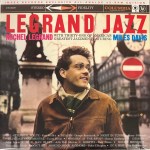
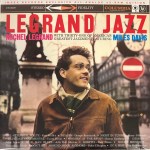
Robert Brook’s Guide to Legrand Jazz on Impex

Robert Brook has a blog which he calls
A GUIDE FOR THE DEDICATED ANALOG AUDIOPHILE

Robert tries to remain positive when choosing the words that would best describe the award winning Impex release of Legrand Jazz. In the end he goes with the spoken word over the written one.

Years ago I wrote about how important the Legrand Jazz album was for me in my growth as a critical listener. It’s yet another example of an album that helped make me a better audiophile by showing me the errors of my tweaking and tuning ways.

Let’s watch the video and see what Robert has learned about Impex’s recent release.

Legrand Jazz (featuring Miles Davis) – the 2019 IMPEX Double 45 rpm

Michael Fremer gives the Impex pressings an 11 for sound. He writes (emphasis added):

“This IMPEX reissue is sourced from an “analog mix-down transfer of the original 1958 work tape by Mark Wilder at Battery Studios” and cut by Chris Bellman and Bob Donnelly at Bernie Grundman Mastering on Grundman’s all-tube mastering system. I have a clean, original 6-Eye pressing that this superbly pressed reissue betters in every way. This will make both your stereo and your heart sing. Some of the greatest jazz musicians of that or any era wailing and clearly having a Legrand time. Limited to 3000 copies. Don’t miss it!”

Who are you going to believe, the Self-Appointed Vinyl Experts of the World and Bestowers of Prestigious Audio Awards (awards which you may have never heard of; I sure hadn’t), or some guy who’s just dedicated to being an Analog Audiophile and knows a good record when he hears one? (Or doesn’t hear one, as the case may be.)

Like Robert, I tried being kinder and gentler, but it didn’t take. I may resolve to try harder in 2024 2026. Then again, I may not. If we’re nicer to the people currently making Heavy Vinyl records, aren’t we running the risk, to cop a line from the late, great P.J. O’Rourke, of encouraging them?

(more…)

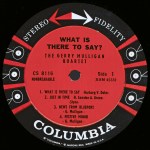
What Is There To Say? – Our Previous Shootout Winner from 2019

Hot Stamper Pressings of Vintage Columbia Albums Available Now

UPDATE 2025

We have two new lists for those who would like to know which Columbia label pressings win shootouts — one for 6-Eye winners and one for 360 Label winners.

Recordings made at their 30th Street Studio are pretty hard to beat. There is no Heavy Vinyl reissue on the planet that can compete with the sound of one of our Hot Stamper pressings of any of the albums you see available, guaranteed or your money back.


This Six Eye stereo LP put every other copy we played to shame on side one with shootout winning Triple Plus (A+++) sound. Side two earned a Double Plus (A++) grade for its explosive dynamics and rich, full-bodied, Tubey Magical sax sound. Tubier, more transparent, more dynamic, with that “jumpin’ out of the speakers’ quality that only The Real Thing ever has. Hard to imagine any reissue, vintage or otherwise, can hold a candle to the sound of this amazing record. 

Recorded at Columbia’s 30th Street studios, here is a record that sounds like Kind of Blue, Ah Um and Time Out, for the simple reason that all were recorded in the same studio using the same equipment and perhaps even the same engineers.

(more…)

Letter of the Week – “…so much more engaging and rich than I was used to.”

Hot Stamper Pressings of the Music of Charles Mingus Available Now

This posting on an audiophile forum was made by our good customer ab_ba who authorized me to print it here. (It started out on Hoffman’s forum but was quickly taken down as the subject of Hot Stampers is verboten. I have added some bolding and italics.)

The title is the author’s.

Better Records Hot Stampers: Or, how I learned to stop collecting and love listening

We are witnessing an absolute explosion in vinyl. It’s thrilling, but it has also become frankly overwhelming.

What matters? The experience of listening, of course. But, how do we know, I mean, how do we really know, what listening experiences are going to be sublime?

Too often, collectability becomes our proxy for listening. We’ve all done it – chasing a near mint early pressing, a Japanese or German pressing, a re-press from a label we trust. We all end up with multiple copies of our favorite records, but only listen to one or two of them. And whether we sell them or not, it brings us some comfort to see their going rates on Discogs continue to climb. For me at least, FOMO was a strange driver of my buying habits. I regretted records I didn’t purchase, far more often than I regretted purchases I did make, even as I have about a year’s worth of listening in records still sealed on the shelf. I’m even afraid to open some of them because I can see their value is rising. Isn’t that silly?

My Philosophy Was Off-Base

I love records. Listening to them, curating a collection, is a joyful hobby. It gets at some need I can’t quite name. But, of course, records shouldn’t be only for collecting. They are for the pleasure of listening. My philosophy was pretty off-base. I didn’t even perceive it that way, and here’s what got me to realize it, and get out of it.

Last summer, I came across an original mono pressing of Mingus Ah Um in one of my local shops. It was labelled as a “top copy” and the surface looked pretty good. The price was a little absurd, and considering I had the [MoFi] OneStep and the Classic Records pressings, I wasn’t sure I needed it. But, this is an album I loved, even as a kid, even on digital, and a first pressing held a lot of allure. I took some time to think about it, do some online comparison shopping, and by the time I got back to the shop, it was gone.

In a fit of pique, I bought the copy Better Records was selling.

It was listed as a Super Hot Stamper, and it was slightly cheaper than the copy the shop was selling. With a 30-day no-questions-asked return policy, it seemed a safe bet.

An Initially Disappointing Hot Stamper Reissue Pressing

Well, you can imagine my disappointment when it arrived a few days later. Nicely boxed for shipping, I unsleeved what was clearly a later pressing. My disappointment magnified when the needle dropped and the first thing I heard was surface noise. I’ve been conditioned by the heavy vinyl renaissance to equate surface noise with a bad-sounding record.

But then, the instruments kicked in, and from the first notes I could tell I was listening to something really different.

It was clear, forward, and dynamic. Nothing harsh, even in the horns, but so much more engaging and rich than I was used to. It was the drum solo partway through the first track that convinced me I was hearing something special in this pressing. I sat and listened to the entire record without doing anything else, and for me, something that holds my attention to where I don’t want to grab my phone or a book is part of what defines a peak listening experience.

(more…)

How Do the Original Mono Pressings of Mingus Dynasty Sound?

Hot Stamper Pressings of the Music of Charles Mingus Available Now

Although this album is fairly common in mono, we found the sound of the mono pressing we played seriously wanting. It’s dramatically smaller and more compressed than even the worst of the other pressings we played in our shootout.

We will never buy another, and of course we would never sell a record that sounds as bad as this mono pressing does.

For those looking for the best sound, the mono pressing is hard to take seriously, and for that reason, we say skip it.

For records reviewed on the blog that sound their worst in mono, click here.

Are You a Jazz Collector or an Audiophile?

If you’re a jazz collector, of course you want the mono. If you’re an audiophile who likes jazz, you should want the stereo.

And if you are a very serious audiophile who has a great deal of time and money tied up in his equipment and room, someone whose motto might best be summarized as “nothing but the best,” then you need one of our killer Hot Stamper pressings of the album.

(more…)

In the Market for New Speakers? See How Well They Handle the Energy of Far More Drums

Hot Stamper Pressings of the Music of Dave Brubeck Available Now

The drum solo Joe Morello lets loose on Far More Drums is one of the best on record. I was playing that song recently and it occurred to me that it is practically impossible for a screen or panel speaker of any design to reproduce the sound of those drums properly, regardless of how many subs you have.

Most of the music is not in the deeper bass anyway. It’s the whack of instruments whose energy is in the lower midrange and mid-bass that a screen speaker will struggle with.

A good large-driver dynamic speaker fed by fast electronics can handle the energy in that range with ease.

This is the album you need to take with you next time you head to your local stereo store to audition speakers.

It will help clarify the issues. Screen speakers do many things well, but drums are not one of them, at least in my experience they aren’t. If drums are important to you, do yourself a favor and buy a dynamic speaker, the bigger the better.

brubeck in the studio733

Time Further Out, like most of the classic Brubeck albums, is a big speaker record. It requires a pair of speakers that can move air with authority below 250 cycles and play at fairly loud levels. If you don’t own speakers that can do that, this record will never really sound the way it should.

(more…)

Letter of the Week – “Who needs an equipment upgrade with records like these?”

Hot Stamper Pressing of Miles’s Albums Available Now

One of our good customers had this to say about some Hot Stampers he purchased recently:

Hey Tom, 

Listening to Kind Of Blue. Who needs an equipment upgrade with records like these?

Our reply:

So true!

It’s actually one of the common faults of audiophile thinking, present company excluded, that if you can make a record like KOB sound great, you must have a good stereo system.

The opposite is true; the real test is to get difficult to reproduce recordings to sound good, not easy to reproduce recordings.

If you want to test the limits of your system, here are some difficult to reproduce records that will allow you to do it.

And if you want to buy some records that sound great but are difficult to reproduce because you love or challenge, or for any other reason, these Hot Stamper pressings should do the trick.

Either way, KOB is killer, and the MoFi of it is a joke, but don’t tell this guy, who appears to be rather new to this whole “reviewing” thing.  Watch it here. If you can stomach more than two minutes worth, you may be reading the wrong blog.

(more…)

Our Guide to Legrand Jazz on Impex

Hot Stamper Pressings of 30th St. Recordings Available Now

Years ago I wrote about how important the Legrand Jazz album was in my growth as a critical listener.

It’s yet another example of an album that helped make me a better audiophile by showing me the error of my tweaking and tuning ways.

Now there is a new pressing of it. Well, new to us anyway. (We readily admit to being behind the times and make no apologies for it. With records like these, we often find ourselves wondering why we bother.)

Two new pressings in fact. One on a single disc at 33 RPM as of 2017, and one mastered at 45 RPM on 2 LPs as of 2019, still in print and available for $59.99.

Production details can be found at the end of this review, along with some favorable comments, some from none other than Steve Hoffman himself.

But first let’s hear from the personification of the well-meaning audiophile reviewer, Michael Fremer. He gives the Impex pressings an 11 for sound. He writes (emphasis added):

This IMPEX reissue is sourced from an “analog mix-down transfer of the original 1958 work tape by Mark Wilder at Battery Studios” and cut by Chris Bellman and Bob Donnelly at Bernie Grundman Mastering on Grundman’s all-tube mastering system. I have a clean, original 6-Eye pressing that this superbly pressed reissue betters in every way. This will make both your stereo and your heart sing. Some of the greatest jazz musicians of that or any era wailing and clearly having a Legrand time. Limited to 3000 copies. Don’t miss it!

Who are you going to believe, the Self-Appointed Vinyl Experts of the World or some guy like me who thinks he knows a thing or two about the sound of records, especially, as in this case, a record I have been playing since 1990 or thereabouts.

(Back in those early days I also had the standard CD, which is excellent and highly recommended. Since I couldn’t clean or play my original vinyl pressing properly, my guess would be that the CD had the better sound at the time.)

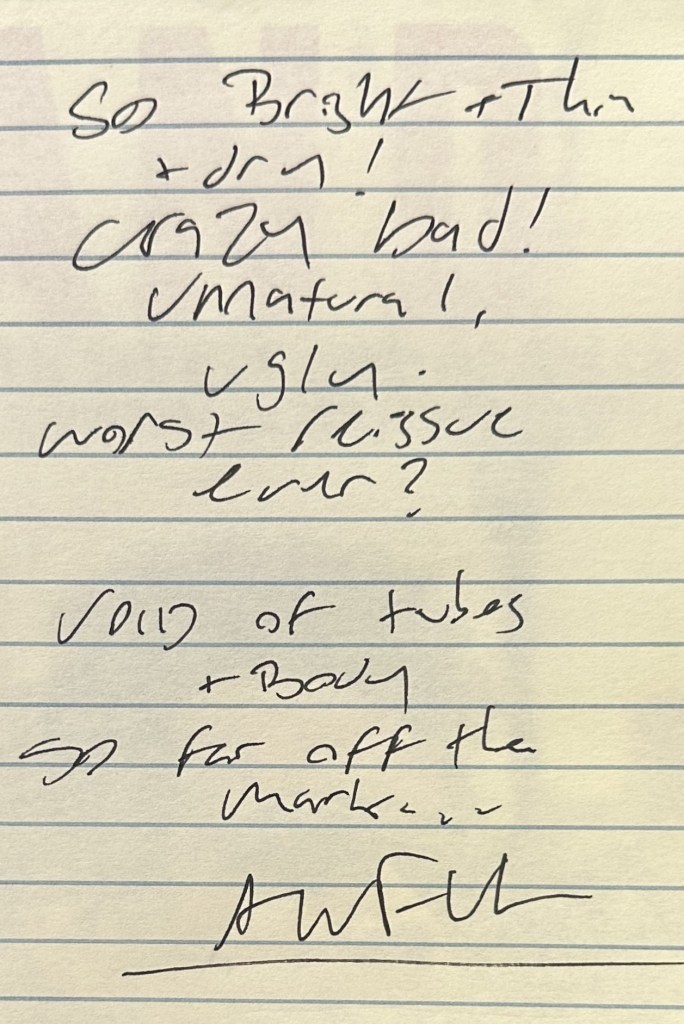
Our notes (for those who have trouble reading our scratch)

So bright and thin and dry.

Crazy bad!

Unnatural, ugly.

Worst reissue ever?

Void of tubes and body.

So far off the mark.

Awful.

A second opinion

Robert Brook reviewed this pressing a while back. He does his best to remain positive when choosing the words that he thinks will help the reader bette understand the experience of playing the Impex release of Legrand Jazz that we had loaned him. In the end he goes with the spoken word over the written one.

(more…)

Lady in Satin – What It Takes to Hear It Right

Robert Brook runs a blog called The Broken Record, with a subtitle explaining that the aim of his blog is to serve as:

A GUIDE FOR THE DEDICATED ANALOG AUDIOPHILE

Here is Robert’s latest posting.

LADY IN SATIN: What it Takes to HEAR it RIGHT

Robert writes:

A few years ago, Better Records founder Tom Port told me something that I’ve never forgotten. I had just demoed my system for an industry guy, and while relaying the experience to Tom, he asked me what records I had played for him. I mentioned a few, including Charles Mingus‘s Ah Um.

Tom said (paraphrasing here) “Not a good choice. You want to play records that can only sound good one way. Ah Um can sound good a lot of different ways.”

At the time I didn’t fully understand what Tom was getting at. Ah Um, or at least the copy of it I had, always sounded great. Wasn’t it therefore a great record to demo my system with?

Since then I’ve come to understand that this was exactly Tom’s point. If you really want to show someone what your system can do, by all means, play a great sounding record, but also one that requires your turntable and your system as a whole be at their best to reproduce it.

Lately I’ve come to understand something that I feel every audiophile, analog audiophiles in particular, would do well to recognize and come to terms with. When we play a record, each of us is listening for different things, and these things are very often not the things that we should be listening for if we want to determine if our system is sounding its best.

Robert continues:

But a pretty steady diet of Ah Um for a number of years now has taught me that the right copy will sound good, even with the most basic turntable setup, and even on a system that’s not performing its best.

Meanwhile, it would seem that Lady In Satin is a record that only sounds good, great even, one way and one way only. It needs us to attend to all the little details in our system before it will reveal its magic.

(more…)

Kind of Blue – Our Shootout Winner from 2013 on the 70s Label

Hot Stamper Pressings of the Music of Miles Davis Available Now

UPDATE 2024: As good as the best 70s Red Label pressings may be, it’s unlikely that any copy other than the Six-Eye original will win a shootout these days.

In other words, in 2013 we still had a lot to learn about Kind of Blue even after we had been doing shootouts for the album for the eight years starting in 2005.

Doing shootouts for the album about twice a year, over the next eleven years and roughly 22 shootouts with every Columbia label represented, the data are in, and the right originals win every time, with no exceptions to that rule in a very long time. As you may have read elsewhere on the blog:


We don’t know it all and we’ve never pretended we did. All knowledge is provisional. We may not be the smartest guys in the room, but we’re sure as hell smart enough to know that much.

We regularly learn from our mistakes and we hope you do too.

But we learn things from the records we play not by reading about them, but by playing them. Our experiments, conducted using the shootout process we’ve painstakingly developed and refined over the course of the last twenty years, produces all the data we need: the winners, the losers, and the ranking for all the records in-between.

We’ve learned to ignore everything but the sound of the records we’ve actually played on our reference system.

This approach allows us to have a unique, and, to our way of thinking, uniquely valuable service to offer the discriminating audiophile. When you’re tired of wasting your time and money on the ubiquitous mediocrities that populate the major audiophile dealers’ sites and take up far too much space in your local record store, let us show you just how much more real handpicked-for-quality recordings can do for your enjoyment of music.

Our Commentary from 2013

This is one of the very best copies we’ve ever heard, and we have literally played more than a HUNDRED copies of this album over just the last five years.

(more…)