Rudy Van Gelder, Engineer – Reviews and Commentaries

This Rudy Van Gelder Cutting of Red Clay Is Good but…

xxx

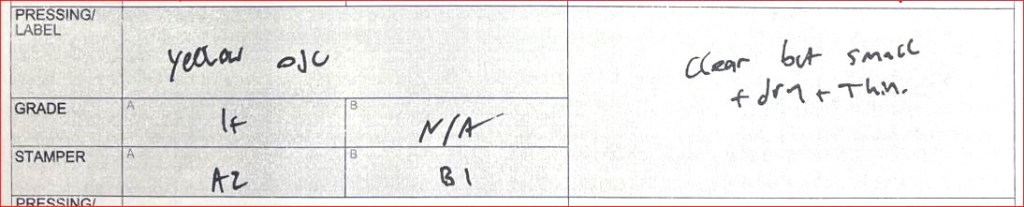
… far from the best we played, earning barely Hot Stamper grades.

And we would be remiss if we failed to point out that the proper cleaning of your records will typically improve their sound quality by at least one half plus, and more often than not one full plus.

It’s very likely that neither of the A3/B3 copies you see below would have qualified as Hot Stamper pressings without the aid of a good cleaning.

Red Clay is one of our favorite CTI albums – Red Clay (the song and the album) is Hubbard’s soul jazz Masterpiece, and it’s a record that belongs in every audiophile’s jazz collection.

Lenny White drums up a storm on this album – on this copy he is playing right in the room with you. If you’re a Hubbard fan, or perhaps a fan of early-70s soul jazz, this title from 1970 is surely a Must Own.

Although Rudy recorded and mastered the album — the only pressings that qualified for the shootout were his — it should be noted that Van Gelder in the dead wax is never a guarantee of high quality sound, on any record.

(It’s easy to criticize the bad pressings of Rudy Van Gelder’s work, but let us not lose site of the countless great ones.)

This A3/B3 pressing was not awful, or even mediocre — the reissues without VAN GELDER in the dead wax would most likely be much worse sounding — but at 1.5+ we would say it has earned good, not great Hot Stamper grades.

The only way to guarantee higher quality sound is to do a shootout with a good-sized pile of cleaned pressings and find the one with the best sound using the rigorous testing methodologies we use.

For this kind of work, top quality playback is a must.

There is of course a way to avoid doing all that work and spending all that money on piles of pressings, most of which you will eventually have no use for, and that’s to buy a Hot Stamper copy of the album from us.

(more…)

The Original Jazz Classics Series Put Out a Passable Relaxin’ in ’85

Hot Stamper Pressings of the Music of Miles Davis Available Now

We much prefer the 70s Two-Fer reissue (PR 24001) to the OJCs of both Cookin’ and Relaxin’. Previously we had written:

These 70s reissue pressings are practically as good as any we have ever heard. Full-bodied, warm and natural, with plenty of space around all of the players, this is the sound of vintage analog.

It had been a while since we last played the OJC pressing of either album, so we picked up a copy of Relaxin’ and threw it into the shootout, where it did about as badly as expected.

The first side earned our 1+ grade, which means that, like a lot of reissues it’s passable, but really not good enough for a serious audiophile (hopefully meaning you) to bother with, which is why we didn’t even play side two (the N/A you see noted where the grade should be).

The OJC is clearly better suited to the old school audio systems of the 60s and 70s rather than the modern systems in use today. These kinds of reissues used to sound good on those older systems, and I should know, I used to have an old school stereo, and some of the records I used to think sounded good back in the day don’t sound too good to me anymore (although this one never did).

(more…)

When All the Stampers Are the Same, What’s a Mother to Do?

Hot Stamper Pressings of Blue Note Albums Available Now

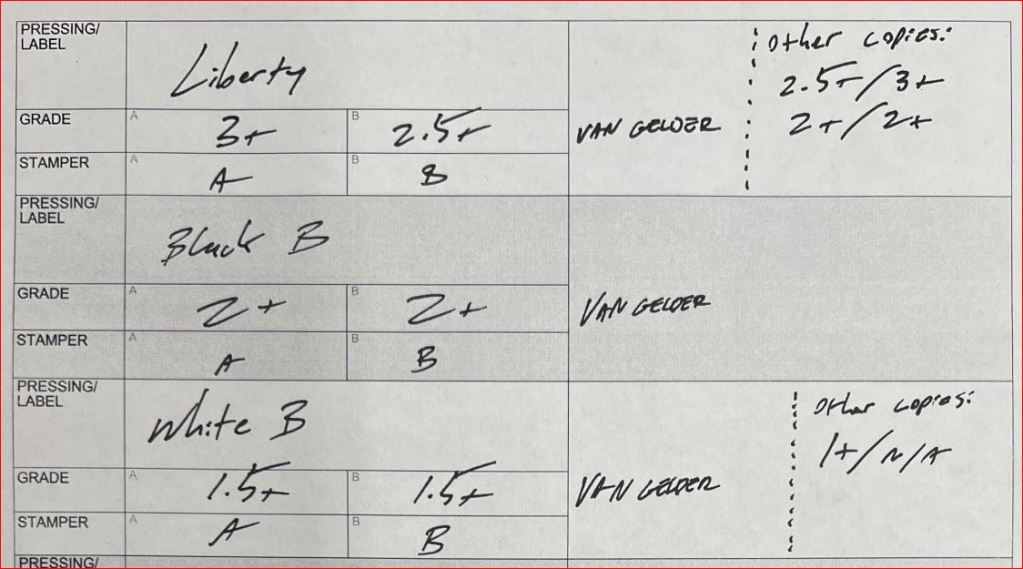
What happens when all the stampers are A and B and every one of them is cut by Rudy Van Gelder?

This is precisely the problem we were faced with on the mystery Blue Note album whose stampers can be seen below.

It’s not Cornbread — those are really hard to find! We did a shootout last year and hope to have another one coming before long, but most of what we buy ends up going back to the seller for noise issues, so it may be a while before we can get it going.

In the meantime, whatever you do, don’t waste your money on the Tone Poets reissue — it’s ridiculously bad.

What information can you rely on when trying to find the best sounding pressings?

The stamper numbers are no help.

And you can’t look for the VAN GELDER stamp in the deadwax since they all have it.

Of course, now that we’ve done the shootout, we know to buy the Liberty label pressings, but that could hardly have been predicted beforehand. Plenty of later labels beat the early label pressings on Blue Note’s albums.

But readers of this blog surely know that we are being facetious when we say we faced a lack of stamper information with the title above.

We have no way of knowing what the label is for any copy that is playing on our turntable, so how could the stamper information possibly matter, ever, under any circumstances?

We judge records by their sound quality, then grade them on that single metric, ignoring all others.

Only later do we learn which labels and stamper numbers correspond with which sonic grades, assuming they actually correspond at all. (Some don’t.)

If you are buying certain pressings because they have earlier labels, rather than pressings with later labels, predicated on the theory that the earlier labels should have better sound, this blog will be a godsend — because it will prove to you that the approach you are taking is not a particularly good one.

You are only fooling yourself if you think it is. It might work more often than not, but do you really want to be wrong about four records out of ten? Forty out of a hundred. Four hundred out of a thousand? With no way of knowing which group — good or bad — any given title happens to fall into?

A record collection of a thousand records is a decent sized collection. But with four hundred titles having second-rate or worse sound? Nobody wants that.

Buying originals is just not a good way to insure your collection will have top quality sound. Fortunately we know of a way that does.

(more…)

The Originals Can Be Very Good, But the Right Reissues Never Fail to Beat Them

Hot Stamper Pressings of Blue Note Recordings Available Now

Warning: the record you see pictured is not the record we are discussing in this commentary.

For this mystery title our recent shootout involved two early New York Blue Note pressings.

We don’t need to tell you that those are the ones that take us years to find, and cost us a pretty penny (in audiophile playing condition) when we do find them.

One of them we’ve had on the shelf for years to use as a reference pressing. We knew it could be beaten, that it would never be able to win a shootout, but we also knew it had a lot of the qualities we were looking for on the album.

It sounds right, the way the best Blue Notes from this era usually do, regardless of what you may have read elsewhere.

Our Hot Stamper pressings are guaranteed to soundly beat (ahem) whichever versions of the album have been recommended by any of the self-described audiophile “experts” or your money back.

When those who produce Blue Note reissues and those who review them tell you Rudy did not know how to cut a record that sounds right on good equipment, you can easily prove to yourself how hard of hearing these people must be by simply buying one of our Hot Stamper pressings.

You can send it back — that’s up to you — but at least you will know how full of it these audiophile reviewers must be to write such nonsense. We love Rudy and make no bones about it.

Our notes for both early pressings are shown below.

Top copy:

This New York label pressing is very sweet and open. It lacks some warmth and depth in the midrange.

Lower copy:

This one is very tubey, big and bold, but it gets hot on the horns and needs space.

(more…)

God Bless the Child Has Some of Don Sebesky’s Best Arrangements

Hot Stamper Pressings of the Music of Kenny Burrell Available Now

This is one of our favorite orchestra-backed jazz records here at Better Records. A few others off the top of my head would be Wes Montgomery’s California Dreaming (1966, also Sebesky-arranged), Grover Washington’s All the King’s Horses (1973) and Deodato’s Prelude (also 1973, with brilliant arrangements by the man himself).

On a killer copy like this the sound is out of this world. Rich and full, open and transparent, this one defeated all comers in our shootout, taking the Top Prize for sound and earning all Three Pluses.

What’s especially notable is how well recorded the orchestra’s string sections are.

They have just the right amount of texture and immediacy without being forced or shrill. They’re also very well integrated into the mix. I wouldn’t have expected RVG to pull it off so well — I’ve heard other CTI records where the recording quality of the orchestration was abominable — but here it works as well as on any album I know.

[Or maybe I just had a bad pressing of a very good recording!]

Both sides impressed us with their deep, wide soundstaging and full extension on both the top and the bottom.

The bass is deep and defined; the tonality of the guitar and its overall harmonic richness are right on the money.

The piano has the weight and heft of the real thing.

This kind of warm, rich, Tubey Magical analog sound is gone forever. You might have to go all the way back to 1971 to find it!

Watch out for some of the later pressings, even the later ones still mastered by Rudy Van Gelder. A case in point:

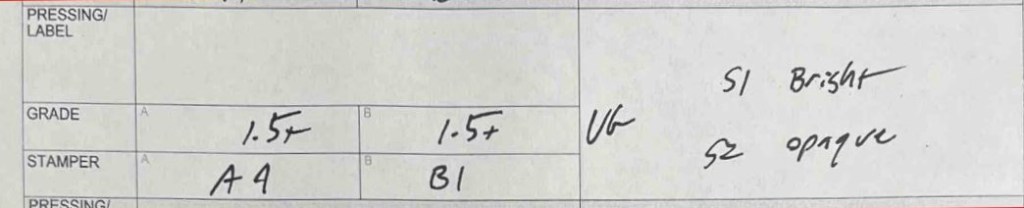
VAN GELDER in the dead wax is no guarantee of high quality sound, on any record.

Side one of this original pressing with later stampers was bright and side two opaque. This pressing was not awful, or even mediocre — the reissues without VAN GELDER in the dead wax would most likely be much worse sounding, we stopped buying them years ago — but at 1.5+ we would say these grades point to the sound is good, not great.

The only way to guarantee higher quality sound is to put the album through a shootout with a good-sized pile of cleaned pressings and find the one that sounds the best using the rigorous testing methodologies we recommend. For this kind of work to be meaningful and reproducible, top quality playback is a must.

There is of course a way to avoid doing all that work and spending all the kind of money it takes to acquire piles of pressings — most of which you will eventually have no use for — and that’s to buy a Hot Stamper copy of the album from us.
The Music

The high point for side one is clearly the first track. It’s got a Midnight Blue relaxed groove going on, the kind that Kenny Burrell seems to be able to bring to any session he plays on. Or maybe it’s the rhythms Ray Barretto works out in the songs that make them so relaxed and swinging at the same time.

Side two is magical from start to finish. The two extended songs, both more than eight minutes in length, leave plenty of room for the band — and the orchestra! — to stretch out.

(more…)

Another Unimpressive Reissue Pressing of Coltrane’s Music — What Is Going On?

Hot Stamper Pressings of the Music of John Coltrane Available Now

We had an early Blue Label Prestige mono pressing that was not as awful as the original Yellow Label mono we played, but it’s not very good either. Our grade for a record that earns one plus on both sides is passable.

Which means you could play it, maybe even enjoy it, but you would have no idea just how well Rudy Van Gelder recorded the sessions in 1958 that went into the making of the album, which as you know was not compiled for release until 1962.

As you can see from the notes above, it was crude, smeary and thick. We don’t sell records that sound like that.

I can’t say that most modern remastered records are crude, although some of them are, but a great many we’ve played are smeary, and almost all of them are thick — that is, lacking in transparency — to some degree. That last quality — a lack of transparency — may be the most irritating of all, a subject we discuss here.

(A great many records we’ve auditioned over the years are good for testing transparency. Those wanting to improve this aspect of their playback should consider making use of them.

(more…)

Top End Extension Is Key to the Best Pressings of Fingers

airtofinge_

Hot Stamper Pressings of Jazz Fusion Albums Available Now

The best copies have the highs that are missing from so many of the CTI originals. When you play them against most copies, there is an extension to the top end that you won’t hear elsewhere. Since this album is heavy on percussion, that difference is critical.

The HARMONICS of the percussion are critically important to the music. When they go missing, it’s as if the music seems to slow down, a strange effect but a fairly common one with rhythmically dense arrangements such as these. Some of the energy of the music is lost. 

With an extended top end the sound is SWEET, not HARSH. Believe us when we tell you, the last thing you want is a harsh sounding pressing of a Rudy Van Gelder recording. (Not unless you have a dull, dull, deadly dull system. Those old school stereos are practically the only way one can tolerate some of his early recordings.)

With so many high frequency transients and such complex arrangements, this is a record that must be mastered (and pressed) with great skill or the result is going to be trouble. RVG, who both recorded and mastered the album, has a penchant for over-cutting records and being heavy handed when it comes to his favorite studio tricks, often to the detriment of instrumental fidelity. When his approach works, the resulting recordings are wonderful. When he gets too carried away with his “sound,” look out.

This is without a doubt the best album Airto ever made. On top of that, this copy really has the kind of sound we look for, with an open, fully extended top end that gives all the elements of this complex music room to breathe.

(more…)

Rollins and Nelson Are Hard to Beat in 66

Hot Stamper Pressings of the Music of Sonny Rollins Available Now

A triumph for Rudy Van Gelder, a Top Impulse title, and as much a showcase for Oliver Nelson as it is for Sonny Rollins. 

This album is on the TAS Super Disc list, which is probably what first alerted me to it. I know I was listening to this album 25 years ago, just from the memory of hearing it in the condo I used to live in. It sounded great back then and it sounds even better now. You will have a hard time finding a better Sonny Rollins record, sonically or musically. 

Great players of course. Kenny Burrell is wonderful as always. Interestingly I never realized that Roger Kellaway is the pianist on these sessions. I saw him live years ago with Benny Carter (who was 90 at the time) and he put on one of the most amazing performances at the piano I have ever seen. For some reason he was never able to make it as a recording artist, but the guy is a genius at the keyboard.

Of course any orchestration by Oliver Nelson is going to be top flight and this is no exception. Two of his records are Must Owns in my book: Jimmy Smith’s Bashin’ and his own The Blues and the Abstract Truth. No jazz collection without them can be taken seriously.

For audiophiles who are looking for one of the best sounding jazz recordings ever made, this is it.

Heavy Vinyl

There was a 180 gram reissue on Impulse a number of years back. I seem to recall it was awful. Most of the Heavy Vinyl reissues that Blue Note and Impulse did under their own names were garbage. They were probably a step up from the CDs those labels were making at the time, but none of those pressings have the magic that’s found on originals like this one.

(more…)

Letter of the Week – “I put on the WHS and found out exactly how much better it could sound.”

Hot Stamper Pressings of Recordings by Rudy Van Gelder Available Now

One of our good customers had this to say about some Hot Stampers he purchased recently:

Hey Tom,  

Well you guys did it again. I had a good promo copy of Baddest Hubbard, lively and big soundstage. I was listening and questioning how much better can it sound.

I put on the WHS and found out exactly how much better it could sound.

More natural, more relaxed, just better any way you cut it.

I knew it in the first ten seconds of track one; that Better Records sound is unmistakable.

Mike H.

Mike,

Glad you enjoyed it!

(more…)

Gabor Szabo / Mizrab – Not Much Here for Us Audiophiles

Hot Stamper Pressings of Jazz Guitar Recordings Available Now

A weak effort from CTI in 1972.

Neither the music nor the sound, at least on the copies we played, is worth your time. 


We’ve auditioned countless pressings like this one in the 37 years we’ve been in business — buying, cleaning and playing them by the thousands. This is how we find the best sounding vinyl pressings ever made.

Not the ones that should sound the best. The ones that actually do sound the best.

If you’re an audiophile looking for top quality sound on vintage vinyl, we’d be happy to send you the Hot Stamper pressing guaranteed to beat anything and everything you’ve heard, especially if you have any pressing marketed as suitable for an audiophile. Those, with very few exceptions, are the worst.

(more…)