Kenneth Wilkinson, Engineer

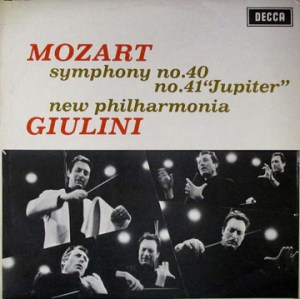
Mozart / Symphonies Nos. 40 & 41 / Giulini on Decca

More of the music of Wolfgang Amadeus Mozart (1756-1791)

  • This early Decca pressing of two of Mozart’s greatest symphonies boasts stunning Nearly Triple Plus (A++ to A+++) grades throughout – just shy of our Shootout Winner
  • Giulini is masterful here, bringing both of these great works to life – both the performance and the sound are hard to fault
  • Both sides are remarkably transparent and energetic, with wonderful space and clarity
  • Full brass; full, rich, tonally correct strings; smooth higher up, never screechy — what’s not to like?
  • Kenneth Wilkinson engineered in Decca’s glorious sounding Kingsway Hall, using the legendary Decca tree microphone setup.
  • If you’re a fan of Mozart’s Symphonic work, this Decca from 1965 belongs in your collection. (The London pressing of this performance is also very good.)
  • The complete list of titles from 1965 that we’ve reviewed to date can be found here.

(more…)

Ted Heath / Shall We Dance

More Big Band Jazz Recordings

  • This original London pressing boasts outstanding Double Plus (A++) grades from first note to last – fairly quiet vinyl too
  • Both of these sides are huge, rich, weighty and dynamic like few records you have ever heard – it sets the Gold Standard for Tubey Magical Big Band sound
  • It’s simply bigger, more transparent, less distorted, more three-dimensional and more REAL than much of what we played
  • Credit Kingsway HallKenneth Wilkinson, and the Decca “Tree” microphone setup as the three elements used to create the magic in these grooves

Years ago we wrote in another listing, “We had a copy of Heath’s Shall We Dance not long ago that had some of the biggest, richest, most powerful sound I have ever heard. Watch for Hot Stampers coming to the site soon.” Well, now they’re here, and this copy fulfills the promise of the album better than most others we played in our recent Shootout.

DEMO DISC SOUND barely begins to do this one justice. This is Audiophile Quality Big Band sound to beat them all. The American big bands rarely got the kind of sound that the Decca engineers were able to achieve on records like this. For one thing they didn’t have Kingsway HallKenneth Wilkinson or the Decca “Tree” microphone setup.

Unlike some of the American big band leaders who were well past their prime by the advent of the two-channel era, Heath is able to play with all the energy and verve required for this style of music. He really does “swing in high stereo” on these big band dance tunes.

(more…)

Rachmaninoff / The Complete Piano Concertos – Wild / Horenstein

More of the Music of Sergei Rachmaninoff

xxxxx

  • An excellent copy of this wonderful original 4 LP Box Set with roughly Double Plus (A++) orchestral sound across these 8 magical sides
  • The vinyl is as quiet as we can find it – like most Shaded Dogs and Mercs, Mint Minus Minus is about the best you can hope for
  • We have been readying this shootout for probably twenty years – we had 8 box sets to play, 32 discs in all, searching for the best sound we could find on these famous TAS List records
  • There is not much chance we will be able to do such a comprehensive shootout in the near future — we find at most one nice set per year, which means the next big shootout is a very long way off
  • Wild’s playing of the Rhapsody On A Theme Of Paganini here is one of our favorites on vinyl
  • Some old record collectors (like me) say classical recording quality ain’t what it used to be – here’s all the proof anyone with two working ears and top quality audiophile equipment needs to make the case
  • “Rachmaninoff’s music . . . changes as the composer goes along, moving from Romantic to a tentative Modernism in such works as the fourth piano concerto and the Symphonic Dances. In this sense, he walks a path similar to Puccini’s, incorporating new approaches to extend that [which was] already essentially his. Certainly, the works here show these changes, as the composer picks up more experience, both in writing and in hearing music.”

(more…)

Ravel, Saint-Saens et al. / Tzigane, Havanaise / Kyung-Wha Chung

Hot Stamper Orchestral Imports on Decca & London
This 1979 London original English pressing of violin showpieces (reviewed in 2012) has Super Hot Stamper sound on side two, which came as a bit of a shock to us after playing side one, which is as congested and opaque as one would expect from such a late London recording.

A great many Decca recordings from the Seventies are not to our liking, for reasons we lay out here.

Side two is fabulous — full-bodied, rich and sweet. Even though it may have been recorded in 1977, the engineer is Kenneth Wilkinson, and the hall is Kingsway — not many bad recordings can be attributed to either.    

But bad mastering or bad pressing quality are surely not the fault of either. When the record doesn’t come out of the oven right, the sound is going to suffer, and the sound on this side one is insufferable all right.

But side two is GLORIOUS, with wonderful music played with skill and feeling. (more…)

Debussy / Clair de Lune / Agoult

  • This rich, sweet and full-bodied UK pressing boasts excellent Double Plus (A++) grades or BETTER from top to bottom – fairly quiet vinyl too
  • Side one gives you not only a wonderful Clair De Lune, but a number of shorter works by Faure, Massenet and Elgar as well, with side two highlighted by meditative pieces by Bach, Tchaikovsky and others
  • We can’t imagine a more beautiful record, both in terms of the program and the sound – this record is a wonderful example of what the Decca recording engineers (Kenneth Wilkinson in this case) were able to capture on tape
  • It’s the same recording as the famous Living Stereo Clair De Lune, LSC-2326, but with a couple of extra tracks included
  • The other main difference between the Living Stereo pressing and our Decca here is that the Decca has better sound

Transparent and spacious, wide and naturally staged, clean yet rich, with zero coloration, there is nothing here to fault. So relaxed and natural you will soon find yourself lost in the music.

It’s yet another remarkable disc from the Golden Age of Vacuum Tube Recording. We were impressed with the fact that it excelled in so many areas of reproduction. The illusion of disappearing speakers is one of the more attractive aspects of the sound here, pulling the listener into the space of the concert hall in an especially engrossing way.

The 1959 master has been transferred brilliantly using “modern” cutting equipment (from 1970, not the low-rez junk they’re forced to make do with these days), giving you, the listener, sound that only the best of both worlds can offer.

(more…)

Stravinsky / Le Sacre du Printemps – Speakers Corner Reviewed

More of the music of Igor Stravinsky

We used to think this was one of the better Speakers Corner Deccas.

Having recently played the London pressing of the same performance (CS 6885), cut by Decca of course, we think we are almost certainly wrong about the quality of the sound, but who knows? Maybe Speakers Corner remastered the record properly and fixed its shortcomings.

Hah, just joking. In our experience that has never happened and we think it is very unlikely that it ever will.

Years ago we wrote the following:

Wow! What a performance! What dynamic full bodied sound! To be fair, I pulled out my original London, one of those awful mid-’70s English pressings that are never quiet, and yes, some of the ambience on the original is missing here on the new version, but everything else seems right: dynamics, tonality, the frequency extremes (including some pretty awesome deep bass).

Some of the above could be right, the parts about the tonality and such. Speakers Corner could have added some bass and lower midrange to make the sound less thin, and taken out some of the upper midrange to make the loud passages less blary, but it certainly doesn’t solve the most serious issues we had with the recording, which is the fact that it is opaque and flat, two qualities that are the death of orchestral music on vinyl.

Here are the notes we made for the London.

The two paragraphs you see reproduced below are also full of bad advice we had given out in the past:

1. Can’t be sure we would still feel that way but I’m guessing this is a good record if you can pick one up at a cheap price. 

2. If you have a quiet original, great, consider yourself lucky. As few of you have any copy at all, I recommend this one. The alternative is to miss Solti’s energetic performance and the precision of the Chicago Symphony, one of the few orchestras capable of making sense out of this complex and infuriating work. (At least it used to infuriate audiences. Now our modern ears can take a difficult work like this and appreciate the complex rhythms and atonality as the expression of a truly original mind.

This paragraph we would still agree with wholeheartedly:

This is not music to play while you are having dinner. This is music to engage the mind fully. It belongs in any collection. Yours in fact. Unless you have small speakers, in which case you would be wasting your money, as small speakers cannot begin to reproduce the power of this work in the hands of Solti and the CSO [or anybody else for that matter].

Respighi / Strauss – Pines of Rome / Don Juan / Kempe

More Orchestral Spectaculars

More Reviews and Commentaries for The Pines of Rome

  • With two top quality sides, we guarantee you’ve never heard The Pines of Rome sound remotely as good as it does here (unless you own one of killer Living Stereo LPs of the work)
  • This Readers Digest pressing of Kempe’s superb 1964 recording for Decca has glorious sound on both sides and plays reasonably quietly for any LP produced by this notoriously difficult label for audiophiles
  • There were only three performances with top quality audiophile sound, and our Wilkinson-engineered pressing here was right up there with the best we heard in our massive shootout
  • If you know anything about these works, you know that they have tons of top and bottom end, and it is the rare pressing that captures both
  • The texture and harmonic overtones of the strings are superb – as we listened we became completely immersed in the music on the record, transfixed by the remarkable virtuosity Kempe and the Royal Philharmonic Orchestra brought to these difficult and demanding works 50 plus years ago

This shootout has been at least thirty years in the making — that’s how long I have been picking up these RDG sets, ever since my friend Robert Pincus turned me on to them all those years ago.

Around 2016 we surveyed the recordings of the work we had on hand, close to a dozen different performances I  think, and found them all wanting, save three: the Reiner (which is still on the TAS List), this Reader’s Digest pressing with Kempe (our second favorite, and a close second at that), and a London with Kertesz.
If a particular performance had any distortion or limitation problems in the higher frequencies, it was quickly rejected out of hand. Same with low end whomp and weight. On The Pines both are crucial.

No other pieces of music of which we are aware have so much going on up high and down low. This narrowed the field of potential Hot Stampers considerably. Great performances by top conductors could not get over these hurdles — high and low — time and time again.

For these reasons, it took us years to find the right recordings. We knew the Reiner would be hard to beat, but we kept trying record after record hoping that we could find one to wrest the crown away from what is widely considered the greatest recording of the works ever made.

The best pressings were doing everything right. There was plenty of top end, with virtually no harmonic distortion, and when I say plenty, I mean the right amount. Not many engineers managed to get all the highs correctly onto the tape, but Lewis Layton and Kenneth Wilkinson sure did.

So many recordings had screechy strings and horns. When the music would get loud — and the Pines gets very loud indeed, assuming the recording will let it — the sound would become unbearably harsh and unpleasant. This is the opposite of what should happen, and it was obvious that those recordings would not make it past the first round.

All three of the finalists could claim enthusiastic performances with powerful energy and top quality orchestral playing.

(more…)

Clair de Lune – Compare and Contrast Sides One and Two

The Music of Claude Debussy Available Now

This Shaded Dog LP has DEMONSTRATION QUALITY SOUND, if what you’re demonstrating is not a Hi-Fi spectacular, but rather a sublime presentation of an exceptionally sweet and natural string section in an orchestra, presented here on analog disc pressed more than sixty years ago.  

I can’t imagine a more beautiful record, both in terms of the program and the sound. This record is a wonderful example of what the Decca recording engineers were able to capture on tape, and the RCA mastering engineers were able to master from that tape.

Even though the album was recorded by Decca, it’s a superb example of Living Stereo Tubey Magic at its best. There will never be a reissue of this record that even remotely captures the space, transparency, sweetness and richness of the sound here.

Side Two

A++ to A+++ or better! Without more copies in hand it’s hard to know how good the sound can get, but we found it Hard To Fault (HTF).

This side has more extension up top and down low and more texture to the strings.

Side One

A++, although it starts out a bit weaker than that and only really gets good a few minutes into the side. (We hear this effect fairly often on the records we play. Noticing things like this is what we do for a living.)

There is some smear and it is slightly opaque as well.

You will hear what we mean when you flip it over and those two problems disappear.

(more…)

Mozart / Haydn – Symphony No. 35 / 104 / Krips

More of the Music of Wolfgang Amadeus Mozart

  • With two outstanding Double Plus (A++) or BETTER sides, we guarantee you’ve never heard these symphonic masterpieces sound as good as they do here
  • It’s also reasonably quiet at Mint Minus Minus considering that RDG vinyl is often a problem -It’s one of the main things that keeps some pressings from sounding their best, obviously not a problem here
  • This Readers Digest pressing of Krips’s superb 1964 recording for Decca has glorious sound for any LP produced by this notoriously difficult label (difficult for audiophiles, everybody else loved the fact that a whole set of amazing sounding records was less than twenty bucks!)
  • The texture and harmonic overtones of the strings are superb – as we listened we became completely immersed in the music on the record, transfixed by the remarkable virtuosity Josef Krips and the Royal Philharmonic Orchestra brought to these difficult and demanding works nearly 60 years ago

This vintage pressing has the kind of Tubey Magical Midrange that modern records can barely BEGIN to reproduce. Folks, that sound is gone and it sure isn’t showing signs of coming back. If you love hearing INTO a recording, actually being able to “see” the performers, and feeling as if you are sitting in the studio with the band, this is the record for you. It’s what vintage all analog recordings are known for — this sound.

(more…)

Mahler’s Symphony No. 4 with Solti on Decca/London

Hot Stamper Pressings of Decca Recordings

Deep bass; rich, smooth strings, lots of lovely hall space – this copy was right up there with the best we heard, and clearly won the shootout for side two. You will hear immediately why this side two could not be beat – it’s wonderful.

CS 6217 is potentially every bit as good.

What amazing sides such as these are doing right is not hard to hear:

  • The biggest, most immediate staging in the largest acoustic space
  • The most Tubey Magic, without which you have almost nothing. CDs give you clean and clear. Only the best vintage vinyl pressings offer the kind of Tubey Magic that was on the tapes in 1961
  • Tight, note-like, rich, full-bodied bass, with the correct amount of weight down low
  • Natural tonality in the midrange — with all the instruments of the orchestra having the correct timbre
  • Transparency and resolution, critical to hearing into the three-dimensional space of the concert hall

No doubt there’s more but we hope that should be enough for now.

And of course, playing the record is the only way to hear all of the above.

An Orchestra Needs This Kind of Space

One of the qualities that we don’t talk about on the site nearly enough is the SIZE of the record’s presentation. Some copies of the album just sound small — they don’t extend all the way to the outside edges of the speakers, and they don’t seem to take up all the space from the floor to the ceiling. In addition, the sound can often be recessed, with a lack of presence and immediacy in the center.

Other copies — my notes for these copies often read “BIG and BOLD” — create a huge soundfield, with plenty of room for all of the players. These copies are not brighter, they’re not more aggressive, they’re not hyped-up in any way, they’re just bigger and clearer.

And most of the time those very special pressings are just plain more involving. When you hear a copy that does all that — a copy like this one — it’s an entirely different listening experience.

Side One

Heiter, Bedächtig, Nicht Eilen 
In Gemächlicher Bewegung

Side Two

Ruhevoll 
Sehr Behaglich

About the Symphony

Mahler had begun work on the 4th symphony in 1899 but the ingredients were not all created from scratch. The music of the final movement dates back to 1892 and a particular collection of songs he composed that February. Many were destined to become part of the epic folk-cycle Das Knaben Wunderhorn but the stand-alone Das himmlische Leben (“Heavenly life”) was intended to be an important component of the massive 3rd Symphony. Indeed, melodic material from this song can be found in that earlier work but Mahler soon realized that it deserved more elaborate treatment.

With a technique not uncommon in Mahler’s oeuvre, he used an idea from one symphony to inform another. Much like the trumpet fanfare in the 4th Symphony’s first movement that foreshadows the 5th Symphony, the “Leben” song fragments of the 3rd Symphony’s fifth movement find their apotheosis in the 4th.

There is a decidedly “Classical” feel to the score of the 4th Symphony and the work employs a much more concentrated emotional profile than the prior symphonies. The child’s view of heaven depicted in the 4th Symphony’s closing movement is largely responsible for this overarching simplicity but there is also a sense that Mahler was attempting something novel with this work.

Interestingly, he does not supply explanatory titles to the first three movements (a rarity to this point in his career) but rather allows the music, in all its sunny subtlety, to speak for itself.

Program Notes

Wilkie and the Decca Tree

Decca was an early adopter of the LP album, which put it ahead of its direct competitor EMI. The company was also an early exponent of stereophonic recording. Wilkinson would make the move to stereo recordings for Decca in April 1958, but until then he remained the engineer with the monaural recording team (for a time there were parallel recording teams) because mono was considered the more important release. In the early 1950s, together with Roy Wallace (1927–2007) and Haddy, he developed the Decca tree spaced microphone array used for stereo orchestral recordings. Decca began to use this for recordings in May 1954 [the month and year I was born!] at Victoria Hall in Geneva, a venue Wilkinson did not record in. He preferred recording in London and Paris although he also recorded in Amsterdam, Bayreuth, Chicago, Copenhagen, Rome, and Vienna.

Wilkinson discussed the use of the Decca tree in an interview with Michael H. Gray in 1987.

You set up the Tree just slightly in front of the orchestra. The two outriggers, again, one in front of the first violins, that’s facing the whole orchestra, and one over the cellos. We used to have two mikes on the woodwind section – they were directional mikes, 56’s in the early days. You’d see a mike on the tympani, just to give it that little bit of clarity, and one behind the horns. If we had a harp, we’d have a mike trained on the harp. Basically, we never used too many microphones. I think they’re using too many these days.

Wilkinson’s method of selecting recording venues was recounted in an article on concert hall orchestral sound written by the conductor Denis Vaughan in 1981:

I have recorded in many halls throughout Europe and America and have found that halls built mainly of brick, wood and soft plaster, which are usually older halls, always produce a good natural warm sound. Halls built with concrete and hard plaster seem to produce a thin hard sound and always a lack of warmth and bass. Consequently when looking for halls to record in I always avoid modern concrete structures.

Wilkinson went on to engineer at hundreds of recording sessions. He was said to have worked with more than 150 conductors. He was the engineer most responsible for Richard Itter’s Lyrita recordings (which Decca produced). Itter always requested Wilkinson as engineer, calling him “a wizard with mics.”

Wilkinson’s stereo recordings with the conductor Charles Gerhardt (including a series of Reader’s Digest recordings and the RCA Classic Film Scores series) and the producer John Culshaw made his name and reputation known to record reviewers and audiophiles. His legacy was extended by the fact that he trained every Decca engineer from 1937 onwards.

Wilkinson, always called “Wilkie” in the music business, was known as a straight-talking man, interested only in the quality of the work. The Decca producer Ray Minshull (1934–2007) recalled Wilkinson’s methods in an interview with Jonathan Valin in March 1993:

Everyone loved and respected Wilkie, but during a session he could be exacting when it came to small details. He would prowl the recording stage with a cigarette – half-ash – between his lips, making minute adjustments in the mike set-up and in the orchestral seating. Seating arrangement was really one of the keys to Wilkie’s approach and he would spend a great deal of time making sure that everyone was located just where he wanted them to be, in order for the mikes to reflect the proper balances.

Of course, most musicians had a natural tendency to bend toward the conductor as they played. If such movement became excessive, Wilkie would shoot out onto the stage and chew the erring musician out before reseating him properly. He wanted the musicians to stay exactly where he had put them. He was the steadiest of engineers, the most painstaking and the most imaginative. In all of his sessions, he never did the same thing twice, making small adjustments in mike placement and balances to accord with his sense of the sonic requirements of the piece being played.

His recordings were characterized by the producer Tam Henderson in an appreciation: “The most remarkable sonic aspect of a Wilkinson orchestral recording is its rich balance, which gives full measure to the bottom octaves, and a palpable sense of the superior acoustics of the venues he favored, among them London’s Walthamstow Assembly Hall and The Kingsway Hall of revered memory”.

On retiring, Wilkinson received a special gold disc produced by Decca with extracts of his recordings. He received three Grammys for engineering: 1973, 1975, and 1978. He also received an audio award from Hi-Fi magazine in 1981 and the Walter Legge Award in 2003 “…for extraordinary contribution to the field of recording classical music.”