*Collecting Better Records

Ideas and methods for collecting the best sounding pressings of your favorite music.

If You’re Just Getting Started, Beware of LPs that Will Inhibit Your Progress

Hot Stamper Pressings of Blue Note Albums Available Now

Robert Brook wrote a scathing review of the Tone Poets pressing of One Flight Up in 2023, much to the dissatisfaction of some of his readers. I was the first to leave a comment as I thought he hit the nail on the head when he said:

Overall, the Tone Poet is closed, distant and frankly boring to listen to. Where is the energy of the music? Where is the presence of these musicians? Where is the studio space?

The snare sounds muted. the piano weak, the horns, especially Gordon’s saxophone, resolves poorly and becomes increasingly tiresome to listen to. On my first listen I lasted about 3 minutes into side 1, mostly because I couldn’t stand the way the sax was sounding.

I posted the comments below on Robert’s review. (I have taken the liberty to rewrite some of my comments for the purposes of clarity, along with some additional thoughts.)

Robert,

Another great post. I have many comments to make, so here goes.

When audiophiles prefer records which are clearly second-rate, more often than not I chalk it up to their lack of a better record to play. In order to hear what they are missing, they have to have a record that somehow makes clear to them precisely which aspects of the sound are failing, or at the very least, not up to par.

You could give out the stamper numbers for your Blue Note reissue — I would be surprised if it does not have VAN GELDER STEREO in the dead wax — and those who like the Tone Poets release of One Flight Up could easily find one on Discogs or Ebay and do the comparison for themselves.

But you know what? I would bet you dollars to donuts they will never do that. They simply won’t bother.

To some audiophiles who collect records, collecting is simply not about sound quality.

It’s about collecting the right audiophile pressings.

These folks don’t want some old Blue Note reissue from the 70s. They want a fancily-packaged remastered record on high quality vinyl that’s made by a label that really cares. If it’s a numbered limited edition, even better!

If these people wanted to find out what is wrong with the sound of the Tone Poets pressing you played — thanks for laying it all out in detail so no one can doubt that you listened carefully and heard what’s really in those grooves — they could easily find a vintage copy of the record that would make a mockery of the one they own.

Twenty years ago I wrote something about this very subject:

(more…)

Building a Store of Knowledge, One Record at a Time

Hot Stamper Pressings of the Music of Elton John Available Now

We recently ran across the commentary below in a reply to a Hot Stamper testimonial for Honky Cat. Drawing on our own experience, we give a quick and dirty primer on how one can build up one’s knowledge of records, stampers, labels, pressing variations and the like.

We don’t really give out much in the way of specific information about any of those things; we just tell you how it can be done. It’s your job to go out and do it. It’s simple: just follow the path we have laid out for you. How tough can it be?

Phil wondered how we could find such an amazing sounding record, which in this case is a rhetorical question.

Phil knows exactly how we find them, because he shops at the same L.A. stores we do and finds a few himself — the only way it can be done, the old-fashioned way.

We buy them, clean them and play them, just like Phil does.

The difference these days is one of scale. With seven or eight people [now ten to twelve] finding, cleaning and playing records every day, we can probably shootout forty or fifty or even a hundred times as many records as any suitably dedicated single person working by himself could.


It turns out, as a practical matter, no such person seems to exist. At least we can find no evidence to support the existence of anyone doing shootouts like the ones we do.

Sure, these kind get done, which may fool some people, but they don’t fool us.


And to find the raw material (LPs, what else?), it helps immensely if you live in a major city like L.A., where records, even high-quality ones, are still abundant, if not ubiquitous. [Not so much anymore.]

After a shootout, one of my favorite things to do is [was, I’m retired now] jot down the stampers for the hottest copies.

I then head right out to my favorite record stores to search through the bins and — even better — the overstock underneath.

So many times I’ve thrilled to the purchase of an album with exactly the right stampers that very day, a copy that I would never have known to buy had we not just done the shootout.

Streamlining the Process

This is how record knowledge builds: one LP at a time. To that end we’ve streamlined the system of finding Hot Stampers, turning the process into a rough kind of science and devoting well over a hundred manhours a week to the effort.

It’s time-consuming and expensive, but every week we find Hot Stamper copies of great albums that MURDER the competition, in the process often dramatically changing our expectations of how good that music can sound. We call them breakthrough pressing discoveries.

It’s the most fun part of the record business.

The rest of it, if I can be honest, I could happily do without. 

(more…)

The Reissues Consistently Beat the Originals on this Mystery Mercury

Hot Stamper Pressings of Mercury Classical Records Available Now
For Mercury classical and orchestral recordings, the original FR pressings on the plum labels are the way to go, right? 

In some cases, yes. We talk about how much better the FR pressings for The Firebird are compared to the much more common, and still quite good, M2 reissue pressings here.

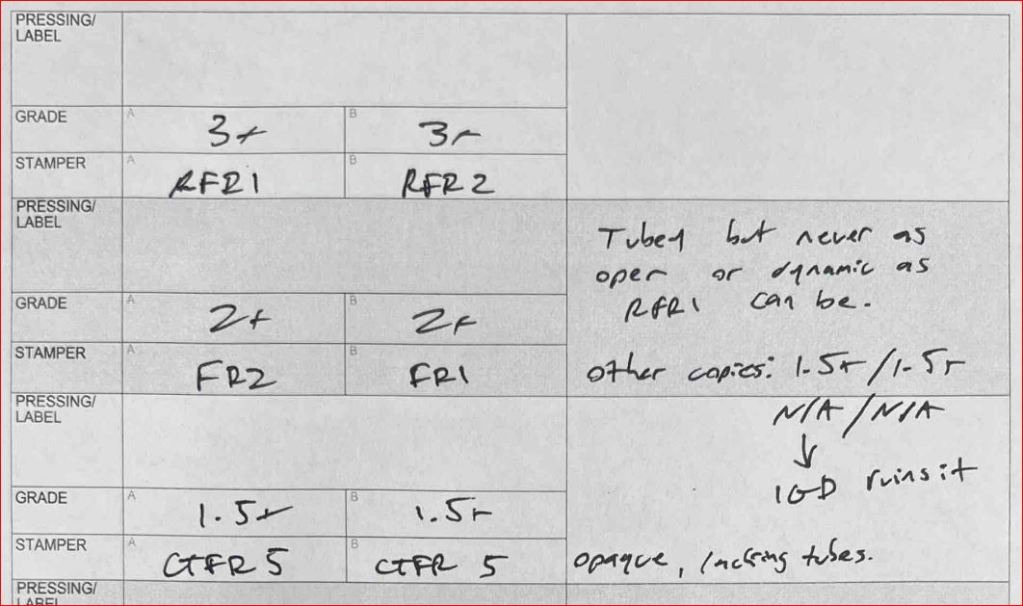
The stamper numbers you see below belong to a different album.

The notes for the FR originals we played read:

  • Tubey but never as open or dynamic as RFR-1 can be.

The better of the three FR pressings we played was not a bad sounding record, earning a grade of 2+. They’re just not as good sounding as the RFR reissues, which, of course, are the ones that win shootouts.

Something to keep in mind: A Super Hot Stamper Mercury orchestral record is guaranteed to be dramatically better than any Heavy Vinyl reissue ever made.

(more…)

Half-Speed Masters – Stopgaps and Benchmarks

Hot Stamper Pressings of the Music of Joan Baez Available Now

Mobile Fidelity released a version of Diamonds and Rust on Anadisq in 1995, and if you want to hear a pressing that’s not murky, compressed and opaque, you would be wise to avoid their remastered pressing.

To be fair, MoFi has made some reasonably good sounding records too. For those of you whose budget is on the limited side, if you find an affordable copy of any of these MoFis, you are probably not completely wasting your money.

Stopgaps and Benchmarks

Our advice for the longest time has been that, while you are actively improving your stereo, room and setup, the best way to use your remastered audiophile pressings is as stopgaps and benchmarks.

As you make more and more progress, eventually you will find the vintage pressings that can show you what your audiophile pressings don’t do well, or at the very least, not as well as they should.

The unfortunate reality — considering how much money you had invested in them — is that they were falling short in many ways for all the years you had been playing them, but until you improved your playback, those problems were hidden from you.

Charting Your Success

As your stereo improves, you can actually chart your success by how many of these kinds of records you are able to eliminate from your collection. Once you can count the number of modern reissues you still own on one or two hands, there is a good chance you have reached a much higher level of playback.

(more…)

Sonny Rollins Helped Us See the Light Many Years Ago

The following commentary was taken from our mid-90s catalogs, the ones that came out back in the days when it was still possible to find great jazz records like Alternate Takes for cheap, often still sealed.

The Analogue Productions Heavy Vinyl recuts done by Doug Sax had come out a few years earlier, starting in 1992. Those remastered records were in print at the time I wrote this, and I was pretty pissed off at the way they sounded.

Here is our listing with some minor changes from long ago:

Acoustic Sounds had just remastered and ruined a big batch of famous jazz records, and shortly thereafter a certain writer in The Absolute Sound had said nice things about them.

Said writer and I got into a war of words over these records, long, long ago. You’ll notice that no one ever mentions these awful records anymore, and for good reason: they suck. If you own any of them, do yourself a favor and get either the CD or a good LP for comparison purposes. I expect you will hear what I’m talking about.

In my essay on reviewers I attack him for giving a big “Thumbs Up” in TAS to the botched remastering of Sonny’s Way Out West. The OJC reissue, though superior, is still only a pale shadow of the original.

The Real Deal

Now we have the real thing! This LP has three alternate takes from that session, all mastered by George Horn, and surprise, surprise, surprise, they sound just like my original, much better than (but not so different from) the OJC, and worlds away from the muted flab of the Analogue Productions LP!

(more…)

Who Can Explain Why This Cheap Reissue Sounds So Good?

Hot Stamper Pressings of the Music of Claude Debussy Available Now

This Decca reissue is spacious, open, transparent, rich and sweet.

Roy Wallace was the engineer for these sessions from 1955 to 1962 in Geneva’s glorious sounding Victoria Hall. His work here is superb in all respects.

It’s yet another remarkable disc from the Golden Age of Vacuum Tube Recording, with the added benefit of mastering using more modern, but apparently still good, cutting equipment from the ’70s, 1972 to be exact.

We are of course here referring to the often amazing modern mastering of 40+ years ago, not the mediocre-at-best modern mastering of today.

The combination of old and new works wonders on this title as you will surely hear for yourself on both of these superb sides.

We were impressed with the fact that it excelled in so many areas of reproduction. The illusion of disappearing speakers is one of the more attractive aspects of the sound here, pulling the listener into the space of the concert hall in an especially engrossing way.

Thread It Up and Just Hit Play Already

What might be seen as odd — odd to some audiophiles but not to us — was how rich and Tubey Magical the reissue can be on the best copies.

This leads me to think that most of the natural, full-bodied, smooth, sweet sound of the album is on the tape, and that all one has to do to get that vintage sound on to a record is simply to thread up the master on a good machine and hit play.

The fact that nobody seems to be able to make an especially good sounding record these days makes clear that in fact I’m wrong to think that this approach would work. It seems to me that somebody should be able to figure out how to do it. In our experience that is simply not the case today, and has not been for many years.

Old Tapes, New Tapes

The master tapes were about fifteen years old when this record was mastered.

Compare that to a current cutting which would be made from approximately fifty year old tapes.

Perhaps that explains it.

Or maybe it doesn’t.

(more…)

The Thrill of Discovering Great Recordings

Hot Stamper Classical and Orchestral Pressings Available Now

This shootout was many years in the making – we’d been trying to do these wonderful overtures for about five years, which just goes to show how hard it is nowadays to find records like these in audiophile playing condition.

We also just debuted a Decca recording with Ansermet at the helm under the title French Overtures featuring two of the pieces found here, and it’s every bit as good.

Which one is better is probably a matter of taste as they are both head and shoulders better than any other recordings of the music that we’ve come across in the last five or ten years. This is often what you are paying for when you buy a White Hot Stamper pressing — the best sound we know of for the music.

We admit that “we know of” is doing a good deal of heavy lifting in the preceding sentence, but the world is full of records and we can’t have played them all, so in the unlikely event that we find something better down the road, do not be too surprised, it happens.

Side One

  • So huge and tubey
  • 3D and spacious and extending high and low
  • Lush strings
  • More realistic and dynamic
  • Big low end
  • Tubey

Side Two

  • 3D, tubey and lush
  • Huge low end and brass
  • Realistic space and cymbals
  • Not hot at all

Let Me Ask You This

Who else is finding incredible Demo Discs like this EMI from 1972 nowadays?

(more…)

Billy The Kid / Rodeo – How Do the Record Club Copies Sound?

Hot Stamper Pressings of Classical Masterpieces Available Now

Without anyone knowing, a Record Club pressing found its way into one of our shootouts a few years back. Because the person doing the listening has no idea what pressing is on the table, biases and prejudices cannot affect the grading or the outcome of the shootout.

It earned Two Pluses, not enough to win a shootout, but enough to put practically any orchestral record made in the last thirty years to shame. We noted at the time:

This spectacular Demo Disc recording is clear, rich, dynamic, transparent and energetic – here is the BIG, BOLD sound we love. There is a note on the inner sleeve that says this was a Record Club of America purchase in 1973.

Can you imagine that a Record Club was offering records in 1973 that were better sounding than anything being made today? Astonishing.

There are about 150 orchestral recordings we think offer the best performance coupled with the highest quality soundThis record has earned a place on that list.

If you’re a fan of orchestral showpieces such as these, this recording from 1967 belongs in your collection.

(more…)

Acoustic Sounds Was Selling This Ridiculously Bad “TAS List” Record Back in the Day

Hot Stamper Pressings of the Music of Cat Stevens Available Now

This commentary was written circa 2001. 

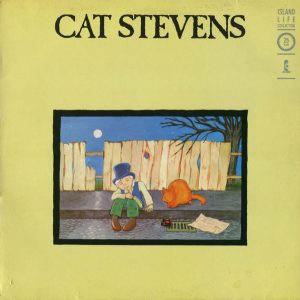
I remember 15 years ago when Acoustic Sounds was selling the then in-print 25th Anniversary Island pressing (with 7U stampers as I recall) for $15, claiming that it was a TAS List record. If you’ve ever heard the pressing, you know it has no business going anywhere near a Super Disc List. It’s mediocre at best and has virtually none of the magic of the good originals.

NEWSFLASH: Just looked it up on Discogs, a site that did not exist when I wrote this commentary. My memory is apparently better than I thought it was. The 25th Anniversary Island Life Collection pressing came out in 1986.

    • Matrix / Runout (Runout side A, variant 1): ILPM 9154 A-1 ILPM•9154•A1
    • Matrix / Runout (Runout side B, variant 1): ILPM 9154 B-7U-1-1-3
    • Matrix / Runout (Runout side A, variant 2): ILPM 9154 A-8U-1- G10
    • Matrix / Runout (Runout side B, variant 2): ILPM 9154 B-7U-1-

By the way, I am not aware of any of these pressings from the 80s being especially good sounding. I remember playing some of them but I don’t remember liking any of them. They were cheap reissues that satisfied those looking for import vinyl, not audiophile quality sound.

I refused to sell it back in those days, for no other reason than the fact that it’s far from a Better Sounding Record. I don’t like misrepresenting records and I don’t like ripping off my customers. It’s bad for business.

That pressing was a fraud and I was having none of it.

Chad probably didn’t even know the difference.

When you don’t know much about records, you can say all sorts of things and not get called out for them. Audiophiles are a credulous bunch and always have been. They still believe the same nonsense that I foolishly fell for back in the 80s. (And I admit that even as late as 2006 I was still a fan of certain Heavy Vinyl pressings.)

(more…)

Out of Our Heads – Mono or Reprocessed Stereo?

Hot Stamper Pressing of the Music of The Rolling Stones Available Now

On this London LP, even though it states clearly on the cover that the record is electronically re-processed into stereo, the songs we heard on side one were in dead mono.

So much for believing what you read on album covers.

This Sonny Rollins pressing of Tenor Madness says it too has been remastered into stereo, but you would have a hard time hearing any left-right information coming from your speakers. On headphones, maybe, but speakers? Unlikely.

Even when a record has been been reprocessed from mono into stereo, it can still sound very good. Not the best, mind you, but good enough to easily wipe the floor with anything pressed by any audiophile label that we’ve ever heard of, and we’ve heard of pretty much all of them.

More on the subject of mono versus stereo.

(more…)