MFSL (Older)

Labels With Shortcomings – Mobile Fidelity (Older)

Mobile Fidelity – The Ultimate Pretender

Hot Stamper Pressings of the Music of Jackson Browne Available Now

During the recording of The Pretender, a newly invented piece of electronics was used called the Aphex Aural Exciter. It harmonically “richened” the sound in interesting and, most would say, pleasing ways.

It was designed to have a euphonic effect, and it succeeded in that aim, beguiling its listeners for a while, especially those at the lo- and mid-fi level, the obvious if unspoken target market these days (although the thought of admitting such a thing would surely cause the sky to fall) for the Heavy Vinyl reissue.

The Aphex was clearly creating distortions, but they were the kinds of distortions that many folks of the audiophile persuasion seemed to like. Which is the very definition of euphonic colorations.

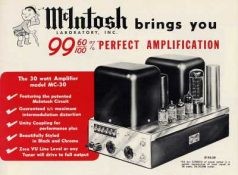
The poster boy for euphonic colorations is our friend here, the famous Mac 30, an amp that came on the market in 1954 and one that still has adherents to this day, some of them quite famous. I had a pair and learned some lessons — as I did with every piece of equipment I owned — in the time I spent listening to them.

If you like old school tubey colorations, the kind we’ve found to be antithetical to the proper reproduction of music in the home, this is the amp for you.
How Much Is Too Much of a Good Thing?

When you play the MoFi pressing of The Pretender, it just seems to have more of that Aphex Aural Excitement.

Here’s the $64,000 question: is MoFi’s supposedly superior mastering technology revealing more of the “aphexy” sound already present on the tapes, or is it adding its own distortions that mimic the Aphex distortions?

It seems to me that in the case of The Pretender it’s clearly the latter.

Deja Vu on MoFi has that same too rich, too smooth sound. Where on earth did that extra richness and smoothness come from? No vintage pressings we have ever played has ever had that sound.

Obviously MoFi preferred The Pretender to sound the way they preferred it to sound, or perhaps it’s more accurate to say that they wanted it to sound the way they thought their customers would prefer it to sound.

Or maybe they have no idea what they’re doing and never did. That strikes me as the most likely explanation for a label that should have gone out of business a long time ago.

Is it just EQ? I’m not expert enough to know, but I do know this: Hot Stamper pressings of The Pretender have much more transparency and clarity, while at the same time offering a good balance of of sweetness and smoothness, with less of that thick, blurry, overly-rich quality that you find on the MoFi pressings of the album.

More on the Aphex

Owen Penglis on the Happymag.tv site describes the Aphex Aural effect this way:

The Aural Exciter brought presence, intelligibility, ‘air’ without hiss, and renewed clarity through its arbitrary process of adding phase shift, harmonics, compression, and intermodular distortion.

(more…)

Half-Speed Mastering – A Technological Fix for a Non-Existent Problem

Hot Stamper Pressings of the Music of Joe Jackson Available Now

UPDATE

This commentary was written many years ago. We had a Hot Stamper Section back then, because we were selling lots of other kinds of records including direct-to-disc recordings, Heavy Vinyl, Half-Speeds, OJC‘s and various other pressings which we thought would appeal to those in search of higher quality sound.

In 2011, we officially stopped selling anything other than records we had cleaned, evaluated, and found to have superior sound.


We do a lot of MoFi bashing here at Better Records, and for good reason: most of their pressings are just plain awful. We are shocked and frankly dismayed to find that the modern day audiophile still flocks to this label with the expectation of a higher quality LP, seemingly unaware that although the vinyl may be quiet, the mastering — the sound of the music as opposed to the sound of the record’s surfaces — typically leaves much to be desired. 

Hence the commentary below, prompted by a letter from our good friend Roger, who owned the MoFi Night and Day and who had also purchased a Hot Stamper from us, which we are happy to say he found much more to his liking.

In my response, after a bit of piling on for the MoFi, I then turned my attention to three Nautilus records which I had previously held in high regard, but now find deserving of a critical beatdown. (We actually have a section for bad sounding records I once liked. Live and learn, right?) This one is entitled:

(more…)

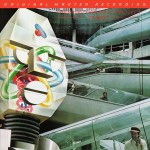
The Alan Parsons Project – A MoFi Disaster

Hot Stamper Pressings of Albums Engineered by Alan Parsons Available Now

MoFi Regular LP: F / UHQR:

Two — count ’em, two — hall of shame pressings and two more MoFi Half-Speed Mastered Audiophile LPs reviewed and found wanting.

The MoFi is a textbook example of their ridiculous affinity for boosting the top end, not to mention the extra kick they like to put in the kick drum, great for mid-fi (sometimes known around these parts as stone age audio systems) but a serious distraction on a high end stereo with good low end reproduction.

If you like the album –and that’s a big if, I myself have never been able to take it seriously — try the Simply Vinyl or the Classic LP.

Even the UHQR sucks. Don’t kid yourself. They’re still mastered by Stan Ricker, and he likes plenty of top end.

Like the old saying goes, if it’s worth doing it’s worth overdoing.

(more…)

Sgt. Pepper’s and Mistaken Audiophile Thinking (Hint: the UHQR Is Wrong)

Hot Stamper Pressings of Sgt. Peppers Available Now

This commentary was probably written between 2005 when we did our first shootout for the album and 2008, by which time it would have been a regular feature on the site. 

We charge hundreds of dollars for a Hot Stamper Sgt. Pepper, which is a lot to pay for a record. But consider this: the UHQR typically sells for a great deal more than the price we charge and doesn’t sound remotely as good. 

Of course the people that buy UHQRs would never find themselves in a position to recognize how much better one of our Hot Stampers sounds in a head to head shootout with their precious and oh-so-collectible UHQR.

They assume that they’ve already purchased the Ultimate Pressing and see no reason to try another.

I was guilty of the same mistaken audiophile thinking myself in 1982. I remember buying the UHQR of Sgt. Pepper and thinking how amazing it sounded and how lucky I was to have the world’s best version of Sgt. Pepper.

If I were to play that record now it most likely would be positively painful. All I would hear would be the famous MoFi 10K Boost on the top end (the one that MoFi lovers never seem to notice), and the flabby Half-Speed mastered bass (ditto).

Having heard really good copies of Sgt. Pepper, like the wonderful Hot Stampers we put on the site from time to time, now the MoFi UHQR sounds so phony to me that I wouldn’t be able to sit through it with a gun to my head.


UPDATE 2025

If you are still buying these remastered pressings, making the same mistakes that I was making before I knew better, take the advice of some of our customers and stop throwing your money away on Heavy Vinyl and Half-Speed mastered LPs.

At the very least let us send you a Hot Stamper pressing — of any album you choose — that can show you what is lacking on your copy of the album.

And if for some reason you disagree with us that our record sounds better than yours, we will happily give you all your money back and wish you the very best.

To learn more about records that sound dramatically better than any Half-Speed mastered title ever made (with one exception, John Klemmer’s Touch), please go to our Half-Speed mastering main page .

(more…)

A Trick Of The Tail – A MoFi Disaster to Beat Them All

This review is fairly old, probably from 2005-2010.

Not long ago I played the MoFi pressing of Trick of the Tail and could not believe how ridiculously compressed it was.  Rarely have I heard sound as squashed as that which is heard on this LP.

On top of that, the midrange is badly sucked out (as is the case with most Mobile Fidelity pressings) making the sound as dead, dull and distant as can be.

Is it the worst version of the album ever made? Hard to imagine it would have much competition. I have the CD and it’s fine. It sounds like a digital version of the British pressings we favor (the domestic pressings having been made from dubs of course).  The MoFi is bad enough to have earned a place in our Mobile Fidelity hall of shame.

You think Modern Heavy Vinyl pressings are lifeless? Play this piece of crap and see just how bad an audiophile record can sound.

And to think I used to like this version! I hope I had a better copy back in the 80s than the one I played a few years ago. I’ll never know of course. If you have one in your collection give it a spin. See if it sounds as bad as we say. If you haven’t played it in a while (can’t imagine why, maybe because it’s just plain awful), you may be in for quite a shock.

If you are still buying these audiophile pressings, take the advice of some of our customers and stop throwing your money away on Heavy Vinyl and Half-Speed mastered records.

(more…)

This Beethoven Ninth Started Out with Two Strikes Against It

Hot Stamper Pressings of the Music of Beethoven Available Now

MoFi took the shortcomings of a mediocre-at-best Decca recording from 1972 and made them even worse by means of their ridiculously misguided mastering decisions and wacky cutting system.

They should not have chosen this performance of the Ninth Symphony in the first place, and they certainly should not have added the treble they chose to add, which they did to this title and to every classical recording they remastered without regard to whether or not the recording needed brightening. None that I know of did. Try telling that to the brain trust running MoFi.

(They hired this guy to do their one-step digitally remastered pressings and from the get-go he’s been giving audiophiles the most ridiculously phony sounding records that collectors with way too much money can buy.)

The Decca recording of the Ninth from 1972 is opaque, lacks size and space, and comes off as a bit flat and dry.

Like practically every later Decca pressing we play, it’s passable at best.

Londons and Deccas from this era (1972 in this case) rarely sound very good to us.

Here is what we specifically don’t like about their sound.

If you want to know what’s wrong with the Mobile Fidelity pressing, take the above faults and add some others to them.

Start with an overall brighter EQ, add a 10k boost for extra sparkly strings, the kind that MoFi has always been smitten with, and finish with the tubby bass caused by the half-speed mastering process itself.

Voila! You are now in the presence of the kind of mid-fi trash that may have fooled some audiophiles way back when but now sounds as wrong as the records this ridiculous label is still making today.

Here are some other pressings with bright string tone that are best avoided by audiophiles looking for top quality sound.

1981 Was a Long Time Ago

Old school audio systems are notorious for being dark, dull and lacking in transparency. They might need bright records in order to sound good, but high quality modern systems do not.

If these two MoFi pressings sounds right to you, you are very likely living with one of those old school systems and it is long past time to get rid of it.

(more…)

Are All MoFis Created Equal? A Pair of Pink Floyd LPs Proved They Aren’t

Hot Stamper Pressings of the Music of Pink Floyd Available Now

[This commentary was written about twenty years ago.]

Many audiophiles are operating under the misapprehension that Mobile Fidelity managed to eliminate pressing variations of the kind we discuss endlessly on the site.

That is simply not the case, and it’s child’s play to demonstrate how misguided this way of thinking is, assuming you have the following four things: good cleaning fluids and a machine, multiple copies of the same record, a reasonably revealing stereo, and two working ears.

With all four the reality of pressing variations for ALL pressings is both obvious and incontrovertible.

The discussion below of a Hot Stamper pair of Dark Sides from long ago may shed light on some of the issues involved.

Remember Classic Records Comparison Packages?

This is our first Hot Stamper Comparison Package.

For those who remember the 45 RPM/ 33 RPM Classic Records comparison packages, this is somewhat in the same vein. Of course, we don’t know that they kept the EQ the same for the 45 versions compared to the 33s of the albums included in the package, so the comparison is suspect at best.

You’re not really comparing apples to apples unless you keep the EQ exactly the same. I rather doubt they did, because on Simon and Garfunkel the sound was noticeably worse at 45 than it was at 33. This is the main reason we don’t carry the 45 versions of Classic’s records: they are a lot more money, and who knows if they’re even any better?

[This one sure wasn’t better. This guy liked it, but he is rarely right about any of this record and equipment stuff, as I hope everyone knows by now.]

(more…)

Driving My Car into a Ditch

Hot Stamper Pressings of the Music of The Beatles Available Now

Mobile Fidelity made a mess of Drive My Car on their Half-Speed mastered release of Rubber Soul in 1982.

Perhaps it’s more accurate to say Stan Ricker, MoFi’s go-to mastering engineer, did.

He equalized out far too much upper midrange and top end.

What fuels the energy of the song are the cow bell, the drums and other percussion. Instead of a scalpel, Mobile Fidelity took a hatchet to this slightly bright track, leaving a dull, lifeless, boring mess.

Some Parlophone copies may be a little bright and lack bass, but at least they manage to convey the musical momentum of the song.

Even the purple label Capitol reissues can be quite good. A bit harsher and spittier, yes, but in spite of these shortcomings they communicate the music, which ought to count for something.

As much as I might like some of the MoFi Beatles records [not so much anymore], and even what MoFi did with some of the other tracks on Rubber Soul, they sure sucked the life out of Drive My Car.

We all remember how much fun that song was when it would come on the radio. Playing it on a very high quality stereo should make it more fun, not less.

If you’ve got a Rubber Soul with a Drive My Car that’s no fun, it’s time to get another one.

By The Way

The best $250 — to the penny! — I ever spent on records is the price I paid for my brand new, still-in-the-shipping-carton MoFi Beatles Box. I ordered it in 1982 when I first learned of it, and it finally came the next year. I already owned all The Beatles albums MoFi had done to date, including the UHQR of Sgt. Pepper, which, like a fool, I got rid of once the set came out.

(more…)

Close to You on Mobile Fidelity Vinyl – Is This the Sound Audiophiles Were Clamoring For in ’83?

Hot Stamper Pressings of the Music of Frank Sinatra Available Now

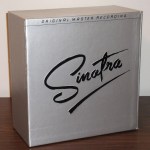
In 2024 we did a shootout for the first of Frank’s many releases from 1957, Close to You. We were fortunate to have the Mobile Fidelity pressing from the ’80s box set to play against the mostly original pressings we had accumulated since our last shootout in 2020.

It takes a long time to find enough clean copies to get a shootout going. Four years is fairly typical these days I would imagine.

As you can see from our notes, side one of this MoFi was just awful. Can you blame us if we didn’t bother to play side two?

P.S. I Love You

  • Over-textured violin
  • Spitty, gritty vocals
  • Hollow and dry

Close To You

  • Very clean
  • Bass and vocals really lacking body and warmth

Our grade, had we given it one, would have had to have been a big fat F.

Is it the worst version of the album ever made?

(more…)

MoFi’s Pictures at an Exhibition Is as Wrong as Wrong Can Be

moussmofiHot Stamper Pressings of the Music of Mussorgsky Available Now

If you like orchestral spectaculars, have we got the record for you.

It’s the same recording of the works, but the one you want is on the real EMI label and pressed on UK import vinyl, not this awful Half-Speed recut from Japan.

The record you see pictured is awful sounding, a true hall of shame pressing.

And why are the colors of the album jacket so washed out? Compare their cover to the real thing below. As we often find ourselves asking after reviewing one of these MoFi records: What were they thinking?

The MoFi mastering of Pictures at an Exhibition and The Firebird here are a bad joke played on credulous audiophiles. And yes, I bought them both back when they came out. I was as credulous as everybody else buying these so-called superior pressings.

All that phony boosted top end makes the strings sound funny and causes mischief in virtually every other part of the orchestra as well. Not surprisingly, those boosted highs are missing from the real EMIs.

These appear to be the unbearably bright strings that Stan Ricker favors — why, we have no idea.

The proof? Find me a Mobile Fidelity classical record with that little SR/2 in the dead wax that does not have bright string tone. I have yet to hear one.

The last time I played a copy of the MFSL I found the sound so hi-fi-ish I couldn’t stand to be in the room with it for more than a minute. Of course the bass is jello as well.

The EMI with the right stampers is worlds better.

(Warning: The domestic Angel regular version and the 45 are both awful.)

MoFi had a bad habit of making bright classical records. (More reviews here.) I suppose you could say they had a bad habit of making bright records in general. A few are dull, some are just right, but most of them are bright in one way or another.

(more…)