Cisco/Boxstar/Impex

The Cisco Pressing of Beethoven’s Kreutzer Sonata

Hot Stamper Pressings of Recordings with Heifetz Performing

An audiophile hall of shame pressing from Cisco / Impex / Boxstar / whatever.

The Cisco pressing of LSC 2577 should not have sound that is acceptable to any person who considers himself an audiophile.

There is no violinist in front of you when you play their pressing.

There is someone back behind your speakers under a thick blanket, and his violin sure doesn’t sound very much like a real violin — no rosiny texture, no extended harmonics, no real body.

In short, the sound of this reissue is much too smearyveiled, and lacking in presence to be taken seriously.

Unfortunately for those of us who love good music with good sound, Cisco’s releases from this era (as well as DCC’s) had to fight their way through Kevin Gray’s transistory, opaque, airless, low-resolution cutting system. We discuss that subject in more depth here.

(more…)

Something Not Very Cool on Cisco

Hot Stamper Pressings of Pop and Jazz Vocals Available Now

We went back and played the Cisco version about 6 or 7 10 or 15 years ago and were quite a bit less impressed with the sound than we had been when it first came out. We wrote the review you see below sometime around 2015 or so.


This is a decent Cisco LP, which is now long out of print. Audiophiles who love female vocal albums and pass on this one are missing the boat, because finding a better sounding original in clean enough condition to play is practically impossible these days.

Of course, if you already have a clean original you sure don’t need to waste your money on this LP.    


To recap briefly:

In 2015 or thereabouts we liked the record a lot less than we did when it came out in 2002.

Our take in 2025: I doubt we could sit through it with a gun to our head.

As we mention throughout this blog, Cisco’s titles had to fight their way through Kevin Gray’s opaque, airless, low-resolution cutting system, a subject we discuss in some depth here. (It was even more opaque back then than it is today.)

Other bad sounding records that Kevin Gray mastered can be found here.

(more…)

I Have to Admit: the Cisco Pressing of Home Again! Had Me Vexed

Reviews and Commentaries for the Music of Doc Watson

Folks, if you made the mistake of buying the Cisco Heavy Vinyl reissue of this album, and you manage to grab one of our Hot Stamper pressings, you are really in for a treat.

I have to confess that when this record came out in 2003 I had a hard time coming to grips with what was wrong with it. I knew I didn’t like it, but I wasn’t sure exactly why. I wasn’t sure exactly what it was doing wrong, if anything. It seemed tonally correct and natural sounding. Why didn’t I like it?

It wasn’t phony up top with sloppy bass like a MoFi.

It wasn’t hard and transistory like so many of the Classic Records pressings back then.

I didn’t know the record at all so I really had nothing to judge it by.

But there was definitely something lacking in the sound that had me confused. Eventually I figured it out. Looking back on it now, the problems with the Cisco I could not identify were these:

  • The Cisco lacks presence. It puts Doc Watson further back than he should be, assuming that he is where he should be on the good vintage pressings, which sound right to me — some better, some worse, of course. Moving him back in the sound field does him no favors.
  • The Cisco lacks intimacy, which is key to the best pressings. The shootout winners remove all the veils and put you in the presence of the living, breathing Doc Watson. The Cisco adds veils and takes the intimacy right out of the record.
  • The Cisco lacks transparency. It frustrates your efforts to hear into the recording.
  • Doc is in a studio, surrounded by the air and ambience that would naturally be found there. The Cisco is airless and ambience-free, with Doc performing in a heavily damped booth of some kind. At least that’s what it sounds like.
  • And the last thing you notice is the lovely guitar harmonics on the originals and early reissues, harmonics that are attenuated and dulled on the Cisco.

As my stereo got better and better, and my critical listening skills improved in tandem, it became more and more obvious to me what was wrong with the Cisco. When we play modern Heavy Vinyl pressings these days, especially albums we know well, it usually doesn’t take us two minutes to hear what they are doing wrong.

We go back and forth between the new pressing and one of our Hot Stampers a few times, make some notes, and proceed to put the review up on the blog, and maybe mention it in our listings for the album. A half hour or an hour is the most it takes these days. Like I say, these records are obviously doing some things poorly, and their failings are easy to spot if you know the album well — a little harder, but not that much harder, if you don’t.

(more…)

Records Like This Make Audiophiles the Laughing Stocks of the Music World

More Reviews and Commentaries for Heavily Processed Recordings

This album has some of the worst sound I have ever heard in my life, worse than The Hunter even, and that’s saying something.

If this kind of crap is what audiophiles choose to play, then they deserve all the derision heaped upon them.

We’re glad we no longer offer embarrassments such as The Well, although we used to, many years ago. In our defense we would simply offer up this old maxim: de gustibus non est disputandum.

Our old slogan was Records for Audiophiles, Not Audiophile Records, but we also followed this business rule: Give the Customer What He Wants.

Now we give the customer what he wants, as long as he wants one of the best sounding pressings of the album ever made. (In this case obviously there is no good sounding pressing.)

How Bad Is It?

If this isn’t the perfect example of a pass/not-yet record, I don’t know what would be.

Some records are so wrong, or are so lacking in qualities that are critically important to their sound — qualities typically found in abundance on the right vintage pressings (although there is no acceptable pressing of this record, vintage or otherwise) — that the defenders of these records are fundamentally failing to judge them properly. We call these records pass/not-yet, implying that the admirers of these kinds of phony-sounding records are not where they need to be in audio yet, but that there is still hope, and if they devote enough time and money to the effort, they can get where they need to be, the same way we did.

(more…)

Mozart / Symphony No. 35 – A Cisco Recommended LP, or Is It?

Hot Stamper Pressings of the Music of Mozart Available Now

I wrote this review in 2001, the equivalent of the stone age in my audio world — most everything of value that I’ve learned in audio over the last fifty years I learned in this century — and would now disagree with a great deal of what I said about the sound of the record.

The music and performances are fine, but the sound has all the hallmarks of bad cutting equipment and dead-as-a-doornail RTI vinyl.

This is the review I wrote in 2001:

Hearing this performance from Thomas Nee and his orchestra is like hearing the work for the first time. It may be difficult to reproduce the magic in these grooves but wonderfully rewarding when you do. You won’t be bored! The sound is intimate and immediate; this is the record for those of you who appreciate more of a front row center seat. Count me in; that’s where I like to sit myself.  

I worked hard on my system for about 4 hours one night, using nothing but this record as my test, because of its wealth of subtle ambience cues, excellent string tone, and massed string dynamics. There is a lot to listen for, and a lot to get right, for this album to sound right.

The performance of the Mozart’s 35th Symphony is definitive. Without a doubt this is the best Mozart record currently available, one that belongs in any serious record collection. I give it a top recommendation for its sublime musical qualities that set it apart from other current releases. In short, a Must Own.


UPDATE 2020

Twenty years and a great deal of audio progress later I have changed my tune. Now I would say:

Cisco’s titles had to fight their way through Kevin Gray’s opaque, airless, low-resolution cutting system, a subject we discussed on the blog in some depth here. Other bad sounding records that he mastered can be found here.

An excerpt:

As is the case with practically every record pressed on Heavy Vinyl over the last twenty years, there is a suffocating loss of ambience throughout, a pronounced sterility to the sound. Modern remastered records just do not breathe like the real thing.

Good EQ or bad EQ, they all suffer to one degree or another from a bad case of audio enervation.

Where is the life of the music?

You can try turning up the volume on these remastered LPs all you want; they simply refuse to come to life.

A textbook case of live and learn.


Cisco Music had this to day about their record:

One of Mozart’s most popular symphonies is given a visceral and driving performance. Instead of slowing down the tempo in service to lyricism, conductor Thomas Nee chose to adhere to Mozart’s written instructions: ‘The first movement must be played with fire; the last, as fast as possible.’ Even if you own several recordings of this bright and joyous work, you’ve never heard it played like this, and certainly never with this kind of audiophile sound! 

This is exactly the kind of “audiophile sound” I fell for 20 25 years ago, long before I had a clue as to just how good the best orchestral recordings could sound.

(more…)

Our Guide to Legrand Jazz on Impex

Hot Stamper Pressings of 30th St. Recordings Available Now

Years ago I wrote about how important the Legrand Jazz album was in my growth as a critical listener.

It’s yet another example of an album that helped make me a better audiophile by showing me the error of my tweaking and tuning ways.

Now there is a new pressing of it. Well, new to us anyway. (We readily admit to being behind the times and make no apologies for it. With records like these, we often find ourselves wondering why we bother.)

Two new pressings in fact. One on a single disc at 33 RPM as of 2017, and one mastered at 45 RPM on 2 LPs as of 2019, still in print and available for $59.99.

Production details can be found at the end of this review, along with some favorable comments, some from none other than Steve Hoffman himself.

But first let’s hear from the personification of the well-meaning audiophile reviewer, Michael Fremer. He gives the Impex pressings an 11 for sound. He writes (emphasis added):

This IMPEX reissue is sourced from an “analog mix-down transfer of the original 1958 work tape by Mark Wilder at Battery Studios” and cut by Chris Bellman and Bob Donnelly at Bernie Grundman Mastering on Grundman’s all-tube mastering system. I have a clean, original 6-Eye pressing that this superbly pressed reissue betters in every way. This will make both your stereo and your heart sing. Some of the greatest jazz musicians of that or any era wailing and clearly having a Legrand time. Limited to 3000 copies. Don’t miss it!

Who are you going to believe, the Self-Appointed Vinyl Experts of the World or some guy like me who thinks he knows a thing or two about the sound of records, especially, as in this case, a record I have been playing since 1990 or thereabouts.

(Back in those early days I also had the standard CD, which is excellent and highly recommended. Since I couldn’t clean or play my original vinyl pressing at a very high level, my guess would be that the CD had the better sound at the time.)

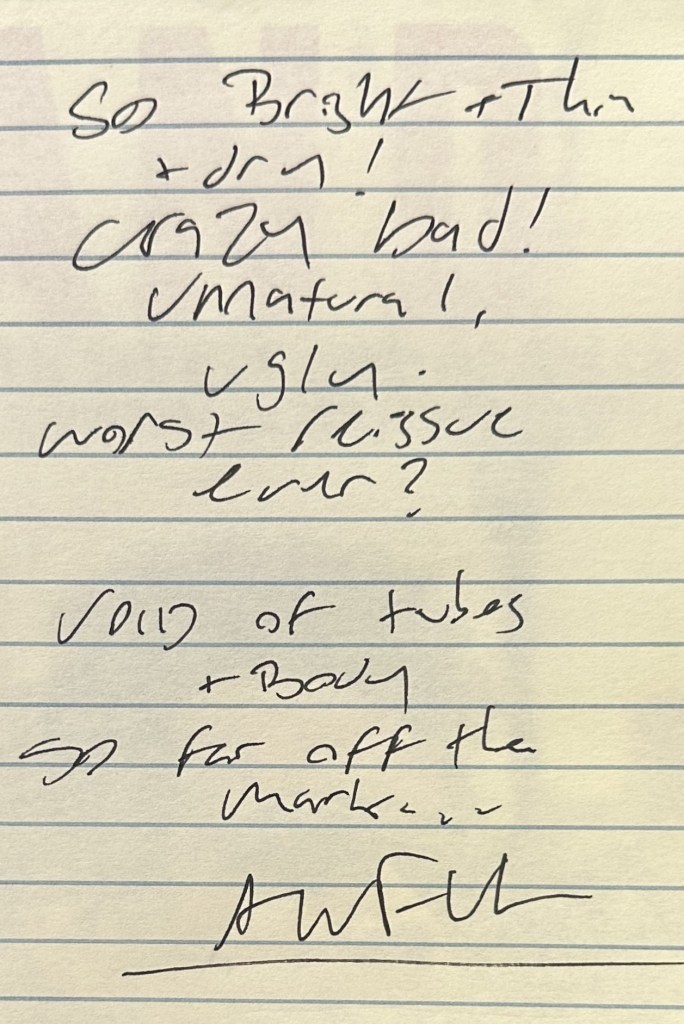
Our notes (for those who have trouble reading our scratch)

So bright and thin and dry.

Crazy bad!

Unnatural, ugly.

Worst reissue ever?

Void of tubes and body.

So far off the mark.

Awful.

A second opinion

Robert Brook reviewed this pressing a while back. He does his best to remain positive when choosing the words that he thinks will help the reader bette understand the experience of playing the Impex release of Legrand Jazz that we had loaned him. In the end he goes with the spoken word over the written one.

Legrand Jazz (featuring Miles Davis) – the 2019 IMPEX Double 45 rpm

I think it’s safe to say Robert has learned a great deal regarding the state of modern remastering. Impex’s recent release may have shown him just how low it can go.

And this is a man who’s played records from The Electric Recording Company!

When you play those, it’s hard to imagine worse sound, but one doesn’t need to imagine it, one only needs to be one of the 3000 unlucky souls who took Michael Fremer’s and Steve Hoffman’s advice and actually paid good money for this Impex pressing.

I might give it an 11 rating if the scale was 1 to 100.

Even that might be too generous. Let’s be honest, it’s a zero on any scale worth a damn, a complete failure and proof, as if more were needed, that Michael Fremer has been as deaf as a post since at least 2017, when he favorably reviewed the first Impex iteration of Legrand Jazz.

No one with two working ears should have anything good to say about this record. If you own these ridiculously bad pressings, buy the CD and find out for yourself if it isn’t better sounding.

(more…)

Time Further Out on Impex – You Could Do a Whole Lot Better

Hot Stamper Pressings of the Music of Dave Brubeck Available Now

The Impex pressing of this classic album was mastered by the late and formerly great George Marino at Sterling Sound. It was released in 2013. We did a big shootout for the album at the end of 2023 and somehow found a copy of the Impex to include.

(My guess is that we probably picked it up locally for cheap. We never pay good money for these pressings. We do these reviews as a public service, so keeping out costs down is baked in to the deal. Now that we’ve played it, we will trade it back to the store we bought it from for whatever they are willing to give us. We sure don’t have any use for it.)

Here it is 2025 and we are just now getting around to publishing the notes  for the Impex LP you see below.

We rarely put much effort into detailing the shortcomings of these Heavy Vinyl reissues. The people that buy them don’t care what we think, and, to be honest, probably cannot hear the sonic flaws we expose or they would long ago have given up buying such markedly inferior pressings, perhaps about the time Classic Records starting pressing their ersatz Living Stereo LPs in the mid-90s.

The fact that some of Classic’s pressing are still on the so-called TAS Super Disc list (renamed the TAS Super LP List for 2023), along with scores of other Heavy Vinyl duds, does not speak well for the magazine or its readers.

The typical audiophile record buyer can be forgiven for not finding much fault in the sound of this Impex pressing. It’s not awful the way so many of their releases are. But up against the real thing it leaves a lot to be desired, and what it lacks can be found in abundance on our admittedly-expensive Hot Stamper pressings.

In our world, the world of truly high-fidelity pressings, you get what you pay for, and if you ever feel otherwise, you get your money back, no questions asked.

With grades of one plus on both sides, the sound was not good enough to compete with even the lowliest of our Hot Stamper pressings. Those must earn a grade of 1.5+ or better to make it to our site.

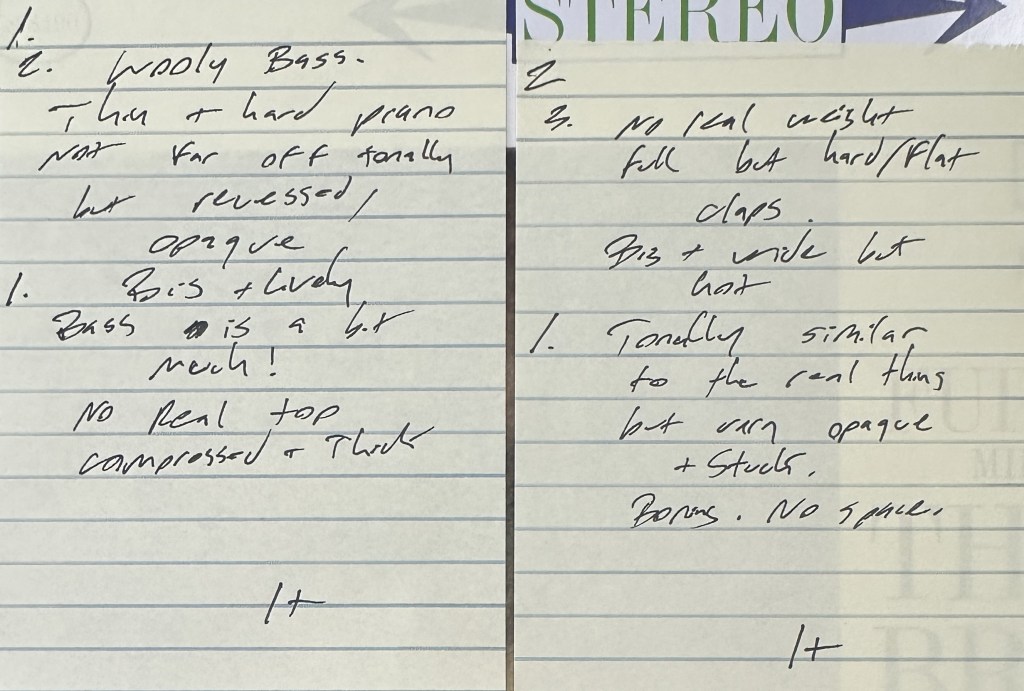
The notes for side one read:

Track two

  • Wooly bass
  • Thin and hard piano
  • Not far off tonally but recessed and opaque

Track one

  • Big and lively
  • Bass is a bit much!
  • No real top
  • Compressed and thick

The notes for side two read:

Track three

  • No real weight
  • Full but hard/flat handclaps
  • Big and wide but hot

Track one

  • Tonally similar to the real thing but very opaque and stuck (in the speakers)
  • Boring
  • No space

Reminds me in some ways of a George Marino-mastered title that we spent a great deal of time evaluating a few years back, this one.

Either way, it’s not terrible, but it’s not all that good either.

Any Six-Eye and probably any 360 Columbia label pressing (but probably not your average 70s Red Label LP —  we stopped buying them years ago) will be better sounding.

Noisier for sure, but clearly better sounding.

If you own this modern reissue and want to hear just how good the album can sound, we would be honored to make that happen.

(more…)

Music From Peer Gynt – Another Cisco Disaster

Hot Stamper Pressings of the Music of Edvard Grieg Available Now

An audiophile hall of shame pressing from Cisco / Impex /  Boxstar / Whatever.

Pretty bad, on a par with the transistory, shrill crap Classic Records had been dishing out for years, but in the opposite direction tonally: it’s dull and dead as a doornail.

I often mention on this blog that Cisco’s releases (as well as DCC’s) had to fight their way through Kevin Gray’s transistory, opaque, airless, low-resolution cutting system. We discuss that subject in more depth here.

Our favorite recording of Peer Gynt is the one by Otto Gruner-hegge and the Oslo Philharmonic from 1959.

(more…)

Listening to Aja (with Free Cisco Debunking Tool)

Hot Stamper Pressings of the Music of Steely Dan Available Now

This commentary references a shootout we did in 2007 or thereabouts, shortly after the release of Cisco’s misbegotten remaster.

Another in our series of Home Audio Exercises with specific advice on What to Listen For (WTLF) as you critically evaluate your copy of Aja.

Our track commentary for the song Home at Last makes it easy to spot an obvious problem with Cisco’s remastered Aja: This is the toughest song to get right on side two.

Nine out of ten copies have grainy, irritating vocals; the deep bass is often missing too. Home at Last can sometimes be just plain unpleasant, which is why it’s such a great test track.

Get this one right and it’s pretty much smooth sailing from there on out.

If you own the Cisco pressing, focus on Victor Feldman’s piano at the beginning of the song. It lacks body, weight and ambience on the new pressing, but any of our better Hot Stamper copies will show you a piano with those qualities in spades on every track. It’s some of my favorite work by the Steely Dan vibesman.

The thin piano on the Cisco release must be recognized for what it is: a major error on the part of the mastering engineers.

Bonus Listening Test for Side Two

The truly amazing side twos — and they are pretty darn rare — have an extended top end and breathy vocals on the first track, Peg, a track that is dull on nine out of ten copies. (The ridiculously bright MoFi actually kind of works on Peg because of the fact that the mix is somewhat lacking in top end. This is faint praise though: MoFi managed to fix that problem and ruin practically everything else on the album.)

If you play Peg against the tracks that follow it on side two, most of the time the highs come back. On the best of the best the highs are there all the way through.

Listening Tests for Side One

Generally what you try to get on side one is a copy with ambience. Most copies are flat, lifeless and dry as a bone. You also want a copy with good punchy bass — many are lean, and the first two tracks simply don’t work at all without good bass. And then you want a copy that has a natural top end, where the cymbals ring sweetly and Wayne Shorter’s saxophone isn’t hard or honky or dull, which it often is on the bad domestic copies.

Also listen for GRAIN and HONK in the vocals on Black Cow. The better your copy is, the less grainy and honky the vocals will be.

(more…)

The Hunter – A Cisco Disaster

More of the Music of Jennifer Warnes

More Reviews and Commentaries for Audiophile BS LPs

Sonic Grade: F

An Audiophile Hall of Shame pressing from Cisco/Impex/Boxstar.

Some of the worst sound I have ever heard in my life. An absolute disgrace, both sonically and musically. 

If you like your Heavily-Processed Big Production Pop [1] to sound as unnatural as possible, this is the album for you.

Not one instrument sounds remotely like it should, and that is surely an insult to audiophiles of every stripe.

The problem was that so many self-identified audiophiles did not seem bothered by the execrable sound, certainly not the way we were.

Oh, but it’s on vinyl! That solves all the problems with the recording, doesn’t it?

Yes, the CD was bad, but the vinyl was no better. I had them both and couldn’t tolerate the sound of either of them.


[1] Note that some of our favorite records are on this list. Yes, they are heavily-processed, “unnatural” recordings, but the engineers, producers and artists who worked on these albums were attempting to create a unique sound for the music they were making, not recreate one, and in many cases the results of their efforts are some of the most powerful and enjoyable albums we’ve ever played.


The only album we like by Ms Warnes is Famous Blue Raincoat

It is her Masterpiece, a Core Collection record, and a clear case of One and Done.

When you have a good copy of Famous Blue Raincoat, you have all the Jennifer Warnes you will ever need.

(more…)