Check Out Some of Our Reviews (and Those of Our Customers’) for Albums on the Analogue Productions Label
Saving the world from bad sound you say? Hey, that’s what I’m about too!
I thought I was doing a pretty good job of it, laying out, often in great detail, exactly what’s wrong with these new Heavy Vinyl records being put out by the likes of Mobile Fidelity and Analogue Productions.
We have over 250 listings for them right here on the blog. Are there some good ones I missed?
Apparently the writer for the Times thinks there are, although some of the ones he mentions do not do much for his credibility. (Aja comes to mind, made from a copy tape — Chad goes that extra mile all right! To see what Sisario has to say about the album, with our take as well, just scroll to the bottom of this commentary.)
Let’s see what Sisario has to say about the man from Kansas and his vinyl empire.
An article about Chad Kassem and Analogue Productions has just come out, written by Ben Sisario for The New York Times.
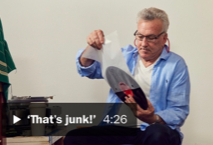
Sisario is the guy who was as enamored with Pete Hutchison of the Electric Recording Company as he seems to be of the fellow you see pictured, a man who he has no trouble calling “The Wizard of Vinyl,” and with a straight face as far as I can tell.
Audiophiles in my experience tend to be credulous — I should know, I was as credulous as they come about everything audio back in my twenties and thirties — but it seems that writers for The New York Times will believe almost anything somebody tells them about records. (Perhaps Sisario will be taken to task in the comments section, but I’m sure not going to waste my time trying to find out.)
I would love to have him come to Westlake so we could play him some of the albums he seems to think are so great. That would be one helluva wake-up call. Not only would he have to retract this article, he would have to retract the one about Hutchison. That would be a win win in my book!
Some quotes you may find interesting, or, if you are like me, congenitally of a more skeptical bent, absurd. At the very least, let’s just say unfounded.
Chad Kassem is on a mission — saving listeners “from bad sound” — at the rural factory where he pores over LPs from some of music’s most important artists.”
One record on the QRP production line was “Fragile,” the 1971 prog-rock favorite by Yes, in a two-disc, 45-r.p.m. edition that sells for $60, as part of a series marking the 75th anniversary of Atlantic Records. It is Analogue Productions’ third iteration of that album in two decades, while Mobile Fidelity Sound Lab, another reissue label, made a two-disc version as recently as 2019, and Rhino, Atlantic’s corporate cousin, offers its own “Fragile” vinyl. Labels know the value in feeding collectors’ endless hunt for the white whale.
“The fact that we can still beat some of the earliest, original pressings,” said Craig Kallman, a top Atlantic executive, “was the idea behind the Chad partnership.”
This is not a fact by any definition of the word that I am familiar with. It is at best a claim, and one we had no trouble refuting when we played the flat-as-a-pancake Fragile that Rhino put out under his auspices. Maybe the new one is better. But how can you trust anyone that would put out anything as bad as that Fragile?
“I’m doing what I love for a living,” he added. “I mean, what’s more satisfying than picking your favorite childhood record, getting the master tape and getting it to sound better than it’s ever sounded before? What’s better than that?”
That would indeed be awesome if someone could do it. We know of only a couple of modern remasterings that can claim superior sound when played up against the best vintage pressings we have auditioned. You can read about one of them here. And no, it is not mastered by any engineer mentioned on any audiophile site or forum. Nobody knows who it is, not even us!
On another note, in the same article about Chad, Mobile Fidelity defends their use of digital, which strikes me as a reasonable defense as far as it goes:
In a statement, a spokesman for Mobile Fidelity defended its process, and said that its digital step (now disclosed) offers various advantages: “For example, we can endlessly tweak it for levels, alignments and adjustments. None of this is possible with original analog master tapes, whose fragile condition subjects them to potential damage with each pass. Our approach represents the best of all worlds — and allows us to continue our role as historical caretakers that safeguard, preserve and respect the irreplaceable original.”
A fellow who goes by DC Moderate wrote in to say he doubted these records are being made with an all-analog chain.
I’m a member of a Facebook group that debates these issues. Two bald-faced assertions have been made by some of the members of that group, and I welcome a reply either from Kassem or from Ben Sisario.
The first is that Kassem, Bernie Grundman and Kevin Gray do not, in fact, have access to the “original master tapes,” as these are locked away in vaults by the record companies. I’m not sure how a rebuttal could be made to such an assertion, as it is the equivalent of being asked “when will you stop beating your wife?” My response has always been that both Gray and Kassem have posted photos of the original master tapes that they utilize. What more can they say?
The second is based upon various posts on You Tube that argue that ALL of these analog mastering studios have digital equipment, and at some point in the mastering process, ALL so-called AAA records are converted to digital. Sisario’s article doesn’t explicitly respond to that allegation, and I therefore welcome a response from Sisario or Kassem. Although implicitly, Sisario and Kassem are already saying that the entire chain is analog.
Ben Sisario replies:
I can’t comment on the practices of Bernie Grundman or Kevin Gray, although I’ve spoken to both of them and they are some of the most esteemed engineers in the industry. And it’s true that some labels don’t let tapes out of the vaults. But I saw with my own eyes that Analogue Productions has access to real masters, and I witnessed their mastering setup in use; they have the old console of Doug Sax, another of the greats.
I can’t comment on the second “allegation.” But I would note that after the Mobile Fidelity fiasco a few years ago, you now see other labels being a bit more specific and clear in how they describe their sources and mastering.
Analog Shmanalog
Now it’s my turn. The following is my reply to the friend who sent me the NYT article. He had been to my studio and heard for himself the sound of the Heavy Vinyl pressings that “The Wizard of Vinyl” produces. Up against properly-mastered, properly-pressed vintage LPs, they are at best mediocre, and more often than not just plain terrible. (Aja is a good example of a cross between mediocre and terrible, see below.)
This “pure analog versus analog tainted with digital” debate needs to stop.
It completely avoids the only question worth asking: are these new records any good?
Who cares how they make them?
Only the deaf! Those who can hear know how badly they suck and could not care less.
You sat me down and we played records. They all failed.
That is the only true test.
Put all of these new records to the same test! Please, somebody!
Somebody with a top quality system can volunteer to do shootouts for any and all of them and let the chips fall where they may.
Finding such a system may be impossible, but we can at least try. This is getting us nowhere.
There is no testing going on, just claims being made with nothing to back them up.
None of this matters. Literally, none of it.
Of course, we at Better Records could volunteer to do it, publicly, with blindfolded listeners under controlled conditions.
But we need to make money and there is no money in bashing crap vinyl.
We play a few from time to time and I post the notes from the shootout on this blog, mostly as a public service.
If you have a good stereo, properly set up in a good room, you should know by now not to buy this crap. Everybody else is falling for this man’s fool’s gold and there is nothing any of us who know better can do about it.
TP
(more…)