More Rock and Pop
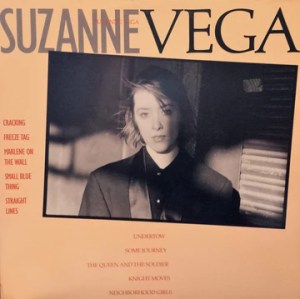
- Suzanne’s debut LP appears on the site for the first time ever, here with solid Double Plus (A++) grades from start to finish
- Both sides are big, rich and sweet with wonderfully present and breathy vocals, excellent clarity and a plenty of bottom end weight
- Remarkably present, real and resolving, this pressing is guaranteed to murder any remastering undertaken by anyone – past, present and future
- 4 stars: “Though early comparisons were made to Joni Mitchell, Suzanne Vega’s true antecedents were Janis Ian and Leonard Cohen. Like Ian, she sings with a precise, frequently half-spoken phrasing that gives her lyrics an intensity that seems to suggest an unsteady control consciously held over emotional chaos. Like Cohen, Vega observes the world in poetic metaphor, her cold urban landscapes reflecting a troubled sense of love and loss.”
This vintage A&M pressing has the kind of Tubey Magical Midrange that modern records can barely BEGIN to reproduce. Folks, that sound is gone and it sure isn’t showing signs of coming back. If you love hearing INTO a recording, actually being able to “see” the performers, and feeling as if you are sitting in the studio with the band, this is the record for you. It’s what vintage all analog recordings are known for — this sound.
If you exclusively play modern repressings of vintage recordings, I can say without fear of contradiction that you have never heard this kind of sound on vinyl. Old records have it — not often, and certainly not always — but maybe one out of a hundred new records do, and those are some pretty long odds.
What The Best Sides Of Suzanne Vega’s Self-Titled Debut Have to Offer Is Not Hard to Hear
- The biggest, most immediate staging in the largest acoustic space
- The most Tubey Magic, without which you have almost nothing. CDs give you clean and clear. Only the best vintage vinyl pressings offer the kind of Tubey Magic that was on the tapes even as late as 1985
- Tight, note-like, rich, full-bodied bass, with the correct amount of weight down low
- Natural tonality in the midrange — with all the instruments having the correct timbre
- Transparency and resolution, critical to hearing into the three-dimensional studio space
No doubt there’s more but we hope that should do for now. Playing the record is the only way to hear all of the qualities we discuss above, and playing the best pressings against a pile of other copies under rigorously controlled conditions is the only way to find a pressing that sounds as good as this one does.
What We’re Listening For On Suzanne Vega
- Energy for starters. What could be more important than the life of the music?
- Then: presence and immediacy. The vocals aren’t “back there” somewhere, lost in the mix. They’re front and center where any recording engineer worth his salt would put them.
- The Big Sound comes next — wall to wall, lots of depth, huge space, three-dimensionality, all that sort of thing.
- Then transient information — fast, clear, sharp attacks, not the smear and thickness so common to these LPs.
- Tight punchy bass — which ties in with good transient information, also the issue of frequency extension further down.
- Next: transparency — the quality that allows you to hear deep into the soundfield, showing you the space and air around all the instruments.
- Extend the top and bottom and voila, you have The Real Thing — an honest to goodness Hot Stamper.
Side One
Cracking
Freeze Tag
Marlene On The Wall
Small Blue Thing
Straight Lines
Side Two
Undertow
Some Journey
The Queen And The Soldier
Knight Moves
Neighborhood Girls
AMG 4 Star Review
Though early comparisons were made to Joni Mitchell, Suzanne Vega’s true antecedents were Janis Ian and Leonard Cohen. Like Ian, she sings with a precise, frequently half-spoken phrasing that gives her lyrics an intensity that seems to suggest an unsteady control consciously held over emotional chaos. Like Cohen, Vega observes the world in poetic metaphor, her cold urban landscapes reflecting a troubled sense of love and loss.
The key track is “Small Blue Thing,” in which the singer pictures herself as an object “Like a marble/or an eye,” “made of china/made of glass,” “lost inside your pocket,” and “turning in your hand.” The sharply picked acoustic guitar and other isolated musical elements echo the closely observed scenes — everything seems to be in tight close-up and sharp focus.
Often, the singer seems to be using the songs to measure an emotional distance; sometimes, as in “Marlene on the Wall,” she observes her own actions from a remove. In “Freeze Tag,” she tells a companion, “I will be Dietrich/and you can be Dean”; in “Marlene,” a poster of the aloof movie star “watches from the wall,” observing the singer’s succession of lovers, and she tries to emulate her heroine’s persona, telling the current one, “Even if I am in love with you/all this to say, what’s it to you?”
The ten songs on Suzanne Vega constitute the self-analysis of a young woman who desires possession without offering commitment; no wonder that, upon its release, it was taken to heart by young women across the country and in Europe.