Deutsche Grammophon Commentaries

How Do the Early Pressings of this Mozart Piano Concerto Album Sound?

Hot Stamper Pressings of the Music of Mozart Available Now

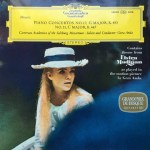
About fifteen years ago (2010) we played an original pressing of this title that we really liked. It’s the one with the rare cover you see pictured, and might have actually been the first one we had ever found in audiophile playing condition. We had a devil of a time finding more copies, but we were convinced that the early pressings were clearly the best.

More recently we were able to acquire quite a variety of different pressings for an upcoming shootout and were fortunate to be able to include one of the stereo originals for the first time in many years.

We started out with high hopes, but once the early pressing began to play, our hopes were dashed fairly quickly.

Our notes for the original pressing read:

  • Overly rich and weighty
  • Dynamics/life are gone.
  • Side two has one of the most boomy sounding pianos I’ve ever heard.

In other words, it just sounded like an old record, and not a very good one at that. The world is full of them.

Only an old school audio system can hide the faults of a pressing such as this one. The world is full of those too, even though they might comprise all the latest and most expensive components.

Were we wrong years ago? Hard to say. That copy from many years ago is gone.

Three things we always keep in mind when a pressing doesn’t sound the way we remember it did, or think it should:

(more…)

Violin and Piano Concerto Recordings that Fall Apart

Hot Stamper Pressings Featuring the Violin Available Now

Hot Stamper Pressings of Piano Concerto Recordings Available Now

Many of the vintage orchestral recordings we’ve auditioned over the years did a good job of capturing the lead instrument in a concerto — for example, the piano or violin — but fell apart completely when the orchestra came in, with unacceptable levels of congestion and distortion.

Orchestras are hard to record. Pianos and violins, not so much.

Here are some titles that often have congestion problems when they get loud. If you play your orchestral recordings at moderate levels, you may not be as bothered by this problem as we are, because we do not have the luxury of listening at moderate levels.

We have to put the records through the ringer, and one of the ringers they must go through is they must sound right at loud levels, because live music gets loud, and it does it without getting distorted or congested.

Congestion and distortion are problems for practically all the titles you rarely see on our site, the vintage pressings of recordings by EMI, DG, Philips, Columbia and dozens of others.

We discussed the problem here in more detail.

Our Favorite Night on Bald Mountain

Hot Stamper Pressings of the Music of Mussorgsky Available Now

If you like Orchestral Spectaculars, have we got the record for you!

What you want this record for is the best performance of Night On Bald Mountain ever recorded.

Fiedler plays it with a kind of pull-out-all-the-stops abandonment that no other conductor has on a modern recording, not to my knowledge anyway. It’s supposed to be a wild witches’ frenzy, and this is the only performance I know of that allows you to experience the full measure of diabolic revelry playing in your mind’s eye.

This is one of those “sleeper” albums that, as record collectors, you might stumble across from time to time, especially if you’re the kind of person who does nothing but play records all day. You will simply be amazed at the performance and the sound on this copy.

The Sound

Lively, set in a huge hall, with big orchestral sound, and more energy than you will find on 99 out of 100 classical LPs. So present, with an extended top end and transparency that allows you to “see” to the back of the hall.

Huge low brass, the kind you hear on Ansermet’s recording from the Victoria Hall. What a sound!

It gets loud and it stays clean doing it. Not many records can make that claim.

This pressing clearly has DEMONSTRATION QUALITY SOUND — not in every way, but in some important ways. The ENERGY of both the sound and the performances of these barnburning showpieces is truly awesome. Fiedler brings this music to LIFE like no other conductor we have heard.

This pressing boasts relatively rich, sweet strings, especially for a Deutsche Grammophon LP. Both sides really get quiet in places, a sure sign that all the dynamics of the master tape were protected in the mastering of this copy, and the reason it is so hard to find a copy that plays better than Mint Minus Minus. (more…)

Now That’s the Way a Piano Should Sound!

On the best copies the rich texture of the strings is out of this world — you will have a very hard time finding a DG with better string tone.

The best pressings of this recording have none of the shortcomings of the average DG: it’s not hard, shrill, or sour.

DG made plenty of good records in the 50s and 60s, then proceeded to fall apart, like most labels did. This is one of their finest. It proves conclusively that at one time — 1962 to be exact — they clearly knew exactly what they were doing.

Without question this is a phenomenal piano recording in every way.

I don’t know of another recording of the work that gets the sound of the piano better. On the better copies, the percussive quality of the instrument really comes through.

It’s amazing how many piano recordings have poorly-miked pianos.

These bad sounding pianos are either too distant, lack proper reproduction of the lower registers, or somehow smear the pounding of the keys into a blurry mess.

Are they badly recorded?

Or perhaps it is a mastering issue?

Maybe a pressing issue?

To be honest, it’s probably all three.

Lately we have been writing quite a bit about how good pianos are for testing your system, room, tweaks, electricity and all the rest, not to mention turntable setup and adjustment.

  • We like our pianos to sound natural (however one chooses to define the term)
  • We like them to be solidly weighted
  • We like them to be free of smear, a quality that is rarely mentioned in the audiophile reviews we read

Other records that we have found to be good for testing and improving your playback can be found here.

(more…)

Some Pressings of Tchaikovsky’s Piano Concerto No. 1 Can Sure Be a Letdown

Hot Stamper Pressings of the Music of Tchaikovsky Available Now

I don’t know of another recording of the work that gets the sound of the piano better. On the properly-mastered, properly-pressed copies, the percussive quality of the instrument really comes through.

But that quality (along with lots of others) is only heard on the better copies.

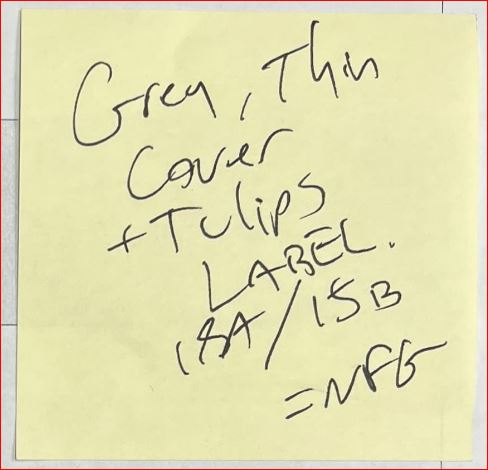
The reissues (one with the later Tulips label, one with the earlier Large Tulips label) described below are at best passable, and some of them were just awful.

The note to the left makes clear that even some of the early Large Tulips label pressings had very bad sound. Watch out especially for 18A/15B stampers. They’re NFG: No F***ing Good.

As you can see from the notes above for this particular recording in the Black and White cover, one side was passable, earning our 1.5+ grade. That makes it a decent sounding record, I suppose, but it’s a long, long, long way from the best.

1.5+ is four grades down from the top copy. That’s a steep dropoff as far as we’re concerned. 1.5+ only hints at how good a recording this DG can be on the best pressings.

To see more records that earned the 1.5+ grade, please click here. (Incidentally, some of them are even on Heavy Vinyl. The better modern pressings have sometimes, if rarely, been known to earn Hot Stamper grades, and two recently shocked the hell out of us by actually winning a shootout. Wouldn’t you like to know which two!)

One Plus (1+) is a sub-Hot Stamper grade. We do not sell records that do not earn a grade of at least 1.5+ on both sides.

For those who might be interested, there’s more on our grading scale here.

Our Favorite Performance with Sound to Match

A recent listing for the album can be found here.

Without question this is a phenomenal piano recording in every way.

On the best copies the rich texture of the strings is out of this world — you will have a very hard time finding a DG with better string tone. This record does not have the shortcomings of the average DG: it’s not hard, shrill, or sour.

DG made plenty of good records in the 50s and 60s, then proceeded to fall apart, like most labels did. This is one of their finest. It proves conclusively that at one time — 1962 to be exact — they clearly knew exactly what they were doing.

It’s amazing how many piano recordings have poorly-miked pianos. The badly recorded pianos are either too distant, lack proper reproduction of the lower registers, or somehow smear the pounding of the keys into a blurry mess.

Are they badly recorded?

Or is it a mastering issue?

Perhaps a pressing issue?

(more…)

Neither of These Tchaikovsky 5ths Made the Grade

More of the music of Peter Ilyich Tchaikovsky (1840-1893)

We’ve been playing quite a number of different pressings of Tchaikovsky’s Symphony No. 5 lately, hoping to find a 5th that would really knock us out.

Most have left us unimpressed with the quality of the sound, and in the case of this Solti on London, the performance.

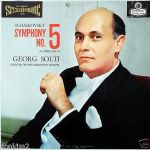
London CS 6117. Solti conducts the Paris Conservatory Orchestra.

The sound is OK. It’s fairly tubey and there’s a decent amount of energy to the recording.

The problem is not the sound, the problem is that the performance is terrible. Our main listening guy said he could hardly recognize the music!

DG SLPM 138 658. Mravinsky conducting the Leningrad Phil on an early pressing from 1961.

Big energy and a great performance but the string tone is shrill and smeary.

We are very used to hearing this kind of sound on Deutsche Grammophon records. This is why you see so few of that label’s pressings on our site.

How Did We Figure All of This Out?

There are more than 2000 Hot Stamper reviews on this blog. Do you know how we learned so much about so many records?

Simple. We ran thousands and thousands of record experiments under carefully controlled conditions, and we continue to run scores of them week in and week out to this very day.

(more…)

The Pines of Rome with Maazel – Not the Pressing You Want

Hot Stamper Pressings of Orchestral Music Available Now

I played a lot of different pressings of this music a while back, trying to find recordings worthy of a shootout.

My notes for this one read:

  • Very multi-miked.
  • No depth, but the stage is wide.
  • Not warm but dynamic.

There are a lot of DG recordings that have this kind of sound. We’ve played them by the score. Most went directly into the trade bin.

We simply do not sell classical records with this kind of second-rate sound regardless of how good the performances may be.

We learned from our first big shootout for these works something that we think will remain true for the foreseeable future: the 1960 Reiner recording with the Chicago Symphony on RCA just can’t be beat.

Our Job

Our job is to find you good sounding pressings.

That’s the reason we carry:

(more…)

Our Planets Shootout Was Years in the Making, and We Got It Wrong Anyway

Hot Stamper Pressings of Orchestral Spectaculars Available Now

This is a VERY old commentary providing the evidence for just how wrong we were about the sound of Steinberg’s 1971 recording for DG.

We did the shootout in 2008 and picked a winner, the Steinberg.

Somewhere in the neighborhood of five years later we picked a new winner, the Previn on EMI, and we have never wavered from that choice. It’s still our favorite.

In fact, the Previn gets better with every improvement we make to our system. That’s one of the ways you can be sure that it’s good: the better your system gets, the better your good records get. The inverse of that effect occurs right alongside your good records. Now your not-so-good records start to show you how not-so-good they always were. (For you fans of Heavy Vinyl and Half-Speeds, this can be painful, but we all have to go through it, so, looking on the bright side, the sooner your system can show you what’s wrong with those audiophile records, the less money you will have wasted on them.)


In July of 2005 we noted on the site that Hot Stampers for this album were discovered, and interested parties should watch the site for killer copies in the coming months. Obviously we didn’t know at the time that the number of coming months would be THIRTY TWO. That’s how long it would be before we could offer our loyal customers truly Hot Stampers, but hey, good things come to those who wait, right?

We had to wait for two things: the revolutionary cleaning techniques that we developed during that time (the heart of which is our $7000 record cleaning machine) which allowed us to get these records to sound better and play quieter, and, secondly, better equipment. 
One Long Shootout

This was one long shootout, two and a half years in the making. And I spent at least ten years before that collecting enough copies to be able to find some pattern in the stampers that clued me in as to what to look for. It was a long time coming but we expect you will find it was all worth it in the end. This music is so important and moving; it belongs in every audiophile’s collection. To get Steinberg’s version into your collection has not been easy, until now. This is the one. 

The Story from 2005

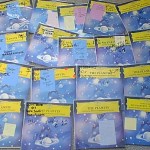
Below you will find an example of a title that will show up on the site someday (I hope): Holst’s The Planets with Steinberg and the BSO on DG. My favorite performance of all time.

But the copies you see pictured above all sound different! If you could read my post-its on the covers you would see that each of them has strengths and weaknesses. Some are quite good, some are quite awful. Some are noisy, some are quiet. Some are grainy, some are sweet, some have powerful bass, some are bass shy. They all sound different, and they all sound different in their own way.

So what we need to do now is winnow this group down to the best 4 or 5 copies, and then shoot them out. First all the side ones, then all the side twos.

This is a big job. A job that will take more than one day. I could probably spend a week playing these records. You can only do so many until fatigue sets in.

I regret to say I just haven’t felt sufficiently inspired to take on a project of this size. What will probably get me going is the next copy I pick up that really sounds good. It will make me want to hear how good it sounds compared to the other copies I like. I have 3 or 4 pretty good sounding copies in my own collection . But which is the best?

Someday I hope to find out.

And when I do I’ll be sure to let you know. It will be my pleasure. Finding really good records is a thrill. Especially when they have music like this on them.

(more…)

Lt. Kije at 45 RPM – An Amazing Discovery from 2015

More of the music of Sergei Prokofiev (1891-1953)

[PLEASE NOTE: We no longer give Four Pluses out as a matter of policy, but that doesn’t mean we don’t come across records that deserve them from time to time.]

We award this copy our very special Four Plus A++++ grade, which is strictly limited to pressings (really, individual sides of pressings) that take a given recording to a level we’ve never experienced before and had no idea could even exist. We estimate that about one per cent of the Hot Stamper pressings we come across in our shootouts earn this grade. You can’t get much more rare than that.

This Japanese 45 RPM remastering of our favorite recording of Prokofiev’s wonderful Lt. Kije Suite has DEMONSTRATION QUALITY SOUND. For starters, there are very few records with dynamics comparable to these. Since this is my favorite performance of all time, I can’t recommend the record any more highly.   

Most of what’s “bad” about a DG recording from 1978 is ameliorated with this pressing. The bass drum (drums?) here must be heard to be believed. We know of no Golden Age recording with as believable a presentation of the instrument as this.

When a particular pressing we’re auditioning takes the recording to a level significantly higher than our expectations, it gets our attention, big time. This can only happen with a record we know well. We thought we knew how good Lt. Kije on Japanese 45 could sound but we were wrong — this pressing is clearly better than the copy we would be proud to call White Hot, which means this one deserves an impossible sonic rating of eleven on a scale of one to ten.

Forget the logic. It’s not about that, it’s about the sound and the music, and we make no apologies for calling this copy Beyond White Hot. It blew our minds.

(more…)

The Planets – Not As Good As We Thought, Sorry!

Hot Stamper Pressings of Orchestral Spectaculars Available Now

This listing from 2008 has not aged well. We no longer recommend this performance of The Planets.

If you want to give one a try, make sure to get one on the Large Tulips label. The reissues tend to be thin and harsh.

Our current favorite performance of The Planets can be found here.


Notes from an Old Shootout

Side one here is AGAIG, as good as it gets. It shows the listener more of everything that’s wonderful about this wondrous work.

Side two is very nearly as good, and was only beaten slightly by one other copy in our shootout. This pressing gives you the complete work in the best sound we can find. 

This was one long shootout, two and a half years in the making.

And I spent at least ten years before that collecting enough copies to be able to find some pattern in the stampers that clued me in as to what to look for.

It was a long time coming but we expect you will find it was all worth it in the end. This music is so important and moving; it belongs in every audiophile’s collection.

To get Steinberg’s version into your collection has not been easy, until now. This is the one.


UPDATE

As it turns out, as our stereo improved, we realized this recording, even on the best pressings, was not the one.

Live and learn is our motto, and progress in audio is a feature, not a bug, of record collecting at the most advanced levels. “Advanced” is a code word for having little to no interest in any remastered pressing marketed to the audiophile community.