Decca/London/Argo – Reviews, Commentaries, Letters, etc.

Coppelia and Sylvia / London Vs. Decca – Updated 2025

Hot Stamper Pressings of Music Conducted by Ernest Ansermet Available Now

Once again, the right Decca reissue blows the doors off the original London we played. This has lately become a pattern, but keep in mind it’s a pattern that’s reliable less than half the time, if memory is any guide. Many of the Decca reissues we’ve played over the last few years have failed badly in a head to head with their earlier-mastered and -pressed counterparts.

But the ones that beat all comers are the ones that stick in our minds and show up on our site.


UPDATE 2025

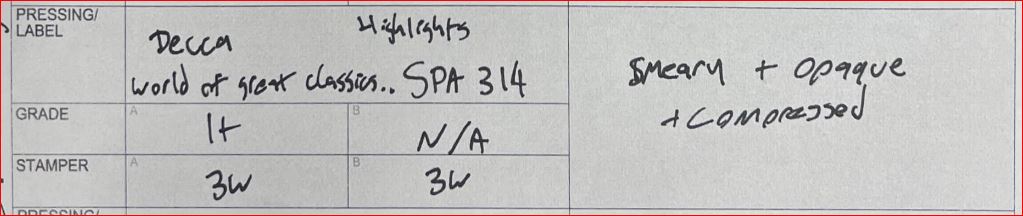
A copy of one of the SPA reissues we used to like shown above made it to our latest shootout and did not do nearly as well as a copy did years ago.

We don’t have those copies anymore and cannot say whether they actually did sound as good as we thought they did.

Our advice would be to assume that this is not the best way to buy this album. But neither is the original, as you will read below.

Clearly a case of confirmation bias, but at least we know something about our own biases, and that puts us well ahead of the audiophile pack.

Record collectors and record collecting audiophiles will tell you it shouldn’t happen, but fools like us, who refuse to accept the prognostications of those supposedly “in the know,” have done the work and come up with the experimental data that’s proven them wrong again and again.

Sort of. We had one, and only one, pressing of the original London (CS 6185), and boy was it a mess — crude as crude can be.

It sounded like an “old London record,” not the Decca engineered and mastered vintage collectible we know it to be.

We’ve played them by the hundreds, so we know that sound fairly well by now.

Are there copies that sound better? Surely there are, but how are you going to find them? Are you going to shell out the going rate of $25-50 on ebay for one (or more) clean copies, only to find that it/they sound every bit as bad as the one we auditioned? The question answers itself.

If, however, you are one of the lucky few who has a nice London or Decca original of this recording, please let us send you this copy so that you can do the shootout for yourself. You may be shocked at how good this music can sound on the right pressing. And if your copy sounds better than ours we will be very shocked indeed. [This offer was only good while we had the record, and it is long gone at this point. We still remember the sound though!]

Production and Engineering

James Walker was the producer, Roy Wallace the engineer for these sessions from April of 1959 in Geneva’s glorious Victoria Hall. It’s yet another remarkable disc from the Golden Age of Vacuum Tube Recording.

The hall the Suisse Romande recorded in was possibly the best recording venue of its day, possibly of all time. More amazing sounding recordings were made there than in any other hall we know of. There is a solidity and richness to the sound beyond all others, yet clarity and transparency are not sacrificed in the least.

It’s as wide, deep and three-dimensional as any, which is of course all to the good, but what makes the sound of these recordings so special is the weight and power of the brass, combined with unerring timbral accuracy of the instruments in every section of the orchestra.


(more…)

Ansermet’s Recording of Pines of Rome Did Not Make the Cut

Click Here to See Our Favorite Pines of Rome

This review was written at least ten years ago. Since then we have done extensive shootouts for both The Pines and The Fountains of Rome.

The London with Ernst Ansermet you see pictured, though good, did not make the cut.

No Hot Stamper pressings — correction, no Hot Stamper pressings hot enough to offer our customers — were found of this recording from 1964.

Below you will find our old review. Needless to say, we have learned a lot since then.

EXCELLENT SOUND! Not a Demo Disc by any means, but a well-recorded, well-mastered Pines.

The problem with Pines is normally too much close miking. This London places the orchestra in a more natural perspective, which I much prefer.

Side two, the Pines, also has the best sound. 

(more…)

Concierto De Aranjuez – Another London with Dry Strings (on Some Copies)

More of the music of Joaquín Rodrigo (1901-1999)

On some copies of this album the strings are dry, lacking the full measure of Tubey Magic we know the tape to have. This is decidedly not our sound, although we’ve heard if often enough, having played hundreds of vintage Decca and London pressings over the years.

If you have a rich sounding cartridge, perhaps with that little dip in the upper midrange that so many moving coils have these days, you will not notice this tonality issue nearly as much as we do.

Our 17D3 is ruler flat and quite unforgiving in this regard. While it certainly makes our shootouts much easier, it does bring out the flaws in all but the best pressings — exactly the job we require it to do.

Here are some other records that are good for testing string tone and texture.

With a sonic grade of A++, the sound is glorious, with practically all of the qualities that make listening to classical music in analog so involving. The presentation is shockingly three-dimensional, with an exceptionally wide and deep stage. The orchestral sound is rich and sweet, yet the guitar is clear and immediate. Managing to balance — so effortlessly — two dissimilar elements such as these, in 1959 no less, requires an enormous amount of skill and effort. Fifty-odd years later, those of us with good turntables are profoundly thankful for their achievement, in terms of both performance and sound.

If you were only to be allowed one Guitar Concerto recording, this would probably be the one to own. You will recognize the main theme instantly; it’s the one Miles Davis appropriated for the astonishingly innovative Sketches of Spain album he did with Gil Evans which came out the following year in 1960.

Side One – Guitar Concerto: “Concerto De Aranjuez” (1939)

A++, including all the qualities we discussed above, with an especially immediate and real solo guitar.

With a bit more top end extension this side would have been White Hot. It should be noted that no Decca or London copy in our shootout had as much top end as we would have liked on the Rodrigo, a fault perhaps in the recording?

Side Two – Fantasìa Para Un Gentilhombre (1954)

A++, equally good in its own way. Rich and lush strings, but slightly veiled compared to side one. So musical and analog, although, like many concerto recordings, the guitar is much larger in the soundfield of the recording than it would be in the concert hall.

The music is reminiscent of Respighi’s Ancient Airs and Dances, for those of you familiar with the work (a longtime resident of the TAS List. Wish we could find them!).

(more…)

Records Like This Give Decca’s Reissues a Bad Reputation

Hot Stamper Pressings of of the Music of Johannes Brahms Available Now

Apparently mastered with no regard to sound quality, this Decca SPA reissue is muddy, dull, congested and full of harmonic distortion in the louder passages.

How do we know that? We go out of our way to play every pressing we can get our hands on, even cheap reissues such as this. That’s our job.  We play everything to find the best sounding records so you don’t have to.

And some of these cheap reissues win shootouts!

But you can’t guess which ones will. You have to play them to find out.

And that’s how we know that some of them are good, some of them are mediocre, and some, like this one, are just awful.

Want to be assured of getting good sounding pressings of the greatest classical recordings of all time?

Step right up and order anything classical or orchestral you see here, Every one of them is guaranteed to please.

Our Pledge of Service to You, the Discriminating Audiophile 

We play mediocre-to-bad sounding pressings so that you don’t have to, a free service from your record-loving friends at Better Records.

(more…)

The Bloated Cello Sound Some Audiophiles Find Appealing

Hot Stamper Pressings of the Music of Claude Debussy Available Now

On this pressing we were a bit surprised at how natural the cello sounded — more like the real instrument and less like the typical recording of it. 

Normally when recording the cello, the microphones are placed fairly close to the instrument. This often results in what’s known as the “proximity effect,” which simply describes a boost in the lower frequencies relative to the more linear response of the microphone when placed at a distance.

The famous Starker cello recordings on Mercury — you know the ones, the originals and even the reissues sell for hundreds and hundreds of dollars — suffer from this effect, which audiophiles seem to prefer. (The Mercury heavy vinyl reissues, at least the ones I’ve played, were ridiculously fat and bloated in the bottom.)

Audiophiles did not seem to mind much, judging by the apparently strong sales and the rave reviews I read. Bass shy systems, and that means most of the systems owned by audiophiles, probably benefited from the bass boost.

Systems with lots of large woofers — at least in our case — would of course make the sound of these pressings positively unbearable. That indeed was our experience.

Getting back to the record at hand, it presents a more natural cello if only because the instrument has been miked from a greater distance.

Side two is a bit fuller sounding than side one, and one of them is going to sound more correct on your system than the other. I would not even want to say for sure which one actually is more correct, as the slight difference between them might be subtle enough to play into room and system non-linearities that plague all stereos and rooms.

Both sides here will sound the way these real instruments sound when played in the kinds of rooms that one might hear them in, practice rooms perhaps. That makes this recording unusual in the world of “audiophile recordings,” if I can call this one, and no less refreshing and enjoyable for it.

(more…)

Ravel / Daphnis et Chloé / Monteux – Reviewed in 2012

More of the Music of Maurice Ravel

Nearly White Hot Stamper sound on this superb London Blueback pressing, quite possibly the best complete Daphnis et Chloe we have ever heard.

Both sides here are BIG, with the space and depth of the wonderful hall that the LSO perform in. From my research it appears that John Culshaw may have produced the album, which surely accounts for the huge size and space, not to mention quality, of the recording. The sound is dynamic and tonally correct throughout. Without more copies on hand we feel it’s best to hold back half a plus on the sonic grade. That said, it’s clearly the best Daphnis et Chloe we’ve played to date.

Please note that we should, but often don’t, make a vitally important distinction between two words we tend to use interchangeably.

There is a difference between the sound of records that we’ve played and the sound that we’ve heard.

The stereo, the listening room, our cleaning technologies and who knows what else are all undergoing constant change.

This means that we may have played a better pressing in the past but couldn’t hear it sound as good as it would now. The regular improvements we make in all areas of playback make sonic comparisons over time all but impossible. (more…)

Bizet / Carmen Fantaisie – A No-Better-than-Decent Decca Reissue

More of the music of Georges Bizet

This Ace of Diamonds UK pressing (SDD 420) of the famous Ricci recording has fairly good sound, but it is a far cry from the real thing on either Decca or London disc.

The right originals are just too good. There is nothing like them. They are simply amazing recordings, unequaled in fifty or more years. If you want that sound, you’d better plan on going back to 1960 or thereabouts to find it.

The Speakers Corner Reissue was my first exposure to this music and I fell in love with it. I recommended it highly back in the days when I was selling Heavy Vinyl.

I admit I haven’t heard one in years, but my guess is that you are probably better off with this Decca Ace of Diamonds pressing that anything Speakers Corner might have put out.

(more…)

This Tchaikovsky 4th Turned Out to Be Not as Good as We’d Hoped

Hot Stamper Pressings of the Music of Tchaikovsky Available Now

About ten years ago we dropped the needle on this Mehta recording and thought it had potential, so we went about acquiring more copies for an eventual shootout.

A few years back we gave them another listen and found the sound not to our liking.

We have not done a shootout for any of the major Tchaikovsky symphonies (4, 5 and 6) in a very long time, but we hope to do them in the future, although that future could be many years from now. Nothing we have dropped the needle on has knocked us out, and that’s usually what it takes to get the ball rolling.


UPDATE 2024

Actually we quite like this RCA reissue with Monteux, and there are some other recordings we know to be good, but they are turning out to be very hard to find.


These Mehta Londons have revealed themselves to be much more artificial sounding than we thought they were, or, more accurately, could tell they were back in 2011.

Like every Royce Hall recording we’ve ever played, including the one everybody knows, there is too much multi-miking and spotlighting going on for us to suspend our disbelief and feel like we are in the living presence of the musicians, to borrow a phrase. The orchestra in this recording is not presented with anything resembling the experience one would have in the concert hall.

James Lock is a brilliant recording engineer, but his work here in the states leaves a lot to be desired.

(more…)

Carmen – Dry Strings on One Side, Rich on the Other

More of the music of Georges Bizet (1838-1875)

My notes for side two on a copy we recently auditioned read:

Could use more tubes.

Strings could be a bit smoother.

Needs a bit more weight down low.

My notes for side one:

Side one had all of this and more!

Some Common Issues with Londons and Deccas

Many London and Decca pressings lack weight down low, which thins out the overall sound and washes out the lower strings.

On some sides of some copies the strings are dry, lacking Tubey Magic. This is decidedly not our sound, although it can easily be heard on many London pressings, the kind we’ve played by the hundreds over the years.

If you have a rich sounding cartridge, perhaps with that little dip in the upper midrange that so many moving coils have these days, you will not notice this tonality issue nearly as much as we do.

Our 17Dx is ruler flat and quite unforgiving in this regard. It makes our shootouts much easier, but brings out the flaws in all but the best pressings, exactly the job we require it to do.

Here are some other records that are good for testing string tone and texture.

(more…)

Carmen Fantaisie / Introduction And Rondo Capriccioso on Ebay for $787

Hot Stamper Pressings of the Music of Georges Bizet Available Now

NEWSFLASH 2021:

We sold this copy last night (10/10), immediately after one had sold in an auction on ebay for $787, a price almost two hundred dollars more than what we were asking.

Note that our copy was cleaned and auditioned and found to be both phenomenally good sounding and reasonably quiet. None of these things could be said of the record on ebay of course, but apparently the word is out that this is an amazing recording and the bidding reflected that fact. I have never seen one go for anything like this kind of dough. Now that they do — there were four bidders about $550 — you should not expect to see a Hot Stamper pressing of the album show up on our site again unless we get very lucky locally, and that is highly unlikely.


Our White Hot copy:

  • Unbelievable Shootout Winning Demo Disc quality sound throughout — Triple Plus (A+++) on both sides and vinyl that is as quiet as any that can be found from this era
  • This is a spectacular recording, and one of the Greatest Violin Showpiece Albums of All Time
  • It is certainly a record that belongs in every right-thinking audiophile’s collection. If you’re on our site and taking the time to read this, that probably means you.
  • Ruggiero Ricci is superb throughout – we know of no better performances of this works than those found on this very record
  • Some old record collectors (like me) say classical recording quality ain’t what it used to be – here’s all the proof anyone with two working ears and top quality audiophile equipment needs to make the case

(more…)