Decca/London/Argo – Reviews, Commentaries, Letters, etc.

An Exceptionally Natural Piano Recording of Pictures at an Exhibition

More of the music of Modest Mussorgsky (1839-1881)

This original London pressing of the solo piano version of Pictures has uncannily natural piano reproduction, which is why we are awarding this side one our highest sonic grade, A Triple Plus.

The fact that the recording takes place in Kingsway Hall in 1967 no doubt plays a large part in the natural sound. The hall is bigger here than on other copies, the piano even more solidly weighted, yet none of this comes at the expense of the clarity of the playing.

The piano has no smear, allowing both the percussive aspects of the instrument and the extended harmonics of the notes to be heard clearly and appreciated fully.

Pianos are very good for testing your system, room, tweaks, electricity and all the rest, not to mention turntable setup and adjustment. More records that are good for testing and improving your playback can be found here.


Side two has Mehta’s performance of the orchestrated work squeezed onto side two, which is never a good idea if one is looking for high quality orchestral sound. The performance itself is mediocre as well.

We are not, and never have been, big fans of Mehta’s work with the Los Angeles Philharmonic on London Records.

The exceptionally rare copy of Mehta’s Planets can sound good, but 90% of them do not — just don’t make the mistake of telling that to the average audiophile who owns one. Harry told him it was the best, he paid good money for it, and until someone tells him otherwise it had better be “the one Planets to own.” (Why audiophiles need someone to tell them what recordings are the best is a mystery. Can’t they just play them and listen for themselves?)

We see one of our roles here at Better Records as being the guys who actually will “tell you different,” and, more importantly, can back up our opinions with the records that make our case for us.

(more…)

Shootout Winning Stampers for Schubert’s Ninth Revealed!

More of the Music of Franz Schubert

Looking to pick up a Hot Stamper on your own?

Easy — all the best Decca copies in our shootout were mastered by Ted Burkett and were incribed with the stampers 5G/7G.

I suppose it’s only fair to point out that all the worst copies had those same stampers.

There were a few others as well — it was quite a big shootout — but most of those ended up in the middle of the pack.

And here you thought I was actually being helpful.

But we are being helpful. We’re sharing with you an important truth.

Stamper numbers only tell part of the story, and they can be very misleading, in the same sense that a little knowledge is sometimes a dangerous thing.

To know what a record sounds like you have to play it.

This is a subject near and dear to us here at Better Records, and that has been the case for many decades.

We discuss it at length in a commentary you may have seen on the site called the book of Hot Stampers.

(more…)

Saint-Saens / Symphony No. 3 – The Mehta Would Not Make the Grade Today

More of the music of Camille Saint-Saens (1835-1921)

Our favorite performance of this magnificent work is the Fremaux on EMI from 1973

This is an old review from 2011. I doubt we would have anything nice to say about this recording these days. Our system has come a long way since then, and these Mehta Londons have revealed themselves to be much more artificial sounding than we thought they were, or, more accurately, could tell they were back in 2011.

Unlike many audiophiles and the reviewers who write for them, we have never been enamored with the recordings Zubin Mehta made with the LA Philharmonic.

They almost always suffer from exactly the same problems that we heard on this album.

We had about five copies on hand in preparation for a shootout, some of which I had noted seemed to sound fine, but once we started listening more critically we heard the problems that eventually caused us to abandon the shootout and give away the stock to our good customers for free.

(more…)

Ravel, Saint-Saens et al. / Tzigane, Havanaise / Kyung-Wha Chung

Hot Stamper Orchestral Imports on Decca & London

This 1979 London original English pressing of violin showpieces (reviewed in 2012) has Super Hot Stamper sound on side two, which came as a bit of a shock to us after playing side one, which is as congested and opaque as one would expect from such a late London recording.

A great many Decca recordings from the Seventies are not to our liking, for reasons we lay out here.

Side two is fabulous — full-bodied, rich and sweet. Even though it may have been recorded in 1977, the engineer is Kenneth Wilkinson, and the hall is Kingsway — not many bad recordings can be attributed to either.    

But bad mastering or bad pressing quality are surely not the fault of either. When the record doesn’t come out of the oven right, the sound is going to suffer, and the sound on this side one is insufferable all right.

But side two is GLORIOUS, with wonderful music played with skill and feeling. (more…)

Boy, Was We Ever Wrong About Solti’s Rite of Spring

Hot Stamper Pressings of the Music of Igor Stravinsky Available Now

This is a VERY old and somewhat embarrassing commentary providing the evidence for just how wrong we were about the sound of Solti’s 1974 recording for Decca.


Here is what we had to say about the album in 2008:

This is an amazing recording, DEMO QUALITY SOUND, far better than the Decca heavy vinyl reissue that came out in the 2000s. [That part is no doubt true.]

This record is extremely dynamic; full of ambience; tonally correct; with tons of deep bass. Because it’s a more modern recording, it doesn’t have the Tubey Magic of some Golden Age originals, but it compensates for that shortcoming by being less distorted and “clean.” Some people may consider that more accurate. To be honest with you, I don’t know if that is in fact the case.

However, this record should not disappoint sonically and the performance is every bit as exciting and powerful as any you will find. The Chicago Symphony has the orchestral chops to make a work of this complexity sound effortless.


Skip forward to the present, roughly ten years later. We had three or four copies on hand to audition when we surveyed the work a couple of years ago in preparation for a big shootout.

The Solti did not make the cut. It was not even in the ballpark.

(more…)

This Blueback of Le Cid Was Just Awful

Hot Stamper Classical and Orchestral Imports on Decca & London

Don’t buy into that record collector/audiophile canard that the originals are always the best sounding pressings.

This original Blueback pressing — true, we only had the one, so take it for what it’s worth — was a complete disaster: shrill, with no top or bottom to speak of, the very definition of boxy sound.

Our current favorite for sound and performance is the one Fremaux conducted for EMI in 1971.

It had been on the TAS List for some time, but we confess we didn’t bother finding out how good it was until about five years ago when it became clear to us what a wonderful conductor Louis Fremaux could be.

Here are some other Hot Stamper pressings of TAS list titles that we like.

Back to London

The sound of the London original you see above was much too unpleasant to be played on high quality modern equipment. There are quite a number of others that we’ve run into over the years with similar shortcomings.

(more…)

Avoid the Early Pressings of the 1812 Overture with Alwyn

More of the Music of Peter Ilyich Tchaikovsky
More than ten years ago, 2010 or thereabouts I’m guessing, we felt we were ready to do a shootout for Tchaikovsky’s famous 1812 Overture, music that surely belongs in any serious audiophile record collection.

On a well-known work such as this, we started by pulling out every performance on every label we had in our backroom and playing them one after the other. Most never made it to the half-minute mark. Compressor distortion or inner groove overcutting at the huge climax of the work? Forget it. On the trade-in pile you go.

A few days went by while we were cleaning and listening to the hopefuls. We then proceeded to track down more of the pressings we had liked in our preliminary round of listening. At the end we had a good-sized pile of LPs that we thought shootout-worthy, pressings that included various RCA, Decca and London LPs.
The London you see above did not impress us. It sounded too much like an old record.

There are a number of other Deccas and Londons that we’ve played over the years that were disappointing, and they can be found here.

We much preferred the Decca budget reissue, cut from the same tapes, shown here.

(more…)

When You Hear Sound Like This, You Know It’s Right

More of the music of Franz Schubert (1797-1828)

Reviews and Commentaries for the Music of Franz Schubert

What I hear on this pressing is sound that is absolutely free from any top end boost, much the way live music is. There’s plenty of tape hiss and air; the highs aren’t rolled off, they’re just not boosted the way they normally are in a recording.

A few years back I had a chance to see a piano trio play locally; they even performed a piece by Schubert. The one thing I noticed immediately during their performance was how smooth and natural the top end was. I was no more than ten feet from the performers in a fairly reverberant room, and yet the sound I heard was the opposite of what passes in some circles for Hi-Fidelity.

This is the OPPOSITE of those echo-drenched recordings that some audiophiles seem to like, with microphones placed twenty feet away from the performers so that they are awash in “ambience.” If you know anything about us, you know that this is not our sound.

I have never heard live music sound like that and that should settle the question. It does in my mind anyway. The Chesky label (just to choose one awful audiophile label to pick on) is a joke.

How anyone buys into that phony sound is beyond me, but any audio show will prove to you that there is no shortage of audiophiles who love the Chesky “sound,” and probably never will be. (more…)

Rachmaninoff / Piano Concerto No. 2 on Domestic STS – Would It Still Hold Up?

Reviews and Commentaries for the Music of Sergei Rachmaninoff
This is a twenty year old review of a pressing we have not played in many years, so please take what we say with a very large grain of salt.

Beating that in mind, if you see one for cheap in your local record store, give it a good look and, for the five bucks they will probably be asking, take a chance to see if the record actually does have the sound we heard all those years ago.

Folks, what we are offering here is THE SLEEPER Hot Stamper pressing of all time. Side one earned an amazingly good grade of A++ with side two every bit as good. The buyer of this album is going to be SHOCKED when he sees what pressing it is. 

For those of you who cherish pressings for their best sound and performances — as opposed to the typical audiophile collector who prefers the “right” original labels on his records, of course produced only in the “right” countries — this is the record for you.

Hold it up for your (right-thinking or otherwise) audiophile friends to witness before you put it on your table and BLOW THEIR MINDS.

How did this kind of sound get produced so cheaply, so late in the game? From what tape, by what engineer? It is a mystery to me, one that is very unlikely to be explained to anyone’s satisfaction.

Side One

A++ Super Hot Stamper sound — rich strings, clear horns, a piano that is full-bodied and natural, with a solid low end (the kind you rarely hear on record but is always so strikingly obvious in the presence of the real instrument).

A bit of compression holds it back from A+++. What a record!

Side Two

A++, not quite as rich as side one but lively, transparent, present, with zero smear (always a problem with piano recordings — you want to hear those hammers striking the strings clearly). 

(more…)

Coppelia and Sylvia / London Vs. Decca – Updated 2025

Hot Stamper Pressings of Music Conducted by Ernest Ansermet Available Now

Once again, the right Decca reissue blows the doors off the original London we played. This has lately become a pattern, but keep in mind it’s a pattern that’s reliable less than half the time, if memory is any guide. Many of the Decca reissues we’ve played over the last few years have failed badly in a head to head with their earlier-mastered and -pressed counterparts.

But the ones that beat all comers are the ones that stick in our minds and show up on our site.


UPDATE 2025

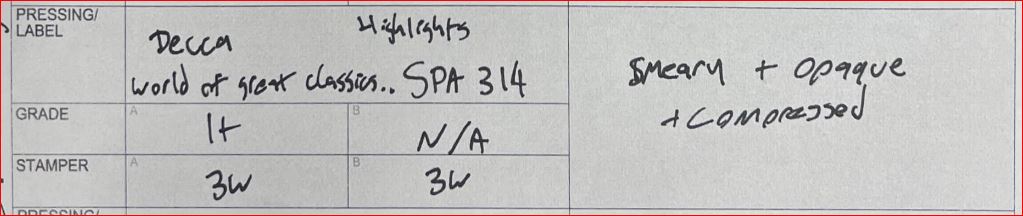
A copy of one of the SPA reissues we used to like shown above made it to our latest shootout and did not do nearly as well as a copy did years ago.

We don’t have those copies anymore and cannot say whether they actually did sound as good as we thought they did.

Our advice would be to assume that this is not the best way to buy this album. But neither is the original, as you will read below.


Clearly a case of confirmation bias, but at least we know something about our own biases, and that puts us well ahead of the audiophile pack.

Record collectors and record collecting audiophiles will tell you it shouldn’t happen, but fools like us, who refuse to accept the prognostications of those supposedly “in the know,” have done the work and come up with the experimental data that’s proven them wrong again and again.

Sort of. We had one, and only one, pressing of the original London (CS 6185), and boy was it a mess — crude as crude can be.

It sounded like an “old London record,” not the Decca engineered and mastered vintage collectible we know it to be.

We’ve played them by the hundreds, so we know that sound fairly well by now.

Are there copies that sound better? Surely there are, but how are you going to find them? Are you going to shell out the going rate of $25-50 on ebay for one (or more) clean copies, only to find that it/they sound every bit as bad as the one we auditioned? The question answers itself.

If, however, you are one of the lucky few who has a nice London or Decca original of this recording, please let us send you this copy so that you can do the shootout for yourself. You may be shocked at how good this music can sound on the right pressing. And if your copy sounds better than ours we will be very shocked indeed. [This offer was only good while we had the record, and it is long gone at this point. We still remember the sound though!]

Production and Engineering

James Walker was the producer, Roy Wallace the engineer for these sessions from April of 1959 in Geneva’s glorious Victoria Hall. It’s yet another remarkable disc from the Golden Age of Vacuum Tube Recording.

The hall the Suisse Romande recorded in was possibly the best recording venue of its day, possibly of all time. More amazing sounding recordings were made there than in any other hall we know of. There is a solidity and richness to the sound beyond all others, yet clarity and transparency are not sacrificed in the least.

It’s as wide, deep and three-dimensional as any, which is of course all to the good, but what makes the sound of these recordings so special is the weight and power of the brass, combined with unerring timbral accuracy of the instruments in every section of the orchestra.

(more…)