Columbia/Epic – Selections

Select commentaries and reviews for Columbia/Epic

We Was Wrong about Sketches Of Spain on Six Eye

Hot Stamper Pressings of the Music of Miles Davis Available Now

Many, many years ago (15?) we had this to say about a killer Red Label pressing we had played at the time.


When you get a Hot Stamper like this one the sound is truly MAGICAL. (AMG has that dead right in their review.)

Tons of ambience, Tubey Magic all over the place; let’s face it, this is one of those famous Columbia recordings that shows just how good the Columbia engineers were back then. The sound is lively but never strained. Davis’s horn has breath and bite just like the real thing. What more can you ask for?

We Was Wrong in the Past About HP and Six-Eye Labels

In previous commentary we had written:

Harry Pearson added this record to his TAS List of Super Discs a few years back, not exactly a tough call it seems to us. Who can’t hear that this is an amazing sounding recording?

Of course you can be quite sure that he would have been listening exclusively to the earliest pressings on the Six Eye label. Which simply means that he probably never heard a copy with the clarity, transparency and freedom from distortion that these later label pressings offer.

The Six Eyes are full of Tubey Magic, don’t get me wrong; Davis’s trumpet can be and usually is wonderful sounding. It’s everything else that tends to suffer, especially the strings, which are shrill and smeary on most copies, Six Eyes, 360s and Red Labels included.


UPDATE

Over the course of the last fifteen or more years we’ve come to appreciate just how good the right Six Eye stereo pressing can sound.

Nowadays, all the copies earning the highest grades will be original stereo pressings. Other pressings can do well, earning grades of 2+ or so, but none will do as well as the originals.

This has never been our experience with Kind of Blue by the way. The later pressings have always done the best job of communicating the music on that album.


UPDATE #2

Our comments for Kind Of Blue are no longer true either. The Six-Eye pressings of the album win all the shootouts now.


The above shows just how wrong we were about the sound of some later label Columbia pressings we used to like.  The commentary below concerning early versus later RCA pressings is part and parcel of the same dynamic.

Back in 2010 we liked reissue pressings of Living Stereo recordings a lot more than we do now. Only the advent of top quality cleaning equipment and fluids and much improved playback made it possible for us to reproduce the early Shaded Dogs in all their glory.

When my system was darker and less revealing, a lot of records that were mastered to be cleaner and brighter sounded great to me. Records like RCA Red Seal pressings, some OJC jazz titles, and lots of other bad records that I used to like were a good complement to my system back in those days. Now, not so much.

When we encourage our readers to get good sound so they can recognize and acquire good records, it’s because we learned that lesson the hard way, by getting lots of great recordings wrong.

Live and learn is our motto, and progress in audio is a feature, not a bug, of record collecting at the most advanced levels.

“Advanced” is a code word for having little to no interest in any remastered pressing marketed to the audiophile community. If you want to avoid the worst of them, we are happy to help you do that. The more progress in audio you make, the more you will  regret having wasted your money on them, and we hate the thought of seeing your hard-earned money go down the drain.

(more…)

In the Market for New Speakers? See How Well They Handle the Energy of Far More Drums

Hot Stamper Pressings of the Music of Dave Brubeck Available Now

The drum solo Joe Morello lets loose on Far More Drums is one of the best on record. I was playing that song recently and it occurred to me that it is practically impossible for a screen or panel speaker of any design to reproduce the sound of those drums properly, regardless of how many subs you have.

Most of the music is not in the deeper bass anyway. It’s the whack of instruments whose energy is in the lower midrange and mid-bass that a screen speaker will struggle with.

A good large-driver dynamic speaker fed by fast electronics can handle the energy in that range with ease.

This is the album you need to take with you next time you head to your local stereo store to audition speakers.

It will help clarify the issues. Screen speakers do many things well, but drums are not one of them, at least in my experience they aren’t. If drums are important to you, do yourself a favor and buy a dynamic speaker, the bigger the better.

brubeck in the studio733

Time Further Out, like most of the classic Brubeck albums, is a big speaker record. It requires a pair of speakers that can move air with authority below 250 cycles and play at fairly loud levels. If you don’t own speakers that can do that, this record will never really sound the way it should.

(more…)

How Did Columbia Make So Many Great Sounding Records Without Today’s Obviously Superior Mastering Equipment?

Hot Stamper Pressings of Vintage Columbia Albums Available Now
When I play Columbia recordings from the 50s and 60s of Brubeck, Ellington, Miles Davis and other jazz giants, what I find most striking about them is how natural, warm and sweet they sound.

I was playing an old mono Ellington record a while back, and when the clarinet solo came in, it almost took my breath away. The sound of the instrument was that real. This from a mid-50s run-of-the-mill Columbia pressing.

Those guys — the engineers and the musicians — knew what they were doing.

Sometimes when I read about the extraordinary lengths modern engineers go to in order to use the highest quality audiophile equipment: custom microphones, tape recorders, wire, and the like, it makes me wonder how many of the best sounding records in the world managed to be recorded without the benefit of any of that stuff.

RCA didn’t need it for their Living Stereos.  Decca didn’t need it.

Contemporary Records managed to record many of the best sounding jazz records without it.

How did all those great records get made with such bad equipment?

I guess we’ll never know.

Columbia may not have always recorded the best “serious” jazz, but they were very serious about the sound of their jazz. Outside of Contemporary, Columbia has better sounding jazz records than any other label of which I am aware.

Recordings made at their 30th Street Studio are pretty hard to beat. There is no Heavy Vinyl reissue on the planet that can compete with the sound of one of our Hot Stamper pressings of any of the albums recorded there you see available on our site, and they are guaranteed to knock your socks off or your money back.

And the Brubeck albums recorded by Fred Plaut are some of the most amazing sounding of all the Columbias, something few audiophiles would dispute. (Try to get the early pressings in stereo. Nothing can touch them. If you can’t afford our prices, we are more than happy to help you find your own. )


UPDATE 2025

We have two new lists for those who would like to know which Columbia label pressings win shootouts — one for 6-Eye Label winners and one for 360 Label winners.

(more…)

What Lessons Can We Take from this Columbia Shootout?

Hot Stamper Pressings of Vintage Columbia Albums Available Now
Recently we conducted a shootout for one of our favorite Columbia recordings, one that we had auditioned many times before and for which we knew the music and the general quality of the sound well.

It’s not the record you see pictured.

For now we’re keeping the title a mystery, consistent with the idea that we give out plenty of stamper information on this blog, including some of the worst ones we’ve had the misfortune to run into, but rarely do we feel the need to give out the really good ones. After decades of doing this kind of work, the time and effort that has gone into finding them is beyond calculation.

When we do give out the best stampers, as is the case here (3BA baby!), we make a point of keeping the title under wraps.

We are not the least bit interested in putting ourselves out of business.

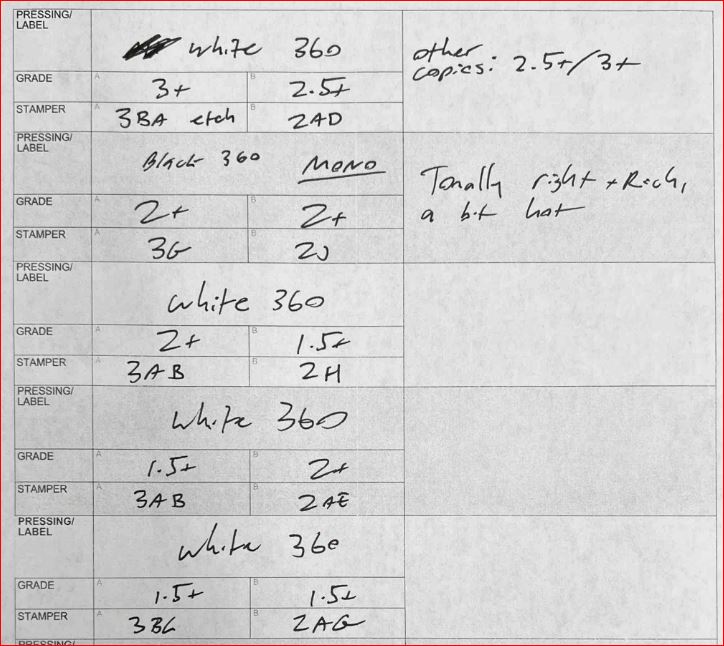
The discussion for today revolves around the idea held by a great many audiophiles that the original White Print 360 label pressings are going to be the best sounding for any title that was made starting with that label in the early-60s.

(The Black Print 360 mono is an example of the mono labels being a bit behind the times as far as I can tell.)

Note that we did not bother to put any of the 70s Red Label Columbia pressings in the shootout. We’ve been down that road with this title before, and we have yet to hear one worth the vinyl wasted on it.

Columbia, like most labels, seems to have made very little effort with the sound quality of their reissues. Perhaps it was the result of all the bad transistor equipment in the studios by the time the 70s rolled around, but that would be speculation on my part, as well as something that would be very hard to find evidence for one way or the other.

We did find one Monk record that sounded better on the Red Label reissue, and readers of this blog should easily be able to find out which one it is by reading our many reviews for Monk’s recorded output.

We have two new lists for those who would like to know which Columbia labels win shootouts — one for 6-Eye winners and one for 360 Label winners.

What interests me in these findings is the following:

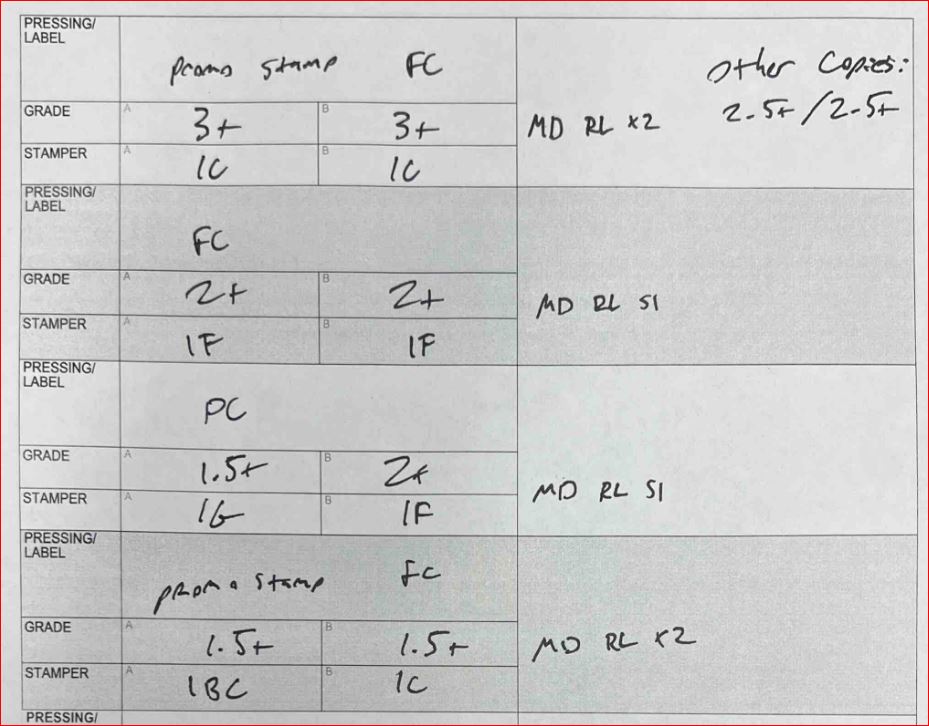
  • Both of our shootout winning copies had the same stampers. Can that really be a coincidence?
  • The shootout winner for side one is 3BA.
  • Two copies with stampers very similar to that one, 3AB, did noticeably worse, 2+ and 1.5+.
  • And the worst of the White Print 360 Label pressings barely earned a Hot Stamper grade at all.
  • They are on the same original label as the other copies, but for some reason they don’t sound as good. Why is that?

If an audiophile collector were to go to Discogs, find a nice clean copy on the early label and buy it, he might find that he know owns a top quality sounding copy, a pretty good sounding copy, or a not-nearly-as-good sounding copy as he’d hoped for, depending on his luck.

And what would he know about the quality of the recording? About that thing that audiophiles and record collectors seem to reference so often, “the master tape,” as if they have any way of knowing about the sound of a tape they have never come into contact with.

Just Assume

If he had a killer 3BA, wouldn’t he just assume that for some reason the recording must be amazing and consider himself lucky to find such a wonderful record to play.

Why one set of stampers sounds so much better than another set, or the same or a similar set on a different pressing, is a mystery, and it’s one that we confidently predict will never be solved.

Does anyone have a practical way to get around the reality that allows one set of stampers to sound great and the same or a similar set of stampers to sound no better than very good, if that?

Well, we can’t say there is a practical way, but we do know of an impractical one. We’ve been practicing and refining that one for more than twenty years.

We just play lots and lots of copies of the albums to find out how they sound.

(more…)

Save the Life of My Child Is One Tough Test

Hot Stamper Pressings of the Music of Simon and Garfunkel Available Now

The big production songs on Bookends have a tendency to get congested on even the best pressings, which is not uncommon for four track recordings from the 60s.

Those of you with properly set up high-dollar front ends should have less of a problem than those of you without them. $3000 cartridges can usually deal with this kind of complex information better than $300 ones.

But not always. Expensive does not always mean better, since painstaking and exacting setup is so essential to proper playback.

Save the Life of My Child — A Tough Test

I used to think this track would never sound good enough to use as an evaluation track. It’s a huge production that I had heretofore found all but impossible to get to sound right on even the best original copies of the album. Even as recently as ten years ago I had basically given up on reproducing it right.

Thankfully things have changed. Nowadays, with carefully cleaned top copies at our disposal and a system that is really cooking, virtually all of the harmonic distortion in the big chorus near the opening has disappeared. It takes a very special pressing and a very special stereo to play this song. That’s precisely what makes it a good test!

America — Another Tough Test

America is another one of the toughest tracks to get right. The big ending with its powerful orchestral elements is positively stunning on the rare copies that have little or no congestion in the loudest passages.

On virtually every copy you will ever hear the voices on this track are a little sibilant. Modern records are made with what is known as a de-essing limiter. This limiter recognizes sibilance and keeps it under control, because once the cutter head sees that kind of high frequency information, which is already boosted for the RIAA curve, it will try to cut it onto the record and the result will be this kind of spitty distortion.

(more…)

Audiophiles Should Avoid These Stampers on West Side Story

Hot Stamper Pressings of Soundtrack Albums Available Now

None of the 360 Label pressings we played recently were competitive with the Six Eye originals. Some sides earned 2+, but no copy on 360 earned grades of 2+ on both sides.

Stick with the early, stereo pressings in order to have any shot at top quality sound.

As you can see from the notes below for this album, one side was passable, earning our 1.5+ grade. It’s a decent sounding record I suppose, but a long, long, long way from the best.

1.5+ is four grades down from the top copy. That’s a steep dropoff as far as we’re concerned. 1.5+ only hints at how good a recording this can be on the best vintage pressings. To see more records that earned the 1.5+ grade, please click here. For those who might be interested, there’s more on our grading scale here.

Here is what a top quality pressing should sound like:

You’ll find INCREDIBLE Shootout Winning Triple Plus (A+++) grades or close to them on both sides of this original Columbia 6-Eye Stereo pressing.

Spacious, rich and smooth – only vintage analog seems capable of reproducing all three of these qualities without sacrificing resolution, staging, imaging or presence.

Tonality is the hardest thing to get right on this album, and here it is right on the money, because if it were not, it would not have won the shootout.

For those of you who like to do your own shootouts, good luck, you will need a lot of originals to find one that sounds as good as this one does.

5 stars: “The soundtrack of the West Side Story film is deservedly one of the most popular soundtrack recordings of all time, and one of the relatively few to have attained long-term popularity beyond a specialized soundtrack/theatrical musical audience.”

This album is at least five times more common in mono than it is in stereo, and finding enough clean early stereo pressings takes us years nowadays.

(more…)

Are White Label Promos the Way to Go on this Mystery Columbia Jazz Album?

Hot Stamper Pressings of Vintage Columbia Albums Available Now

Recently we conducted a shootout for a Columbia recording, one that we had auditioned a couple of times before and one for which we knew the music and the general quality of the sound well.

It’s not the record you see pictured. For now we’re keeping the title a mystery, consistent with the idea that we give out lots of bad stampers on this blog, but almost never do we give out the good ones. (When we do give out the best stampers, we keep the title a mystery. We are not the least bit interested in putting ourselves out of business.)

The discussion for today revolves around the idea held by a great many audiophiles that the White Label Promo copies are going to be the best sounding pressings of almost any album they might happen to run across.

And, to be fair, in the case of this mysterious double album, they’re right.

Our two best sounding copies were White Label Promos.

What interests me in these findings is that the stampers for a White Label Promo copy, the second one, the one with mostly Super Hot grades, are almost identical to the one that came in last in the shootout, with barely passable grades.

If an audiophile collector were to go to Discogs, find the WLP pressings, write down their stampers, and then check them against the copies he owned or might want to buy, he could either find himself with a top quality copy, or a not-nearly-as-good copy, depending on his luck. (And side four of the worst pressing earned a sub-Hot Stamper grade of 1+.)

Why one set of stampers sounds so much better than another set, or the same or similar set on a different pressing, is a mystery.

Does anyone have a practical way to get around the unfortunate reality that allows one set of stampers to sound great and the same or a similar set of stampers to sound not much better than decent?

Well, we can’t say there is a practical way, but we do know of an impractical one. We’ve been practicing and refining that one for more than twenty years.

(more…)

Motown Still Had It in 1982

Hot Stamper Pressings of the Music of Marvin Gaye Available Now

With two superb Shootout Winning Triple Plus (A+++) sides, this Midnight Love is certainly as good a copy as we have ever heard.

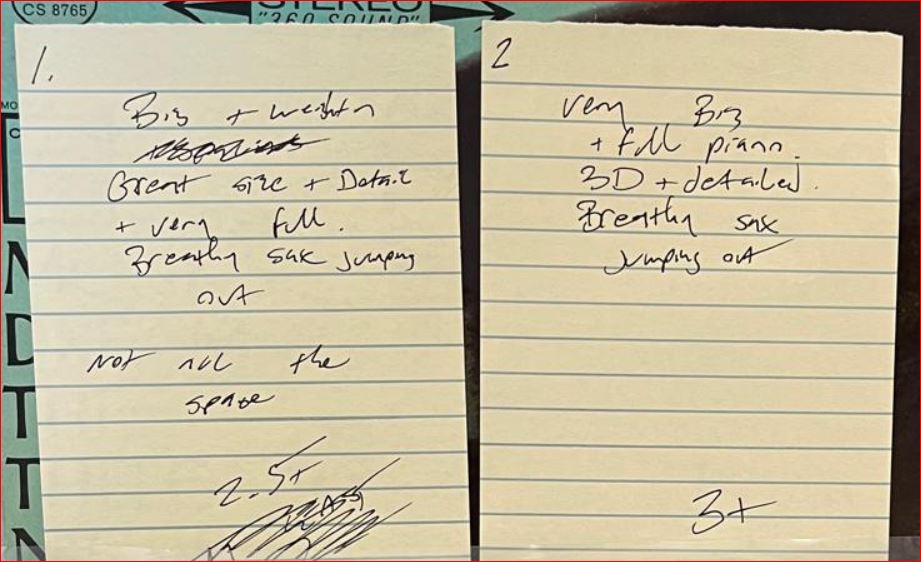
Here are just a few of the things we had to say about this amazing copy in our notes: “round and punchy”…”jumping out of the speakers”…”good size and weight”…”spacious and relaxed percussion and vox”…”top detail” (side two).

Our post-it notes tell the album’s story. (By the way, if you like reading our post-it notes, we’re putting more and more of them on the blog these days. We talk about the importance of taking notes as part of the shootout advice we share. This post will help you with the basics.)

Drop the needle on “Sexual Healing,” then sit back and relax as the rich, warm sound of analog sets the mood!

There’s good frequency extension up top and down low, with plenty of meaty bass and silky highs (check out those bells).

This copy has two qualities which are essential for this music to really work its soulful magic: silky vocals and a BIG meaty bottom end.

Check out all the texture to the synths on Turn On Some Music – this is a highly resolving pressing which takes Marvin Gaye’s music — the last he would make before his death — to another level.

Many copies of Midnight Love suffer from a phony hi-fi-ish quality, sacrificing much of the warmth that is the all-important hallmark of analog. Is that any way to listen to this great Soul Classic? (My sources say no.)

Hey, want to find your own top quality copy?

Consider taking our moderately helpful advice concerning the pressings that consistently win our Hot Stamper shootouts.

(more…)

How Do the Columbia Special Products Reissues Sound on Mingus Dynasty?

Hot Stamper Pressings of the Music of Charles Mingus Available Now

In general it is best to avoid pressings with the round sticker you see to the left, the one attached to the Columbia Special Products bargain reissue series.

They are rarely much better than awful, although there are a few exceptions to that rule. (There are almost always exceptions to the kinds of rules collectors use to find the best sounding records.)

The 6 Eye label domestic stereo pressings of Mingus Dynasty win our shootouts, in this case without exception.

On this title, the 360 label pressings, Black Print or White Print, can sound very good, but they never win shootouts.

We’ve identified a select group of reissues with the potential to do well in shootouts, typically earning a grade of Super Hot (A++) when up against the best originals, which are the only ones that seem to have the potential to earn our top grade, White Hot (A+++).

(more…)

Reproducing the Phenomenal Size and Space of Time Out

More Columbia 30th Street Studio Recordings

Time Out is a jazz album that’s been a personal favorite of mine for a very long time, as well as a record I’ve been obsessed with for decades. I spent a lot of time working on my system in order to get this album to sound its best.

It taught me a lot, and for that reason it is a recording that deserves a fair amount of credit for helping me become a better listener.

Here is how we described a copy that won one of our shootouts a while back:

Spacious and transparent, this copy has the big three-dimensional soundstage that makes this record such a joy to listen to. The piano has weight and heft, the drums are big and dynamic, and everything is relaxed and sweet — in short, this copy is doing pretty much everything we want a top quality Time Out to do. 

Listen to the drums on Everybody’s Jumpin’. This album was recorded on a big sound stage and there is a HUGE room which can clearly be heard surrounding the drum kit. Add to that that some of the drums are in the left channel and some of the drums are in the right channel and you have one big drum kit — exactly the way it was intended to sound.

Size and Space

One of the qualities that we don’t talk about on the site nearly enough is the SIZE of the record’s presentation. Some copies of the album just sound small — they don’t extend all the way to the outside edges of the speakers, and they don’t seem to take up all the space from the floor to the ceiling. In addition, the sound can often be recessed, with a lack of presence and immediacy in the center.

Other copies — my notes for these copies often read “BIG and BOLD” — create a huge soundfield, with the music positively jumping out of the speakers. They’re not brighter, they’re not more aggressive, they’re not hyped-up in any way, they’re just bigger and clearer.

And most of the time those very special pressings just plain rock harder. When you hear a copy that does all that, it’s an entirely different listening experience.

More letters, reviews and commentaries for recordings made at Columbia’s 30th Street studio.

(more…)