Columbia/Epic – Selections

Select commentaries and reviews for Columbia/Epic

This Is Why We Love Columbia in the 60s

More of the Music of Al Kooper

More of the Music of Michael Bloomfield

Please excuse the copying and pasting from previous listings. When records are this good, we tend to say the same things about them, because they are doing all the things we want them to do.

From time to time a record comes our way that sounds absolutely amazing, “Way better than it used to sound” amazing. Progress in audio is a feature, not a bug, of record collecting and music reproduction at the most advanced levels.

If it’s the kind of record that sounds like the best copy of The Live Adventures of Bloomfield and Kooper from our most recent shootout, we might even let our enthusiasm for its superb fidelity get the better of us. That’s the effect a record as good as the copy we played can have. You just can’t stop yourself from saying one great thing after another about it.

Our over-the-top notes, like those you see below, attempt to convey what it’s like to experience the superb sound we were hearing.

But where is the harm in that? These are notes that no one outside of the staff are ever expected to see. They are helpful to us in writing our commentary and pricing the specific copy we auditioned, but they are practically never quoted in the listings.

The Live Adventures of Bloomfield and Kooper is an example of one of those recordings that comes along from time to time in order to show us sound that we’d almost forgotten was possible.

Oh yes, with the rare properly-cleaned, properly-mastered, properly-pressed vintage vinyl LP, played back on top quality equipment in a heavily treated, dedicated soundroom, we can assure you it is very possible indeed. Allow us to make the case with the Shootout Winning original pressing you see below.

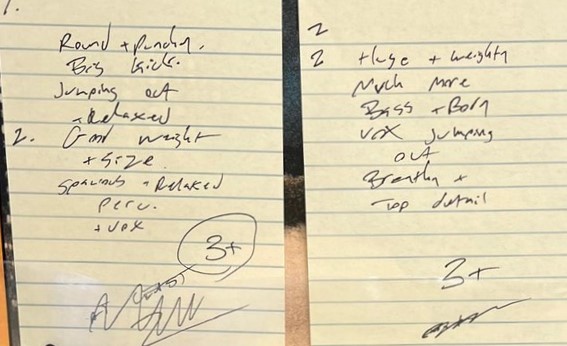
The notes for side one read: 

  • Big, Tubey and jumping out
  • Breathy vocals
  • Deep, sustained bass

Side two:

  • Spacious
  • Glowing and rich drums are weighty and 3-D
  • No congestion
  • Extending high and low
  • Silky and present vocals

Side three:

  • Weighty and rich
  • No hardness
  • Extending high and low

Side four:

  • Rich and ? and space
  • More dynamic and 3-D
  • All around good weight

You know what’s unusual about these notes?

They’re the kind of notes we have never written for any Heavy Vinyl reissue, even for the one that won our shootout not long ago.

(more…)

Time Further Out – “It’s amazing how well-recorded the group was back then.”

Hot Stamper Pressings of the Music of Dave Brubeck Available Now

Fred Plaut is one of our favorite recording and mixing engineers.

His work on Time Further Out speaks for itself — we think it’s the best sounding Brubeck recording of them all. 

We could find no information about the venue for this recording. It might be the Columbia Studios known as “The Church” — that would explain the amazing sound quality of the album — but it may just be Plaut’s engineering prowess in another location that makes this some of the best sound to be found on any Brubeck record.

Frederick “Fred” Plaut was a recording engineer and amateur photographer. He was employed by Columbia Records during the 1940s, 1950s, and 1960s, eventually becoming the label’s chief engineer.

Plaut engineered sessions for what would result in many of Columbia’s famous albums, including the original cast recordings of South Pacific, My Fair Lady, and West Side Story, jazz LPs Kind of Blue and Sketches of Spain by Miles Davis, Time Out by Dave Brubeck, Mingus Ah Um and Mingus Dynasty by Charles Mingus.

Wikipedia

Mark Wilder was interviewed about the recording of these Fred Plaut sessions and noted [bold added by me]:

Fred Plaut and Frank Laico were two of Brubeck’s recording engineers. Plaut is a true balance engineer; he’s my idol. I don’t know how he could pull off what he did in three hours.

He continued:

It’s amazing how well-recorded the group was back then. The sound is so three-dimensional, bigger than life.

Yet it’s amazing how little the engineers did to get that sound. They just put one mic a few feet from each instrument, and mixed live to 3-track—for left, center, and right. Then they edited the tape and mixed down to 2-track.

The old stuff sounds better than what we’re doing now. We’ve been going in the wrong direction sound-wise for many years. The layout of the stereo stage was more realistic then, too. Drums were on the left, piano on the right, sax and bass in the middle.

It’s easy to hear what each musician was playing because they were separated spatially. These days, you hear each instrument in stereo, on top of each other. The drums spread all the way between the speakers, and so does the piano.

In one Brubeck recording (Castilian Drums, not on this set), the stereo perspective changes radically within the recording. It starts with drums hard left and piano hard right. But when the drum solo starts, there’s an edit and suddenly you hear the drum set spread out in stereo.

At the end of the solo, you’re back to drums left and piano right. These effects are on Brubeck’s albums Countdown (Columbia CS 8575) and Time Further Out (Columbia CS 8490).

(more…)

Abraxas – A 180 gram Columbia Disaster

More of the Music of Santana

Reviews and Commentaries for Abraxas

Sonic Grade: F

There is a 180 gram domestic pressing of Abraxas that may still be available. The reason we never sold it even when we were selling Heavy Vinyl many years ago is that it’s AWFUL. One side, I don’t remember which one, is actually Mono.

You will see people selling this record on Ebay as an audiophile pressing. Believe me, no audiophile in his right mind would want this record.

Is it the worst version of the album ever made? Hard to imagine it would have much competition.

We play mediocre-to-bad sounding pressings so that you don’t have to, a public service from your record-loving friends at Better Records.

You can find these two in our Hall of Shame, along with others that — in our opinion — are best avoided by audiophiles looking for hi-fidelity sound. Some of these records may have passable sonics, but we found the music less than compelling.  These are also records you can safely avoid.

(more…)

Time Further Out – We Was Wrong Again

Hot Stamper Pressings of the Music of Dave Brubeck Available Now

UPDATE 2023

About five years ago we wrote:

The monos we played in our last two or three shootouts didn’t do much for us. They tended to be thin and hard sounding, and of course much of the space of the studio disappears completely. One side of one copy did well enough I suppose, but my advice would be to avoid them if you’re looking for top quality sound.

Years before we had discovered an outstanding mono copy and described it this way:

This Columbia Six-Eye pressing is THE BEST SOUNDING MONO COPY OF THIS ALBUM WE’VE EVER HEARD! The better Mono pressings of this album give you extra immediacy, more solidity to the drums, and energy like you wouldn’t believe. That makes the drum solo on side two sound OUT OF THIS WORLD. Most copies are congested and veiled, but not this one! The sound is spacious and transparent with wonderful presence. You will not believe how lively it is! 

Both sides are rich and full-bodied with lots of sweetness and extension up top. The energy and transparency are wonderful. The bass is a bit tubby, but that’s what you get on these vintage Six Eye pressings. It’s worth it when there’s as much tubey magic as you get on this pressing.

Fast forward to 2023 and once again we manage to stumble upon a rare 6 Eye Mono pressing in our shootout that had the Time Further Out goods:

  • With superb Double Plus (A++) sound throughout, this vintage 6-Eye Mono pressing will be very hard to beat – fairly quiet vinyl too
  • It’s extremely unlikely that any mono pressing will win a shootout, but just to keep us on our toes, we like to put some monos of famous albums in our shootouts from time to time to see how they measure up
  • This 2+ early pressing was the best of the bunch, and it’s guaranteed to beat the pants off any modern Heavy Vinyl pressing ever made

So there you have it. The right mono pressings can sound very good indeed.

Apparently, we was wrong to think we was wrong.

(more…)

Robert Brook Compares Three Very Different Pressings of Lady in Satin

Hot Stamper Pressings of the Music of Billie Holiday

Robert Brook has a blog which he calls

A GUIDE FOR THE DEDICATED ANALOG AUDIOPHILE

Below is a link to the review he has written for one of our favorite records, Lady in Satin.

In this review he compares our White Hot Stamper pressing to his two originals, a Six Eye Mono and a Six Eye Stereo. We knew where this review was headed; we’ve been down that road ourselves. For our most recent Hot Stamper reissue, we noted:

There may be amazingly good sounding original pressings, as amazingly good as this one, but we’ve never run into one and we have our doubts about the existence of such a magical LP – where could they all be hiding?

Add Robert’s two originals to the pile of pressings that sound good, but not as good as we might want them to.

Lady In Satin: CAPTIVATING on the WHITE HOT STAMPER

Barabajagal – Never Played a Good One

My notes: Murky sound.

We’ve played pressings from every era and have yet to hear one sound any good.

A PUBLIC SERVICE

We play mediocre-to-bad sounding pressings so that you don’t have to, a public service from your record loving friends at Better Records.

You can find this one in our Hall of Shame, along with more than 350 others that — in our opinion — qualify as some of the worst sounding records ever made. (On some Hall of Shame records the sound is passable but the music is bad.  These are also records you can safely avoid.)

Note that most of the entries are audiophile remasterings of one kind or another. The reason for this is simple: we’ve gone through the all-too-often unpleasant experience of comparing them head to head with our best Hot Stamper pressings.

When you can hear them that way, up against an exceptionally good pressing, their flaws become that much more obvious and, frankly, that much less excusable.

(more…)

In June of 2005 Our First Hot Stamper of Kind of Blue Went Up

Hot Stampers of Miles’s Albums Available Now

Reviews and Commentaries for Kind of Blue

This Columbia Red Label LP has DEMO DISC QUALITY SOUND!

Call me crazy, but I DON’T THINK YOU CAN CUT A BETTER SOUNDING KIND OF BLUE THAN THIS ONE!

I’m fully aware of how outrageous a statement that is, considering the fact that this is a ’70s Red Label reissue. But I’ve long known of amazing sounding Kind Of Blue reissues.

Having played dozens of different pressings of this record over the years, I think I know this recording about as well as anyone. The tube mastered original Six Eye Stereo copies have wonderful, lush, sweet sound. I’ve heard many of them. The 360s from the ’60s often split the difference — less tubey magical, but cleaner and more correct.

But my point here is simply this: you can cut this record DIFFERENTLY, but you can’t cut it any BETTER.

If you cut it with tubes it will bring out some qualities not as evident on this pressing. But there will be loses as well. It’s a matter of trade-offs. There is no copy that will satisfy everyone, just as there is no speaker or amplifier that will satisfy everyone.

So what do you get on this copy? Zero distortion. Zero compression. 100% transparency. Amazing transients. The deepest, cleanest, most note-like bass with no smearing, veiling or added warmth. The sense that you are hearing every instrument sound exactly the way it really does sound.

You could almost say this pressing sounds like a master tape, not a record at all. Now don’t get me wrong. I love tubey colorations. I say so all over this site. And if I had to choose one pressing of this record to take to a desert island, I don’t know which one it would be. But there is no way that the qualities of this record exist on those early, tubey cuttings. They simply didn’t have the technology. The technology they did have is wonderful in its own way. And this record is wonderful in its own, very different, way.

$150 is a lot of money for a record that any jazz record dealer would be embarrassed to charge more than $20 for. But jazz record dealers don’t know anything about sound. They know about collectability. They know about price guides. They know their market — jazz collectors — and I know mine: audiophiles. This record has unimpeachable audiophile credentials. It has the sound in the grooves like you have never heard before.

And of course it beats the pants off of the Classic reissue, as good as that one is. If you don’t want to spend a lot of money for this album — widely considered the greatest jazz album of all time — then the Classic should do the job just fine.

(more…)

Symphonic Dances and the Need for Full Brass and Clean Cymbals

Hot Stamper Pressings of Orchestral Spectaculars Available Now

This reissue had the sound we were looking for!

One of the biggest advantages this copy had over most of what we played is fuller brass. The shrill sounding horns on most Columbia albums is what gets them tossed in the trade pile.

Fortunately for us audiophiles who care about these sorts of things, the sound here is rich and clean, with solid, deep bass. The stage is huge, with the multi-miking kept to a minimum so that you can really hear the space this big group of musicians occupies.

This pressing is a reissue, not a Six Eye original. The reason this particular LP beat every other pressing we played comes down to one specific quality — the top is dramatically cleaner and more extended.

There is a HUGE amount of top end on this recording. Wildly splashing cymbals and other percussion instruments are everywhere, and they are a joy to hear. No original was as clean up top as this reissue, and without a clear, (mostly) distortion-free top end, the work will simply not sound the way Bernstein wanted it to.

All that percussion is in the score. The high-frequency energy – perhaps the most I have ever heard from any recording of his music — is there for a reason. He conducted his own score, and one can only assume he liked the way it came out. We sure did.

I Once Fell Into a Common Audiophile Trap – Legrand Jazz Helped Me Find My Way Out

More Vintage Hot Stamper Pressings on Columbia Available Now

This 2005 commentary discusses how easy it is to be fooled by tweaks that seem to offer more transparency and detail at the expense of weight and heft. Detail is everything to some audiophiles, but detail can be a trap that’s easy to fall into if we do not guard against it.

The brass on this wonderful Six Eye Mono pressing of the album set me straight. [Since that time I have not been able to find mono pressings that sounded as good as I remember this one sounding. That sh*t happens.]

I was playing this record today (5/24/05) after having made some changes in my stereo over the weekend, and I noticed some things didn’t sound quite right. Knowing that this is an exceptionally good sounding record, albeit a very challenging one, I started playing around with the stereo, trying to recapture the sound as I remembered it from the last copy that had come in a few months back.

As I tweaked and untweaked the system around this record, I could hear immediately what was better and what was worse, what was more musical and what was more Hi-Fi. The track I was playing was Night In Tunisia, which has practically every brass instrument known to man, in every combination one can imagine.

Since this is a Mono pressing, I didn’t have to worry about issues like soundstaging, which can be misleading, or perhaps distracting is a better way to describe the problem.

I was concerned with tonality and the overall presentation of the various elements in the recording.

To make a long story short, I ended up undoing all the things that I had done to the system over the weekend! In other words, what improvements I thought I had made turned out not to be improvements at all. And this is the album that showed me the error of my ways.

Brass instruments are some of the most difficult to reproduce, especially brass choirs.

(more…)

Resolution and Warmth Are Key to the Best Pressings of Stardust

Hot Stamper Pressings of the Music of Willie Nelson Available Now

This copy is hi-res without sacrificing the analog warmth that makes the recording exceptional, especially for one from 1978.

Georgia On My Mind is a DEMO QUALITY track on this album. You aren’t going to believe all the ambience. The top end is gorgeous — sweet, delicate, and silky with loads of extension. The sound is extremely hi-res without sacrificing any of the warmth that makes this music so special.

Just listen to the rimshots and the bell in Georgia On My Mind — we guarantee you have NEVER heard those instruments sound so present, clear, and immediate. 

Willie’s voice is natural and tonally correct, with all the breathy texture you could ever hope to hear. The acoustic guitars and Booker T.’s organ are perfection.

Awareness

Many copies of this album suffer from an phony hi-fi-ish quality (which is probably the reason why Stardust made the TAS List in the first place). You’ve got to play a big stack of copies to come up with a pressing that offers this kind of relaxed, natural sound. That’s our job here at Better Records — playing bad records so you don’t have to.

(more…)