*Thinking About Records

Thinking about records is something we do a lot of around here.

However, almost everything we know about records we learned by playing them in shootout after shootout going on twenty years.

Once you understand the importance of record experiments and the scientific method, the thinking stops and real learning begins.

I Owe a Debt of Gratitude to Mobile Fidelity

Hot Stamper Pressings of the Music of Supertramp Available Now

For me, Crime of the Century worked like a gateway drug to get me addicted to the amazing soundscapes found on so many 70s Prog Rock and Art Rock recordings, although I didn’t know what the term Art Rock meant or whether it even existed yet.

I just knew I loved Supertramp’s music. Both Crime and Crisis? What Crisis? were in heavy rotation in the cheap apartment I rented three blocks from the beach in San Diego where I was living in the mid-70s.

(It shared no common walls with any other units, which was an absolute necessity for someone who liked to play his music good and loud and often late into the evening. The police came knocking on my door once at two in the morning after I got a bit too carried away with the “running around the airport” song on Dark Side of the Moon. Apparently the next door neighbors were not enjoying it as much as I was.)

MoFi Rocks

The first Supertramp album I bought on audiophile vinyl would have had to have been Crime of the Century released by Mobile Fidelity in 1978.

It was that label’s first rock release and it showed me the kind of Big Rock Sound I didn’t think was possible for two speakers to produce no matter how big they were, and mine were very big indeed.

In my mind it sounded to me like live music at a concert. I had simply never heard sound like that in my livingroom.

Partly that was because a few years earlier I had upgraded to some very big speakers and some awesomely expensive tube gear in 1976.
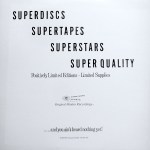
When I threw that super Hi-Fi Audiophile pressing on the turntable and turned the volume up good and loud, I thought there could be no question that finally, after all these years and after so many different stereo systems, I had reached the pinnacle of home audio. How could the sound possibly get any better? (Of course, although I didn’t know it at the time, I would devote the next 40-plus years to exploring that question.)

By 1978, Crisis? What Crisis and Even in the Quietest Moments had already come out, and though you couldn’t buy either of those albums on a super-duper disc from Mofi, there was a Half-Speed of Crisis which, I have to admit, sounded great to me at the time and well after it should have. (I don’t know what I thought of the Sweet Thunder pressing of EITQM, but I know what I think now: it sucks.)

I became an even bigger fan of Crisis than I had been of COTC, if you can believe such a thing. (None of my friends could.)

Since Crime… is one of those albums that I still listen to regularly, I can say with confidence that it is the better album by a small margin, and one that would come with me to my desert island even if I were limited to as few as ten titles — that’s how good it is.

And I owe a debt of gratitude to a label that comes in for a lot of criticism on this blog, the one that took Supertramp’s best album and made it a Demo Disc the likes of which I had never heard before, Mobile Fidelity.

(more…)

An Overview of Beatles Oldies But Goldies

Hot Stamper Pressings of the Music of The Beatles Available Now

This is a Beatles album we think we know well.

We’ve done a number of shootouts for A Collection of Beatles Oldies over the last ten years or so, and our experimental approach using many dozens of copies provides us with strong evidence to support the following conclusions regarding the sound of the originals vis-a-vis the reissues:

  1. The best of the early pressings always win our shootouts. No reissue has ever earned our top grade of A+++ and it is unlikely any reissue ever will.
  2. The reissues can be quite good however. The best of them have earned grades of Double Plus (A++).
  3. The worst of the early pressings also earned grades of Double Plus (A++).
  4. Conclusion: if you have a bad original and a good reissue, you might be fooled into thinking the sound quality was comparable.

(more…)

Graham Nash’s Wild Tales and Their Mysteries Many and Deep

Hot Stamper Pressings of the Music of Graham Nash Available Now

What hurts so many pressings of this album is a generally lifeless quality and a lack of presence in the midrange.

Were the stampers a bit worn for those copies, or no good to start with, or was it bad vinyl that couldn’t hold the energy of the stamper, or perhaps some stampers just weren’t cut right?

Maybe it’s something as simple as the pressing plates going out of alignment at some point in the cycle?

Don’t ask us. We sure don’t know. And one thing we’ve learned over the years is not to pretend to.

These are record mysteries, and they are mysteries that will always be mysteries, if for no other reason than the number of production variables hopelessly intertwined at the moment of a pressing’s creation can never be teased apart no matter how smart you are.

As we never tire of saying, thinking is really not much help with regard to finding better sounding records.

Not surprisingly, we’ve found that cleaning and playing them seems to work fairly well.

Those two things work fairly well because nothing else works at all.

(more…)

Could This Be the Sound Audiophiles Complain About with Vintage Pressings?

Hot Stamper Pressings of the Music of Red Garland Available Now

A rare and expensive (!) early stereo pressing that we played in a recent shootout for Bright and Breezy was passable at best.

As you can see from the notes reproduced below, we found the sound to be “sweet, relaxed, but badly veiled and lacking weight and bass.” (Note that records without a 1.5+ grade or better on both sides are not considered Hot Stamper pressings.)

In other words, it sounded too much like an old record, and not a very good one at that. The world is full of them. (For this album, clearly the best sound is found on the right OJC.)

(more…)

Every Last One of These Bartok Records with Ansermet Was No Good

Hot Stamper Pressings of the Music of Bela Bartok Available Now

Every last one of our London pressings of Concerto for Orchestra was a disaster: smeary strings, blary brass and painfully shrill throughout, with no top or bottom to speak of, the very definition of boxy sound.

The entire group of CS 6086 we had on hand — whether on Blueback or Whiteback, we had a good selection of both — were much too unpleasant to be played on high quality modern equipment.

Why had I been buying them for years?

I made the mistake of assuming that the phenomenally talented Decca engineering and producing team who worked on this project could be relied upon to produce a top quality recording of the Concerto for Orchestra.

As it turns out, my guess turned out to be wrong.

I had made the mistake of believing in the infallability of experts.

I talk about the team of producers and engineers seen below in listing after listing, raving about the amazing sound of the recordings produced by them in the 50s and 60s, many of which are right at the top of the best sounding recordings I have ever had the privilege to play.

(more…)

Is So Far Really Just a Waste of Money?

Hot Stamper Pressings of the Music of Crosby, Stills and Nash Available Now

The All Music Guide considers So Far to be a waste of money (on CD) because it was a slapped together effort to capitalize on CSN’s success, combining material from only two albums and then adding two unreleased tracks.

Their attitude boils down to the idea that the first two records are essential, so why buy this album for two songs?

I’ll tell you why.

Because finding good sounding pressings of either of the first two albums is practically impossible for the average audiophile record collector.

I mean that literally: as a practical matter, it is very, very difficult to find Hot Stamper versions of the band’s first two releases. This is especially true for the self-titled album from 1969, which sounds best in our experience on a later reissue that we have a devil of time finding and therefore rarely have in stock.

Both the first two albums and So Far are records we credit with helping us dramatically improve the playback quality of our system.

A Few Words About Deja Vu

Deja Vu is a special album for me, one I have been obsessed with since I first became an audiophile.

I was a big Crosby, Stills and Nash fan already — the first album being life-changing to a 15 year old music lover such as myself, on 8-track tape in the care no less — so it was only natural that I would fall in love with Deja Vu when it came out in 1970.

(more…)

Practical Advice for Collecting Hot Stampers If You’re New to the Game

Our Guide to Record Collecting for Audiophiles

Our good customer ab_ba has some advice for those who are interested in improving the quality of their collections by acquiring more Hot Stamper pressings.

I have taken the liberty of editing parts of his letter, mostly to focus the reader’s attention on some of the practical tips Aaron wishes to share.

Hi Tom,

I’ve been your customer for over four years now, and I count more than 60 records of yours on my shelf. I know I’m not quite one of your heavy-hitter customers, but I’ve got enough familiarity to know how refreshingly different your ecosystem is from everything else out there. I’ve purchased white hot stampers from you for nearly all of my lifelong favorite albums.

I’ve purchased many super hots and even plain-old hot stampers, and many of them are among my most-played records. I’ve also used your site as a way to discover new music.

But, very few of your new customers are likely to go straight to the White Hot Stamper shelf. I sure didn’t. And, some of my Super Hots are albums I return to and enjoy again and again. Yes, when I’m playing a super hot, then by definition I know that there are other copies out there that sound even better, and in the few instances where I’ve been able to directly compare a Super Hot and a White Hot, I know that your ranking system is indeed reliable.

In my experience, any record you sell is highly likely to sound better than the same title purchased anywhere else. Not only that, even if I don’t have a copy to compare it to, I can count on your records to sound great. So much so, in fact, that I really don’t bother with discogs and record stores anymore. Your system – everything from procuring to cleaning to shooting out – yields a product that is so superior to what else is available, that I simply don’t bother hunting around anymore. Being able to cut through the deluge of options available brings a lot of peace of mind in a world that’s increasingly full of mediocre slop, and that’s why Better Records is increasingly necessary.

My suggestion to anybody who’s starting to discover what you offer is to adopt two strategies I’ve landed on.

First, make your want list requests. This way you can be assured that you can get the best-sounding copies of that handful of albums you love the most.

Second, the nearly white hot records, and the white hots with issues, are a real treasure trove. They are considerably more affordable than the white hots, and even if one leaves me feeling idly curious what a true white hot would sound like, I’ve been amazed and delighted by the nearly white hots I’ve purchased. Even if somebody out there has a better-sounding copy, I can console myself with the money I saved.

Anybody who’s even remotely serious about listening to records really owes it to themselves to try your records. I am sure that for many who try you out, it will become an ethos, as it did for me. It takes a lot to believe what people (Robert Brook, you, your customers) post on the internet, especially when it is so counterintuitive and so contra the prevailing groupthink.

I wish people could borrow your records, hear them, or come over to my house, or go to Robert’s, and listen with us. Some of the friends who have come over to listen to your records with me have followed suit, becoming your customer, and building their stereos around your suggestions. They only go deeper, and like me and Robert, they aren’t looking back.

So, as 2026 starts, Tom, I am feeling gratitude for the little oasis you and your crew have enabled me to build.

Aaron

Aaron,

Please excuse the heavy editing — that was a long letter you wrote! — and I hope to be able to get more of it up on the blog soon.

You hit ithe nail on the head with your advice for Nearly White Hot Stamper pressings and those with Condition Issues.

Records in those two sections sell at a substantial discount to their higher graded brethren, or pressings with comparable grades that play quieter.

About a quarter of the records on the site at any given time have condition issues; it’s the nature of the medium and not a lot can be done to change that. We clean the hell out of our records, but some surface noise will always be part of even the highest quality analog playback. We lay out our grading scale and condtion standards here for those who may be interested.

Over the last few years Robert Brook has travelled the same road I started down twenty-odd years ago, and by doing so discovered lots of things about equipment and records that I had discovered myself. This is not the least bit odd. When you do the work properly, you find out how things work, and one of the main things you find out about how things work is that they don’t work the way most audiophiles want them to, or think they do.

(more…)

Making Mistakes Is Key to Finding Better Sounding Records

Our Guide to Record Collecting for Audiophiles

Wise men and women throughout the ages have commented on the value of making mistakes.

Here is one of our favorite quotes on the subject.

“A man should never be ashamed to own he has been in the wrong, which is but saying… that he is wiser today than he was yesterday.”   Alexander Pope, in Swift, Miscellanies

When I think of the 20 odd years (early ’70s to early ’90s) I wasted trying to figure out how audio works before I had acquired any real critical listening skills, it brings to mind that old Faces’ song, “I wish that I knew what I know now, when I was younger.”

Learning how to do shootouts for your favorite albums is without a doubt the fastest and easiest way to hone your listening skills, a subject we discuss often on the site and most cogently in this commentary from way back in 2005.

We believe that the only way to really learn about records is to gather a big pile of them together, clean them up and listen to them one by one as carefully and critically as possible.

We do not recommend devoting much time to reading about them in magazines or on forums.

We also would dissuade the serious record collector from paying much attention to what the most sought after or most expensive pressings are. Records have market prices based on a host of factors that have almost nothing to do with sound quality.

And don’t think you can “logically” predict which pressings should sound the best and then just go about acquiring them.

None of these methods are likely to produce good results.

Making mistakes will though. And the more you make, the more you learn. The more you learn, the easier it is to recognize and pursue good records. It also makes it easy to part with your bad ones. The latter group we hope will include the majority of your holdings of Heavy Vinyl and Half-Speed Mastered Recordings. At best those should be seen as placeholders. They’ll do until something better comes along. And considering how mediocre so many newly remastered records are, “something better’ should not be hard to find.

And the better developed your critical listening skills become, the less likely “they’ll do” at all. They’ll just get put on a shelf. It has been our experience that good records get played and bad records don’t.

(more…)

Good Digital Beats Bad Analog Any Day

Hot Stamper Pressings of the Music of Sonny Rollins Available Now

And this is some very bad analog indeed!

We here present our 2010 review of the Sonny Rollins Plus 4 album, the one remastered on two slabs of 45 RPM Analogue Productions Heavy Vinyl.

It has everything going for it, right?

Steve Hoffman, Kevin Gray, 45 RPMs, Heavy Virgin Vinyl, fancy packaging — clearly no expense was spared!

The ingredients may have been there, but the cake they baked was not only not delicious, it was positively unlistenable — I mean, inedible.

I cannot recall hearing a more ridiculously thick, opaque and unnatural sounding “audiophile” pressing than this Rollins record, and believe me, I’ve heard plenty. (And it seems the bad news will never stop.)

As I noted in another commentary “Today’s audiophile seems to be making the same mistakes I was making as a budding enthusiast more than thirty forty years ago. Heavy Vinyl, the 45 RPM 2 LP pressing, the Half-Speed limited edition — aren’t these all just the latest audiophile fads, each with a track record more dismal than the last one?”

It reminds me of the turgid muck that Doug Sax was cutting for Analogue Productions back in the 90s. The CD has to sound better than this. There’s no way could it sound worse.


CD Update:

I managed to track down a copy of the CD and it DOES sound better than this awful record, and by a long shot. It’s not a great sounding CD, but it sure isn’t the disaster this record is.

Buy the CD, and whatever you do, don’t waste money on this kind of crap vinyl.


This is a very bad sounding record, so bad that one minute’s play will have you up and out of your chair trying to figure out what the hell is wrong with your system. But don’t bother. It’s not your stereo, it’s this record.

It has the power to make your perfectly enjoyable speakers sound like someone wrapped them in four inches of cotton bunting while you weren’t looking.

(more…)

In the 80s We Had No Idea How Good the Best OJC Pressings Could Sound

Hot Stamper Pressings of the Music of Chet Baker Available Now

For our first Hot Stamper Shootout Winner. we noted:

Both sides here are Tubey Magical, rich, open, spacious and tonally correct. We’ve never heard the record sound better than in our most recent shootout, and that’s coming from someone who’s been playing the album since it was first reissued in the 80s.

I used to sell these very records in the 90s — we retailed them for ten bucks back then — but we had no clue just how good they could be back in those days. We couldn’t clean them right, or even play them right, and it would never have occurred to us to listen to a big pile of them one after another in order to pick out the best sounding copies.

This is a wonderful Chet Baker record that doesn’t seem to be getting the respect it deserves in the wider jazz world. You may just like it every bit as much as the Chet album, and that is one helluva record to compare any album to. In our estimation it’s about as good as it get.

(more…)