“Sleeper” Classical Recordings – Reviews and Commentaries

Haydn / Symphonies 59 & 81 – The Best on Record

More of the music of Joseph Haydn (1732-1809)

Hot Stamper Mercury Pressings Available Now

These notes are taken from the first shootout we did many years ago.

These are THE BEST HAYDN SYMPHONIES I have ever heard on disc. Folks, until I heard Dorati and the Festival Chamber Orchestra perform these pieces I never knew there could be this much FIRE in Haydn’s music. (Please excuse the pun; the 59th Symphony is entitled “Fire”.)

The producers and engineers for Mercury bring the kind of recording energy and presence to this music that I have frankly never heard before. Credit must go to both Dorati and his players.

His tempi are fast and sprightly throughout, and the smaller orchestra allows the players to zig and zag with the musical changes much more quickly than would be the case with a larger and more inertia-bound group.

The FCO are so technically proficient and so light on their feet that Dorati was able to push them to dizzying heights of performance. For the first time I can honestly say that Haydn’s music really works — it’s wonderful!

(If you’ve ever heard Previn conducting Prokofiev’s Classical Symphony with the L.A. Phil from 1990 you will know what I mean. In his (their) hands the work is so lively it’s hard to hear it performed by anyone else. Bad digital sound but it’s worth it to hear the piece played with such gusto.)

Dorati and Haydn

As you may know, Dorati recorded all the symphonies of Haydn for London/Decca. Having played some of them I can tell you they certainly do not sound like this! (Perhaps my copies were not the best, but how many copies of these records can be found nowadays? Not enough to do shootouts with, that’s for sure.)

This recording is not your typical dry, bright, nasaly, upper-midrangy Merc, on side one especially. Here the sound is rich and smooth like a good London, with a big stage and lovely transparency. We graded it A++ to A+++ — side two had more texture to the massed strings than this side one, so we downgraded it half a plus. In virtually every other way it was SUPERB!

Side Two

A touch of that Mercury brightness can be heard on this side, but it is well under control at normal listening levels. The strings are textured and lively, the orchestra just bursting with enthusiasm for this music and the recording captures it all! A++ to A+++, again, superb, and priced accordingly.

(more…)

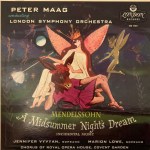
Mendelssohn / A Midsummer Night’s Dream in Mono with Maag – Reviewed in 2004

More of the Music of Felix Mendelssohn

London mono original Radio Promotion Copy with DEMO QUALITY SOUND!

Another winner on the early London FFRR Red Label. Maag’s performance here is famous, if not definitive. Audiophiles have known of this record”s qualities for decades. As our stereos get better, so do amazingly natural recordings such as this one.

Speakers corner did a reissue of this record on heavy vinyl which was quite good — too fat in the mid bass but otherwise acceptable. It sure doesn’t sound like this though! This is the real thing! You won’t find too many 180 gram records that sound like this one. (If you can find any.)

Here is the commentary I wrote for the Coppelia mono pressing. The same insights hold true.

This is the kind of record that the mono cartridge owners of the world worship. And for good reason. But you don’t need to have a mono cartridge to hear how good — in fact, how much better — this copy sounds than the stereo pressing.

I found out about mono classical records one day when I got a mono copy of the power of the orchestra, vcs 2659. It sounded better than any stereo recording of that work I had ever heard. All the instruments were so much more solid sounding, so palpable, so free from distortion, that it made me recognize for the first time what the mono record lovers of the world were talking about. That was ten [twenty five by now] years ago. Since then many high end mono cartridges have come on the market, specifically to bring out that sound.

But I don’t have a mono cartridge, and I sure don’t need one to hear how good this record sounds. Everything is right on the money. And of course with Ansermet, ballet conductor extraordinaire, you can be sure the performance is of the highest caliber. A top recommendation from better records.

By the way, there’s a good reason why London makes such good mono records. They ran a separate microphone feed into a monophonic tape recorder for their mono recordings, well into the stereo era in fact. Mercury did also, which is why many Mercury monos have excellent sound. RCA, on the other hand, frequently took the three-track master tape and simply mixed it to mono for their mono releases, which explains why a minority of RCA monos have good sound.

London knew how to do it right and the results speak for themselves.

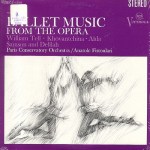
Ballet Music From The Opera – Our Favorite Pressing Since 2013

Better than Super Hot Stamper sound on side one of this lovely Victrola reissue from 1960, one of the best in the entire series.

Pay attention to the brass — yes, it may have some tubey smear, but listen to how HUGE and POWERFUL it is! Drop the needle on the first side and watch (or listen) as the sound comes jumping out of your speakers.

Modern records can’t do that.

These Decca-derived recordings are highly sought after, and with good reason. It’s hard to imagine a more wonderful audiophile disc, both in terms of the program and the quality of the sound.

This is the precisely the kind of big, bold, lifelike sound Decca engineers were able to capture on tape, and RCA mastering engineers were able to master from that analog tape, fifty or so years ago. (more…)

Ravel / Concerto in G / Munch – Reviewed in 2010

More of the Music of Maurice Ravel

This is a wonderful sounding performance of Ravel’s Piano Concerto, originally available on Shaded Dog (LSC 2271) and overflowing with Tubey Magical Living Stereo sound from 1958.

The Victrola here is from 1964, and may or may not sound better than the average original RCA pressing. LSC 2271 is not a record we run into every day, so comparisons would be speculative to say the least.

What we can tell you is that our Victrola here is big, spacious, transparent and clear, with dead-on tonality throughout.

The overall sound seems to lack weight at first but with continued listening it appears to be the result of the orchestration being “lighter”, more appropriate to the jazz influences in the music. If you like Gershwin this piece will be right up your alley. (more…)

Gaite Parisienne & Les Sylphides – Reverse Your Polarity

More of the Music of Jacques Offenbach (1819-1880)

This is one of the pressings we’ve discovered with Reversed Polarity.

Amazing in every way! The top end of this record is clear, clean and correct. No other copy sounded like this one on the first side. When you hear all the percussion instruments — the tambourines, triangles, wood blocks and what-have-you — you know instantly that they sound RIGHT.

The overall sound is very different from many of the other recordings of the work that we have offered in the past. Rather than smooth, rich and sweet, the sound here is big and bold and clear like nothing we have ever played.

This is Front Row Center sound for those whose systems can reproduce it!

And this is truly a top performance by Fistoulari and the Royal Philharmonic. I know of none better. For music and sound this is the one!

Side One

The Triple Plus sound makes this THE Gaite Parisienne to Own.

If you have a hot copy of LSC 1817 consider yourself very fortunate. If your copy of LSC 1817 has never thrilled you, then this pressing will beat the pants off it, as it is pretty darn THRILLING. Even if you do have a great 1817 I would still put this up against it and expect it to win the shootout.

It’s clear, clean and above all, TRANSPARENT. This is a claim no modern remastered record, in our opinion, can make. The energy is spectacular on this side. Not only that, but listen to the bite of the brass — that’s some high-rez sound! (more…)