Testing the Lower Midrange and Mid-Bass

Linked below are more than twenty titles that are good for testing the lower midrange and mid-bass performance of your system. Some brass instruments, e.g., trombones and baritone saxophones, as well as cellos, pianos and other keyboard instruments live or die by your system’s ability to faithfully and forcefully reproduce this area of the frequency spectrum.

What the Shootout Winning Copies of A Hard Day’s Night Really Get Right

Hot Stamper Pressings of the Music of The Beatles Available Now

I wrote this bit of commentary about twenty years ago:

When comparing pressings of this record, the copies that get their voices to sound both present and warm, smooth, and sweet, especially during the harmonies, are always the best.  All the other instruments seem to fall in line when the vocals are correct. This is an old truism — it’s all about the midrange — but in the case of A Hard Day’s Night, it really is true.

Now that we are putting our unredacted (!) shootout notes on the blog for everyone to see, here are the actual notes for the shootout winning pressing we just played (6/2025), notes that back up what we said so many years ago 100%.
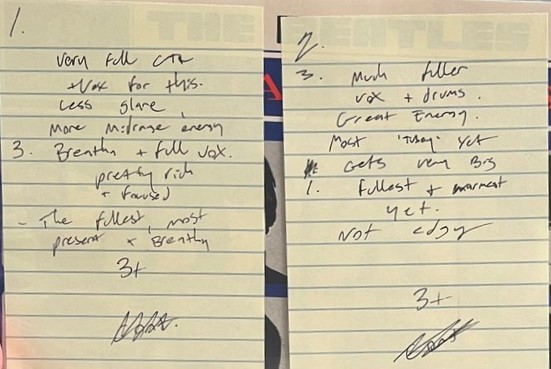
What’s does this amazing side one sound like?

  • Very full guitars and vocals for this
  • Less glare
  • More midrange energy
  • Breathy and full vocals
  • Pretty rich and focussed
  • The fullest, most present and breathy vocals

And this amazing side two?

  • Much fuller vocals and drums
  • Great energy
  • Most “tubey” yet
  • Gets very big
  • Fullest and warmest yet
  • Not edgy

Both sides had qualities that did much to set them apart, coupled with fewer of the shortcomings we found in practically all the other pressings we played.

Less glary and less edgy are critical to the better pressings, simply because few copies are not glary and edgy in the midrange to some degree.

But the real keys to the shootout winners are vocals that are full, present, warm and breathy.

For The Beatles in 1964, nothing else about the sound of their recordings could possibly compete with those four qualities.

We could add two more. Energy would probably be the next most important one, followed by Tubey Magic.

That brings the total of most important qualities to a grand total six.

(more…)

What We Listen For on Soul to Soul

Hot Stamper Pressings of the Music of Stevie Ray Vaughan Available Now

Number one:

Too many instruments jammed into too little space in the upper midrange.

When the tonality is shifted-up, even slightly, or there is too much compression, or too much smear, there will be too many elements — voices, guitars, drums — vying for space in the upper area of the midrange, causing congestion and a noticeable loss of clarity.

With the more solid sounding copies, the lower mids are full and rich; above them, the next “level up” so to speak, there’s plenty of space in which to fit all the instruments comfortably, without having them sound like they are all piled up on top of one another as is so often the case.

With more space and less compression and less smear the upper midrange does not sound overstuffed and overwhelmed with musical information.

Number Two:

Edgy vocals, which is related to Number One above.

Almost all of Stevie Ray Vaughan’s recordings seem to have some edge to his vocals — the man really belts it out on his albums, it’s what he does — but the best copies keep the edge under control, without sounding compressed, dark, dull or smeary.

That’s what you get with a Hot Stamper pressing — it’s the one that keeps the edge under control, but has all the energy, presence, richness and clarity you were never able to find on any pressing of the album on your own.

(more…)

On Discovered Again, Does It Sound Like the Snare Is Wrapped in a Towel on Your Copy?

Hot Stamper Pressings of Direct-to-Disc Recordings Available Now

The bulk of this commentary was written in 2008 and is based on the shootout we had just done, our first for the album. It has been amended a number of times since.

I bought my first copy of Discovered Again in 1976 upon its release. I was a big fan of the label at the time. The Missing Linc had been a revelation to me years before in terms of how good music could sound in the home (or apartment as the case may be). I wrote a bit about it here.

I credit that amazing record as well as Discovered Again as fundamentally important in helping me advance in this devilishly difficult hobby of ours. Back in those dark days of the 70s, although I was completely clueless at the time about pretty much everything having to do with vinyl and equipment, I can take some solace in the fact that everybody else was every bit as clueless as I was too.

This blog is dedicated to sharing some of what I’ve learned — with the unflagging help of my staff of course — about records and audio over the last fifty years.


The sound quality of the typical pressing of Discovered Again leaves much to be desired.

Two areas are especially lacking as a rule: the top end tends to be rolled off, and there is a noticeable lack of presence, which can easily be heard in the drum sound.

The snare sounds like it’s covered with a towel on most copies of this album.

How does that even happen?

Who knows? Even though the mastering is fixed at the live event, there are many other variables which no doubt affect the sound. The album is cut on two different lathes — M (Master) and S (Slave), and pressed in two different countries: Japan and Germany. Many mothers were pulled from the acetates and many, many stampers made from those mothers. (I saw one stamper marked number 15!)

Bottom line? You got to play ’em to know how they sound, just like any other pressing. If no two records sound the same, it follows that no two audiophile records sound the same, a fact that became clear early on in the listening.

Of course not many audiophiles are in a position to shootout six copies of Discovered Again, and I’m not sure most people would have the patience to do it. Here at Better Records we have a whole system set up to do that, so we waited until we had a pile of them, got them all cleaned up, and off to the races we went.

What Else to Listen For

Listen to the harmonics around the cymbals and bells on Git Along Little Dogies — on the best copies you can really hear the transients of the cymbals and percussion, so important to the actual sound of those instruments. (More records that are good for testing percussion can be found here.)

The stand-up acoustic bass is amazingly well recorded on this album; it’s so rich and full-bodied. You will have a hard time finding a string bass that sounds better.

Track after track, the sound is surprisingly open and airy. Dave’s keyboards throughout have wonderful presence; on the best copies they really jump out of the speakers. (A good test for midrange presence.)

(more…)

In the Market for New Speakers? See How Well They Handle the Energy of Far More Drums

Hot Stamper Pressings of the Music of Dave Brubeck Available Now

The drum solo Joe Morello lets loose on Far More Drums is one of the best on record. I was playing that song recently and it occurred to me that it is practically impossible for a screen or panel speaker of any design to reproduce the sound of those drums properly, regardless of how many subs you have.

Most of the music is not in the deeper bass anyway. It’s the whack of instruments whose energy is in the lower midrange and mid-bass that a screen speaker will struggle with.

A good large-driver dynamic speaker fed by fast electronics can handle the energy in that range with ease.

This is the album you need to take with you next time you head to your local stereo store to audition speakers.

It will help clarify the issues. Screen speakers do many things well, but drums are not one of them, at least in my experience they aren’t. If drums are important to you, do yourself a favor and buy a dynamic speaker, the bigger the better.

brubeck in the studio733

Time Further Out, like most of the classic Brubeck albums, is a big speaker record. It requires a pair of speakers that can move air with authority below 250 cycles and play at fairly loud levels. If you don’t own speakers that can do that, this record will never really sound the way it should.

(more…)

Now That’s the Way a Piano Should Sound!

On the best copies the rich texture of the strings is out of this world — you will have a very hard time finding a DG with better string tone.

The best pressings of this recording have none of the shortcomings of the average DG: it’s not hard, shrill, or sour.

DG made plenty of good records in the 50s and 60s, then proceeded to fall apart, like most labels did. This is one of their finest. It proves conclusively that at one time — 1962 to be exact — they clearly knew exactly what they were doing.

Without question this is a phenomenal piano recording in every way.

I don’t know of another recording of the work that gets the sound of the piano better. On the better copies, the percussive quality of the instrument really comes through.

It’s amazing how many piano recordings have poorly-miked pianos.

These bad sounding pianos are either too distant, lack proper reproduction of the lower registers, or somehow smear the pounding of the keys into a blurry mess.

Are they badly recorded?

Or perhaps it is a mastering issue?

Maybe a pressing issue?

To be honest, it’s probably all three.

Lately we have been writing quite a bit about how good pianos are for testing your system, room, tweaks, electricity and all the rest, not to mention turntable setup and adjustment.

  • We like our pianos to sound natural (however one chooses to define the term)
  • We like them to be solidly weighted
  • We like them to be free of smear, a quality that is rarely mentioned in the audiophile reviews we read

Other records that we have found to be good for testing and improving your playback can be found here.

(more…)

Rich, Rosiny Lower Strings in Living Stereo Like These Are to Die For

Hot Stamper Pressings of the Music of Franz Liszt Available Now

Find me a modern record with rich, rosiny lower strings and I will eat it.

And by “modern record” we hasten to include both modern recordings and modern remasterings of older recordings. No one alive today can make a record that sounds as good as this one.

To call it a lost art is to understand something that few vinyl-loving audiophiles appear to have fully grasped since the advent of the Modern Reissue, which is simply this: head to head they are simply not competitive.

After twenty years of trying and literally hundreds of failed examples, both the boutique and major labels of today have yet to make a record that sounds as powerful and lifelike as this RCA from the old days. 

Fortunately for record lovers and record collectors alike, we here at Better Records are not trying to make a record sound the way these sides do.

Our job is much easier than that. We’re just trying to find ones that do. When we find sides as good sounding as these, we call them Hot Stampers and charge a lot of money for them.

But you get what you pay for when you buy a record from us. And if you disagree, for any reason, you get your money back.

(more…)

Some Pressings of Tchaikovsky’s Piano Concerto No. 1 Can Sure Be a Letdown

Hot Stamper Pressings of the Music of Tchaikovsky Available Now

I don’t know of another recording of the work that gets the sound of the piano better. On the properly-mastered, properly-pressed copies, the percussive quality of the instrument really comes through.

But that quality (along with lots of others) is only heard on the better copies.

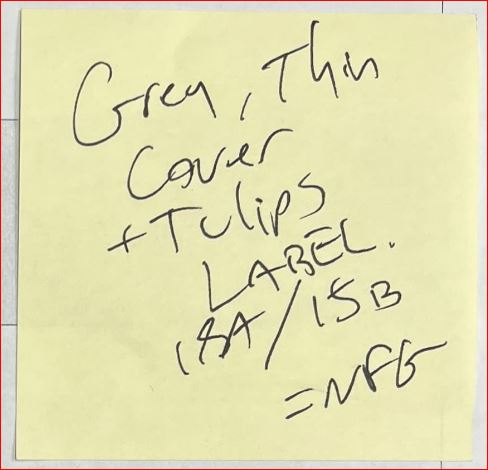
The reissues (one with the later Tulips label, one with the earlier Large Tulips label) described below are at best passable, and some of them were just awful.

The note to the left makes clear that even some of the early Large Tulips label pressings had very bad sound. Watch out especially for 18A/15B stampers. They’re NFG: No F***ing Good.

As you can see from the notes above for this particular recording in the Black and White cover, one side was passable, earning our 1.5+ grade. That makes it a decent sounding record, I suppose, but it’s a long, long, long way from the best.

1.5+ is four grades down from the top copy. That’s a steep dropoff as far as we’re concerned. 1.5+ only hints at how good a recording this DG can be on the best pressings.

To see more records that earned the 1.5+ grade, please click here. (Incidentally, some of them are even on Heavy Vinyl. The better modern pressings have sometimes, if rarely, been known to earn Hot Stamper grades, and two recently shocked the hell out of us by actually winning a shootout. Wouldn’t you like to know which two!)

One Plus (1+) is a sub-Hot Stamper grade. We do not sell records that do not earn a grade of at least 1.5+ on both sides.

For those who might be interested, there’s more on our grading scale here.

Our Favorite Performance with Sound to Match

A recent listing for the album can be found here.

Without question this is a phenomenal piano recording in every way.

On the best copies the rich texture of the strings is out of this world — you will have a very hard time finding a DG with better string tone. This record does not have the shortcomings of the average DG: it’s not hard, shrill, or sour.

DG made plenty of good records in the 50s and 60s, then proceeded to fall apart, like most labels did. This is one of their finest. It proves conclusively that at one time — 1962 to be exact — they clearly knew exactly what they were doing.

It’s amazing how many piano recordings have poorly-miked pianos. The badly recorded pianos are either too distant, lack proper reproduction of the lower registers, or somehow smear the pounding of the keys into a blurry mess.

Are they badly recorded?

Or is it a mastering issue?

Perhaps a pressing issue?

(more…)

One Man Dog Is Another Good Conga Tester Title

Hot Stamper Pressings of the Music of James Taylor Available Now

If you have a Hot Side One for One Man Dog you will know it in a hurry. The guitars and congas will leap out of your speakers at the beginning of One Man Parade. If they don’t, forget it, move along to the next copy and keep going until you find one in which they do.

There are plenty of other, more subtle cues to separate the White Hots from the Supers and Hots, but if the sound doesn’t come to life right from the get go, it never will.

This reminded me of another record that can be judged by the jump-out-the-speaker energy of it congas, Teaser and the Firecat. An excerpt:

The congas are what drive the high-energy songs, songs like Tuesday’s Dead and Changes IV.

Here is how we stumbled upon their critically important contribution.

We were listening to one of the better copies during a recent shootout. The first track on side one, The Wind, was especially gorgeous; Cat and his acoustic guitar were right there in the room with us. The transparency, tonal neutrality, presence and all the rest were just superb. Then came time to move to the other test track on side one, which is Changes IV, one of the higher energy songs we like to play.

But the energy we expected to hear was nowhere to be found. The powerful rhythmic drive of the best copies of the album just wasn’t happening. The more we listened the more it became clear that the congas were not doing what they normally do. The midbass to lower midrange area of the LP lacked energy, weight and power, and this prevented the song from coming to LIFE the way the truly Hot Stamper pressings do.

The sound of the congas on many of the records we audition is a good test for some of the most important qualities we listen for: energy, rhythmic drive, presence and weight.

Congas, like drums and pianos, are good for testing records.

(Stereos too of course.)

If these instruments get lost in the mix, or sound smeary or thin, it’s usually fairly easy to hear those problems if you are listening for them. Most of what you will read on this blog is dedicated to helping you do that.

The richness of analog is where much of its appeal lies. Lean drums, congas and pianos are what you more often than not get with CDs.

These three instruments are also exceptionally good for helping you to choose what kind of speakers to buy. (We recommend big ones with large dynamic drivers.)

(more…)

Our 2024 Shootout Winner of Mac’s Greatest Hits Was Amazing Sounding

Hot Stamper Pressings of the Music of Fleetwood Mac Available Now

With a KILLER Shootout Winning Triple Plus (A+++) side two mated to a solid Double Plus (A++) side one, this vintage British import is doing practically everything right.

Here are just a few of the things we had to say about this incredible copy in our notes: “big and tubey and weighty”…”lots of space and detail”…”sweet and breathy vox”…”jumping out of the speakers.”

Big, rich, energetic, with an abundance of analog Tubey Magic, this original Orange Label UK pressing has exactly the right sound for this music.

“Oh Well, Parts One and Two,” “Black Magic Woman,” “Man of the World,” and the surprise Number One single “Albatross” are all here and guaranteed to blow your mind.

Peter Green is hands down our favorite British Blues Guitarist of All Time – play this record and you will surely see why we feel that way.

This is a lot of money for a somewhat noisy copy, but the sound is so awesome and quiet pressings of the album so hard to come by that we hope someone will take a chance on it and get the thrill we did from hearing it sound right for once.

We’ve recently compiled a list of records we think every audiophile should get to know, along the lines of “the 1001 records you need to hear before you die,” but with less of an accent on morbidity and more on the joy these amazing audiophile-quality recordings can bring to your life.

If you’re a fan of Fleetwood Mac, this copy is guaranteed to blow your mind. Like all the best vintage British pressings, the sound is smooth, rich and full.

This is Old School ANALOG, baby. They don’t make ’em like this anymore because they don’t know how to.

(more…)

In the Market for New Speakers? See How Well They Handle the Fat Snare on Dreams

Hot Stamper Pressings of the Music of Fleetwood Mac Available Now

Rumours is a record that is good for testing your speakers’ lower midrange and mid-bass reproduction.

What do the best copies of Rumours have that the also-rans don’t?

Lots and lots of qualities, far too many to mention here, but there is one you should pay special attention to: the sound of the snare.

When the snare is fat and solid and present, with a good “slap” to its sound, you have a copy with weight, presence, transparency, energy — all the analog stuff we adore about the sound of the best copies.

Now if your speaker is not capable of getting the snare to sound that way, perhaps because you have screen speakers or a small boxed design, or a lousy copy of the album (anything without KP in the deadwax), this is still a handy test. Next time you are on the hunt to buy new speakers, see which ones can really rock the snare.

That’s probably going to be the speaker that can do justice to Rumours, and The Beatles, and Zuma, and lots of other favorite records of ours, and we hope favorites of yours too.

The speaker you see to the left is probably not the right kind of speaker for a record such as Rumours. Three 6.5 inch woofers are just not going to be enough to get that snare to sound big and fat.

Here are some other records that are good for testing the sound of the snare drum.

(more…)