Month: October 2024

Analogue Productions and Sterling Produce a Disastrous Scheherazade

Hot Stamper Pressings of the Music of Rimsky-Korsakov Available Now

Wikipedia has a nice entry for some of Rimsky-Korsakov’s ideas behind the final movement of the piece:

These [later] works resemble brightly colored mosaics, striking in their own right and often scored with a juxtaposition of pure orchestral groups. The final tutti of Scheherazade is a prime example of this scoring. The theme is assigned to trombones playing in unison, and is accompanied by a combination of string patterns. Meanwhile, another pattern alternates with chromatic scales in the woodwinds and a third pattern of rhythms is played by percussion.

Wikipedia

Could not have said it better myself!

We’ve written at length about the thrills to be had when playing the last movement of Scheherazade — not brilliantly, to be sure, as the writer for Wikipedia has done, but serviceably I hope. Unfortunately, not every pressing of Reiner’s performance is able to communicate the musical values of the work the way the best pressings can.

As you can see from our notes for the this Heavy Vinyl Analogue Productions pressing, the thrill was barely there on the first side, and by the second side it was completely gone.
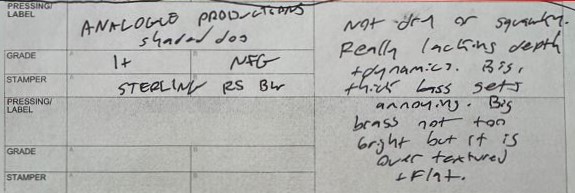
The notes from our 2024 shootout read:

  • Not dry or squawky
  • Really lacking depth and dynamics.
  • Big, thick bass gets annoying.
  • Big brass not too bright but it is over-textured and flat.

Plenty of modern records suffer from these as well as lots of other shortcomings. For some reason, the writers for The Absolute Sound who put this crappy LP on their Super Disc list didn’t seem bothered by them the way we were.

If you own this pressing, here are the kinds of things you might want to listen for in order to recognize its many, and quite serious, failings.

When played head to head against any properly-mastered vintage vinyl LP, this pressing will fall short in a number of important areas. Linked below are titles we’ve found to be good for testing these same qualities in a recording.
(more…)

Stevie Ray Vaughan – Couldn’t Stand The Weather

More Stevie Ray Vaughan

More Electric Blues

  • Boasting two excellent Double Plus (A++) sides, this vintage copy (one of only a handful to hit the site in ten months) is doing just about everything right
  • The bass is big, the overall presentation is huge, and the energy is jumpin’ on this early pressing – this is the right sound for SRV’s hard-chargin’ Electric Blues
  • 4 stars: “Stevie Ray Vaughan’s second album, Couldn’t Stand the Weather, pretty much did everything a second album should do: it confirmed that the acclaimed debut was no fluke, while matching, if not bettering, the sales of its predecessor, thereby cementing Vaughan’s status as a giant of modern blues.”

Superb sound for this Stevie Ray classic! Just picture yourself in a blues club. Now imagine the volume being about ten times as loud. This is the kind of music you would hear and it would tend to sound pretty much like this: a bit messy but also real. If you’re one of those audiophiles who likes pinpoint imaging, forget it. They were going for the “live in the studio” sound with this one, which means it’s a bit of a jumble image-wise. But that’s the way you would hear it in a blues club, so where’s the harm?

This copy has excellent presence to the vocals and guitars, keeping in mind that the vocals are usually well back in the mix compared to the guitars, which for a guitarist of SRV’s skills is probably a good thing.

(more…)

Compression Works Its Magic on The Christmas Eve Suite

Hot Stamper Pressings of the Music of Rimsky-Korsakov Available Now

Some notes about the compression effects we heard on side two of a Blueback pressing of The Christmas Eve Suite album back in 2012. We wrote:

Side two is even more transparent and high-rez than side one. The texture on the strings and the breathy quality of the woodwinds make this a very special pressing indeed.

The horns are somewhat smeary and do get a bit congested when loud.

There is more compression on this side two than there was on the best copy we played, and that means low level detail is superb, but louder parts, such as when the more powerful brass instruments come in, can present problems.

Note how good The Flight of the Bumble Bee sounds here.

Compression is helping bring out all the ambience and detail in the recording, and there’s no downside because the orchestra is playing softly, unlike the piece that precedes it.

A classic case of compression having sonic tradeoffs.

(more…)

Casino Royale from Canada – Not Fit for Us Audiophiles

Hot Stamper Pressings of the Music of Burt Bacharach Available Now

I can honestly say that until we discovered the Hot Stampers for this album, I never thought this record deserved the praise The Absolute Sound’s Harry Pearson heaped upon it.

One of only thirteen entries in the Best of the Bunch: Popular section?

Not that hard to believe if, like me, you think a number of the titles there don’t really deserve to be called Super Discs in the first place. (See here and here and plenty more where those two came from.)

In case you are tempted to pick up a Canadian pressing of the album, don’t. Judging by the one we had, they are godawful.

(more…)

Art Pepper / Art Pepper Today

More of the Music of Art Pepper

  • Outstanding sound throughout this original Galaxy pressing, with both sides earning solid Double Plus (A++) grades
  • It has more presence, space, clarity and top end extension than most of what we played in our recent shootout
  • Big, rich and full-bodied sound was not that easy to find on the album, but this copy had plenty of all three
  • 4 stars: “Altoist Art Pepper, in the midst of a successful comeback, recorded this excellent set for Galaxy. With pianist Stanley Cowell, bassist Cecil McBee, and drummer Roy Haynes, Pepper performs a definitive version of his intense ballad ‘Patricia.’ Other highlights include ‘Miss Who,’ ‘Lover Come Back to Me’ and ‘Chris’ Blues.'”

(more…)

Hampton Hawes at the Piano Is His Best Album

Hot Stamper Pressings of the Music of Hampton Hawes Available Now
This Contemporary Yellow Label LP has the best sound and the best music we have ever heard on a Hampton Hawes album.

When we frist dropped the needle on this one many years ago we could not believe our ears — it’s got The Big Sound, that’s for sure.

If you’re a fan of jazz piano trios playing live-in-the-studio, this Contemporary from 1958 surely deserves a place in your collection. Of course it’s a personal favorite of yours truly.

This is my favorite Hampton Hawes record of all time. He died less than a year after these sessions. Looking at the cover, you can almost see in his face his acceptance of the end he knew was coming. He plays with deep emotion here.

Ray Brown and Shelly Manne (the same rhythm section who back Joe Sample on my all-time favorite piano trio album, The Three) accompany Hawes beautifully here.

As good as The Three may be, it is not remotely as natural sounding as this Contemporary recording by Roy DuNann. Due to the multi-miking approach Lee Herschberg took for the session, Shelly Manne’s drums on The Three stretch from speaker to speaker, presenting us with a drummer whose arms are impossibly long.

On this Contemporary recording the drummer is placed in the soundfield in one fixed location and his drum kit is the size of a standard jazz kit of the ’50s. I’m good with either approach, but there’s no question which one is more natural.

Drop the needle on “Blue In Green” on side two — the sound of the bowed bass is WONDERFUL. The version of “Killing Me Softly With His Song” that opens the album is especially lovely. (One high point of this album is the interview that Lester Koenig conducts with Hampton Hawes on the back cover. Lester died soon thereafter himself.)

(more…)

Frank Zappa and The Mothers – Over-Nite Sensation

More Frank Zappa

  • Over-Nite Sensation returns to the site for the first time in over three years on this original Discreet pressing that boasts two INSANELY GOOD Shootout Winning Triple Plus (A+++) sides
  • Here are just a few of the things we had to say about this amazing copy: “Very rich, breathy and dynamic,” “Silky, spacious, and present,” “Tubey, jumping out [of the speakers],” “Punchy and solid drums,” “Huge, rich and silky top end.”
  • We guarantee there is dramatically more space, richness, vocal presence, and performance energy on this copy than others you’ve heard, and that’s especially true if you made the mistake of buying whatever Heavy Vinyl pressing is currently on the market
  • Most pressings of this album are just awful, if you can even find one that’s clean enough to bother playing, which is why it’s been years since our last shootout
  • 4 1/2 stars: “Love it or hate it, Over-Nite Sensation was a watershed album for Frank Zappa, the point where his post-60s aesthetic was truly established; it became his second gold album, and most of these songs became staples of his live shows for years to come.”

(more…)

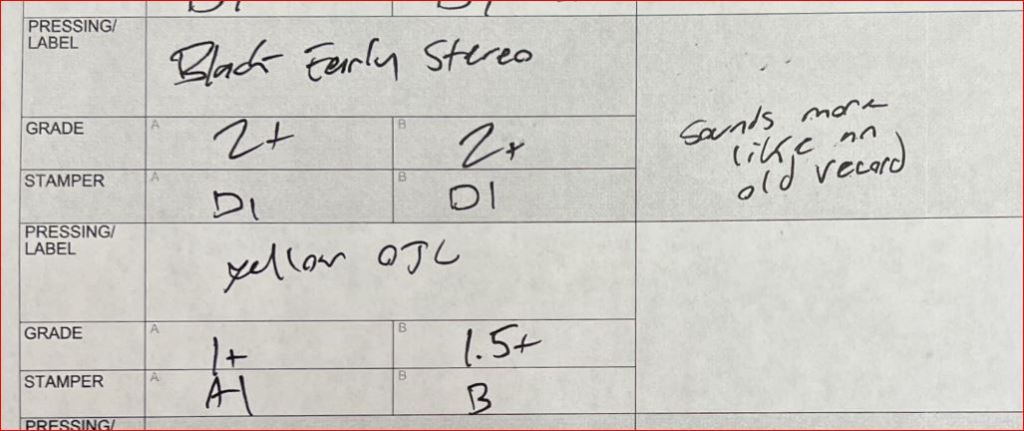
How Does the D1/D1 Jazz Giant Black Label Pressing Sound?

Hot Stamper Pressings of Contemporary Jazz Albums Available Now

Even though the Black label original of Jazz Gianot we played in our shootout held its own well enough, it did suffer from a slight case of “old record” sound.

Head to head with the best vintage reissues, it was a bit crude, didn’t extend fully on the top end, and wasn’t as resolving in the midrange.

The fact that it earned a Super Hot (A++) sonic grade means that it could not have sounded too much like an old record. It was still doing most everything right.

It just had a few sonic shortcomings we recognized were holding it back.

The reissues that beat it in the shootout showed us just how good the album could sound, maybe not night and day better, but definitely better, a full grade better.

The Black Label original we played would still beat the pants off the godawful Analogue Productions Heavy Vinyl pressing that came out in the 90s, the one mastered by the formerly-brilliant Doug Sax.

For those who may not have been collecting back then, we describe in great detail the bad sound of the Heavy Vinyl pressing that AP produced for their version of Way Out West in 1992.

Mobile Fidelity got into the reissue act in 1994, making murky-sounding records on 200 gram vinyl and calling them Anadisqs.

Classic Records started producing their bright, screechy reissues of Living Stereo titles that year as well.

It seems a lot of bad sounding records were being made back then!

Is it any different now? (If it is, please contact me at tom@better-records.com and tell me what you think the differences are. I am at a loss after playing these six Heavy Vinyl titles in 2024 and finding that all of them fell well short of the mark. What mark is that, you ask? Why, the mark set by their vintage counterparts.)

(more…)

Lincoln Mayorga Volume 1 and Obvious Pressing Variations

Hot Stamper Pressings of Direct-to-Disc Recordings Available Now

After doing our first shootout many years ago for the record that single-handedly introduced the audiophile community to Direct to Disc recording, Lincoln Mayorga and Distinguished Colleagues, Volume One, I have to confess I was taken aback by the significant pressing variations we heard among the copies we played, 

These LPs are all over the map sonically.

Some Sheffield pressings are aggressive, many of them are dull and lack the spark of live music, some of them have wonky bass or are lacking in the lowest octave — they are prey to every fault that befalls other pressings, direct to disc and otherwise.

Which should not be too surprising. Records are records. Pressing variations exist for every album ever made. If you haven’t noticed that yet, start playing multiple copies of the same album while listening carefully and critically. If your stereo is any good at all, it should not take you long to notice how different one record sounds from another in practically every case.

Biggest problems on S9?

I would have to say smear is Number One.

When the brass loses its bite and the bells don’t have the percussive quality of metal being struck, this is not a good thing. The band also seems to lose energy when the pressing suffers from smear.

Number Two would be a lack of top end extension.

The harmonics of the sax and trumpet are muted on some copies, and the harpsichord really suffers when the top end isn’t all there. This lack of extension is most noticeable on all the lovely bells and percussion instruments that pepper the soundstage, but you can actually hear it on practically every instrument once you recognize the problem. It’s there on guitar harmonics, cymbals and snares, and on down the list.

Linked here are other records that are good for testing these same shortcomings:

(more…)

Turntable Setup Guide Part 1: Updated

Robert Brook runs a blog called The Broken Record, with a subtitle explaining that the aim of his blog is to serve as:

A GUIDE FOR THE DEDICATED ANALOG AUDIOPHILE

We know of none better, outside of our own humble attempt to enlighten that portion of the audiophile community who love hearing music reproduced with the highest fidelity and are willing to go the extra mile to make that happen.

Here is Robert’s latest posting.

Turntable Setup Guide Part 1: UPDATED

Nothing will bring you as much joy as when you manage — by whatever means, probably against all odds — to make significant audio progress. (Just ask our good friend Bill S. how he feels about his stereo sounding so much better.)

The more progress you make, the more enjoyment you will get from your favorite music.

(more…)