snare-test

Ravel and Ansermet Produce The Best Bolero on Vinyl

Hot Stamper Pressings of the Music of Maurice Ravel Available Now

Here are some comments from a Hot Stamper listing we did years ago.

The sound is clear, with wonderful depth to the stage.

As a rule, the classic ’50s and ’60s recordings of Ansermet and the Suisse Romande in Victoria Hall are as big and rich as any you may have ever heard.

These recordings may just be the ideal blend of clarity and richness, with depth and spaciousness that will put to shame 98% of the classical recordings ever made.

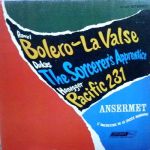
Side One

Bolero (Ravel)

Tubey and clear, with both the snare and the flute coming from so far back in the hall. OUTSTANDING energy and dynamic power.

Turn it up and it really comes to life like LIVE MUSIC. It’s big, wide and believable. We loved it.

Side Two

The Sorcerer’s Apprentice (Dukas)

ZERO compression. ZERO distortion when loud. Which means it has ZERO compressor distortion, something not five out of a hundred Golden Age recordings can claim. Nice extended top too.

There is depth and richness to beat the band, as well as clarity and tonal correctness that let you forget the recording and just enjoy the music. This piece is not quite as transparent as the Ravel, but still has earned every one of its Three Pluses.

The timbre of the brass is right on the money. As we have noted before, the brass of the Suisse Romande is some of the best to have ever been committed to analog tape.

Again, this side had OUTSTANDING energy and dynamic power the likes of which we think you may never have heard.

La Valse (Ravel)

Boasting some of the best sound of the three works we played on this copy. Again, with that wondrously huge hall adding a sense of space that will allow your speakers to disappear. The performers are not too close, which is very much in keeping with live music.

In his tribute to Ravel after the composer’s death in 1937, Paul Landormy described the work as follows:

“….the most unexpected of the compositions of Ravel, revealing to us heretofore unexpected depths of Romanticism, power, vigor, and rapture in this musician whose expression is usually limited to the manifestations of an essentially classical genius.”

Listening in Depth to Graham Nash / David Crosby

More of the Music of David Crosby and Graham Nash

Presenting another entry in our extensive listening in depth series with advice on what to listen for as you critically evaluate your copy of Graham Nash / David Crosby.

Here are some albums currently on our site with similar Track by Track breakdowns.

This album has some of the BEST SOUND Crosby and Nash ever recorded, but you’d never know that listening to the average pressing. You need plenty of deliciously rich Tubey Magic if this music is going to work, and on that count this copy certainly delivers.

Bill Halverson was the engineer for this album, the man behind the first CSN album and many others.

We asked ourselves: Where in the world did all the midrange magic we were hearing on Graham Nash / David Crosby come from?

On a song like Where Will I Be the sound is so unbelievably transparent, open and intimate, it sounds like an outtake from David Crosby’s first album, one of the ten best sounding rock records ever made. How did Bill Halverson learn how to record as well as Stephen Barncard all of a sudden?

[We were very wrong to disparage Bill Halverson’s engineering skills and will be addressing our error soon.]

(more…)

We Was Wrong about Billy the Kid in 2011

Living Stereo Titles Available Now

The rave review you see below was written in 2011. Recently we played a stack of copies of the album and realized that we was wrong about it.

As you may have noticed, this is a regular feature of The Skeptical Audiophile.

Live and Learn is our motto, and progress in audio is a feature, not a bug, of record collecting at the most advanced levels.

(“Advanced” is a code word for having little to no interest in practically any remastered pressing marketed to the audiophile community. If you want to avoid the worst of them, we will gladly help you do that.)


Our Review from 2011

Super Hot Stamper sound on BOTH sides, with side one so energetic and exciting it would easily qualify as a Demo Disc. This title is almost impossible to find in anything but beat up condition. Records like these got played over and over and few survived the ten grams of stylus pressure and mis-aligned cartridges of the day.  

The Big Sound

Side one is a bit recessed sounding at the beginning but it soon comes to life.

The drums and snares are HUGE in this recording, way at the back of the hall where they belong.

The sound just jumps out of the speakers — believe me, not many Living Stereo pressings from 1958 can do that.

If you like your exciting music to have exciting sound, this pressing will do the trick.

A++ is our grade. The loudest massed string passages can be a bit much, but they are tolerable. Many pressings of this album that we’ve played in the past have pretty much been unlistenable.

Rodeo

So dynamic! — you better have your stereo working at the top of its game or this side is going to be hard to sit through. The close-miked xylophone will give your arm and cart a real workout. If you have precise control over your setup, this may be a good record to fine tune it with. VTA is of course ultra-critical on vintage classical albums such as this.

The quieter passages fare best, showing off the Living Stereo Tubey Magic to full advantage.

Hoe-Down sounds like it may be slightly worn; either that or its got some compressor distortion problems.

With Big Bold sound such as this, the engineers had to walk a very fine line in order to balance the dynamic power of the music without letting the quietest passages disappear. (Nowadays loud orchestral music is either dynamic and shrill or compressed to death.)

(more…)

Rockin’ the Fat Snare on Dreams

This is a rock album — it needs to be played loud and it needs to be played on a dynamic system.

What do the best copies have that the also-rans don’t?

Lots and lots of qualities, far too many to mention here, but there is one you may want to pay special attention to: the sound of the snare.

When the snare is fat and solid and present, with a good “slap” to the sound, you have a copy with weight, presence, transparency, energy — all the stuff we ADORE about the sound of the best copies of Rumours.

Next time you are on the hunt to buy new speakers, see which ones can really rock the snare on Dreams. That’s probably going to be the speaker that can do justice to the entire Rumours album, as well as anything by The Beatles, and Neil Young’s Zuma, and lots of other favorite records of ours, and we expect favorites of yours too.

Side One

Dreams

The drums that open this track and the one monster cymbal crash at the beginning are PERFECTION on the best pressings. If you took ten copies of this album and just played that cymbal crash, I’m guessing you could tell the difference in the sound of every copy. If that cymbal crash doesn’t splash you in the face like a bucket of cold water, you do not have a killer copy. It’s way out front in the mix and that’s the way they want it.

Ideally the bass is very prominent on this track. It should be way up in the mix, loud, tight and note-like, with the guitar and kick drum clearly separated. It absolutely drives the song; the copies that got the bass right on this track really came to life. If you want to know why Fleetwood and Mac are revered as one of the all-time great rhythm sections, this song should provide all the evidence you need. (Try Werewolves of London if this song doesn’t convince you. Same sound too.)

Listen for Stevie Nick’s humming before she starts to sing. On the good copies it’s quite clear.

Punchy bass and punchy drums are key to the best sounding copies of Rumours.

What to Listen For in General

(more…)

Listening in Depth to Blood, Sweat and Tears

More of the Music of Blood, Sweat and Tears

Reviews and Commentaries for Blood, Sweat and Tears

In my opinion this is the BEST SOUNDING rock record ever made. Played on a BIG SPEAKER SYSTEM, a top Hot Stamper pressing is nothing less than a thrill, the ultimate Demo Disc.

Credit must go to the amazing engineering skills of ROY HALEE. He may not be very consistent (Graceland, Still Crazy After All These Years) but on this album he knocked it out of the park. With the right copy playing on the right stereo, the album has the potential to sound like LIVE MUSIC.

You don’t find that on a record too often, practically never in fact. I put this record at the top of The Best Sounding Rock Records of All Time.

TRACK LISTING

Side One

Variations on a Theme by Erik Satie (1st & 2nd Movements)

The song is always going to be plagued with a certain amount of surface noise. A solo guitar opening on a pop record pressed on Columbia vinyl from the ’60s? A brand new copy would have surface noise, so it’s important to not get too worked up over surfaces that are always going to be problematical.

Smiling Phases
Sometimes in Winter

This shootout taught me a lot about this track. There is a huge amount of bass which is difficult to reproduce; the best copies have note-like, controlled (although prodigious) bass which is a very tough system test.

Having said that, what separates the killer copies from the merely excellent ones is the quality of the flute sound. When you can hear the air going through the flute, and follow the playing throughout the song, you have a superbly transparent copy with all the presence and resolution of the best. If the flute sounds right, Katz’s voice will too. The sound will be Demonstration Quality of the highest order. Want to shoot out two different copies of this album on side one? Easy. Just play this track and see which one gets the flute right.

By the way, we LOVE the version of this song that Sergio Mendes does on Stillness. Eric Katz is a decent singer; the two girls in Brazil ’66 are SUPERB singers. The fact that they are female, that there are two of them and that they can harmonize as beautifully as any two singers you’ve ever heard allows their version of the song to have qualities far beyond the boys in Blood Sweat and Tears. But the BS&T guys make up for it by being REAL JAZZ MUSICIANS. Most of this album is real jazz played by top notch players. No other successful pop album to my knowledge can make that claim. In that sense it’s sui generis. But it’s unique in other ways as well, not just that one.

(more…)

Listening in Depth to It’s Like You Never Left

More of the Music of Dave Mason

The first track on side one, Baby…Please, has huge bass and is very rich.

Check out the sweet vocals on the second song, Every Woman, and the Tubey Magical richness of track three, If You’ve Got Love.

On side two note how big the piano sounds, and how much space surrounds it.

Then in comes the solid snare, followed by rich, meaty horns; breathy, silky vocals, and big guitars.

This album is very well recorded and you don’t need a pair of golden ears or a state-of-the-art system to hear it — assuming you have a great copy like this one.

If you don’t have a good copy of the album, no amount of money spent on stereo equipment is going to get this album to sound the way it should.

I Was a Fan in 73

I was a big fan of this album when it came out in 1973. I used to play it all the time in fact. Now I hear why – it’s big and rich with a solid bottom end and a smooth, sweet top, perfect for the big but not especially sophisticated speakers (the Fulton J System) I had back in the day.

This album has the kind of sound that the typical CD wants nothing to do with. Not that the Compact Disc couldn’t pull it off — there are good sounding CDs in this world, I own hundreds of them — but it doesn’t seem to want to even try.

Graham Nash helps out on vocals on tracks one, two and five on the first side.

Stevie Wonder plays a lovely harmonica solo on The Lonely One on side two, and George Harrison guests on guitar on If You’ve Got Love, the third track on side one. (more…)

We Happily Admit the Originals of Time Out Are (Potentially) the Best Sounding

More of the Music of Dave Brubeck

This time around [2014] no other copy of Time Out could touch our good Six Eye Stereo pressings. They were simply in a league of their own.

If you’ve been with us for a long time you may remember that this was not always the case. We used to really like some 360s as I recall, as well as the original mono pressing. This time around, not so much. 

This time around most everything is different. Allow us to explain.

1. Our stereo is different; we’ve made quite a number of changes to it since our last big shootout for Time Out a few years back. We are strong proponents of making audio progress.

2. We’re different; we have better (I would hope) listening skills. In fact I’m sure we listen for different qualities in a recording than we might have years ago.

3. Even more importantly, we don’t have the same pile of pressings we had years ago. They’re gone, replaced by a new batch. This new batch had some killer original pressings, some good 360s, and not much to speak of on the later labels. 

With a different batch we might have found a great sounding 360 pressing; we have to believe they exist, and we certainly can’t say that our best copy here could not have been bettered in some way. That would be foolish; anything can be bettered.

The next time we run this experiment, the results could be different.

[Update from 2021: we have run the experiment a number of times in the five years since this commentary was written, and the best Six Eye in the shootout has not been beaten yet. Yet.]

For us, in 2014 (and probably through 2015), this is it.

This is the right sound.

(more…)

Blood Sweat and Tears – The 30 Second Spinning Wheel Test

Hot Stamper Pressings of the Music of Blood, Sweat and Tears Available Now

This test is found in the track commentary for side two of our Hot Stamper listings for the album.

If you think you have a hot copy, see if yours does what our best copies do.

We also think that a record like this — a dynamic, full-spectrum recording, not overly concerned with detail — makes a much better Test Disc than the kind most audiophiles seem to prefer.

Patricia Barber it is not.

If you’re in the market for new speakers, take this record — or one like it — with you to the audition. Any speaker that can play this record properly deserves your consideration, or at the very least your respect.

In my experience not many speakers have what it takes to do this album justice.

The Blood, Sweat and Tears Spinning Wheel Test 

The first thirty seconds are key. Here is what you should be listening for.

Piano, Cowbell, Snare

Side two starts off with a bang; note that the piano has real weight to it right from the git go. When the cowbell comes in it should not sound muffled in any way (it’s a bell, don’t you know), quickly followed by the solid-as-a-rock-snare (the best on record.)

The Brass

On the killer copies that first blast of brass will be completely free of grain or grunge, yet the brass instruments themselves (trumpets and trombone) have all their leading edge transients, their “bite,” fully intact. They’re not in any way muffled or smeared, yet the sound is never aggressive. If anything, the brass is so free from distortion and so tonally correct it should actually sound smooth.

The Vocals

Some of the vocals on side one can have a bit of honk or edge, but not here. They are natural, rich and sweet as any you will hear on the album.

Bottom End Energy

And don’t forget that there is a tremendous amount of bottom end throughout the song. It’s the very foundation of the music, and it needs to be reproduced properly, no ifs, ands or buts, as in “but I only have a small speaker”. To play this song you need big woofers and lots of them. Small speakers simply make a mockery of this music.

If you’ve ever heard big band up close, you know that there is not a speaker in the world that can do justice to that sound. It’s too big and it’s too powerful. But some speakers do more justice than others, and in my experience those speakers tend to have large cabinets with plenty of dynamic drivers. If you have a system built around such speakers there is a very good chance that this will be the best sounding record you have ever heard, assuming you have one of our Hot Stamper pressings or a good one of your own. If not, we would love to get you one. You won’t believe the sound.

Now You Try

Play your own copy. Everything you need to know about the sound of your LP can be heard in the first thirty seconds of side two.

On the Hot Stampers it’s all there. On most copies, however, the reverse is true: Problems raise their ugly heads right off the bat.

Thinness, grain, smearing, bloat, edginess — all the failings that records are heir to will be thrown in your face if your copy is not up to snuff, and not many of them are.

Watch What Happens – Now That’s What a Real Drum Kit Sounds Like!

Another Record We’ve Discovered with (Potentially) Excellent Sound…

and One We Will Probably Never Shootout Again

Some records are just too consistently noisy for us to offer to our audiophile customers no matter how good they sound.

We have a section for records that tend to be noisy, and it can be found here.

This is the most realistic drum kit I have heard on a non-jazz album in my life. The drum sound on the first track is exactly the sound we all know from hanging around small clubs and our friends’ garage bands. There is simply no audible processing on any part of the kit. The drums are centered behind the vocals and lead instruments, with what sounds like to me the barest of miking, surrounded by just the right amount of unbaffled studio space.

When the drums come in on the first track on side one you will hear immediately what I mean. The third track on side two has especially good drums as well. The vocals on that third track, Message to Michael, are some of the most natural on the album as well. Lena can strain a bit on some songs in the loudest passages, but on others she can belt it out and stay clean all the way to the top. Listen track by track to hear how well she holds up when the bigger choruses come in.

As music lovers and audiophiles this was a truly marvelous discovery for us years ago. True, we’ve known about the album for a long time, but as a practical matter it’s been impossible to find enough clean copies to do a shootout — until now of course.

Dave Sanders, a name I — and no doubt most audiophiles — was not familiar with, brilliantly engineered the album as well as other favorites of ours, including Szabo’s 1969, Gilberto’s Windy and McFarland’s Does The Sun Really Shine On The Moon? It’s hard to find a recording he did that isn’t full of Tubey Magic, huge studio space and right-on-the-money instrumental timbres. (more…)

Dexter Gordon Knocked Us Out All the Way Back in 2007

Hot Stamper Pressings of Blue Note Albums Available Now

[Some text has been altered, mostly the overuse of capitalization.]

This Blue Note LP is without a doubt one of the best sounding jazz records we’ve ever heard. We were auditioning a bunch of jazz records today (4/25/07), and when the needle hit the grooves on this one we were absolutely blown away.

I can’t think of one jazz record we’ve ever played here at Better Records with this kind of whomp. Everything here is so rich and full — nothing like a typical Blue Note album.

Both the sax and the trumpet sound unbelievably good — airy and breathy with lots of body and clearly audible leading edge transients. It’s hard to find a Blue Note where the horns aren’t either too smooth or too edgy, but here they have just the right amount of bite. The overall sound is open, spacious, tonally correct from top to bottom and totally free from distortion. We’ve heard good copies of this album before, but this one is magical.

The presence and immediacy on this copy are stunning. Just listen to the snare drum at the beginning of Coppin’ The Haven — it sounds like someone is bangin’ that thing right in your living room.

We’ve never heard a Blue Note with this kind of clarity, this kind of transparency, and this much life. We rate it an A+++ on both sides — Master Tape Sound, As Good As It Gets.

This copy has the power of live music. When we turned it up loud, it was as if we were right up front at one of the best jazz concerts imaginable. The music is every bit as good — soulful hard bop played superbly and passionately.

Just listen to Donald Byrd blowing his lungs out on his own Tanya, or Gordon’s lyrical solo on Darn That Dream — these guys are pros at the top of their game.


Further Reading