
regular-shootouts

As explained in these commentaries, regular shootouts are the best way to improve the sound of the albums in your collection.

So You Actually Think an OJC Can Beat an Original Black Label Contemporary?

Hot Stamper Pressings of Contemporary Jazz Albums Available Now
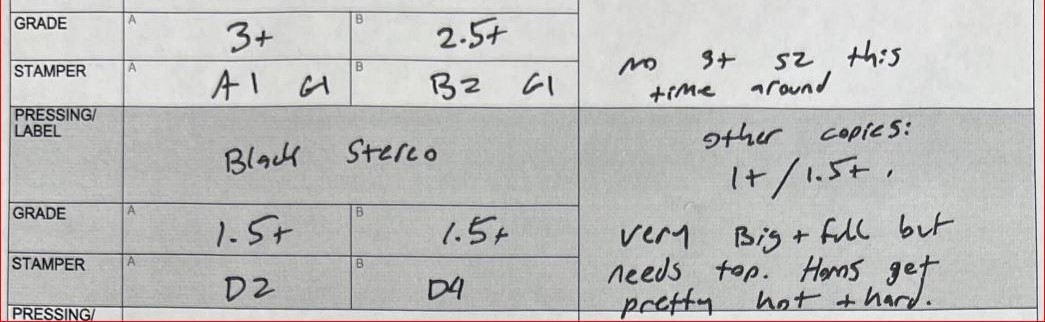
Yes, we think that, because that’s what the evidence from our most recent shootout in 2025 showed us.

As you can see from the stamper sheet below, the A1/B2 stampers of our OJC, in a blinded test, came out on top.

Better mastering equipment? Better mastering skills? Better vinyl? Better pressing methods?

Who the hell knows?

Better yet, what audiophile or record collector with a lick of sense would even pretend to know?

Not us, that’s for sure. At this point we are very comfortable not having answers for the unanswerable questions we posed above.

But don’t rush off to buy the OJC of the Sonny Rollins record you see pictured. This commentary has nothing to do with that record. For now we’re keeping the title a mystery, consistent with the idea that we give out lots of the bad stampers on this blog, but rarely do we give out the good ones. (That said, here are some of the stampers that win shootouts, and we expect to be posting more soon, mostly for records we can no longer do shootouts for due to: 1.) a lack of interest, or 2.) unacceptably high costs for the best pressings, or 3.) or the fact that we are simply unable to find pressings that play quietly enough for audiophiles.)

So why is it that you can’t tell us the title of this record?

The cost of discovering the right stampers (aka R&D) is usually high, can sometimes take decades, and is fundamentally at the heart of how we make our money: by taking pressings we hope to be good, cleaning them up, playing them, and offering only those that actually do sound good, regardless of when they were made, who made them or why.

Once the shootout is done, the time for hoping and guessing is over. We have the evidence, and in our world that is the only thing that counts. That evidence may be provisional — we could prove ourselves wrong with the next shootout, and there have been times when that has happened — but for now this is the best information we have to work with.

Key Takeaways for this Mystery Record

  • We did not have enough copies with the right stampers to find a 3+ side two. (The other copies earned grades of no better than 2+/2+.)
  • Which simply means that if we’re not hearing faultless or nearly-faultless sound on one side or another, the sound is not White Hot and does not deserve a 3+ grade. Fair’s fair after all.
  • The original pressing you see with D2/D4 stampers had some of that “old record” sound we find on far too many vintage pressings.
  • True, it was very big and full, but lacked top end, causing, among other things, the horns to get hot and hard.
  • Who wants to listen to a Sonny Rollins famous classic jazz record with horns that don’t sound right?

(more…)

Letter of the Week – “Here is where the life and groove of the music is!”

Hot Stamper Pressings of the Music of Crosby, Stills, Nash and (Sometimes) Young

One of our good customers had this to say about some Hot Stampers he purchased recently:

What a batch of records! I just finished playback last night.

It only occurred to me afterwards that some of these titles I had only heard on compact disc or streaming, I thought I knew this music but the Hot Stampers – particularly Aja and CSNY So Far – defied me.

Here is where the life and groove of the music is! The digital formats have been calling my attention to all the wrong details.

I could go on and on. All eight titles are a knockout. Close To The Edge is a monster – the presentation is massive, and I’m sure my system isn’t doing it full justice, but I love this record and it’s by far the best I have ever heard it.

Thanks again to the Better Records team for everything you do – for this music lover it’s manna from heaven.

Cheers,

Austin

Austin,

Yes, you are so right about the digital formats. They get the sound of classic albums wrong by drawing your attention to recording details at the expense of the flow and drive and energy of the music.

As for So Far, I am a huge Crosby, Stills and Nash fan — the first album being life-changing to a 15 year old music lover such as myself, on 8-track tape in the car no less — and my ardor never flagged in all the years that have gone by since then.

It seems that there are some albums that will last you a lifetime — the first two albums, produced in 1969 and 1970, are still right at the top of my All Time Favorites.

Close to the Edge is a monster and always has been. I listen to it regularly, along with The Yes Album and Fragile. What a run of albums they released before hitting a wall with Tales of Topographic Oceans in 1973.

Aja is record I have been writing about for decades. It’s often an overblown mess, on vintage and modern pressings alike.

The copies that do well in our shootouts are the ones that are coherent, where the over-production suits the songs and does not draw too much attention to itself.

(more…)

Living and Learning Is How the Game Is Played

Hot Stamper Pressings of the Music of Elton John Available Now

A classic case of live and learn.

Scroll down to read more about what we learned from a big shootout we did many years ago for the Self-Titled album.

To illustrate how the game is played, we’ve copied some of the previous commentary into this listing to clarify how our understanding had changed from 2004 to roughly 2010, which is when all the comments you see below were written.

Live and Learn, Part One

These domestic original pressings have the very same stamper numbers as the British pressings. It appears that the metalwork was produced in England and shipped to America for pressing on domestic vinyl. What’s strange is that the American pressings are consistently brighter than the British pressings. Why this should be is a mystery, but I have a theory to explain it. The British stampers are used to make British LPs on that lovely see-through purple vinyl, and I’m guessing that that compound is a little smoother sounding than the vinyl that Uni uses. Either that or there is some other way that Uni produces their records so that they end up being brighter, even using the exact same stampers as the British ones.”

Partly true.

We have five British copies in stock, and the reason they don’t sound as good probably has less to do with British vinyl and more to do with the fact that the British ones we have are not the stampers we like the best. The domestic pressings with our favorite stampers have more highs and better highs and just plain sound better to us now.

Notice how I completely contradict myself below, yet both listings were up on the site all this time and nobody, especially me, seems to have noticed.

Live and Learn, Part Two

These original British pressings, with the lovely see-through purple vinyl, are the only good sounding versions of this album that I have ever heard. As you can imagine they are extremely difficult to come by in clean condition.

What is there to say about such a bald-faced turnabout?

Simple. We make our judgments based on the records we have on hand to play. When better pressings come along, or our equipment has improved to the point where we can appreciate other pressings, we will happily and unhesitatingly report what we hear.

The Best Version?

(more…)

One of The Most Tubey Magical Rock Recordings of All Time

Hot Stamper Pressings of Psychedelic Rock Recordings Available Now

This is some of the best High-Production-Value rock music of the 70s. The amount of effort that went into the recording of this album is comparable to that expended by the engineers and producers of bands like Supertramp, Yes, Jethro Tull, Ambrosia, Pink Floyd and too many others to list.

It seems that no effort or cost was spared in making the home listening experience as compelling as the recording technology of the day permitted. (Of course, as it turns out, recording technology only got worse as the decade wore on, and during the 80s the sound of most recordings went off the proverbial cliff.)

Big Production British Rock just doesn’t get much better than A Space in Time.

Just listen to the guitar solo on Let The Sky Fall. It comes complete with layer upon layer of guitars, acoustic and electric, with some backwards guitar thrown in for good measure. And that’s just the guitar parts. This kind of dense aural soundscape, presented with so many carefully placed elements from side to side and front to back, makes repeated listenings especially rewarding.

No matter how many times you play the album, you are likely to hear (and hopefully appreciate) something new in the mix. I’ve been playing ASIT for forty fifty years (bought my copy when I was still in high school) and I heard lots of things this time around I never knew were there. This is why we keep improving our systems, right? There is never going to be a time when these nearly forty more than fifty year old recordings have nothing new to offer.

Their Only Essential Album

By the way, this was the first Ten Years After record I bought, and I liked it so much I went out and bought many of their other albums, only to find that none of those albums are anything like this one. None of them sound particularly good; none of them are particularly well produced; and, worst of all, most of the music is fairly forgettable British Blues Rock.


Want to find your own killer copy?

Consider taking our moderately helpful advice concerning the pressings that tend to win our shootouts.

As of 2025, shootouts for this album should be carried out:

How else can you expect to hear this record at its best?

Based on our experience, Bad Company sounds its best:

(more…)

Mobile Fidelity Actually Produced a New and Improved Deja Vu in 1983

Hot Stamper Pressings of the Music of Crosby, Stills, Nash and (Sometimes) Young

A letter came to us years ago with the comment “I had no idea that vinyl could produce this sound.”

As the time I made some of the following comments in reply and have added a few new ones since then.

Deja Vu is indeed a very special album, one I have been obsessed with since I first became an audiophile.

I was a big Crosby, Stills and Nash fan already — the first album being life-changing to a 15 year old music lover such as myself, playing over and over on 8-track tape in the car no less — so it was only natural that I would fall in love with Deja Vu when it came out in 1970.

13 Years Go By

Time went by and then, oddly enough, my love for the music was reignited by a pressing that came out 13 years after the album’s first release, on a label you may be familiar with, Mobile Fidelity Sound Labs.

I realized instantly that Mobile Fidelity had indeed improved upon the average original’s sound.

This is not a high bar considering how awful sounding most originals are, but let us give credit where credit is due. With the volume cranked good and loud,  I often played the first track, Carry On, using the MoFi pressing to demonstrate how smooth, rich, big, powerful and dynamic my system could sound.

“The CD may be taking over the world,” I would say, because by 1983 that was exactly what was happening, “but you”ll never hear a CD that sounds like this!”

13 More Years Go By

It would take me many years, at least another 13 or so, to come across the domestic reissues that trounced the MoFi and showed me how colored, compressed, thick, blurry and recessed their pressing was.

Here is the real shocker from that time: I actually thought that the extremely hard-to-find reissue I’d discovered was so flukishly good that it could never be beaten by any other pressing!

(To be fair, my long-time audiophile buddy Robert Pincus probaby deserves the credit for finding it. He found a great many special pressings for me back when I was buying records from him, reaching all the way back to 1987.)

Which is yet another example of everything being relative. I admit I had a poor understanding of that vitally important concept at the time. I really had no idea how good a recording Deja Vu was, and I didn’t really have a way to find out because many of the most important revolutions in audio had not been incorporated into my system, or had yet to be invented.

Within the last five years or so another domestic pressing, and now most recently an import (!), have come to be seen as clearly superior to all of these.

This is the result of having never given up the search for a better Deja Vu.

Record Collecting in My World

Anticipating the release of the newest Half-Speed remastered pressing that would deliver me from the evils of the garden-variety domestic or import LP I happened to own was the dominant feature of my record collecting world in the 70s and 80s.

No one reading this blog will be surprised to learn that almost none of those “new and improved” pressings would pass the test of time. This is an idea I first came to appreciate in the 90s and one that has become more true with each passing year.

With the increasing proliferation of one Heavy Vinyl mediocrity after another, in 2007 we finally recognized we had a duty to our customers to stand athwart audio history and yell “Stop.”

(more…)

Falla / Three-Cornered Hat / Argenta

Hot Stamper Pressings of the Music of Falla Available Now

In our review from 2010, we wrote:

Falla’s Three Cornered Hat is positively WONDERFUL on this copy (A++), and the Sinfonia Sevillana by Turina on side two is every bit as good. The second suite on side one is particularly lovely — check out how rich and full the sound is.

Side two has a HUGE soundstage, as wide as they come. The sound is very rich and full of audiophile colors — this is the kind of record that you’re going to love playing for your audio pals!  

Argenta brings the authentic Spanish flavor out in these works. Like so many audiophile reviewers have over the years, you may find these performances definitive.

The strings on the first side are a bit dry to start, like the sound many of you will recognize from Mercury’s classical records. Still, there’s much to like about the sound and you’ll have a very hard time finding a copy that’s any better. Most pressings do not have such an extended top end, and that quality here really brings this music to life.


UPDATE 2025

We played a copy of CS 6050 not long ago and were not at all pleased with the sound. You can read more about it here.

Is the London a good album or a bad one? We can’t say for sure, but we suspect the latter.

Were we wrong? Probably.

The De Burgos performance for EMI in 1964 and the Ansermet for Decca from 1961 are both better recordings and our two current favorites, with the Ansermet getting the nod due to its wonderful recording energy and its exciting performance. There are about 150 orchestral recordings we think offer the best performances with the highest quality sound. Both are  deserving of a place on that list.

(more…)

We Was Wrong about Presence

Hot Stamper Pressings of Led Zeppelin’s Albums Available Now

My history with Led Zeppelin’s seventh album is a classic case of me mistakenly blaming the recording.

In our listings for Presence from about fifteen years ago (a lifetime in audio, at least for us) we noted:

“By the way, Royal Orleans (at the end of side one) never sounds good; it’s always grainy. Same story with the intro to Nobody’s Fault But Mine. It sounds like groove damage, but since it’s on every last one of our domestic copies (the only ones that have the potential to sound amazing in our experience) we know it has to be a pressing problem and not a problem with the individual copies. It’s a shame, but the rest of the songs here all sound amazing.”

This is no longer true, or at least the part about Nobody’s Fault But Mine being grainy or distorted isn’t, since I didn’t test Royal Orleans this time around.

I had just put in a fresh Dynavector 17d3 two days before and spent almost three hours getting the setup dialed in. In fact, it was so right when I was done that I spent the next three or four hours experimenting with room treatments.

When I was done the changes seemed to have opened up the sound and increased the transparency even further. (I went a little too far and had to dial it back a bit, but that’s not at all unusual in my experience.)

Wait a Minute

So now I’m reading about the problems we used to encounter with Nobody’s Fault and thinking to myself, “Wait a minute. I didn’t hear any grain or distortion. Not on the good copies anyway.”

Of course the reason I hadn’t heard those problems is that over the last year or so we’d fixed them.

How I don’t really know.

Maybe the main improvements happened just last week with the cartridge being dialed in better.

Or maybe it was that in combination with a few new room tweaks.

Or maybe those changes built upon other changes that had happened earlier; there’s really no way to know.

(more…)

A Pink Label Island LP Left Us with Egg on Our Face

Hot Stamper Pressings of the Music of Traffic Available Now

We used to think that The Best of Traffic had better sound than the early pressings of Mr. Fantasy, but in a head to head comparison with a killer copy we played not long ago, we were proved wrong, or, perhaps more accurately, we proved ourselves wrong, something we pride ourselves in being able to do by carrying out regular shootouts for records we’ve been listening to for more than twenty years.

Oddly enough, in our shootouts we often learn new things about records we thought we knew well.

Here is what we had to say about one of the tracks on Mr. Fantasy that we thought sounded dramatically better on The Best of Traffic back around 2005:

Best evidence: Heaven Is In Your Mind, the second track on side one. It is amazing sounding here and such a disappointment on every Pink Label Island original we’ve played.

Once you know how good that song can sound — by playing a Hot Stamper copy of Best of Traffic like this one — going back to the original version of the song found on the album is not just a letdown, it’s positively painful. Where’s the analog magic? The weight to the piano? The startling clarity and super-spaciousness of the soundfield? The life and energy of the performance?

They’re gone, brother. Not entirely gone, mind you, more a shadow of what they should be, but once you’ve heard the real thing it’s not a lot of fun listening to a shadow.

You can be sure that we did not know what we were talking about when we wrote all that.

What we had done is assumed that all the pink label pressings of Mr. Fantasy sounded like the one we played, something we’ve been telling audiophiles for twenty years not to do, because collecting records by label is a fool’s game.

In this case, clearly we are the fools.

It probably — probably, since all the evidence points in the same direction — had the stampers you see below, apparently known as an Orlake Pressing, something I knew nothing about until reading about it on Discogs just now.

  • Matrix / Runout (Side A, stamped): ILPS+9061+A
  • Matrix / Runout (Side B, stamped): ILPS+9061+B

These same stampers would be used to press the Pink Rim Label copy you see below. We put it into a recent shootout and described it as having “hollow, dubby” sound.

Yes, we heard the very same “dubby” sound on a copy we played about twenty years ago, and thought all the early pressings on Island, pink and pink rim alike, had these same mastering shortcomings.

Back then we didn’t know what we know now, which is that the right UK pressings on Island of Mr. Fantasy are dramatically better sounding.

In fact, they handily win our shootouts, something they have been doing for at least the last ten years or so.

We’ve run into so many sonically-flawed Pink label Island pressings by now that hearing one sound lackluster if not actually awful doesn’t phase us in the least.

Some of the other pink label Island pressings that never win shootouts can be found here.

But before that, back in the dark days of the early 2000s, we clearly were lacking a comprehensive understanding of the sound of the various UK pressings of the album.

There was a great deal of research and development left to be done. Eventually our efforts led to a breakthrough in 2006.

For more than twenty years, this is the kind of work we have undertaken. Why? Because we get paid to do it.

We may be the most knowledgeable experts on the planet when it comes to the best sounding pressings of audiophile-quality recordings — if we’re not I’d like to know who is, and how they came by that information — but that doesn’t mean we know it all.

If we come across that way, it’s the result no doubt of our enthusiastic responses to the hundreds of amazing records we’ve had the pleasure to hear. For example, here’s one, and of course there are literally hundreds and hundreds of others with similarly over-the-top notes. Allow me to apologize for any misunderstanding our commentary may have caused.

One thing we do know: all knowledge, of records or anything else you care to name, is provisional.

If somehow we did know it all, there would not be a hundred entries in our live and learn section.

We regularly learn from our mistakes — like the record reviewed here — and we hope you do too.

However, we learn things from the records we play — not by reading about them, but by playing them. Our record experiments, conducted using the shootout process we’ve painstakingly developed and refined over the course of the last twenty years, produces all the data we need: the winners, the losers, and rankings for all the records in between.

We’ve achieved our results by purposefully ignoring everything there is to know about a record — who made it, how they made it, when they made it — everything, that is, but the sound coming out of the speakers of our reference system.

(more…)

Letter of the Week – “I had no idea that vinyl could produce this sound.”

Hot Stamper Pressings of the Music of Crosby, Stills, Nash and (Sometimes) Young

One of our good customers had this to say about some Hot Stampers he purchased recently:

Hey Tom, 

Tom, I just listened to the White Hot Stamper (A+++) CSNY album.

Amazing. I had no idea that vinyl could produce this sound. Worth every penny.

The sound at low volume is amazing. The sound at high volume is spectacular.

The clarity, the depth, the soundstage are very rich and alive with color and presence.

Thank you! I am now going to investigate your piece on the cleaning process.

Rocco

Rocco,

Glad you liked this copy as much as we did! Deja Vu is indeed a very special album, one I have been obsessed with since I first became an audiophile.

I was a big Crosby, Stills and Nash fan already — the first album being life-changing to a 15 year old music lover such as myself, on 8-track tape in the car no less — so it was only natural that I would fall in love with Deja Vu when it came out in 1970.

Years went by and then, oddly enough, my love for the music was reignited by a pressing that came out 13 years after the album’s first release, on a label you may have heard of, Mobile Fidelity.

I realized instantly that Mobile Fidelity had indeed improved upon the average original’s sound. (Not a high bar considering how awful sounding most originals are.)

It would take me and my staff many years, at least another 13 or so, to come across the domestic reissues that trounced the MoFi and showed me how colored, compressed, thick, blurry and limited it was.

(more…)

The Warm Moods – The Reissue Is So Good, How Can the Original Be Better?

Our review from years ago for the Discovery reissue of The Warm Moods can be found below.

We loved the sound, so much so that we found it hard to fault.

Imagine our surprise when we discoverd that that the original was clearly better.

Much better. At least a full grade better.

When we did the shootout again, a rare (in stereo anyway) original Reprise showed us just how wrong we were.

The best original pressing we found took the sound of The Warm Moods to another level, and a pretty high one at that.

It’s yet another example in which the most important question in all of audio had been overlooked: compared to what?

Who knew the recording could sound any better than the wonderful Discovery pressing we’d played?

(more…)