lacks-tubes

These records badly lack Tubey Magic.

Sibelius / Violin Concerto / Ricci

Hot Stamper Pressings of the Music of Jean Sibelius Available Now

This is a wonderful sounding London Stereo Treasury pressing featuring one of our favorite violinists, Ruggiero Ricci, performing the Sibelius Violin Concerto in D Minor.

The tone of the violin on side one is just right — every nuance of Ricci’s bowing can clearly be heard.

While the violin sounds amazing on side one, the orchestra lacks a bit of weight.

This side is also not quite as Tubey Magical as it could be. In our opinion, however, the violin tone and the incredible dynamics are more than enough to make us want to award this record a fairly high grade.

Side two actually has a bit more fullness, but this also seems to rob the violin of some of its presence. 

(more…)

When I Wrote this Years Ago I Was Being Far Too Charitable

Hot Stamper Pressings of the Music of Chet Atkins Available Now

It’s been quite a while since I played the Classic pressing, but I remember it as nothing special. Like a lot of the records put out by this label, it’s tonally fine but low-rez and lacking space, warmth and, above all, Tubey Magic.

When I wrote that years ago I was being far too charitable.

A remastered pressing of a Chet Atkins recording from 1959 that lacks Tubey Magic is one that is failing fundamentally to understand why it has any reason to exist.

The premise of the modern Heavy Vinyl pressing, as its legions of defenders constantly remind us, is to allow the listener to hear the music as it was meant to be heard — with two added bonuses: better vinyl, and affordable, non-collector prices.

(The dirty little secret of the mid-fi collector market is that affordability, not sound quality, is at the heart of it. The knock on our records is that they are expensive, but how is that relevant to the sound quality of the pressings we offer? A better sounding pressing is a better sound pressing, regardless of its price.)

These newly remastered pressings are meant to offer the music lover the opportunity to hear the true sound of the master tape. This elusive holy grail they will stop at nothing to acquire can be summed up in three words: Master Tape Sound. Or so they think.

(The fact that vanishingly few audiophiles have ever heard a master tape or would know oen if they heard one is an inconvenient truth that must not be allowed to interfere with their righteous desire to own whatever pressing purports to offer it.)

But I digress. Back to Chet Atkins in 1959. Let me sum up my position this way, with a nod to the Brits:

A Living Stereo recording that lacks Tubey Magic is one that has completely lost the plot.

(more…)

More Evidence of Ron McMaster’s Flat Out Incompetence

Hot Stamper Pressings of the Music of Steely Dan Available Now

Reasonably good bass, we’ll give it that, but no top end and no Tubey Magic.

More of Ron McMaster’s handiwork. The result is a record that simply has no reason to exist.

The AVERAGE original pressing sitting in your local record store bin right now for probably all of ten bucks will MURDER this piece of crap. 


UPDATE 2025

It’s been a long time since anybody could buy a clean original of Gaucho for ten bucks! Fifty is the going price at our local stores these days. Worth every penny too.


As we noted for Ron’s remastered Band album:

When you see that little RM in the dead wax of one of these new Heavy Vinyl reissues, you know you’ve just flushed your money down the toilet. There should be a warning label on the jacket: Mastered by Ron McMaster.

It’s only a warning to those of us familiar with his work of course; the general public, and that includes the general audiophile public, probably won’t have much of a problem with the sound of this record, or anything else he does.

He still has the job, doesn’t he? What does that tell you?

(more…)

Don’t Skip the OJC, Put It in a Shootout

Of the three early OJC pressings of West Coast Sound we played recently, only one met our standards. At 2+/1.5+, the sound was good, not great.

One copy earned grades of 1+/1+, which means the sound was passable. The last copy had an NFG side two, which means it was just awful.

(Many of the Heavy Vinyl disasters we’ve been cataloging lately have earned that notorious grade. The unacceptably lo- to mid-fi sound even the better ones offer doesn’t seem to bother the audiophiles who rave about them, however.)

So does side two of the OJC pressing have fairly good sound, merely passable sound, or is the sound hopelessly bad?

In the case of this Shelly Manne album, all three, and the only way we were able to discover that is by cleaning up three of them and playing them head to head with real Contemporary pressings in a blinded experiment.

Obviously we were hoping for better results from our OJCs — only one of the copies we played will turn out to be saleable.

Why did we bother? That old bugaboo the profit motive was all that was needed to make us give the OJC pressings a try. We thought we could make money on them but it turns out that the opposite will happen. Oh well, nothing ventured, noting gained.

More importantly, we are not the least bit shy about coming clean and sharing the results with our readers and customers, especially the part about three identical looking copies with the same stamper numbers all sounding very diffferent from each other.

An added bonus is that side two was worse than side one most of the time. That happens often enough, but nobody but us ever seems to want to talk about it.

If we had had ten OJC pressings to play, we probably would have be able to find at least one or two with a grade of 2+/2+, meaning that George Horn probably did a creditable job mastering the album back in 1984 when he cut it for Fantasy, to sell for the very affordable price of $5.98. It’s most likely the pressing plant that let listeners down.
Needs Tubes

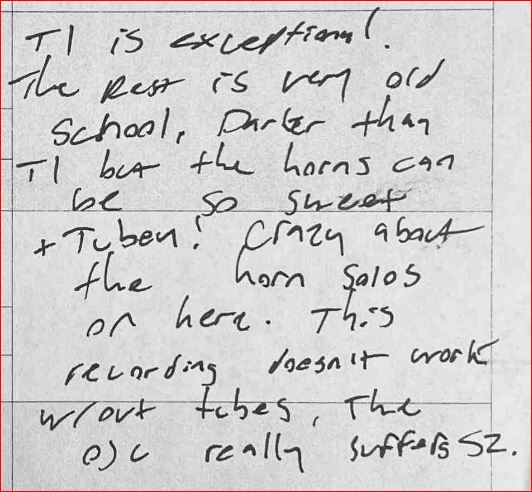
The problem here is that this title needs tubes, or, at the very least, the sound of tubes, and George apparently did not have them, or enough of them, in his mastering chain.

Our specific notes can be seen on the left. We mention that the first track has the best sound (1956 dates), the rest falling short for being darker and more crude (“old school,” some dating from 1953).

The West Coast horn players are the reason to buy this title, with horns that are “sweet and tubey,” but of course to hear that kind of sound you will need a real Contemporary pressing, not an OJC — or anything made in the modern era for that matter.

(more…)

A Disappointing OJC of Swinging With The Mastersounds

Hot Stamper Pressings of Top Quality Jazz Recordings Available Now

UPDATE 2025

We did a shootout for this Mastersounds title many years ago. It didn’t sell very well so we decided to give it a rest for a decade or so.

Recently we got another couple of copies in, including their other album we used to like on OJC, A Date with the Mastersounds, and found none of them to be nearly as impressive as we thought they were back in the day. Some quick notes:

  • A Date with the Mastersounds

Vibes are dry and glassy. Not much Tubey Magic.

  • Swinging With The Mastersounds

Rich but veiled sound. Just OK, not great.

With that said, we still like the music, so if you see one of these pressings for cheap and you like vibes-based jazz from the 50s, pick it up and discover the music of The Mastersounds for yourself.

(more…)

How Is It that the Earliest Pressings from the Tube Era Often Lack the Sound of Tubes?

Hot Stamper Pressings of Music on Island Records Available Now
Please note that the album you see pictured on the left is not the one we are discussing here.

It has been our experience going back many years that the earliest pressings for many records on the Island label are not very good.

To be fair, this one — again, not Mr. Fantasy — is not a bad sounding pressing.

With grades of 1.5+ on both sides, it fits comfortably in our section for good, not great sounding LPs. But the right reissues are a big step up in class sonically. They’re the ones that win shootouts, not these Pink Label LPs.

It’s big and clear but dry and spitty and badly needs tubes — or the sound of tubes — in the cutting chain.

That’s not supposed to happen, the early pressings are supposed to be the most Tubey Magical ones, with the reissues being less Tubey Magical — but in the world of records, when has that rule of thumb ever counted for anything?

Been There, Done That

We’ve run into so many sonically-flawed Pink Label Islands by now that hearing one sound lackluster if not actually awful doesn’t phase us in the least. Some of the other Pink Labels that never win shootouts can be found here.

(more…)

Jimmy Page Makes a Mess of His Masterpiece

Hot Stamper Pressings of the Music of Led Zeppelin Available Now

In 2022 Geoff Edgers contacted me to find out what the story was with these so-called Hot Stampers we were selling, the ones that had so many audiophiles up in arms.

I told him our records will beat anything he can find to throw at them, so we arranged to meet at my studio and play anything he wanted to hear.

He brought with him three well known titles to play on our reference system in order to get my reaction to the sound of some of the Heavy Vinyl pressings that had found favor with reviewers and the audiophile community in general, including the 2014 remaster of Led Zeppelin II (excellent), the remaster of Brothers in Arms that Chris Bellman cut, released in 2021 (also excellent, review to come), and last and definitely least, the pricey Craft Recordings remaster by Bernie Grundman of Lush Life (astonishingly bad, review coming).

What shocked me about the sound of the Led Zeppelin II that Geoff brought over to play was how big, dynamic, present and alive it was. It sounded like a real record, not one of these remastered fakes.

At the time, it was simply not part of our experience to play a Heavy Vinyl pressing with those qualities.

We’d heard hundreds of them (and reviewed 330 on this blog as of 5/2025) that were small, flat, compressed, veiled and lifeless, but big, dynamic, present and alive were qualities we’d only experienced when playing the carefully-cleaned, properly-mastered, curated-for-sound-quality pressings we sell as Hot Stampers.

In fact, those are some of the very qualities that confer the status of Hot Stamper to a record during a shootout. That’s exactly what we’re listening for.

Houses of the Holy from the same series had a bad case of modern sound, lacking all the best qualities of the original Robert Ludwig-mastered pressings that we have come to adore. (Naturally those Ludwig masters are the only ones we would ever consider offering).

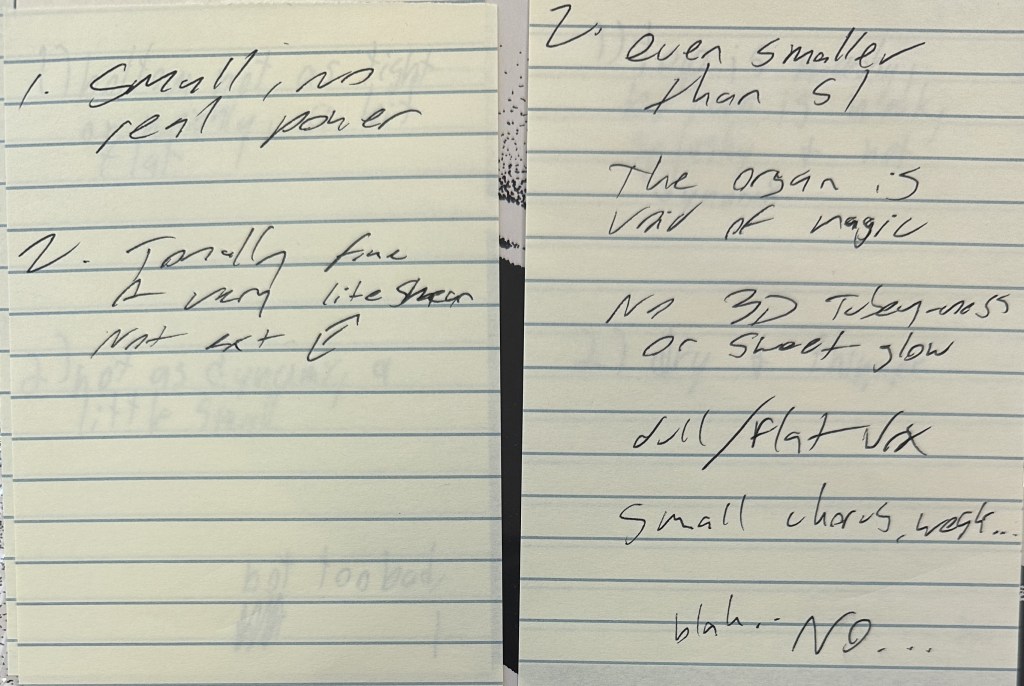
Now it’s time to talk about the first album, which I suspect will be the last of the Page remasters we will bother to play. It seems that II was a fluke.  Here is everything we didn’t like about it, which is pretty much everything.

Side One

Good Times Bad Times

    • Small, no real power

Babe I’m Gonna Leave You

    • Tonally fine
    • A very light sheen
    • Not extending high or low

(more…)

The Reissues Consistently Beat the Originals on this Mystery Mercury

Hot Stamper Pressings of Mercury Classical Records Available Now

For Mercury classical and orchestral recordings, the original FR pressings on the plum labels are the way to go, right? 

In some cases, yes. We talk about how much better the FR pressings for The Firebird are compared to the much more common, and still quite good, M2 reissue pressings here.

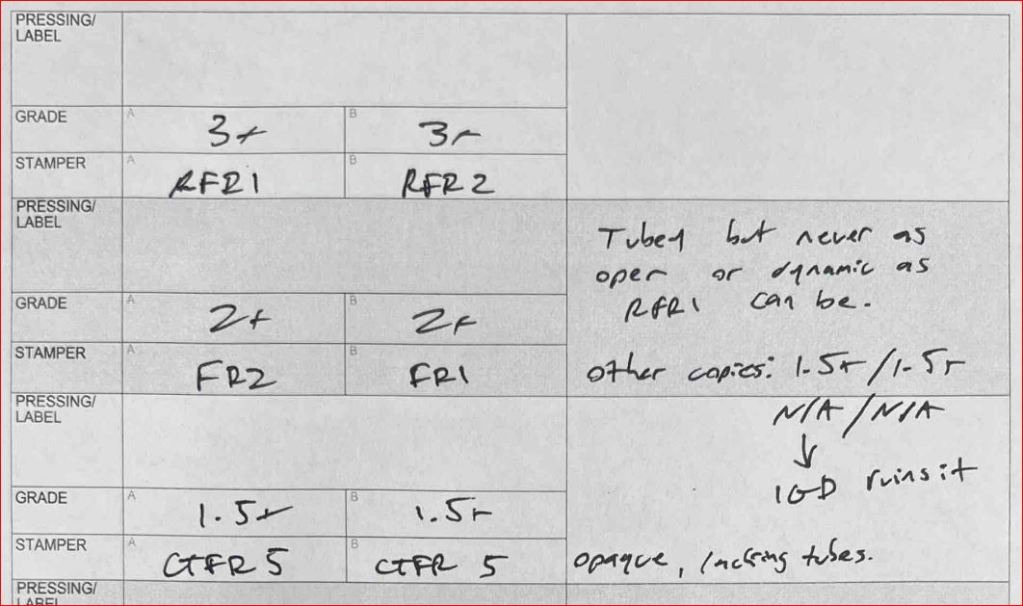
The stamper numbers you see below belong to a different album.

The notes for the FR originals we played read:

  • Tubey but never as open or dynamic as RFR-1 can be.

The better of the three FR pressings we played was not a bad sounding record, earning a grade of 2+. They’re just not as good sounding as the RFR reissues, which, of course, are the ones that win shootouts.

Something to keep in mind: A Super Hot Stamper Mercury orchestral record is guaranteed to be dramatically better than any Heavy Vinyl reissue ever made.

(more…)

These Pink Label Pressings Can Sound Good, But Great? Not a Chance

Hot Stamper Pressings of Music on Island Records Available Now
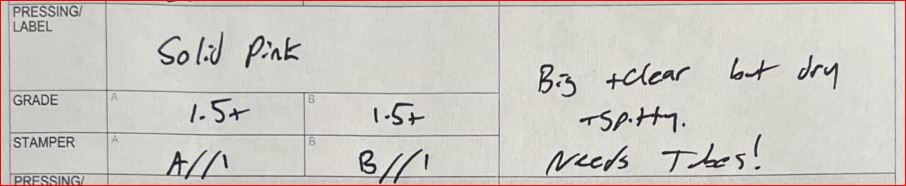
Below you will see the bottom part of the stamper sheet for a shootout we did recently.

Please note that the album you see pictured is not the one we are discussing here.

It very well could have been been a Jethro Tull album, but all we can say for sure is that it was definitely an album on Island, which just happens to be one of our favorite labels, for sound and music.

The earliest pressings for many records on the Island label are not very good. This one — again, not for This Was, for some other record — is not a bad sounding pressing.

With grades of 1.5+ on both sides, it fits comfortably in our section for good, not great sounding LPs — but the right reissues from the 70s are a big step up in class sonically. They’re the ones that win shootouts, not these Pink Label LPs.

It’s big and clear but dry and spitty and badly needs tubes in the cutting chain.

Do the record collectors who prize the Pink Label pressings above all others notice these things?

Do the audiophiles who play them?

Been There, Done That

We’ve run into so many sonically-flawed Pink Label Islands by now that hearing one sound lackluster if not actually awful doesn’t phase us in the least. Some of the other Pink Labels that never win shootouts can be found here.

(more…)

Our Guide to Legrand Jazz on Impex

Hot Stamper Pressings of 30th St. Recordings Available Now

Years ago I wrote about how important the Legrand Jazz album was in my growth as a critical listener.

It’s yet another example of an album that helped make me a better audiophile by showing me the error of my tweaking and tuning ways.

Now there is a new pressing of it. Well, new to us anyway. (We readily admit to being behind the times and make no apologies for it. With records like these, we often find ourselves wondering why we bother.)

Two new pressings in fact. One on a single disc at 33 RPM as of 2017, and one mastered at 45 RPM on 2 LPs as of 2019, still in print and available for $59.99.

Production details can be found at the end of this review, along with some favorable comments, some from none other than Steve Hoffman himself.

But first let’s hear from the personification of the well-meaning audiophile reviewer, Michael Fremer. He gives the Impex pressings an 11 for sound. He writes (emphasis added):

This IMPEX reissue is sourced from an “analog mix-down transfer of the original 1958 work tape by Mark Wilder at Battery Studios” and cut by Chris Bellman and Bob Donnelly at Bernie Grundman Mastering on Grundman’s all-tube mastering system. I have a clean, original 6-Eye pressing that this superbly pressed reissue betters in every way. This will make both your stereo and your heart sing. Some of the greatest jazz musicians of that or any era wailing and clearly having a Legrand time. Limited to 3000 copies. Don’t miss it!

Who are you going to believe, the Self-Appointed Vinyl Experts of the World or some guy like me who thinks he knows a thing or two about the sound of records, especially, as in this case, a record I have been playing since 1990 or thereabouts.

(Back in those early days I also had the standard CD, which is excellent and highly recommended. Since I couldn’t clean or play my original vinyl pressing properly, my guess would be that the CD had the better sound at the time.)

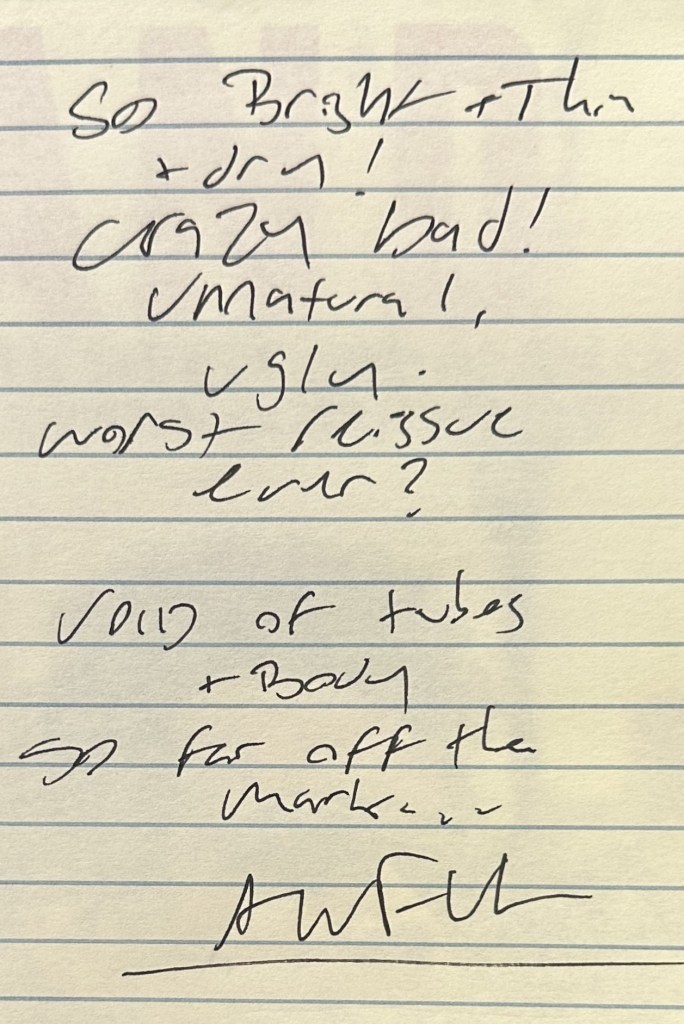
Our notes (for those who have trouble reading our scratch)

So bright and thin and dry.

Crazy bad!

Unnatural, ugly.

Worst reissue ever?

Void of tubes and body.

So far off the mark.

Awful.

A second opinion

Robert Brook reviewed this pressing a while back. He does his best to remain positive when choosing the words that he thinks will help the reader bette understand the experience of playing the Impex release of Legrand Jazz that we had loaned him. In the end he goes with the spoken word over the written one.

(more…)