holstplane

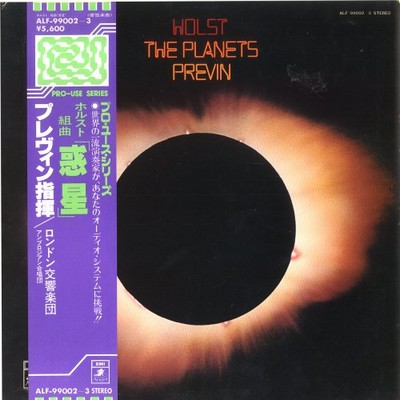
Holst – The Planets / Previn

More of the Music of Gustav Holst

  • An early British EMI pressing of Holst’s magnum opus, here with very good Hot Stamper sonic grades on both sides
  • Previn’s and the LSO’s performances are without peer in our estimation
  • We guarantee there is more space, richness, presence, and performance energy on this copy than others you’ve heard or you get your money back – it’s as simple as that
  • TAS list Super Disc, with a performance that’s as spectacular as the recording (thanks to the work of the two Christophers)
  • Marks and problems in the vinyl are sometimes the nature of the beast with these vintage LPs, but once you hear the sound of this copy, you might be inclined, as we were, to stop counting ticks and pops and just be swept away by the music
  • This link will take you to more of our favorite orchestral performances with top quality sound

(more…)

The Planets – Select Commentaries and Letters

Hot Stamper Pressings of Orchestral Spectaculars Available Now

Below you will find a number of the more popular commentaries we’ve written about the various recordings of this wonderful work that we’ve spent time auditioning over the years.

Included here is also a letter from a customer who spent some time with a Hot Stamper pressing of our favorite recording, Andre Previn’s with The London Symphony in 1974.

This Recording of The Planets Has “Blockbuster Sound,” For Better and For Worse

The Planets – MoFi and UHQR Reviewed

Our Planets Shootout Was Years in the Making, and We Got It Wrong Anyway

Letter of the Week – “A very rewarding day spent visiting a remarkable piece of music.”

The Planets – Testing with Mars and Saturn

The Planets – Can You Imagine Sound this Bad from a TAS List Super Disc?

Hot Stamper Classical and Orchestral Pressings Available Now

We can, we played it.

Or, to be more correct, we played them. Two pressings, each with one good side and one very bad side.


UPDATE 2025

Take all of this with a very large grain of salt. In the course of doing more shootouts for the Mehta Planets, we’ve played quite a number of different pressings and now believe — believe being the operative word — we know which are the best stampers.

It is very unlikely that any Dutch pressing would be competitive with the best UK-pressed copies cut by Harry Fisher.

For those of you who just want a good sounding copy of The Planets to play and enjoy, our favorite by far is Previn’s reading on EMI from 1974.

We know of no better performance, and we much prefer the dramatically more natural sound quality.

The Mehta recording, like much of what he recorded for Decca in those days, is a multi-miked mess, the kind we grew out of (for the most part) a long time ago. (More of the multi-miked records we’ve auditioned, of varying quality to be sure, can be found here.)


Our old commentary (please excuse the heavy-handed caps):

This 2-pack from many years ago (ten fifteen perhaps), described below, boasts White Hot Stamper sound on side two for the Mehta Planets. Yes, it IS possible. Side two shows you what this record is actually capable of — big WHOMP, no SMEAR, super SPACIOUS, DYNAMIC, with an EXTENDED top.

It beat every London pressing we threw at it, coming out on top for our shootout. Folks, we 100% guarantee that whatever pressing you have of this performance, this copy will trounce it.

But side one of this London original British pressing was awful.

We wrote it off as NFG after about a minute; that’s all we could take of the bright, hard-sounding brass of War.

If you collect Super Discs based on their catalog numbers and labels and preferred countries of manufacture, you are in big trouble when it comes time to play the damn things.

That approach doesn’t work for sound and never did.

If your stereo is any good, this is not news to you. The proof? The first disc in this 2-pack is Dutch. It earned a Super Hot grade in our blind test, beating every British copy we played against it save one. Side two however was recessed, dark and lifeless. Another NFG side, but the perfect complement to our White Hot British side two!

(more…)

The Planets – Proper VTA Adjustment Is Critical

More of the music of Gustav Holst (1874-1934)

Accurate VTA adjustment for classical records is critical to their reproduction. If you do not have an arm that allows you to easily adjust its VTA, then you will just have to do it the hard way (which normally means loosening a set screw and moving the arm up and down until you get lucky with the right height).

Yes, it may be time consuming, it may even be a major pain in the ass, but there is no question in my mind that you will hear a dramatic improvement in the sound of your classical records once you have learned to precisely adjust the VTA for each and every one of them. We heard the improvement on this record, and do pretty much on all the classical LPs we play. All records really.

VTA is not a corner you should be cutting.

Its careful adjustment is critical. Of course, so are anti-skate, azimuth and tracking weight. The links below have a fair amount of advice on turntable setup which might be worth checking out.

By The Way

If you want a good sounding pressing of The Planets, our favorite by far is Previn’s reading on EMI from 1974.

(more…)

The Planets – Testing with Mars and Saturn

More of the music of Gustav Holst (1874-1934)

Mars on the first side and Saturn on the second present serious challenges to any recordings of the work you may own, especially if you own the overrated Mehta recording on the TAS List.

Generally speaking, the White Hot copies stand apart from the pack with more top end extension, and/or more lower end weight. Our notes will typically say “extended highs and lows,” and those are hard to come by, on any record.

Let’s get to the specifics of the two movements we feel are the best test for The Planets as a whole.

The War Test — Side One

War, the first movement, has the string players “bouncing” their bows upside down to create the effect you hear. It’s not fingers plucking the strings; it’s the wood of the bows bouncing on the strings. The quality of that technique is so obvious and correct sounding on the good copies and so blurry and indistinct on the bad ones that you could almost judge the whole first side by that sound alone. When it’s right it’s really right. 

And of course the players are spread out wider and the soundfield is so much more transparent when these types of sonic qualities are brought out. This bouncing bow test makes it easy to separate the better copies from the also-rans when it comes to smear, resolution, transparency and the like.

The Saturn Test — Side Two

(more…)

This Recording of The Planets Has “Blockbuster Sound,” For Better and For Worse

Hot Stamper Pressings of the Music of Gustav Holst Available Now

This recording has what we here at Better Records like to call blockbuster sound.

Even on the best copies, the recording does not sound very much like a live orchestra, nor is it actually even trying to sound like a live orchestra in concert.

It’s trying to be huge and powerful in your home.

Which is more in line with a rock Demo Disc such as Crime of the Century or Dark Side of the Moon.

Everything has been carefully and artificially placed in the soundfield. Each instrument or group of intstruments is given its own space and (sometimes ridiculous) location.

It’s clearly not the recreation of a live orchestral event.

No live concert I have ever attended sounds anything like this record.

Instead it’s the actual creation of a unique orchestral sound, with unique staging of its own design.  Lots of microphones were used, which cause instruments and sometimes whole sections of the orchestra to appear in places and take up spaces they could not possibly occupy in reality.

If you have a good-sized listening room and your stereo images well, with realistic three-dimensional staging and depth, you will have no trouble hearing what we are talking about with any pressing of the album.

This is the sound that Bernard Herrmann made such wonderful use of with his series of Phase IV recordings for Decca, rather different than the four mics and two stereo channels of the Fiedler Gaite Parisienne from RCA in 1954.

Which is ironic. HP talked about The Absolute Sound of live unamplified music as being the standard, yet somehow this recording ended up in his Top Twelve all time greats. Makes no sense to me, but neither do many of the records on the TAS Super Disc list.

That said, our current favorite Planets is the other Planets on the TAS List, Previn’s reading on EMI from 1974.

(more…)

Do Pressings Remastered at 45 RPM Have Better Sound?

Record Collecting for Audiophiles – 45 RPM Pressings

No doubt some do, but based on our admittedly limited experience, we rather doubt any of the titles shown here, or from this series, are likely to be very good sounding.

I was going to write about the awful Holst The Planets with Previn from this series that I had played a few years back, but never got around to it.

Lots of punchy, powerful and deep bass — yes, 45 RPM mastering is known for that — but the dry, overly clean, clear, modern sound and the screechy strings made me take it off the turntable halfway through the first side. (We write more about EMI and Angel pressings here.)

If you want a good sounding pressing of The Planets, our favorite by far is Previn’s reading on EMI from 1974.

As usual, our advice is to accept no substitutes. There are a lot of bad sounding, poorly performed Planets out there.


(more…)

The Planets on Pro-Use Japanese Vinyl at 45 RPM Is Just Awful

More of the music of Gustav Holst (1874-1934)

This EMI 45 RPM Japanese Import 2 LP set is considered one of the great Planets by many audiophiles, but it’s not, based on our playing of a copy we had years ago, which means it belongs in our audiophile hall of shame.

The best copies on British or Dutch EMI vinyl are clearly better than this “audiophile” pressing.

What could be less surprising?

This is precisely why we dislike Japanese pressings as a rule — they sound like this audiophile trash.

Our favorite performance of The Planets can be found here.

The Big Picture from a Lifelong Audiophile

You may have seen the following text in another listing, but it bears repeating.

There is nothing new under the sun, and that is especially true when it comes to bad sounding audiophile records. The world is full of them.

There has been one big change from the days when I self-identified as a freshly minted audiophile in the 70s.

Yes, the records being marketed to audiophiles these days may have second- and third-rate sound, but at least now they have good music. That’s progress, right?

The title reviewed above is a good example of the kind of crap we newbie audiophiles used to put up with back in the old days, long before we had anything resembling a clue.

This one clearly belongs on our list of bad audiophile records.

You might be asking: What kind of audio fool was I? to buy a dumbass record like this.

It’s a fair question. Yes, I admit I was foolish enough to buy records like this and expect it to have good music, or at least good sound. Of course it had neither. Practically none of these kinds of records ever did. Sheffield and a few others made some good ones, but most Direct to Disc recordings were crap.

As clueless as I was, even back in the day I could tell that I had just thrown my money away on this lipsticked-pig in a poke.

But I was an audiophile, and like a certain Mr. Mulder, I wanted to believe. These special super-hi-fidelity records were being made for me, for special people like me, because I had expensive equipment and regular records are never going to be good enough to play on my special equipment, right?

To say I was wrong to think about audio that way is obviously an understatement. Over the course of the last forty years, I (and to be fair, my friends and my staff) have been wrong about a lots of things in the worlds of records and audio.

You can read more about many of the things we got wrong under the heading: live and learn.

The good news? Audio progress is real and anyone who goes about doing audio the right way can achieve the equivalent of miracles.

(more…)

Holst / The Planets / Mehta

More of the music of Gustav Holst (1874-1934)

More Orchestral Spectaculars

  • This early London pressing of Holst’s phenomenal Magnum Opus boasts stunning sound from first note to last
  • These sides are clear, full-bodied and present, with plenty of space around the players, the unmistakable sonic hallmark of the properly mastered, properly pressed vintage analog LP
  • Vibrant orchestrations, top quality sound and scratch-free surfaces combine for an astounding listening experience of this TAS-approved recording

(more…)

Holst – The Planets / Previn – Our 2022 Shootout Winner

More of the Music of Gustav Holst

  • This early British EMI pressing is guaranteed to be the best copy of Holst’s Magnum Opus you have ever heard, with both sides earning top quality sonic grades
  • The vinyl on these mid-70s EMI pressings is never as quiet as we would like – with such a dynamic recording, one with so many quiet sections, lightly ticky vinyl is unavoidable
  • Previn’s and the LSO’s performances are without peer in our estimation
  • These sides are rich, clear and dynamic, with weighty brass, and the kind of dynamic power that lifts the energy level right into space
  • TAS List Super Disc, with a performance that’s as spectacular as the recording (thanks to the work of the two Christophers)
  • This link will take you to more of our favorite orchestral performances with top quality sound

These sides have some of the best sound we have ever heard for the work, and that’s saying something considering the scores of recordings we have played of this famous and famously well-loved piece.

Fortunately for audiophiles who love The Planets but are disappointed by most performances, a group that includes us to be sure, the amazing sound found on this copy is coupled with a superb performance.

As you might imagine, on a big system this would make for a powerful listening experience, which is exactly the experience we ourselves had during our recent shootout. This copy actually deserves its place on the TAS List.

Both sides earned strong grades for their powerful energy and orchestral excitement, especially from the brass section, a subject we discuss at length below. (more…)