holstplane

This Recording of The Planets Has “Blockbuster Sound,” for Better or Worse

Hot Stamper Pressings of the Music of Gustav Holst Available Now

This recording has what we here at Better Records like to call blockbuster sound.

Even on the best copies, the recording does not sound very much like a live orchestra, nor is it actually even trying to sound like a live orchestra in concert.

It’s trying to be huge and powerful in your home.

Which is more in line with a rock Demo Disc such as Crime of the Century or Dark Side of the Moon.

Everything has been carefully and artificially placed in the soundfield. Each instrument or group of intstruments is given its own space and (sometimes ridiculous) location.

It’s clearly not the recreation of a live orchestral event.

No live concert I have ever attended sounds anything like this record.

Instead it’s the actual creation of a unique orchestral sound, with unique staging of its own design.  Lots of microphones were used, which cause instruments and sometimes whole sections of the orchestra to appear in places and take up spaces they could not possibly occupy in the real world.

If you have a good-sized listening room and your stereo images well, with realistic three-dimensional staging and depth, you will have no trouble hearing what we are talking about with any pressing of the album.

This is the sound that Bernard Herrmann made such wonderful use of with his series of Phase IV recordings for Decca, rather different than the four mics and two stereo channels of the Fiedler Gaite Parisienne from RCA in 1954.

Which is ironic. HP talked about The Absolute Sound of live unamplified music as being the standard, yet somehow this recording ended up in his Top Twelve all time greats. Makes no sense to me, but neither do many of the records on the TAS Super Disc list.

That said, our current favorite Planets is the other Planets on the TAS List, Previn’s reading on EMI from 1974.

(more…)

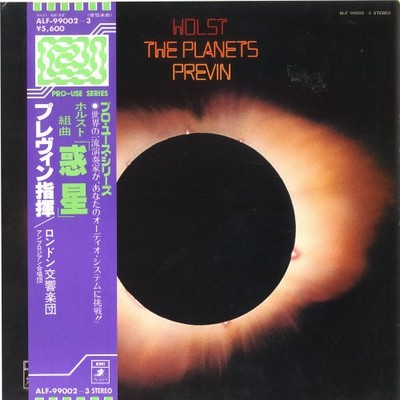
The Planets on Pro-Use Japanese Vinyl at 45 RPM Is Just Awful

More of the music of Gustav Holst (1874-1934)

This EMI 45 RPM Japanese Import 2 LP set is considered one of the great Planets by many audiophiles, but it’s not, based on our playing of a copy we had years ago, which means it belongs in our audiophile hall of shame.

The best copies on British or Dutch EMI vinyl are clearly better than this “audiophile” pressing.

What could be less surprising?

This is precisely why we dislike Japanese pressings as a rule — they sound like this audiophile trash.

Our favorite performance of The Planets can be found here.

The Big Picture from a Lifelong Audiophile

You may have seen the following text in another listing, but it bears repeating.

There is nothing new under the sun, and that is especially true when it comes to bad sounding audiophile records. The world is full of them.

There has been one big change from the days when I self-identified as a freshly minted audiophile in the 70s.

Yes, the records being marketed to audiophiles these days may have second- and third-rate sound, but at least now they have good music. That’s progress, right?

The title reviewed above is a good example of the kind of crap we newbie audiophiles used to put up with back in the old days, long before we had anything resembling a clue.

This one clearly belongs on our list of bad audiophile records.

You might be asking: What kind of audio fool was I? to buy a dumbass record like this.

It’s a fair question. Yes, I admit I was foolish enough to buy records like this and expect it to have good music, or at least good sound. Of course it had neither. Practically none of these kinds of records ever did. Sheffield and a few others made some good ones, but most Direct to Disc recordings were crap.

As clueless as I was, even back in the day I could tell that I had just thrown my money away on this lipsticked-pig in a poke.

But I was an audiophile, and like a certain Mr. Mulder, I wanted to believe. These special super-hi-fidelity records were being made for me, for special people like me, because I had expensive equipment and regular records are never going to be good enough to play on my special equipment, right?

To say I was wrong to think about audio that way is obviously an understatement. Over the course of the last forty years, I (and to be fair, my friends and my staff) have been wrong about a lots of things in the worlds of records and audio.

You can read more about many of the things we got wrong under the heading: live and learn.

The good news? Audio progress is real and anyone who goes about doing audio the right way can achieve the equivalent of miracles.

(more…)

Holst – The Planets / Previn – Our 2022 Shootout Winner

Hot Stamper Classical and Orchestral Pressings Available Now

This early British EMI pressing of Previn’s reading from 1974 is guaranteed to be the best copy of Holst’s Magnum Opus you have ever heard. Previn’s and the LSO’s performances are without peer in our estimation. These sides are rich, clear and dynamic, with weighty brass, and the kind of dynamic power that lifts the energy level right into space.

A TAS List Super Disc, with a performance that’s as spectacular as the recording (thanks to the work of the two Christophers).

As you might imagine, on a big system this would make for a powerful listening experience, which is exactly the experience we ourselves had during our recent shootout. This copy actually deserves its place on the TAS List.

The EMI Sound

EMI’s are usually recorded with a mid-hall perspective, which is somewhat distant for our taste. That’s not our sound. We prefer the Front Row Center seats (especially at these prices). That said, when an EMI from the ’70s is recorded, mastered and pressed properly, it actually sounds more like the real thing, more like the live performance of orchestral music in a concert hall.

It’s uncanny how real the best copies of this record sound. For a recording of The Planets it has no equal in our experience.

A Must Own Record

This orchestral spectacular should be part of any serious Classical Collection. Others that belong in that category can be found here.

Side One

Mars, the Bringer of War
Venus, the Bringer of Peace
Mercury, the Winged Messenger
Jupiter, the Bringer of Jollity

Side Two

Saturn, the Bringer of Old Age 
Uranus, the Magician 
Neptune, the Mystic

Structure

The suite has seven movements, each of them named after a planet and its corresponding Roman deity (see also Planets in astrology):

  • Mars, the Bringer of War
  • Venus, the Bringer of Peace
  • Mercury, the Winged Messenger
  • Jupiter, the Bringer of Jollity
  • Saturn, the Bringer of Old Age
  • Uranus, the Magician
  • Neptune, the Mystic

With the exception of the first two movements, the order of the movements corresponds to increasing distance of their eponymous planets from the Earth. Some commentators have suggested that this is intentional, with the anomaly of Mars preceding Venus being a device to make the first four movements match the form of a symphony.

One alternative explanation may be the ruling of astrological signs of the zodiac by the planets. If the zodiac signs are listed along with their ruling planets in the traditional order starting with Aries, ignoring duplication, Pluto (then undiscovered and now de-planetised), and the luminaries (the Sun and the Moon), then the order of the movements matches.

Another possibility, this time from an astronomical perspective, is that the first three movements, representing the inner terrestrial planets, are ordered according to their decreasing distance from the Sun. The remaining movements, representing the gas giants that lie beyond the asteroid belt, are ordered by increasing distance from the Sun. Critic David Hurwitz offers an alternative explanation for the piece’s structure: that “Jupiter” is the centerpoint of the suite and that the movements on either side are in mirror images. Thus “Mars” involves motion and “Neptune” is static; “Venus” is sublime while “Uranus” is vulgar, and “Mercury” is light and scherzando while “Saturn” is heavy and plodding. (This hypothesis is lent credence by the fact that the two outer movements, “Mars” and “Neptune,” are both written in rather unusual quintuple meter.)

“Neptune” was the first piece of music to have a fade-out ending. Holst stipulates that the women’s choruses are “to be placed in an adjoining room, the door of which is to be left open until the last bar of the piece, when it is to be slowly and silently closed”, and that the final bar (scored for choruses alone) is “to be repeated until the sound is lost in the distance”. Although commonplace today, the effect bewitched audiences in the era before widespread recorded sound – after the initial 1918 run-through, Holst’s daughter Imogen (in addition to watching the charwomen dancing in the aisles during “Jupiter”) remarked that the ending was “unforgettable, with its hidden chorus of women’s voices growing fainter and fainter… until the imagination knew no difference between sound and silence”.


Further Reading

Our Planets Shootout Was Years in the Making, and We Got It Wrong Anyway

Hot Stamper Pressings of Orchestral Spectaculars Available Now

This is a VERY old commentary providing the evidence for just how wrong we were about the sound of Steinberg’s 1971 recording for DG.

We did the shootout in 2008 and picked a winner, the Steinberg.

Somewhere in the neighborhood of five years later we picked a new winner, the Previn on EMI, and we have never wavered from that choice. It’s still our favorite.

In fact, the Previn gets better with every improvement we make to our system. That’s one of the ways you can be sure that it’s good: the better your system gets, the better your good records get. The inverse of that effect occurs right alongside your good records. Now your not-so-good records start to show you how not-so-good they always were. (For you fans of Heavy Vinyl and Half-Speeds, this can be painful, but we all have to go through it, so, looking on the bright side, the sooner your system can show you what’s wrong with those audiophile records, the less money you will have wasted on them.)


In July of 2005 we noted on the site that Hot Stampers for this album were discovered, and interested parties should watch the site for killer copies in the coming months. Obviously we didn’t know at the time that the number of coming months would be THIRTY TWO. That’s how long it would be before we could offer our loyal customers truly Hot Stampers, but hey, good things come to those who wait, right?

We had to wait for two things: the revolutionary cleaning techniques that we developed during that time (the heart of which is our $7000 record cleaning machine) which allowed us to get these records to sound better and play quieter, and, secondly, better equipment. 

One Long Shootout

This was one long shootout, two and a half years in the making. And I spent at least ten years before that collecting enough copies to be able to find some pattern in the stampers that clued me in as to what to look for. It was a long time coming but we expect you will find it was all worth it in the end. This music is so important and moving; it belongs in every audiophile’s collection. To get Steinberg’s version into your collection has not been easy, until now. This is the one. 

The Story from 2005

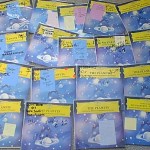
Below you will find an example of a title that will show up on the site someday (I hope): Holst’s The Planets with Steinberg and the BSO on DG. My favorite performance of all time.

But the copies you see pictured above all sound different! If you could read my post-its on the covers you would see that each of them has strengths and weaknesses. Some are quite good, some are quite awful. Some are noisy, some are quiet. Some are grainy, some are sweet, some have powerful bass, some are bass shy. They all sound different, and they all sound different in their own way.

So what we need to do now is winnow this group down to the best 4 or 5 copies, and then shoot them out. First all the side ones, then all the side twos.

This is a big job. A job that will take more than one day. I could probably spend a week playing these records. You can only do so many until fatigue sets in.

I regret to say I just haven’t felt sufficiently inspired to take on a project of this size. What will probably get me going is the next copy I pick up that really sounds good. It will make me want to hear how good it sounds compared to the other copies I like. I have 3 or 4 pretty good sounding copies in my own collection . But which is the best?

Someday I hope to find out.

And when I do I’ll be sure to let you know. It will be my pleasure. Finding really good records is a thrill. Especially when they have music like this on them.

(more…)

The Planets – MoFi and UHQR Reviewed

Reviews and Commentaries for The Planets

Sonic Grade: Regular MoFi LP: F / UHQR: D

Years ago we auditioned an excellent sounding Decca Purple Label British import LP, the same performance, the same recording that Mobile Fidelity remastered (#510), but, thankfully, it sounded a whole lot better.

I just listened to both and a catalog of the faults of the MFSL pressing would be quite lengthy. I won’t waste your time listing them.

Although the recording is far from perfect, the Decca pressing shows it in its proper light. It finds the right balance between the multi-miked sound of the super disc List Mehta and a vintage recording from the Golden Age such as the famous Boult.

The sound is very dynamic and the brass has tremendous weight.

Not the MoFi. It’s thin and bright.

Their UHQR is somewhat better, not quite as thin and phony up top, but not really very good either.

Avoid them both.

Our Recommendation

Our favorite performance of The Planets can be found here.

Many of Solti’s recordings from the Seventies are not to our liking, for reasons we lay out here.


Our Pledge of Service to You, the Discriminating Audiophile 

We play mediocre-to-bad sounding pressings so that you don’t have to, a free service from your record-loving friends at Better Records.

(more…)

The Planets – Not As Good As We Thought, Sorry!

Hot Stamper Pressings of Orchestral Spectaculars Available Now

This listing from 2008 has not aged well. We no longer recommend this performance of The Planets.

If you want to give one a try, make sure to get one on the Large Tulips label. The reissues tend to be thin and harsh.

Our current favorite performance of The Planets can be found here.


Notes from an Old Shootout

Side one here is AGAIG, as good as it gets. It shows the listener more of everything that’s wonderful about this wondrous work.

Side two is very nearly as good, and was only beaten slightly by one other copy in our shootout. This pressing gives you the complete work in the best sound we can find. 

This was one long shootout, two and a half years in the making.

And I spent at least ten years before that collecting enough copies to be able to find some pattern in the stampers that clued me in as to what to look for.

It was a long time coming but we expect you will find it was all worth it in the end. This music is so important and moving; it belongs in every audiophile’s collection.

To get Steinberg’s version into your collection has not been easy, until now. This is the one.


UPDATE

As it turns out, as our stereo improved, we realized this recording, even on the best pressings, was not the one.

Live and learn is our motto, and progress in audio is a feature, not a bug, of record collecting at the most advanced levels. “Advanced” is a code word for having little to no interest in any remastered pressing marketed to the audiophile community.

Holst / The Planets / Boult

More of the Music of Gustav Holst

This 1967 recording of the work has one very special quality that’s not often heard on classical vinyl — THE FEEL OF LIVE MUSIC. This is also something you will not often hear us say about EMI recordings from the late ’60s and ’70s.

Unlike HP and most audiophiles in the ’70s, we find that EMI’s recordings leave a lot to be desired, lacking in warmth, with a thin, sour, overly clear presentation. Great for muddy equipment but bad news on higher resolution modern rigs.

Super Hot Stampers on both sides means this Planets can take on any pressing you have of the piece and show you what you’ve been missing out on all these years.

There are a LOT of bad Planets out there. With its monstrously large orchestra and chorus, it’s not an easy work to capture on tape. (more…)

Holst / The Planets / Solti

More of the Music of Gustav Holst

This is a fairly quiet, excellent sounding Decca in the Box Purple Label British import LP.

This is of course the same performance, the same recording that Mobile Fidelity remastered (510), but, thankfully, this copy sounds A WHOLE LOT BETTER! 

This pressing is very dynamic and the brass has tremendous weight.

Our favorite performance of The Planets can be found here.

(more…)

Our Milestone Four Plus Pressing of The Planets from 2013

Hot Stamper Pressings of Orchestral Spectaculars Available Now

UPDATE 2026

It wasn’t intil 2013 that we had a system that could play The Planets properly. Read all about it below.


We award side two of this copy of Previn’s recording for EMI our very special Four Plus A++++ grade, which is strictly limited to pressings (really, individual sides of pressings) that take a given recording to a level we’ve never experienced before and had no idea could even exist. We estimate that about one per cent of the Hot Stamper pressings we come across in our shootouts earn this grade. You can’t get much more rare than that.

We no longer use this grade for a number of reasons we won’t go into here. Suffice to say, if you buy a White Hot Stamper pressing from us, you are getting the best sounding pressing we know to exist.

This Beyond White Hot Stamper Planets has Out Of This World sound on side two, where it earned a Four Plus sonic grade for its MINDBLOWING orchestral power, especially from the brass section, a subject we discuss at length below. 

This is some of the best sound I have ever heard coming out of my two speakers, if not THE best. Side two of this very copy takes the recording to a level we had no idea was possible. Out of the fifty or so copies of The Planets we’ve played in the last decade or so, this is without a doubt the best side two of them all.

We can only hope to find a side one as good in the next ten years. It probably exists, but will it take us another fifty copies to run into it? Only time will tell! (more…)

The Mehta Planets – Sealed with the Pioneer Booklet

More of the music of Gustav Holst (1874-1934)

Factory Sealed CS 6734 with the super rare Pioneer spacecraft booklet inside the shrink!

There’s a very good chance this is the last such copy on the planet. I have never seen one before, and I remember when this record came out, so probably few were made with this special booklet included.

I’m guessing it has about a dozen pages or so, and probably talks about the Pioneer mission to Jupiter.

“Launched on 2 March 1972, Pioneer 10 was the first spacecraft to travel through the Asteroid belt, and the first spacecraft to make direct observations and obtain close-up images of Jupiter. Famed as the most remote object ever made by man through most of its mission, Pioneer 10 is now over 8 billion miles away.”