congest-loud-pop

Rock, pop, soul, and other such pressings that have a tendency to get congested in the louder parts of the music.

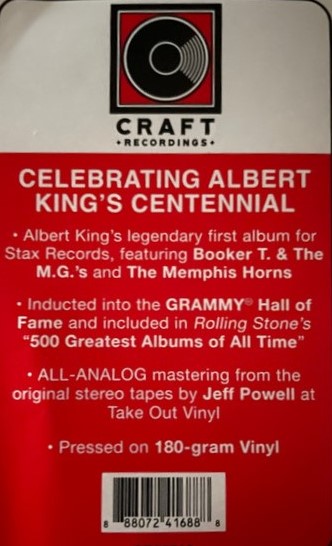
This Craft Pressing Was Definitely Born Under a Bad Sign

Hot Stamper Pressings of Electric Blues Albums Available Now

About a year ago we played the Craft pressing (CR00513) that had come out in 2023.

We have audition notes for lots of these dreadful Heavy Vinyl pressings sitting around. Sometimes they sit around for years. Obviously we are in no hurry to put them up.

The notes I took for the Craft pressing of Lush Life that Geoff Edgers played me still has not been posted, and he played me that record all the way back in 2022. For those of you who can’t wait for the complete review, I told him it sounded like a CD and proceeded to take it off the turntable.

At the time, I don’t think he understood how that could even be possible. He’d visited Bernie Grundman and read all the rave reviews for his work in the audiophile press. What do you mean his record sounds like a CD? Who the hell do you think you are anyway?

Geoff knows what that means now. I will leave it at that.

We were not surprised to find that the sound of this Craft pressing was terrible. Whoever this Jeff Powell is, I admit I’ve never heard of him, if you see his name on a remastered record, you might want to consider that if he can make a record that sounds this bad, he may not know what he is doing.

This strikes us as a safe bet.

Our notes for the album comprise all of five words. They read:

  • Not good
  • Blurry and congested

As you can see, we didn’t feel the need to spend too much time with it. When a record shows you right off the bat how badly mastered it is, we move on pretty quickly.

We admitted to having liked the Sundazed pressing when it came out in the late-90s, something that you can imagine embarrasses us no end now. In our defense, let me just say 1998 was a long time ago, before we had ever heard a properly cleaned, really good sounding original pressing.

We know how good the originals can sound. We’ve played them. What we have not been able to do is to find enough quiet, good sounding copies to do a shootout. Even at more than a hundred bucks a pop, it’s the rare copy that does not go back to the seller for excessive noise and groove damage. This record was not bought by audiophiles to play on expensive equipment.  The opposite of that demographic cohort would be closer to the truth.

As for the record collecting public, one guy on Discogs thought it didn’t sound good, but for some reason he gave it three stars anyway. Our review would have been one star out of five, assuming that even the worst sounding record must get at least one star. The other three who reviewed the album seemed to really like it.

(more…)

So at 45 RPM – One Side Bad, Another Awful, What’s a Mother to Do?

Hot Stamper Pressings of the Music of Peter Gabriel Available Now

In 2016 a version of So came out using this currently popular vinyl format:

2 180g discs / 45 RPM / Deluxe, Numbered, Limited Edition /Half Speed mastered

As of this writing, there are 15 copies on Discogs, the cheapest of them starting at $139.77.

Sounds like it must be pretty good for that kind of money!

This So release was mastered by a fellow named Matt Colton, who has been doing this kind of work for a very long time, judging by the fact that he has 3,775 technical credits under his name on Discogs.

That did not stop this particular 2 LP set from being one of the worst sounding albums we have played in quite a while.

Let’s take a closer look at the specifics. We played sides one and four of the two-disc, four-sided album. That was more than enough to evaluate the sound quality.

(more…)

Why Is It So Hard for Mobile Fidelity to Get the Midrange Right?

Hot Stamper Pressings of the Music of Joni Mitchell Available Now

We recently auditioned the Mobile Fidelity One-Step pressing of Blue and made the notes regarding the sound you see below.

We focussed on the quality of their pressing’s vocal reproduction, for the simple reason that a Joni Mitchell album that gets the vocals wrong is a Joni Mitchell album that no music lover and certainly no audiophile  would ever want to play.

The fact that some audiophiles do want to play this record speaks poorly of their ability to reproduce it properly. Accurate playback will reveal the problems with Joni’s voice described in detail below. The post-it for side one is on the left, for side two on the right.

We try to be very specific about the shortcomings of these records, which is why we reproduce our notes whenever they are available.

Side One

  • Tonally not far off, a bit too stringy and flat. Not awful. Congested vocals at peaks, harsh. 1+

Side Two

  • Vocal peaks like “traveling, traveling, traveling…” or “California” get squashed and harsh, lacking the real dynamics, presence and space of the vocals. No grade. (Awful in other words.)

(more…)

Listening in Depth to Bookends

More of the Music of Simon and Garfunkel

Musically side two is one of the strongest in the entire Simon and Garfunkel oeuvre (if you’ll pardon my French). Each of the five songs could hold its own as a potential hit on the radio, and there is no filler to be found anywhere. How many albums from 1968 can make that claim?

The estimable Roy Halee handled the engineering duties. Not the most ‘natural” sounding record he ever made — the processing is heavy handed on a number of tracks — but that’s clearly not what neither he nor the duo were going for.

If you want natural, Parsley, Sage, Rosemary and Thyme has what you are looking for. That said, as of 2022 both are Top 100 Titles.

The three of them would obviously take their sound much farther in that direction with the Grammy winning Bridge Over Troubled Water from 1970.

The bigger production songs on this album have a tendency to get congested on even the best pressings, which is not uncommon for four track recordings from the 60s. Those of you with properly set up high-dollar front ends should have less of a problem than some. $3000 cartridges can usually deal with this kind of complex information better than $300 ones.

But not always. Expensive does not always mean better, since painstaking and exacting setup is so essential to proper playback.

The Wrecking Crew provided top quality backup, with Hal Blaine on drums and percussion, Joe Osborn on bass and Larry Knechtel on piano and keyboards.


Side One

Bookends Theme
Save the Life of My Child

I used to think this track would never sound good enough to use as an evaluation track. It’s a huge production that I’d found practically impossible to get to sound right on even the best original copies of the album. Even as recently as ten years ago I had basically given up trying.

Thankfully things have changed. Nowadays, with great copies at our disposal and a system that is really cooking, virtually all of the harmonic distortion in the big chorus near the opening disappears. It takes a very special pressing and a very special stereo to play this song.

(more…)

Billion Dollar Babies Often Suffers from a Case of 70s Warner Bros. House Sound

More of the Music of Alice Cooper

The last White Hot Stamper copy we put up had the two best sides back to back we heard in our shootout, with a killer side two that really brought this music to life.

Which is not easy to do, given that the average copy of this album is a sonic mess —

There are a lot of green label Warner Bros. records from the 70s that sound like that, one might even call it their “house sound.”

When you play most of the later pressings, it’s obvious that they’ve gone overboard in cleaning up the murk, leaving a sound that is lean, flat and modern — in other words, unmusical, inapt and more often than not disastrous.

Finding the right balance of fullness and clarity, especially on this album, may not be easy, but it can be done. This side two was far and away the best we heard and proves that the album can sound good.

(more…)

Identical Stampers and New Vinyl Somehow Produce Clearly Different Sounding Records?

nirvaneverMore Milestone Events in the History of Better Records

In this listing from 2007 we recount our experience with some copies of Nirvana’s Nevermind album. It was an important milestone in the evolution of Better Records.

We learned our lesson – no more sealed records. Not if you’re the kind of audiophile record dealer who cares what his records sound like (which appears to put us in a class of exactly one.)

That same year we decided to stop carrying any new Heavy Vinyl release, prompted mostly by the mediocrity of the Rhino reissue of Blue.

So, all in all 2007 was a good year for us. We stopped playing their game and invented a new one all our own. Judging by the enthusiastic response of our customers we think we did the right thing.

Nevermind Circa 2007

The dirty little secret of the audiophile record biz is that the purveyors of these pressings cannot possibly know with any certainty the quality of the sound of any sealed record they are selling. (Whether they can tell what the sound quality is of any record they sell is an open question, and one we would have to answer in the negative based on the hundreds of audiophile pressings we’ve auditioned over the last 40 years.)

They turn a blind eye to the fact that some copies are simply not going to measure up to the sound of the review copy that they auditioned and described.

This is a good reason not to sell sealed records, which, of course, we don’t.

That’s because we’ve done the experiments and found out the things they cannot be bothered to learn.

But wait a minute. Even that’s giving audiophile record dealers far too much credit.  Only a small fraction actually review the records they sell. Most cut and paste a review from the manufacturer and let it go at that. And the few that do write reviews are often so far off the mark that they might as well be talking about another pressing entirely.
(more…)

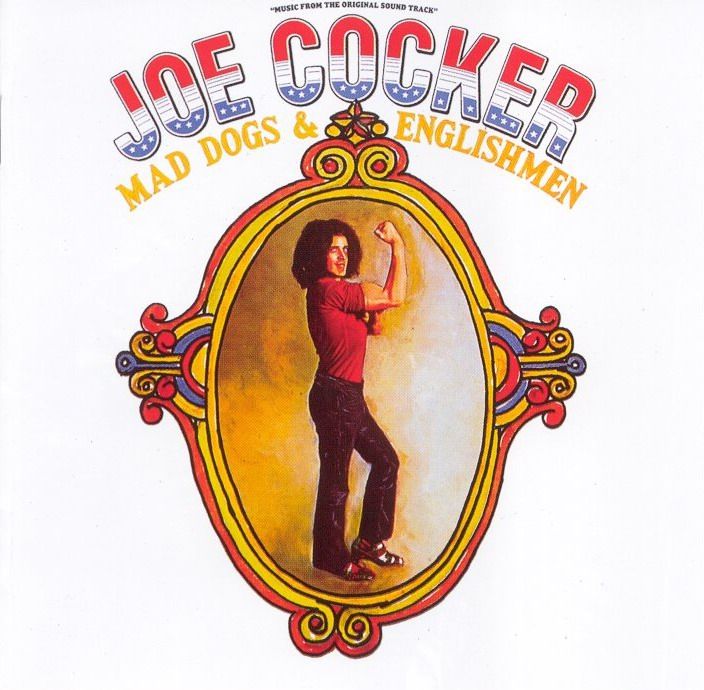
Mad Dogs, Englishmen and Copies with Bad Stampers

More of the Music of Joe Cocker

The weaker copies have a tendency to sound smeary and congested. Listen for good transients and not too much compression. Many are also somewhat opaque as well as dull up top; try to find the ones with some degree of transparency and as much top end extension as you can (the percussion will be helped most of all by the extended top).

And of course you need to find a copy that rocks, as this is a definitely a Rock Concert, although what it most reminds me of is Ray Charles doing a choice set of modern pop classics, mixing it up by off-handedly throwing in a few hits of his own. See how they all fit together? That’s how the pros do it. (The main pro in this case is Leon Russell, the mastermind of the whole operation.)

Biggest Problems

Well, for one thing, if you get the wrong stampers on this record you will discover, as we did, that it’s clearly been mastered from a badly transferred dub tape. The “cassette-like” sound quality will not be hard to recognize. If you have stumbled onto one of those pressings, give up on it and try your luck elsewhere, making sure to note the bad stampers. That’s how we do it; there is in fact no other way. Trial and error is the name of the record hunting game.

All tracks were engineered by the legendary Eddie Kramer, then selected and mixed by the equally legendary Glyn Johns. (more…)

The Cars on Nautilus – Ouch!

More of the Music of The Cars

Sonic Grade: F

This Nautilus Half-Speed Mastered LP is pure mud — compressed, thick and congested, a disaster on every level, much like their atrocious remastering of Candy-O.

Is it the worst version of the album ever made? Hard to imagine it would have much competition.

If you own this Audiophile BS pressing (NR-14) and you can’t hear what’s wrong with it, you seriously need to consider ditching your current playback system and getting another one.  It is doing you no favors.

Our Nautilus pressing here is yet another one of those Jack Hunt turgid muckfests (check out City to City #058 for the ultimate in murky sound), is incapable of conveying anything resembling the kind of clean, clear, oh-so-radio-friendly pop rock sound that producer Roy Thomas Baker, engineer Geoff Workman and the band were aiming for.

The recording has copious amounts of Analog Richness and Fullness to start with. Adding more is not an improvement; in fact it’s positively ruinous.

(more…)

The Original Pressings of The Beatles Albums Are the Best Sounding, Right?

beatles help labelHot Stamper Pressings of the Music of The Beatles Available Now

No, they are most definitely not. At least the ones on the label you see pictured are not (with the exceptions noted below).

We think it’s just another example of mistaken audiophile thinking.

Back in 2005 we compared the MFSL pressing of Help to a British Parlophone copy of the Help album and were — mistakenly, as you may have already surmised — impressed by the MoFi. We wrote:

Mobile Fidelity did a GREAT JOB with Help!. Help! is a famously dull sounding record. I don’t know of a single original pressing that has the top end mastered properly. Mobile Fidelity restored the highs that are missing from most copies.

The source of the error in our commentary above is in this sentence, see if you can spot it:

I don’t know of a single original pressing that has the top end mastered properly.

Did you figure it out? If you’ve spent any time on this blog you did.

Original pressing?

Is that the standard?

Why? Who said so? Where is it written?

(more…)

Celebrate Me Home – Notes from a 2011 Shootout Winner

Hot Stamper Pressings of the Music of Loggins and Messina Available Now

This WHITE HOT Stamper side one shows you just how good this record can sound, which is surprisingly good, considering how many copies of the album are just plain awful. Finally, most of the grit, grain and transistory opacity have fallen away, leaving in its place the rich, full-bodied and Tubey Magical ’70s sound one would expect. 

As obvious as it may sound (especially to anyone on this site), the master tape is a whole lot better than the average copy of the record would have you think. This side one is proof positive. And side two is nearly as good, earning a solid Super Hot stamper grade of A++. Without a doubt this is by far the best copy of the album we have ever heard.

It’s also the only Loggins solo album that I’ve ever liked; it was actually a favorite of mine back in the day. I’ve owned this very copy for more than twenty years (bought it in 1988 according to the price sticker). Seems like a good time to send it on its way to find a new home.

Side One

A+++, taking top honors for its rhythmic energy and real frequency extension both high and low. (Most copies have no real top end; if you own one give it a listen and we think you’ll agree with us.) Great bass, plenty of Tubey Magic, clarity and richness — no other copy in our shootout could do what this one was doing.

(more…)