brook-record-review

Lady in Satin – What It Takes to Hear It Right

Robert Brook runs a blog called The Broken Record, with a subtitle explaining that the aim of his blog is to serve as:

A GUIDE FOR THE DEDICATED ANALOG AUDIOPHILE

Here is Robert’s latest posting.

LADY IN SATIN: What it Takes to HEAR it RIGHT

Robert writes:

A few years ago, Better Records founder Tom Port told me something that I’ve never forgotten. I had just demoed my system for an industry guy, and while relaying the experience to Tom, he asked me what records I had played for him. I mentioned a few, including Charles Mingus‘s Ah Um.

Tom said (paraphrasing here) “Not a good choice. You want to play records that can only sound good one way. Ah Um can sound good a lot of different ways.”

At the time I didn’t fully understand what Tom was getting at. Ah Um, or at least the copy of it I had, always sounded great. Wasn’t it therefore a great record to demo my system with?

Since then I’ve come to understand that this was exactly Tom’s point. If you really want to show someone what your system can do, by all means, play a great sounding record, but also one that requires your turntable and your system as a whole be at their best to reproduce it.

Lately I’ve come to understand something that I feel every audiophile, analog audiophiles in particular, would do well to recognize and come to terms with. When we play a record, each of us is listening for different things, and these things are very often not the things that we should be listening for if we want to determine if our system is sounding its best.

Robert continues:

But a pretty steady diet of Ah Um for a number of years now has taught me that the right copy will sound good, even with the most basic turntable setup, and even on a system that’s not performing its best.

Meanwhile, it would seem that Lady In Satin is a record that only sounds good, great even, one way and one way only. It needs us to attend to all the little details in our system before it will reveal its magic.

(more…)

Big Star’s #1 Record – Is All Analog Better?

Robert Brook runs a blog called The Broken Record, with a subtitle explaining that the aim of his blog is to serve as:

A GUIDE FOR THE DEDICATED ANALOG AUDIOPHILE

We know of none better, outside of our own humble attempt to enlighten that portion of the audiophile community who love records and are looking to understand them better.

Here is one of Robert’s postings from way back in 2021. The reason it is going up today is that the fellow who remastered the record for Craft, Jeff Powell, also remastered the Born Under a Bad Sign we reviewed recently here. Small world, right?

Back in the 90s I played an import pressing that was in print at the time. As I recall it was very bright, but that seems to be the sound the band was going for. I like Power Pop as much as the next guy, but the bright sound put me off and that was that. I never offered the record for sale, figuring that most customers would not be happy with the sound.

Chris Bellman cut the record for Classic Records in 2009, reportedly on an “All Tube” cutting system. Based on the man’s previous work I would not expect it to be to my liking. He cut a serviceable version of Brothers in Arms years ago, which I thought was quite good for anything pressed on Heavy Vinyl. It would probably earn a grade of 1.5+. Eventually I will get around to posting a review on this blog about it. To say Chris Bellman is no Robert Ludwig may be a massive understatement, but is there anyone today who can begin to match the mastering skills of the great RL?

By the way, the cheapest copy on Discogs is $163.04 if you are interested.

Big Star’s #1 Record Reissues: Is ALL ANALOG Better?


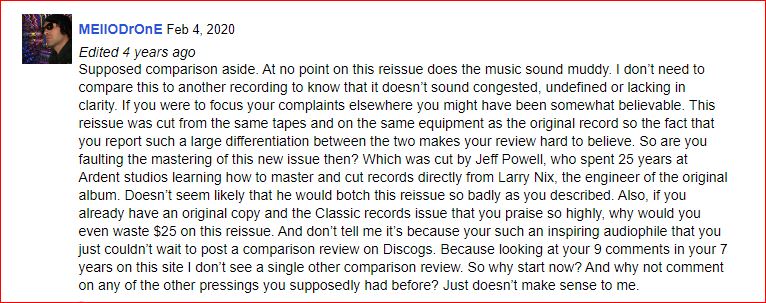
Most of the reviews on Discogs are of the Five Star “I can’t believe how good this record sounds” variety, something that is both tiresome and somewhat sickening considering that the quality is sure to be as poor as Robert says it is, if not worse.

One guy had the temerity to stick his head up, offering a dissent from the lovefest being thrown for a record he found of dubious quality. Naturally, a bunch of Discogers jumped all over him for his apostasy.

It’s just now dawning on me that this sort of behavior is not limited to the Steve Hoffman forum.

Here he “risks eternity” by speaking his mind. If they could find a way to burn him at the stake for the crime of questioning the quality of a Heavy Vinyl pressing they happen to like, you can be sure they would be organizing the gathering of the kindling at this very moment. They call him an “elitist goof, ” “a wanker,” and question his bona fides as an audiophile, the standard-issue audiophile forum approach to those who waver from the true path.

This is my favorite reply, offering little more than an appeal to authority. These guys are pros. How could they possibly make a bad sounding record? That’s not what they do, you idiot!

Why anyone would choose to associate with such intolerant, ill-mannered, small-minded people is beyond me.

The true believers at the Hoffman forum are even worse. There, if you write something upsetting to the delicate sensibilities of its members, they simply delete the post and send it down the memory hole where it can no longer do harm to the faithful.

(more…)

There’s Something Not Quite Right about MoFi’s Blue

Robert Brook has a blog which he calls

A GUIDE FOR THE DEDICATED ANALOG AUDIOPHILE

Below is a link to a review Robert Brook wrote recently for the MoFi One-Step pressing of one of our favorite albums of all time, Joni Mitchell’s Blue, originally released in 1971.

BLUE: What’s the RIGHT SOUND For Joni Mitchell’s CLASSIC?

Blue Sounds Funny Now

Based on everything I am reading these days from Robert Brook, he has a good stereo, two working ears, and knows plenty about records and what they are supposed to sound like.

This was not always the case as he himself would tell you. His stereo used to be much better at hiding the faults of a record like the MoFi One-Step of Blue than the stereo he has now. He got rid of most of his audiophile electronics, got a better phono stage, cartridge and arm, improved the quality of his electricity, found some sophisticated vibration controlling platforms for his vintage gear and did lots of other things to make his playback more accurate and — we cannot stress this too strongly — more fun, more exciting and more involving.

When your stereo is doing a better job of reproducing what’s in the grooves of your records, the first thing you notice when playing a Mobile Fidelity or other Heavy Vinyl pressing is that the sound is funny and wrong. (Please excuse the technical jargon; those of you who have been audiophiles as long as we have will understand what I mean, the rest of you can just play along. All of this will make sense eventually.)

When you use colored-sounding audiophile equipment — but I repeat myself — then your colored-sounding audiophile records don’t sound nearly as colored as they would under other conditions.

For example, other conditions obtain if you have — again, sorry about the jargon — revealing, accurate, tonally correct, natural-sounding equipment, free from the colorations — euphonic and otherwise — that allow one piece of audiophile equipment to sound so different from another.

(more…)

Can Chris Bellman Cut Records As Well As Artisan Used to?

Robert Brook has a blog which he calls

A GUIDE FOR THE DEDICATED ANALOG AUDIOPHILE

Robert’s story begins:

Recently a friend and a frequent reader of my website suggested I review the 50th Anniversary Edition of David Crosby’s debut. He’d read my article from a while back in which I made comparisons between two different Hot Stamper copies of the record, and he knew I was a fan the album.

I’m sure he also knew, as any of my regular readers would, that I’m extremely skeptical of modern reissues. You can find many examples on this site of reissues I’ve written about that have failed miserably to impress me. But this friend was pretty insistent that this one, remastered by long time engineer Chris Bellman, was different. He also told me it was on par with original Monarch pressing of …My Name he also owned.

Bellman was responsible for cutting one of the few heavy vinyl reissues that my friend Tom Port has liked and recommended – a European pressing from 2020 of the Dire Straits record Brothers In Arms. Tom likes precious few “audiophile” reissues. He’s mentioned maybe 4 or 5 over the years as being worthy of any consideration. Given that, and the fact that my friend was so insistent, I figured why not give Bellman’s recut of . . .My Name a shot?

Click on the link to read the whole thing. I left some comments at the end you may enjoy reading. I hope to be able to address some of the other issues Robert brings up at a later date.

IF ONLY I COULD REMEMBER MY NAME: 50th Anniversary Edition

If you are interested in picking up an amazing Hot Stamper pressing of the album, we currently (as of 2/24) have some in stock. Click on this link to see what is available: If I Could Only Remember My Name.

On the website, we talk about just how much we love this album:

(more…)

Robert Brook Reviews the ERC Pressing of My Favorite Things

One of our good customers has a blog which he calls

A GUIDE FOR THE DEDICATED ANALOG AUDIOPHILE

Here is Robert’s review of ERC’s mono release of My Favorite Things. MFT happens to be one of our favorite Coltrane records, but we understandably prefer the stereo pressings, which is almost always the case when an album has been recorded in stereo, as My Favorite Things was in 1960.

ELECTRIC RECORDING COMPANY’s Reissue of MY FAVORITE THINGS

We even tell you what to listen for to help you separate the best pressings from the merely good ones: the piano.

A solid, full-bodied, clear and powerful piano. As we focused on the sound of the instrument, we couldn’t help but notice how brilliant McCoy Tyner is. This may be John Coltrane’s album, but Tyner’s contribution is critically important to the success of My Favorite Things.

The engineering duties were handled by Tom Dowd (whose work you surely know well) and Phil Iehle, who happens to be the man who recorded some of Coltrane’s most iconic albums for Atlantic: Giant Steps (1960) and Coltrane Jazz (also in 1961).

Electric Recording Company

We’ve played a number of ERC releases.

In the video embedded in the Washington Post article “In Search of the Perfect Sound,” at some point you can hear me exclaim “This guy makes mud pies!” while listening to the ERC pressing of Quiet Kenny.  I am happy to stand behind that judgment, and I think Robert Brook would agree with me about that.

Here is our review of ERC’s Forever Changes.

Our commentary making the case that these albums are aimed primarily at collectors and speculators, not audiophiles, can be found here.

We have now played the ERC pressing of My Favorite Things for ourselves and will be reviewing it soon.

Other Opinions

As much as we dislike these records, there are some music lovers who are quite pleased with them. A certain JLysaker wrote the following on discogs in 2021 about the ERC records a friend of his gave him (!) (edited for brevity).

I own 4 lps from this label. All sound amazing… The [Way] Out West pressing, stereo, is probably the best sounding LP I own… I also had an AP edition of one of the albums and the ERC pressing was hands down more natural sounding and imaged with greater clarity, and not just to my ears but to that of another buddy there for a listen.

Was it $500 better? I really doubt sonic differences translate into clear dollar amounts, but I would understand someone saying: ‘I’ll stick with damn good.’ Then again, some albums are dear to people and they want to hear it in the best possible fashion, and that probably won’t be through an original pressing — too rare, condition issues, and so forth as pointed out below. So they pop for one of these, as I did with My Favorite Things, which isn’t even a well recorded album.

And I am glad I did as Coltrane’s soprano never sounded better to me, and I have been listening to that recording for decades. So, from experience, these pressings are special. But acquiring them involves serious opportunity costs for anyone not rolling in the dough. And I doubt I ever would have sprung for one if an evil friend hadn’t given me some.

But here I am, feeling neither scammed nor screwed, and quite certain that those releasing these records are qualified to do so.

Others in the comments section were not so positive. Then again, nobody gave them the records and the price struck them as a bit high (median pricing for the album is currently $723.10).

We get similar complaints about our prices, but then again, we’re in the business of selling the best sounding pressings ever made, which is clearly not the case with ERC. They’re in the business of selling mud pies.

(more…)

Robert Brook Shoots Out Brilliant Corners

Robert Brook has a blog which he calls
A GUIDE FOR THE DEDICATED ANALOG AUDIOPHILE

Below you will find a link to the shootout Robert recently conducted for Thelonious Monk’s amazing Brilliant Corners album on OJC.

(more…)

Robert Brook Discusses His Evolving Understanding of Bass

More from Robert Brook

Robert Brook has a blog which he calls

A GUIDE FOR THE DEDICATED ANALOG AUDIOPHILE

Below you will find a link to Robert’s story about the famous Charlie Mingus record you see pictured.

He had a number of different pressings, each of which showed him some qualities that the others lacked. Ultimately you have to pick one to play, and he did.

“GETTING” BASS with Charles Mingus’ BLUES & ROOTS

Robert went from a $20,000 speaker with one eight inch woofer to the Legacy III’s, a speaker costing less than half as much, with three ten inch woofers, to the Legacy Focus, a speaker quite a bit less than $20k, with three twelve inch woofers.

Robert learned something about his Parsifals by playing a speaker that could do so much more down low:

But I’ve learned since that, for all their strengths, the Parsifal had at least one fatal flaw – they made just about every record sound good.

Adding:

Making every record sound good is, it turns out, not a good quality to have in a speaker, nor in any other piece of equipment you use. At least it’s not if you want the best possible sound from your analog system.

(more…)

Robert Brook Shoots Out One Flight Up

Hot Stamper Pressings of Blue Note Albums Available Now

We have never heard the Tone Poets pressing that Robert played against the Van Gelder cutting he discusses in the commentary below.

We have one in stock and are just waiting to do the shootout for the album so that we can compare it to the better pressings we know we will find.


UPDATE 2025

We have now played the Tone Poets pressing for ourselves, and if anything, Robert is being too kind!


You may have read that we were knocked out by a killer copy way back in 2007. We expect to be no less knocked out in 2023.

Robert concludes with his take on the strengths and weaknesses of the two pressings. Here is a excerpt:

Overall, the Tone Poet is closed, distant and frankly boring to listen to. Where is the energy of the music? Where is the presence of these musicians? Where is the studio space?

He goes on in much more detail, but this is exactly the kind of sound we hear on one Heavy Vinyl pressing after another. For some reason, none of these shortcomings appears to bother the fans of the label. I get why this guy is missing the boat: he actually thinks a system with five inch woofers can play jazz. What possible excuses could these other people have? [1]

The complete review can be found below. If you are considering following the crowd and buying some of this label’s albums, you might want to take it slow. (Those of you with five inch woofers can charge right ahead. The sonic problems with the Tone Poets releases Robert Brook describes would barely be audible on such a system, so get while the gettin’s good. Just make sure you are never tempted to upgrade to big speakers. You could find yourself in the unfortunate position of needing a new record collection to go along with them. Unlike Tone Poets releases, good records ain’t cheap.)

Dexter Gordon’s ONE FLIGHT UP: One of the Better TONE POETS?

[1] This is rhetorical question. These other folks have no excuses. They have exactly the sound quality they have earned by underutilizing the two most important audio resources they have at their disposal: time and money.

If they have failed to put in enough of either one or both, they have only themselves to blame for letting themselves be fooled by the chalatans currently marketing one meretricious [2] Heavy Vinyl pressing after another.

If they decide to remedy this sad state of affairs, we are more than happy to guide them in the new and exciting direction we’ve pioneered over the course of the last twenty years or so. The advice we give in this commentary would be a good place to start: first get good sound – then you can recognize and acquire good records

For another 60+ pieces of record collecting advice, more than enough to keep anyone busy for months, perhaps years, please click here.

[2] To save you the trouble of looking it up, Merrian-Webster defines meretricious as apparently attractive but having in reality no value or integrity. Used to suggest pretense, insincerity, and cheap or tawdry ornamentation.

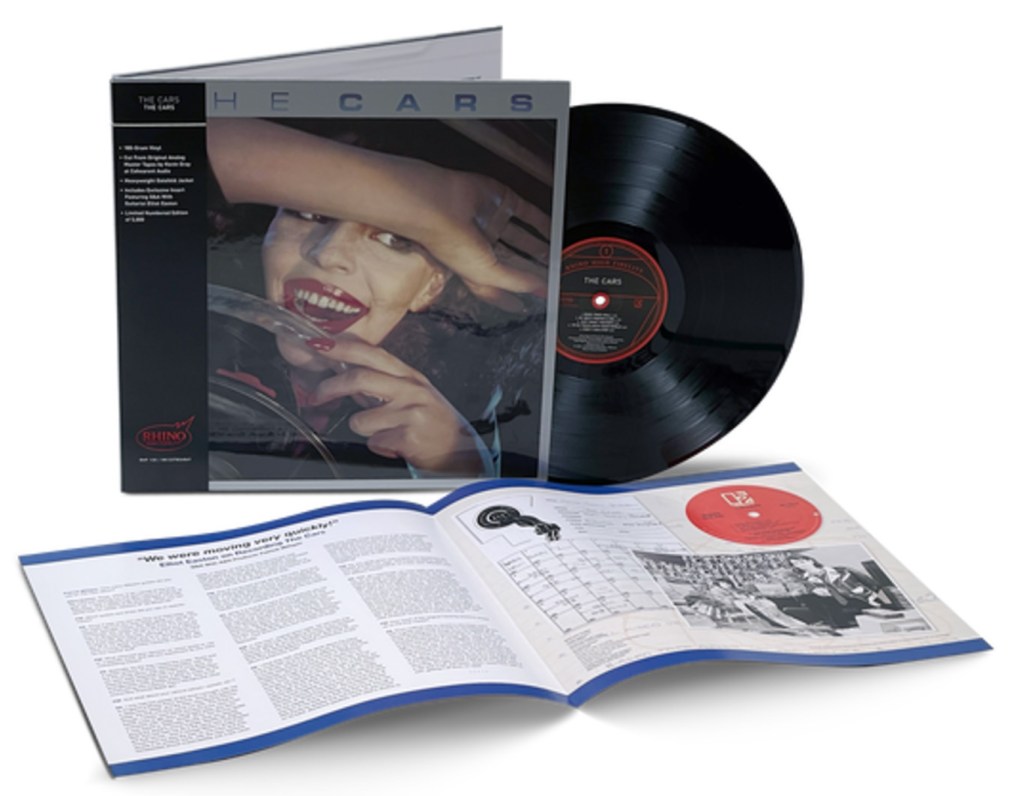
For a deeply meretricious release of recent vintage (OBI strip!, custom booklet!, premium heavy vinyl!, fold-open cover!), see The Cars on Rhino. The only thing left out of the package was a good sounding LP.


Further Reading

(more…)

Robert Brook and I Discuss His Revolver Shootout on Youtube

Robert Brook has a blog which he calls

A GUIDE FOR THE DEDICATED ANALOG AUDIOPHILE

He has now started a youtube channel and he invited me to talk about records for about an hour or so.

Please to enjoy.

Quick tip: set the playback speed at 1.25, 1.5 or 1.75, the conversation will still be intelligible and a lot shorter!

Robert Brook Discusses His Youtube Shootout Video

Hot Stamper Pressings of Revolver Available Now

More Reviews and Commentaries for Revolver

One of our good customers, Robert Brook, writes a blog which he calls A GUIDE FOR THE BUDDING ANALOG AUDIOPHILE. 

He recently made a youtube video for his shootout for Revolver, which we wrote about here.

Now he has posted some context and talked about his journey in audio which we think you will enjoy reading. Robert and I will be doing a video next week about his shootout, so expect to see that here on The Skeptical Audiophile soon.

REVOLVER SHOOTOUT!!!

(more…)