Bill Schnee, Engineer – Reviews, Commentaries and Letters

Letter of the Week – “After playing a few very smooth and quiet bands I put on my excellent vintage copy of Aja that proceeded to destroy the Cisco.”

More of the Music of Steely Dan

One of our good customers had this to say about some Hot Stampers he purchased recently (bolding added):

Hey Tom,   

It’s amusing that even Golden Ears who have the attention of large readerships can miss and misunderstand so much. You don’t have to understand the technical why of the variability of LPs to appreciate just how profound the audible differences can be from stamper to stamper. Even in acknowledging that differences are present, they do not seem to appreciate the extreme degree of the variation in sound among LPs from different stampers.

As so many of us have learned from you, a “hot stamper” LP is simply in a whole different league in sound quality. A good sound system is necessary to realize just how big that difference is and the more optimized that system is the better.

Beyond the audible reality and the technical issues, it is the subject of value that is not understood or appreciated. The ability to simply find a nice playable copy of a vintage LP is a major task. So many LPs have suffered the gouging of what must have been a rusty nail used as a stylus as well as all the other sins that can be wreaked on the plastic disc. Then the incredible task of assembling enough different copies to be able to do the “shoot-out” would seem impossible.

I have, as many now may have tried, done a simple “shoot-out” of a few copies of a favorite LP. Among those I have always found the “better” of the bunch. Now and then and just by luck (since the statistics of not having enough samples was not working in my favor) I have found what must indeed be a “hot stamper). And WOW …..what a difference!

The number of times this has occurred fits on less than one hand yet when you hear an LP that has been mixed and mastered really well and then “transferred” with care and quality via an excellent stamper, there is an epiphany. Suddenly you hear what you often refer to as “master tape” sound. As I have said before, this is really a sad statement about the quality and consistency of record production throughout its history.

The “Audiophile” Half-Speed thing only piles it on top of this with the way mastering at half speed seems to extract the dynamic life and frequency response from an album in contrast to a standard copy.

The logical intention that mastering at half speed would allow the cutting lathe tool to have “more time” to lay down more of the music signal just never really worked.

You would think the “Golden Ears” that developed this idea would have compared the result with real-time cutting speed (not brain surgery). I never wanted all this to be the way it is and didn’t even know it until I stumbled upon Better Records one day. But it is the way it is!

(more…)

Listening to Aja (with Free Cisco Debunking Tool)

Hot Stamper Pressings of the Music of Steely Dan Available Now

This commentary references a shootout we did in 2007 or thereabouts, shortly after the release of Cisco’s misbegotten remaster.

Another in our series of Home Audio Exercises with specific advice on What to Listen For (WTLF) as you critically evaluate your copy of Aja.

Our track commentary for the song Home at Last makes it easy to spot an obvious problem with Cisco’s remastered Aja: This is the toughest song to get right on side two.

Nine out of ten copies have grainy, irritating vocals; the deep bass is often missing too. Home at Last can sometimes be just plain unpleasant, which is why it’s such a great test track.

Get this one right and it’s pretty much smooth sailing from there on out.

If you own the Cisco pressing, focus on Victor Feldman’s piano at the beginning of the song. It lacks body, weight and ambience on the new pressing, but any of our better Hot Stamper copies will show you a piano with those qualities in spades on every track. It’s some of my favorite work by the Steely Dan vibesman.

The thin piano on the Cisco release must be recognized for what it is: a major error on the part of the mastering engineers.

Bonus Listening Test for Side Two

The truly amazing side twos — and they are pretty darn rare — have an extended top end and breathy vocals on the first track, Peg, a track that is dull on nine out of ten copies. (The ridiculously bright MoFi actually kind of works on Peg because of the fact that the mix is somewhat lacking in top end. This is faint praise though: MoFi managed to fix that problem and ruin practically everything else on the album.)

If you play Peg against the tracks that follow it on side two, most of the time the highs come back. On the best of the best the highs are there all the way through.

Listening Tests for Side One

Generally what you try to get on side one is a copy with ambience. Most copies are flat, lifeless and dry as a bone. You also want a copy with good punchy bass — many are lean, and the first two tracks simply don’t work at all without good bass. And then you want a copy that has a natural top end, where the cymbals ring sweetly and Wayne Shorter’s saxophone isn’t hard or honky or dull, which it often is on the bad domestic copies.

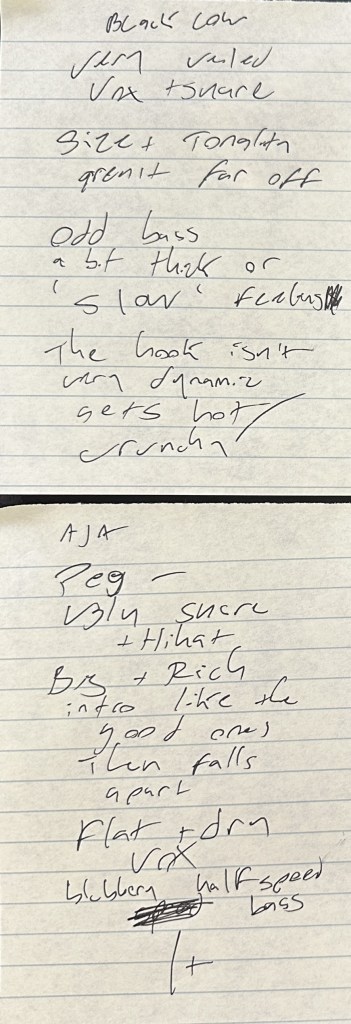
Also listen for GRAIN and HONK in the vocals on Black Cow. The better your copy is, the less grainy and honky the vocals will be.

(more…)

Relax, Stare into the Middle Distance and Listen to the Players as a Group

Hot Stamper Direct-to-Discs Available Now

Reviews and Commentaries for More Direct to Disc Recordings

Many years ago we had discussed the polarity issues associated with this record:

According to the liner notes, this album has its polarity reversed. They tell you straight out to reverse the positive and negative at the speaker terminals for the best “transient response and spatial clarity.”

That out of phase quality is as plain as the nose on your face when you know what to listen for. There’s an unpleasant hardness and hollowness to the midrange, a lack of depth, and an off-putting opaque quality to the sound. The top gets dull and the bass gets weird and wonky.

With our EAR 324p phono stage, the click of a button reverses the polarity. I can’t tell you how handy it is to have such a tool at your disposal. Checking the polarity for Discovered Again couldn’t have been easier.

But get this: most side ones are NOT out of polarity. How about them apples! We could not have been more shocked. Here is the most famous reversed polarity audiophile recording in the history of the world — or maybe just the history of our world — and it turns out most copies are not reversed on side one at all.

Findings from a Few Years Back

I did not do the shootout for the album, but I wanted to check on the polarity just to hear it for myself. I must admit I had to go back and forth a number of times, using my favorite song on the album and an old Demo track from back in my earliest days in audio, the mid- to late-70s: Keep Your Eye On The Sparrow.

Harvey Mason’s super-punchy drum playing catches your attention right off the back. A tambourine comes along in the left channel at some point. Lots of bass. Rit’s guitar in the right channel and Grusin’s keyboards in the center fill out the soundstage. The ensemble is on fire.

Evaluating the sonic differences of the individual instruments in and out of polarity had me confused. A typical conundrum: Should the tambourine be smoother with more body, or brighter with more harmonic overtones? Which is right? Who can say definitively?

Experiments Provide Answers

It was only after about fifteen minutes of switching the polarity back and forth that the penny dropped.

Focussed on an individual instrument, I could hear it just fine both ways. But then I noticed that with the polarity reversed the group got vague.

The images seemed blurrier, less defined. If I relaxed and just stared into the middle distance and let the music flow, the band seemed to be more jumbled up and messy.

That was the key. The obvious change when the polarity was wrong was a loss of image specificity. Flipping the record over to side two and using my new “lens” to hear the difference with the polarity changed, it was obvious when the polarity was right or wrong.

I have experimented with polarity on scores of records.

Certain effects on certain records are unmistakable. But these effects seem to vary a great deal from title to title.

Grusin’s brilliant direct to disc recording initially had me at a loss. With a little experimentation, the improvement in the sound with the correct polarity became evident over time, as it always seems to do. Thank god I didn’t have to change speaker leads the way I used to in the old days. (more…)

Aja Gets the UHQR Treatment Good and Hard

Hot Stamper Pressings of the Music of Steely Dan Available Now

It’s been almost one full year since we reviewed our first Steely Dan UHQR, Can’t Buy a Thrill. If you have a few minutes to kill, you can read about it here.

One whole year. Time flies!

Some folks chide us for constantly beating up on one Heavy Vinyl release after another, as if we actually like doing it. We don’t think that’s fair (the “constantly beating up” part, not the “like doing it” part. We actually do like doing it. If we didn’t, we wouldn’t do it. It costs us money and time, and obviously doesn’t put a penny in our pockets, since we would never sell you a record that sounds as wrong as most of them do).

Contrary to what some folks believe, and as we try to make clear in the following paragraphs, we’re actually quite far behind on our Heavy Vinyl reviews. The reality of our situation is that we simply cannot keep up with all the bad records being made these days.

Let’s take stock. The Electric Record Company’s Heavy Vinyl pressing of Quiet Kenny is still waiting for a review after three years. The Kind of Blue on Mofi at 45 RPM? That one I played at least three years ago. Still no review. I know what I want to say about it, I just haven’t found the time to say it.

Other bad records still waiting to be written up include the Craft pressings of Born Under a Bad Sign and Lush Life; the Britten Young Person’s Guide to the Orchestra on Cisco; Mingus’ Blues and Roots; Dire Straits’ first album, Tapestry and Blue on MoFi; the AP Plow that Broke the Plains; Black Sabbath’s Paranoid; Weaver of Dreams on Classic; LeGrand Jazz on Impex; the 2018 remix of Pink Floyd’s Animals; the Abbey Road Half-Speed mastered pressing of Sticky Fingers (shocker: it could be worse!); Tina Brooks on Music Matters (not that bad, actually); Led Zeppelin’s first album and Houses of the Holy remastered by Jimmy Page; and there are bound to be plenty of others that I’ve simply lost track of.

I have the records here in Georgia with sonic notes attached, and one of these days I will dig them out and make listings for them.

There is an overwhelming, seemingly inexhaustible supply of collectible, out-of-print Heavy Vinyl available to the credulous audiophile with a computer and a credit card.

In addition, there are hundreds of new titles being released every year, far more than a cottage operation such as ours could ever hope to find the time and money it would take to buy, clean, play and review them all.

Keep in mind that we don’t get paid to do any of that. We play and review these records to help audiophiles — customers and non-customers alike — better understand their strengths and weaknesses relative to the amazing sounding vintage pressings we offer as Hot Stampers.

(more…)

Letter of the Week – “The White Hot stamper just pulled you into those songs, so you could feel every little dynamic shift and tonal change…”

More of the Music of Steely Dan

More of the Music of Cat Stevens

One of our good customers had this to say about some Hot Stampers he purchased recently. [The bolding has been added by us.]

Hey Tom,   

A friend and I just did a shootout of 16 copies of Aja, plus one of your White Stampers, which easily trounced them all (including some DJ 12″ singles from the album) [1], and in exactly those areas that you cover in some of the WTLF descriptions you have for that album. Just a great big, open and lovely-sounding record–what a thrill!. And thanks very much for those notes–they help clarify the critical listening process.

We also listened to 16 copies of Tea for the Tillerman. Among those (UK pink rims, German, Japanese, and many US labels) were two excellent early brown label A&M pressings, which I saved for the end of the shootout.

And we had the Analogue Productions 33 rpm pressing, which has been a big disappointment since I first heard it. [2] Those two original A&Ms both sound so much more natural, with more delicacy, extension, air, presence and energy than the AP version. My listening buddy said they sounded as if they were cut at 45 rpm; and neither of us really expected your White Hot UK pink-rim pressing could be a significant improvement over those.

But, as good as those are, it was also obvious that your WHS brought the music several steps closer. The A&M brown labels both added some thickness and over-emphasized the low range of his voice–which (until we heard your WHS) was a pleasant coloration.

But as you frequently mention, the biggest issue, once you’ve heard a great copy, is how much more energy and flow the music has. The WHS stamper just pulled you into those songs, so you could feel every little dynamic shift and tonal change that the musicians were bringing to the table. It allowed that music to breathe in a way I’ve never heard before. What a record!

The BIG thing your Hot Stampers do is present the music in a perfectly balanced way — no frequency range is emphasized, which also means none are compromised. I think this is why you can always turn up the volume on a Hot Stamper. If you’ve got a bad mastering or bad pressing, at some point, turning up the volume only make parts of the recording more unlistenable. Turning up a Hot stamper makes it a bit louder, sure. But it also brings you further into the studio, and closer to the music — and that’s we really want, right?

Ivan

Ivan,

Quite a shootout! I see you learned a lot. That’s what shootouts are for, to teach you what the good copies do well that the other copies do not do so well. As you well know, going deep into the sound the way you did is a thrill, one we get to enjoy on a regular basis. Maybe not every day — not every record is as good as Tea for the Tillerman – but multiple times a week. It’s what make the coming to work every day fun for those of us on the listening panels.

(more…)

Question about Aja: “Are these all original issues from September 1977…?”

Hot Stamper Pressings of the Music of Steely Dan Available Now

Got this letter a while back:

Hey Tom,   

I’m very interested in purchasing one of your copies of Steely Dan’s Aja. Are the catalog numbers the same for all 3 albums? Are these all original issue from September 1977 when the album was first released?

I’m new to your website (and vinyl collecting in general) so any commentary you have would be appreciated. $200 is probably the most I can afford for this album.

Thanks,
Joe

Joe, yes, only the early pressings of the album are any good and we would not sell anything else. They would not have all come out in September but they look as original as any others would. You will get a lot of sound and music for your money on this album, and you should hear a world of difference between our copy and any other you may own.

Best, TP

Got it – Can you just confirm the catalog number is AB 1006? I’m specifically looking at the version that’s $199 on your site.

Thanks,
Joe

Dear Joe,

Keep in mind that we’re the guys who are all about sound, not originality.

We discussed it in our FAQ as a matter of fact:

This listing gets to the point:

(more…)

Letter of the Week – “The WHS made the music sound more natural and more involving.”

More of the Music of Steely Dan

One of our good customers recently bought a Super Hot pressing of Aja, and wasn’t quite sure if he loved the music enough to keep it, so he wanted to try a White Hot Stamper pressing to see if that would win him over, the idea being that the better sound of the White Hot copy would communicate the music better. This is his story.

Dear Tom,

Probably my favorite thing to do in audio these days is putting on a record of yours for the first time. When the Aja White Hot Stamper came, I had to wait a few hours until after the kids were all tucked in. I listened with headphones for a change, and right away I could tell how clear and intricate this copy was. Knowing how my other copies sounded, I knew no shootout was going to be necessary.

I also really love doing mini-shootouts of my own. It’s a great way to really sink in to listening for a while. I don’t have 16 other copies of Aja, the way your other customer described, but I could still stack your WHS up against three other ABC pressings with identical-looking labels and nearly-identical deadwax, along with a MoFi and a Japanese pressing.

It proved to be the most beguiling shootout I’ve ever done. Each copy had merits, and among the ABC pressings, I was hearing clear similarities to the WHS. This is such delicate and full music, so obviously well-recorded, that I guess it’s hard for any pressing to completely muck it up.[1]

I’ve heard you say that a white hot stamper is a copy that just does everything right, and that was completely true in this case. The differences were subtler, but also more important, than they usually are in my mini-shootouts. The WHS made the music sound more natural and more involving. All those crazy details, present in the others if you really pay attention, came right up to the surface when the WHS played.

I really can’t claim it trounced the others, but I can certainly say that it had the best aspects of each of them, while in turn not being improved on in any aspect by any of the others. Sure, it would be fun to get to hear one of the sought-after pressings, like a Cisco, but with prices verging on hot stamper territory, it’s not like I’m going to go track that down. I’ll just content myself with your word that this one would beat one of those.[2] Since I’m not feeling anything lacking here, I have no reason to keep going.
After almost every purchase from you, I ask myself, “is it worth what I paid?” This was a funny one. I don’t love Steely Dan, even though all indications are that I should. I’ve always dug Aja, but not to the obsessive levels I know others to be (and that I am with other records). I was curious to own a WHS because I know it’s such a well-recorded album, I knew I’d love the sound, and as you suggested when I asked you about it, I wanted to see if a great-sounding copy could help me get into the music.

So far so good. I appreciate the virtuosity of the musicians, the touch they’ve got on their instruments, the clever wordplay (now that the vocals are so easy to make out), and the communication among them, like a great jazz session. Is it worth what I paid? Well, I’m not sending it back, even though I know you wouldn’t mind if I did. So, thanks for another gem in my collection.

Thank you,

Aaron

Aaron,

Thanks for your letter. A few thoughts:

[1] Yes, an early ABC pressing is unlikely to sound wrong or terrible in our experience. Of the hundred or more that we’ve played, a don’t remember one that did not at least sound good enough to sell, earning perhaps our lowest Hot Stamper grade.

You’ve recently upgraded your system quite a bit. If you keep going that way, in five or ten (or two!) years you may want to revisit the WHS copy relative to your other three ABC pressings (forget the others) and see what changes you have wrought, although I do not recommend you use Aja as a test disc, for the simple reason that extremely artificial recordings can often sound amazingly good, but when your system goes off the rails to some degree from a new tweak or change, they will sound different, but not necessarily better or worse, not more right or more wrong, and then you don’t know whether the change was a good one or a bad one.

Different means nothing. Things sound different all the time.

More right or more wrong should always be your test.

Test discs like the ones we recommend should make it easy to distinguish better from worse, right from wrong. Test discs that don’t are simply not good test discs and should not be used for that purpose.

[2] Don’t take my word for how bad the Cisco pressing is. We have letters from customers who say the same thing.

The Cisco is so bad we call it a pass/fail record.  We describe pass/fail records this way:

Some records are so wrong, or so lacking in qualities that are crucial to the sound — qualities typically found in abundance on the right vintage pressings — that the advocates for these records, reviewers and audiophiles alike, have clearly failed to judge them accurately.

Tea for the Tillerman on the new 45 may be substandard in almost every way, but it is not a Pass/Fail pressing. It lacks one thing above all others, Tubey Magic, so if your system has an abundance of that quality, the way many vintage tube systems do, the new pressing may be quite listenable and enjoyable. Those whose systems can play the record and not notice this important shortcoming are not exactly failing. Audiophiles of this persuasion most likely have a system that is heavily colored and not very revealing, but it is not a system that is hopeless.

(more…)

An Experiment Apparently Not Worth the Trouble

Hot Stamper Pressings of the Music of Steely Dan Available Now

A couple of years ago, an interested party inquired about a Hot Stamper pressing of Aja he had seen on our site, specifically whether we were selling the AB first pressing or the AA reissue. You can find the discussion that ensued here.

As a kind of a postscript, we added:

By the way, [Joe] ended up not buying our Hot Stamper pressing. When you have to have an original, you have to have an original and that’s all there is to it.

If Joe was of a more scientific or skeptical bent — in other words, if he were more like me — he would have acquired an original, and then ordered our Hot Stamper in order to compare the two.

This is the subject I want to talk about today.

Audiophiles tend to subscribe to widely-held, conventional theories about what kinds of records are most likely to have the best sound. Outside of those of us who write for this blog, you will find very few audiophiles who believe that a substantial percentage of vintage reissues — not the modern ones, we’re talking about the ones from the 60s, 70s and even the 80s — are superior to their more original brethren.

Assuming Joe wanted the best sound — nobody who pays our prices could possibly be interested in anything else, right? — then he was simply making the point that since he wanted the best, and an original pressing absolutely had to be the best, nothing else would do, and that was that.

Joe could have done the experiment for himself easily enough. Had he asked us to send him our best AA pressing, we could have done that, and he could have compared that pressing to the original he no doubt owns, or, in the case that he had no original, acquiring one or more could have easily been arranged. They made them by the millions.

And that experiment might have resulted in an interesting learning experience, or not — who can say what the best pressing would have been on Joe’s stereo, with Joe’s ears doing the listening? It could have gone any which way, but something would have been gained in the act of sitting down to find out, for a fact, what pressing sounded better.

With all this in the back of my mind. just recently we did a shootout for Aja, and I checked the stampers for the two top copies.

Sure enough, the stampers found on the AB pressings won.

But those same stampers are found on the AA pressings for one of the titles, and one of the sides for the other title.

I could not even tell you for sure which pressings — AB or AA — actually won, because we rarely keep track of that information.

We only buy early pressings on the original labels because those are the only ones that sound good to us.

We don’t pay attention to the catalog number on the label because that doesn’t tell us anything of value. Playing the records is how we know what they sound like, and unless all the AB pressings beat all the AA pressings, or vice-versa, then that information is none of our concern.

Even if all the AB copies beat all the AA copies, we still have to buy, clean and play the AA copies in our shootouts because some of them are going to do well and can be offered to the customers who don’t want to spend the big bucks the top copies command.

We are generally opposed to having one-size-fits-all theories about the messy world of records, and you can find some of the commentaries we written about that subject here.

(more…)

Listening in Depth to No Secrets

Hot Stamper Pressings of the Music of Carly Simon Available Now

Presenting another entry in our extensive listening in depth series with advice on what to listen for as you critically evaluate your copy of No Secrets.

Here are some albums currently on our site with similar Track by Track breakdowns.

Balance is key to getting all the tracks to sound their best. Many copies we played were too dull or too bright.

One more note: having your VTA set just right is critical to getting the best out of this album.

The loudest vocal parts can easily strain otherwise.

Once you get your settings dialed in correctly, a copy like this will give you the kind of rich, sweet sound that brings out the best in this music.

Two Tracks Are Key

Listen to Embrace Me, You Child on side two — on the best copies you can really hear the rosiny texture of the strings as they are bowed.

The cymbals too can sound amazing — listen to how extended the crashes are on You’re So Vain.

Side One

The Right Thing to Do
The Carter Family
You’re So Vain

A wonderful song and a good test track to boot. On the best copies the bass will be deep and well-defined, and one can expect the vocals to have a lovely breathy quality.

His Friends Are More Than Fond of Robin
We Have No Secrets

The top end is key to finding great sound on this album. If it’s boosted you’ll have a bright copy that will be glaringly unpleasant. If it’s missing or attenuated, you’ll have a dull copy that’s boring and uninvolving.

Ah, but when it’s extended and correct, everything else seems to fall into place. That’s why this song is such a good test track. If the voices sound smooth but you still have extension up top, you know your copy has been mastered and pressed properly.

(more…)

Lincoln Mayorga Volume 3 – Listen for Strained and Blary Brass

Hot Stamper Pressings of Direct-to-Disc Recordings Available Now

Most copies of this album are slightly thin and slightly bright.

They give the impression of being clear and clean, but some of the louder brass passages start to get strained and blary, or glary if you like.

The good copies are rich and full.  The sound is balanced from top to bottom.

The sound is smooth, which allows you to play the album all the way through at good loud levels without fatigue.

On the best pressings, the trumpets, trombones, tubas, tambourines, and drums all have the true tonality and the vibrancy of the real thing. The reason this record was such a big hit in its day is because the recording engineers were able to capture that sound better than anybody else around [not really, but that’s what it seemed like at the time].

That’s also the reason this is a Must Own record today — the sound and the music hold up.

Just listen to that amazing brass choir on Oh Lord, I’m On My Way. It just doesn’t get any better than that. If ever there was a Demo Disc for Brass, this is one!

I used to think the Tower label copies were not as good — that the later pressings were pressed better. Now I know that it doesn’t matter what era the pressing is from: the tonal balance is the key to the best sound.

(more…)