Top Artists – Bill Evans

Basic Miles – Our Four Plus Shootout Winner

Hot Stamper Pressings of the Music of Miles Davis Available Now

In 2018 we awarded this copy’s side two of Basic Miles our very special Four Plus (A++++) grade, which is strictly limited to pressings (really, individual sides of pressings) that take a recording to a level we’ve never experienced before, a level we had no idea could even exist.

We estimate that less than one per cent of the Hot Stamper pressings we come across in our shootouts earn this grade. As I write this there is not a single other record on the site that earned that grade on either side. You can’t get much more rare than that.


UPDATE 2026

  • Our lengthy commentary entitled outliers and out-of-this-world sound talks about how rare these kinds of pressings are and how we go about finding them.
  • We no longer give Four Pluses out as a matter of policy, but that doesn’t mean we don’t come across records that deserve them from time to time.
  • Nowadays we most often place them under the general heading of breakthrough pressings. These are records that, out of the blue, revealed to us sound of such high quality that it changes our appreciation of the recording itself.
  • We found ourselves asking “Who knew?” Perhaps a better question might have been “How high is up?”

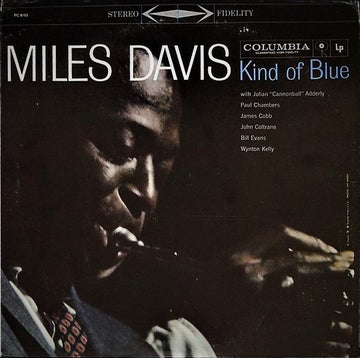
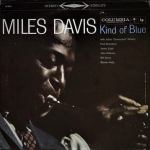
Kind of Blue

Want to know how good our Hot Stamper Kind of Blue pressings sound? Listen to this very record. If you play the tracks that were recorded in 1958, the year before Kind of Blue, you will hear practically the same lineup of musicians.

That means Stella By Starlight and Little Melonae on side one, and Green Dolphin Street and Fran-Dance (Put Your Little Foot Right Out) on side two. We’re talking Bill Evans, John Coltrane and Cannonball Adderley in their prime, 1958, with top 1958 sound to match.

The nine-minute-plus Green Dolphin Street that opens side two is nothing short of amazing, some of the coolest jazz you will ever hear, on any record, at any price.

(more…)

Miles Davis / Basic Miles – Here Is the Hot Stamper Sound of Kind of Blue

More of the Music of Miles Davis

  • Demo Disc Jazz sound for this wonderful collection, with both sides earning killer Nearly Triple Plus (A++ to A+++) grades, just shy of our Shootout Winner – fairly quiet vinyl too
  • Opening side two, the 9+ minutes of “On Green Dolphin Street” has some of the coolest jazz you will ever hear, on any record, at any price
  • We’re talking Bill Evans, John Coltrane and Cannonball Adderley in their prime, 1958, with top 1958 sound to match
  • If you want to know what the better copies of Kind of Blue sound like, this pressing will tell you, because it has that sound
  • And that means it is absolutely NOTHING like the MoFi 45 RPM 2 LP set that some audiophiles (and the reviewers who cater to them) seem to like so much, why, we cannot begin to fathom

Want to know how good our Hot Stamper Kind of Blue pressings sound?

Listen to this very record.

If you play the tracks that were recorded in 1958, the year before Kind of Blue, you will hear practically the same lineup of musicians.

That means Stella By Starlight and Little Melonae on side one, and Green Dolphin Street and Fran-Dance (Put Your Little Foot Right Out) on side two. 

The nine-minute plus Green Dolphin Street that opens side two is nothing short of amazing, some of the coolest jazz you will ever hear. With Fran Dance on the same side, that gives you about 17 minutes of great-sounding jazz by Miles’ classic Kind of Blue lineup.

Side one has the same cats playing for more than 12 minutes. By my calculation, that’s close to another album’s worth of material from the group. The rest of the material on this compilation is best seen as gravy; maybe not essential, but never less than interesting. (more…)

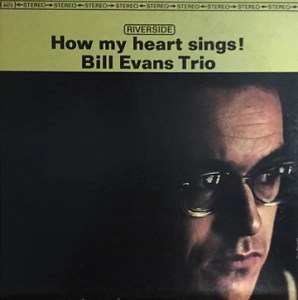
Bill Evans – How My Heart Sings!

More of the Music of Bill Evans

  • How My Heart Sings, here with solid Double Plus (A++) sound throughout this Riverside recording pressed on fairly quiet OJC vinyl
  • Both of these sides are lively, dynamic and full-bodied, and there’s real weight to the piano, a key quality we look for on all the piano recordings we play
  • It’s bigger, richer, more Tubey Magical, with more extension on both ends of the spectrum and more depth, width and height than most other copies we played
  • “Recorded in May and June of 1962, at the same time as the Moonbeams sessions, How My Heart Sings shows a different side of the Bill Evans Trio than that all-ballads album. In Evans’ own words, the band’s desire was to ‘provide a more singing sound’ in this material.”
  • 4 stars: “[The recording] flies in the face of the conventions Evans himself has set, and yet retains the deep, nearly profound lyricism that was the pianist’s trademark.”

(more…)

In the 80s We Had No Idea How Good the Best OJC Pressings Could Sound

Hot Stamper Pressings of the Music of Chet Baker Available Now

For our first Hot Stamper Shootout Winner. we noted:

Both sides here are Tubey Magical, rich, open, spacious and tonally correct. We’ve never heard the record sound better than in our most recent shootout, and that’s coming from someone who’s been playing the album since it was first reissued in the 80s.

I used to sell these very records in the 90s — we retailed them for ten bucks back then — but we had no clue just how good they could be back in those days. We couldn’t clean them right, or even play them right, and it would never have occurred to us to listen to a big pile of them one after another in order to pick out the best sounding copies.

This is a wonderful Chet Baker record that doesn’t seem to be getting the respect it deserves in the wider jazz world. You may just like it every bit as much as the Chet album, and that is one helluva record to compare any album to. In our estimation it’s about as good as it get.

(more…)

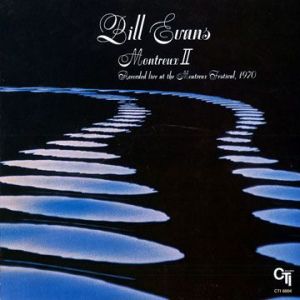
Bill Evans – Montreux II

More of the Music of Bill Evans

  • This vintage copy of this classic live jazz recording boasts solid Double Plus (A++) sound from first note to last
  • An excellent pressing, with lovely richness and warmth, real space and separation between the instruments
  • Recorded at the Montreux Jazz Festival in Switzerland, this 1970 release showcases Evans’s stylings in the trio setting that marked his best work
  • “Bill Evans’ second recording at the Montreux Jazz Festival in 1970 was a highly anticipated concert, finding the pianist in peak form, accompanied by bassist Eddie Gómez and drummer Marty Morell. “

(more…)

Letter of the Week – “Oh my gosh, so much money wasted on magic buttons, secret sauce and dilithium crystals…”

Hot Stamper Pressings of Miles’s Albums Available Now

One of our good customers had this to say about some Hot Stampers he purchased a long time ago (emphasis added):

Hey Tom,

I imagine you get a little bored with audiophile negativity around the concept of Hot Stampers. I have to admit, they are expensive and I sometimes just can’t push myself to buy (even though I want to). As an alternative I have purchased some of the “new” remastered all analogue classics like Kind of Blue hoping to get great sound.

I listen for enjoyment, but like many folks I get caught up in the hype of technology hoping for better sound. Oh my gosh, so much money wasted on magic buttons, secret sauce and dilithium crystals for a different but really not better sound.

So, to the point, I purchased a copy of Kind of Blue from you about 2 years ago. It was graded by you as A++ – A+++ on both sides. I tell myself this story when I need an incentive and want to buy another Hot Stamper.

I played the newly remastered UHQR KOB. It was quiet, wonderful, excellent.

And so just for fun I decided to listen to the copy of KOB I bought from you.

My Hot Stamper is a re-press from Columbia probably from the ’70’s. The difference between both copies was startling.

My Hot Stamper copy of KOB had bigger dynamics, air, tonal awareness, spatial sense.

Bass, sax, piano and Miles – alive and vibrant. It sounded better. The only negative difference was the vinyl was not as quiet.

My experience with the albums I buy from you has always been satisfying because they sound so good. So thanks and screw all the naysayers .

Anyways, just felt like saying thanks and trying to push myself forward on my next purchase.

Best, Art

Art,

Thanks for your letter. You are our letter of the week!

This caught my eye:

“…so much money wasted on magic buttons, secrete sauce and dilithium crystals for a different but really not better sound.”

Ain’t it the truth. Lots of smoke and mirrors and fancy packaging, but when the record in question is at best mediocre, as you discovered for yourself, we describe such a record as putting lipstick on a pig.

Michael Fremer says it’s the best KOB ever, and will be for all time.

Why can’t you hear what he can?

Seriously, could there be a more absurd and ridiculous statement? When discusssing pressings, this kind of certainty is the unmistakable mark of shallow and misguided thinking.  Audiophiles as a group evince far too much credulity and not nearly enough skepticism about both records and audio, which is why they are always looking for easy answers and quick fixes.

They don’t want to do the work. They want someone to tell them they don’t have to do the work.

(more…)

Bill Evans / Moon Beams on OJC

More of the Music of Bill Evans

  • This Riverside recording of Evans’s 1962 classic pressed on fairly quiet OJC vinyl boasts solid Double Plus (A++) sound or BETTER from first note to last
  • Full-bodied and warm, exactly the way vintage analog should sound, yet as clear and as open as any pressing you’ve heard (or your money back)
  • The first album Evans recorded after Scott LaFaro’s death and it is a deeply immersive experience
  • AllMusic raves it’s “…so well paced and sequenced the record feels like a dream … Moonbeams was a startling return to the recording sphere and a major advancement in his development as a leader.”

Moon Beams is one of the best sounding Bill Evans records we’ve ever played. You can see why we chose it to be the first OJC Hot Stamper of his to hit the site back in 2015.

Play It Might As Well Be Spring for the kind of sublime musical experience you only find on 20th century analog.

(Well, almost. Some of the newer OJC pressings from this century can be quite good too.)

(more…)

Bill Evans / Moon Beams on Riverside

More of the Music of Bill Evans

  • This Riverside reissue pressing of Evans’s 1962 classic boasts solid Double Plus (A++) sound from first note to last
  • Full-bodied and warm, exactly the way vintage analog should sound, yet as clear and as open as any pressing you’ve heard (or your money back)
  • The first album Evans recorded after Scott LaFaro’s death and it is a deeply immersive experience
  • AllMusic raves it’s “…so well paced and sequenced the record feels like a dream … Moonbeams was a startling return to the recording sphere and a major advancement in his development as a leader.”

Moon Beams is one of the best sounding Bill Evans records we’ve ever played. Play “It Might As Well Be Spring” for the kind of sublime musical experience you only find on 20th century analog.

Both sides are Tubey Magical, rich, open, spacious and tonally correct. We’ve never heard the record sound better, and that’s coming from someone who’s been playing Bill Evans’s albums since the 80s when they were first reissued in their current form.

These guys are playing live in the studio and you can really feel their presence on every track — assuming you have a copy that sounds like this one.

(more…)

How to Avoid Making this Rookie Record Collecting Mistake

Record Shopping Day Video!

Not sure how much of this video you can stand — nothing could interest me less than watching a couple of vinyl enthusiasts spouting off on what they think about some random records sitting in a local store’s bins.

But one or two bits caught my eye. I thought I might take the opportunity to share my take on them with you.

Is there any value to the comments of these two collectors? If you care about what music they like, perhaps.  Anything about what to look for on the label or jacket that might correspond to better sound?  If it’s there I sure didn’t see it, but I admit to speeding through most of it, so I can’t say for sure.

The first bit I refer to above is at 18:42.  The album in question is the legendary Kind of Blue. At this point the unseen helmet-cammed audiophile picks up the record, recognizes the cover, and proceeds to pull the record out to see what era the pressing is from.

Drat! The disappointment in this audiophile’s voice is palpable as he drops the record back in the bin with his dismissive comment that  “it’s a later pressing.”

But we here at Better Records would be falling all over ourselves to get our hands on that later pressing.

Those late pressings can and often do win shootouts. We would never look down our noses at a Red Label Columbia jazz LP, and neither should you.


UPDATE 2025

As good as the best pressings on the Red Label can sound, it has been years since one won a shootout. Here is our commentary for a recent 70s copy that went up on the site, one that earned a Super Hot grade on both sides.

They tend to sell for four or five hundred dollars these days. Why so much you ask? Because they beat the pants off of every so-called audiophile pressing of the album ever made. The testimony of one of our customers does a good job of describing the differences.

In addition, it turns out that at least nine out of ten of the copies with the red label are not remotely as good as the ones that earn Super Hot grades. The good ones are so rare that we only pick them up locally since practically none of the ones we find on the web have the right stampers. Trying to find the right red label needle in the haystack is more trouble than it’s worth, so don’t expect to see many coming to the site.


Our intrepid audiophile explorer does much the same thing about 23 minutes in. It seems pretty clear to us that he has no respect for such reissues, another example of one of the most common myths in record collecting land, the myth that the  original pressing is always, or to be fair, usually better.

This is simply not true, and those of our customers who have purchased White Hot Stamper pressings from us that turned out to be reissues know exactly what I am talking about. This is especially true for the records we sell by The Beatles. No original pressing has every won a shootout. [With one exception.]

Let’s get back to Kind of Blue.

Is the 50s original always better, is the 70s reissue always better, is the 60s 360 pressing always better?

No to one, two and three.

Why? Because no pressing is always better. All pressings are unique and should only be judged on their merits, and you do that by playing them, not by looking at their labels. For us this truth is practically axiomatic. It is in fact the premise of our entire business. Over the course of the 28 years we have been selling records we have never found any compelling evidence to invalidate it.

The day that someone can accurately predict the sound quality of a specific record by looking at the label or cover is a day I do not expect to come, ever.


UPDATE 2025

The above is somewhat misleading. With enough clean 6-Eye pressings on hand to play in a shooout, one of them will win.

That being the case, we have created two lists for those who would like to know which Columbia labels win shootouts — one for 6-Eye winners and one for 360 Label winners.


(more…)

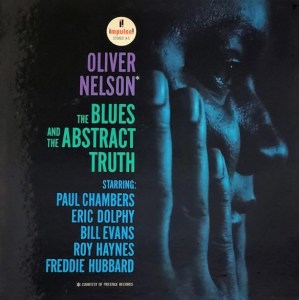
Oliver Nelson – The Blues and the Abstract Truth

More of the Music of Oliver Nelson

  • Oliver Nelson’s Masterpiece (one of only a handful of copies to hit the site in close to three years), here with solid Double Plus (A++) sound or close to it from first note to last – fairly quiet vinyl too
  • Clean, clear and present with a solid bass foundation, as well as the big stage this big group of musicians needs (particularly on side one)
  • If all you know is Van Gelder’s original cutting, you will surely have your eyes and ears opened by this wonderful reissue pressing (also particularly on side one)
  • The knockout pressings we discovered many years ago are ones with very particular markings that are very hard to find, which is explains why this musical Masterpiece comes to the site only once every three years
  • AllMusic gives it 5 stars (of course) and calls this album “…his triumph as a musician for the aspects of not only defining the sound of an era… but on this recording, assembling one of the most potent modern jazz sextets ever.”

The sound is tonally correct, Tubey Magical and above all natural. The timbre of each and every instrument is right and it doesn’t take a pair of golden ears to hear it. So high-resolution too. If you love 50s and 60s jazz, you cannot go wrong here.

For those record lovers who still cling to the idea that the originals are better, this record will hopefully set you straight.

Yes, we can all agree that Rudy Van Gelder recorded it, brilliantly as a matter of fact. Shouldn’t he be the most natural choice to transfer the tape to disc, knowing, as we must assume he does, exactly what to fix and what to leave alone in the mix?

Maybe he should be; it’s a point worth arguing.

But ideas such as this are only of value once they have been tested empirically and found to be true.

We tested this very proposition in our recent shootout, as well as in previous ones of course. It is our contention, based on the experience of hearing quite a number of copies over the years, that Rudy did not cut the original record as well as he should have. For those of you who would like to know who did, we proudly offer this copy to make the case.

Three words say it all: Hearing is believing.

(And if you own any modern Heavy Vinyl reissue we would love for you to be able to appreciate all the musical information that you’ve been missing when playing it. I remember the one from the 90s on Impulse being nothing special, and the Speakers Corner pressing in the 2000s if memory serves was passable at best.)

(more…)