Test Records

Thoughts on Hearing an Amazing Copy of Thriller in the 80s

Hot Stamper Pressing of the Music of Michael Jackson Available Now

The killer copy of Thriller that we discovered in our 2006 shootout gave us a whole new appreciation for just how good the album could sound. It was a real breakthrough, and proof that significant progress in audio is just a matter of time and effort, the more the better.


Our review from 2006

I remember twenty years ago (that would be 1986) playing Thriller and thinking the sound was transistory, spitty, and aggressive.

Well, I didn’t have a Triplanar tonearm, a beautiful VPI table and everything that goes along with them back then. (More here.)

Now I can play the record.

I couldn’t back then.

All that spit was simply my table, arm, cartridge and setup not being good enough, along with all the garbage downstream from them feeding the speakers.

The record is no different, it just sounds different now. Which is what makes the record a great test. If you can play this record, you can probably play practically any pop and rock record. (Orchestral music is quite another matter.)

This Pressing Changes Everything

This pressing has a side two that’s so amazing sounding that it completely changed my understanding and appreciation of this album. The average copy is a nice pop record. This copy is a Masterpiece of production and engineering.

(more…)

Leftoverture – “…a certain ‘squawky, pinched’ sound to the guitars…”

Hot Stamper Pressings of Arty Rock Albums Available Now

This is one of the pressings we’ve discovered with reversed polarity.

This copy of Kansas’ most consistent album, their masterpiece I might venture to say, has an OFF THE CHARTS A+++ side two! This copy shows you the ROCK album they actually recorded. The average copy of Leftoverture only hints at the power of the band.

Side two just KILLED from start to finish, with the deepest, punchiest bass, moving up the frequency ladder to the clearest sweetest mids, and following it all the way to the top with the most extended grain-free, silky highs.

Most copies, like so many rock records from the era, are veiled and smeary. Often they lack extension at one or both ends of the frequency spectrum, more often than not up top, which results in harshness and shrillness, not the sound you want on a Kansas record.

But copies such as this one show you the kind of sound that is possible with Leftoverture. It is, in a word, SMEAR-FREE, with superb transients, textures and clarity that are the natural result of getting every last bit of musical information into the grooves.

(more…)

Listening in Depth to Harvest

Hot Stamper Pressings of the Music of Neil Young Available Now

Many copies we played would work for the heavy songs and then fall short on the quieter tracks. Others had gorgeous sound on the country-tinged numbers but couldn’t deliver much whomp* for the rockers.

Only a select group of copies could hold their own in all of the styles and engage us from start to finish. We’re pleased to present those exceptional pressings as the Hot Stamper copies of Harvest that so many of you have been begging for.

Side One

Out on the Weekend

We love the sound of the drums on Neil Young records — think of the punchy kick drum on After The Gold Rush and the punchy thwack of the snare on Zuma. On the best copies, this song should have the kind of BIG, BOLD Neil Young drum sound we audiophiles have been in love with since the album first came out.

The pedal steel guitar also sounds out of this world on the best copies.

(more…)

Getting the Balance Right on Mean to Me

Hot Stamper Pressings of Pop and Jazz Vocals Available Now

Mean to Me is a favorite test track for side one, with real Demo Disc quality sound. We credit it with helping us dramatically improve our playback.

Roy DuNann at Contemporary was able to get all his brass players together in one room, sounding right as a group as well as individual voices.

The piano, bass, and drums that accompany them are perfectly woven into the fabric of the arrangement.

What makes this song so good is that when the brass really starts to let loose later in the song, with the right equipment and the right room, you can get the kind of sound that’s so powerful you could practically swear it’s live.

Helen was recorded in a booth for this album, and her voice is slightly veiled relative to the other musicians playing in the much larger room that of course would be required for so many players.

When you get the brass correct, the trick is to get her voice to become as transparent and palpable as possible without screwing up the tonality of the brass instruments.

The natural inclination is to brighten up the sound to make her voice more clear.

But you will quickly be made painfully aware that brighter is not better when the brass gets too “hot” and starts to tear your head off.

The balance between voice and brass is key to the proper reproduction of this album.

Once you have achieved that balance, tweak for transparency while guarding against too much upper midrange or top end. Which also means watch out for audiophile wires that may have fooled you into thinking they were more resolving when actually they were just peakier in some portion of the frequency range.

(more…)

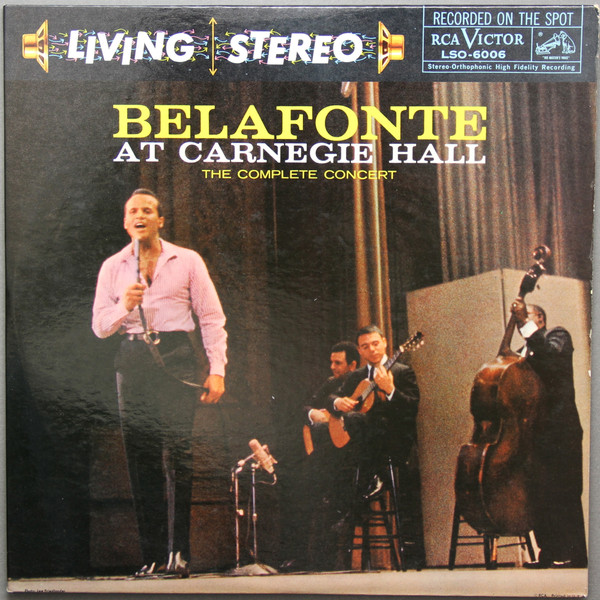
Belafonte at Carnegie Hall – I Have a Theory

Hot Stamper Pressings of the Music of Harry Belafonte Available Now

We’ve long known that some copies of the album are mastered with the polarity reversed. This is one of those copies.

But the crazy news we have today is that this copy of the album sound just fine without reversing the polarity of the system, better than any other copy we played.

True, it sounds a bit better with the polarity reversed, but it is still our Shootout Winner even with the wrong polarity.

I would never have believed that to be the case in the past, but my theory is that the new studio we built has reduced distortions and problems to such a degree that polarity issues are less of a problem now than they might have been in the past.

As I say, it’s just a theory, and as time goes on we will revisit this idea with other recordings that we know to have polarity issues, and we’ll be sure to let you know what we find.

The best sounding versions we played are cut super clean. The brass and strings have dead-on correct textures and timbres.

As good as some pressings are, the best pressings are clearly a step up in class. The differences are easy to hear:

  • The brass has more weight and body and richness.
  • Same with the strings.
  • The voice gets fuller and sweeter and less sibilant, while still maintaining every nuance of detail.
  • The presence is startling; Belafonte is absolutely in the room with you.

(more…)

Botnick and Levine Knocked Equinox Out of the Park

Hot Stamper Pressings of the Music of Sergio Mendes Available Now

The music is of course wonderful, but what separates Sergio from practically all of his ’60s contemporaries is the AMAZING SOUND of his recordings. Like their debut, this one was engineered by the team of Bruce Botnick and Larry Levine.

Botnick is of course the man behind the superb recordings of The Doors, Love and others too numerous to mention. 

Levine is no slouch either, having engineered one of the best sounding albums on the planet, Sergio Mendes’ Stillness.

Just play the group’s amazing versions of Watch What Happens, Night and Day, or Jobim’s Wave to hear the kind of Mendes Magic that makes us swoon. For audiophiles it just doesn’t get any better. (Well, almost. Stillness is still the Ultimate, on the level of a Dark Side of the Moon or Tea for the Tillerman, but Equinox is right up there with it.)

Only the best copies are sufficiently transparent to let the listener hear all the elements laid out clearly, with each occupying a real three-dimensional space within the soundfield. When you hear one of those copies, you have to give Botnick and Levine their due. These guys knew what they were doing like few that have come along since.

(more…)

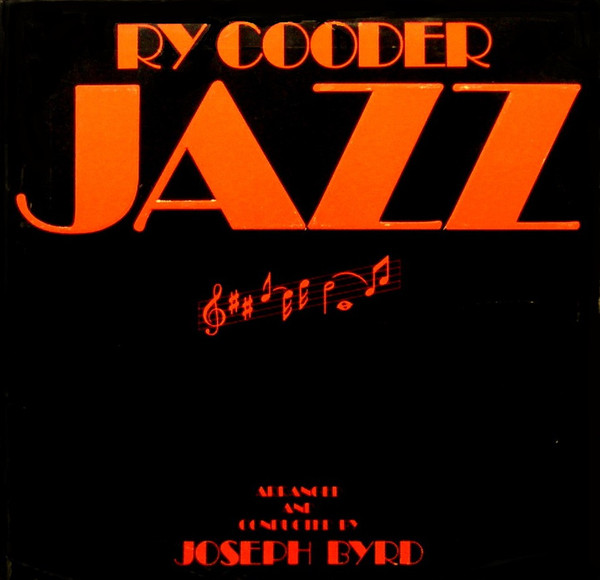
On this Jazz, Transparency Is Key

Hot Stamper Pressing of the Music of Ry Cooder Available Now

The best copies realistically convey the live in the studio quality of the sound. This is a tight ensemble working at the top of their game, no surprise there — Ry surrounds himself with nothing but the best.

But the better copies have such amazingly transparent sound you can’t help feeling as though you really are in the presence of live human beings. You really get the sense of actual fingers plucking those guitar strings. You hear mouths blowing air through horns and woodwinds.

These are sounds that most recordings pretend to capture, and like hypnotist’s subjects, we go along for the ride. This recording has the potential to actually bring forth that living, breathing musician sound, no imagination required.

As is sometimes the case, there is one and only one set of stampers that consistently wins our shootouts for this album.  Click on this link to see other titles with one set of stamper numbers that always come out on top

(more…)

Our Top Copy of Broken Barricades Was Amazing Sounding

Hot Stamper Pressings of Art Rock Albums Available Now

Our recent Shootout Winning early UK pressing was described this way:

Looking for some proggy music that falls somewhere between Jethro Tull and Supertramp, with sonic credentials to match the recordings of those two very well-recorded bands? Well, look no further.

This early UK press is full of the Tubey Magic and studio space that makes the band’s recordings the joy they are to play on a heavily-tweaked audiophile rig.

If you’re a Prog Rock or Art Rock fan, this is a classic from 1971 that belongs in your collection. This also just happens to be our pick for the best sounding recording by the band. Others of similar stature can be found here.

And here are the notes that back up everything we had to say about the copy that knocked us out.

We LOVED playing this album, both for the music and the sound. These guys don’t get the respect they deserve among audiophiles, but we’re doing our best to try to change that.

Side one kicks off with the hit track Simple Sister, and you won’t believe how hard it rocks. Some copies are overly clean — they have the kind of clarity you might hope to find, but lacked the richness and fullness that makes ’70s analog so involving. Those “clean” copies simply do not earn very high grades from us. We leave that sound to the Heavy Vinyl and CD crowd; they seem to like it.

Punter and Thomas

John Punter engineered and Chris Thomas produced. They have worked on many of our favorite — and best-sounding – albums by British artists.

(more…)

Listening in Depth to Emerson, Lake & Palmer

Hot Stamper Pressings of the Music of Emerson, Lake and Palmer Available Now

If you’ve got the system to play this one loud enough, with the low end weight and energy it requires, you are in for a treat with Emerson, Lake and Palmer’s debut.

The organ that opens side two will rattle the foundation of your house if you’re not careful. This music really needs that kind of megawatt reproduction to make sense. This is bombastic prog that wants desperately to rock your world. At moderate levels it just sounds overblown and silly. At loud levels, it actually will rock your world.

To play this record right, you should have, at a minimum:

  • Big dynamic speakers, and they should be pulled out well into the room to create a three-dimensional presentation, in this case of a live rock concert. If the speakers are too big for the room, or stuck in the corners, you haven’t got a chance with a recording as powerful as this one.
  • A large room. (Our new studio has a 12 foot ceiling, a big help with a blockbuster recording such as this one.)
  • Strong walls with no windows, and, if possible, a concrete floor to keep the bass from leaving the room.
  • Seating for a single listener far from any boundary, especially the back wall (a common problem with small-ish rooms).
  • Extensive room treatments to deal with the loud levels this music requires.
  • Enough amplifier power driving speakers with big enough woofers to move all the air in the listening room with authority.
  • And, finally, high quality electricity, a heavily tweaked front end and all the rest of the audio stuff we discuss endlessly on this blog.

Without all of these things, it’s hard for us to imagine anyone could hear this record sound the way the artists and engineers wanted it to. Playing a record like this in a small room at moderate levels practically guarantees that the listener will not be able to hear what makes the best copies of this album so special.

(more…)

Port’s Rule and The Song of the Volga Boatman

More Records that Helped Me Make Progress in Audio

The track that started us down the road to our first Sauter-Finegan shootout is, to this very day, our Number One Test Track of All Time, a little ditty known as the Song of the Volga Boatman.

We first heard it back in the 90s on Bob and Ray Throw a Stereo Spectacular, which is still the version we test with, but this album of forward-looking big band contains that track  as well as 10 others, all with truly amazing sound.

Why is the Song of the Volga Boatman our ultimate test track?

The simplest way to understand it is that all the instruments are being played live in the studio, and all of them in the huge soundfield are real and acoustic — string bass, drums, horns of every size and type, woodwinds, percussion, tubular bells, etc.

In addition, the arrangements given to this roomful of players is so complex and lively that if anything sounds “funny,” to use the precise audiophile nomenclature, it really calls attention to itself.

Port’s Rule states: If it isn’t easy for your Test Discs to sound wrong, they are not very good Test Discs.

Wrong is the natural order of things.

Getting it right is where the work comes in to play.

And it should seem more like play than work or you are unlikely to get very far with it. (That’s another one of Port’s Rules, sometimes referred to as music does the driving.)

When the stereo is right from top to bottom, this song is right from top to bottom, and every other record we know the sound of will have the sound it’s supposed to have.

It seems simple and in some ways it is.

We’ve been getting the Song of the Volga Boatman to sound bigger and better now for years, through scores and scores of changes. At our current stage of audio evolution, at the very loud levels we play it at, it’s shocking how big, powerful and real it seems. It has more of the “live music” qualities we prize than almost any other studio recording I can think of.

(more…)