Test Records

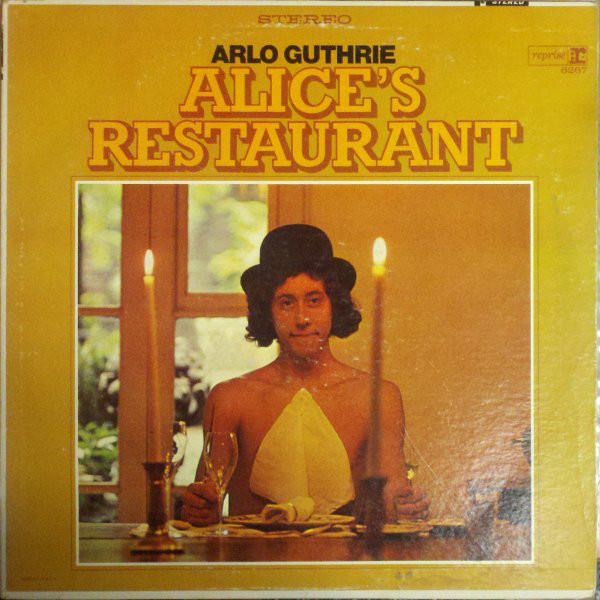
Watch Out for Vocals that Are Too Forward on Alice’s Restaurant

More Records with Specific Advice on What to Listen For

It’s not easy to find a copy of this album that sounds right.

Many of the copies we played suffer from a “too-forward” quality to the vocals, which make them positively unpleasant to listen to.

Others lacked presence, which left them easy on the ears but ultimately boring.

Then there were the copies that got the vocals right but just didn’t have all the Tubey Magic you want for this kind of simple, folky music.

I’m not going to go out on a limb and say this is an album everyone needs in their collection, but it’s certainly enjoyable. For those of you who get a kick out of this slice of 60s life, you’re going to have a very hard time finding a copy that sounds as good as this one.

It’s nice when the copy in hand has all the transparency, space, layered depth and three-dimensionality that makes listening to records such a fundamentally different experience than listening to digitally-sourced material, but it’s not nearly as important as having that rich, relaxed tonal balance.

A little smear and a subtle lack of resolution is not the end of the world on most of the records we sell, including this one.

Brightness and leanness, along with grit and grain on the vocals, can be.

If the average record sounded even close to right, nobody would need us to find good sounding copies for them. They’d be sitting in every record bin in town and we would have to find some other kinds of records to sell.

The records may indeed be in every bin in town — that’s where we found the copies that went into this shootout — but the sound sure isn’t.

Hint: for the best sound, stick to the Tri-Tone original Reprise pressings. They win every shootout.

(more…)

Charlie Mingus Asks the Question of the Day for Audiophiles – Compared to What?

Hot Stamper Pressings of the Music of Charles Mingus Available Now

We used to think the early Limelight pressing shown here was so amazing sounding that finding better sound for this recording would simply be impossible, but the original Mercury showed us just how wrong we were – the right Mercury pressing takes the recording to another level, one we never imagined it could reach. (In our experience records do that from time to time. We’ve written about some of the ones we’ve played here.)

Here is a small excerpt from our most recent commentary for the album:

The best copies recreate a live studio space the size of which you will not believe (assuming your room can do a good job of recreating their room). (Here are some of the other recordings we’ve auditioned with exceptional amounts of size and space.

The sound is tonally correct, Tubey Magical and above all natural. The timbre of each and every instrument is right and it doesn’t take a pair of golden ears to hear it — so high-resolution too.

If you love ’50s and ’60s large group jazz you cannot go wrong here. Mingus was a genius and the original music on this record is just one more album supporting the undeniability of that fact.

More evidence, if any were needed, that the three most important words in the world of audio are compared to what?

(more…)

Lincoln and Doug Produced The Audiophile Sgt. Pepper of Its Day

Hot Stamper Pressings of the Music of Lincoln Mayorga Available Now

When I was selling audio equipment back in the 70s (Audio Research, Fulton speakers), The Missing Linc this was a favorite Demo Disc in our store.

With a big speaker like the Fulton J, the bass drum at the end of track two would shake the walls. At the time I had never heard a record with bass that went remotely that deep. (The album came out in 1972. I’m guessing I probably first heard a copy in ’75 or ’76 when I bought my Fultons, which would have been sometime in my early twenties.)

Every bit as amazing to me was the string quartet on side 2. You could actually hear the musicians breathing and turning the pages on their music stands, just as if you were actually in their “living presence.” No recording I had ever owned allowed me to hear that level of natural detail.

This is one of the albums that made me realize how good audio in the home could be.

(more…)

On Our Top Copy, How Could We Tell that One Side Was Not as Full-Bodied?

Hot Stamper Pressings of the Music of Gordon Lightfoot Available Now

We described a recent Shootout Winning pressing of Summer Side of Life this way:

So transparent, open, and spacious that nuances and subtleties that escaped you before are now front and center.

Everything you want in the sound of a good Folk Rock album is here in abundance.

Tubey Magical acoustic guitar reproduction is superb on the better copies of this recording. Simply phenomenal amounts of Tubey Magic can be heard on every strum, along with richness, body and harmonic coherency that have all but disappeared from modern recordings (and especially from modern remasterings).

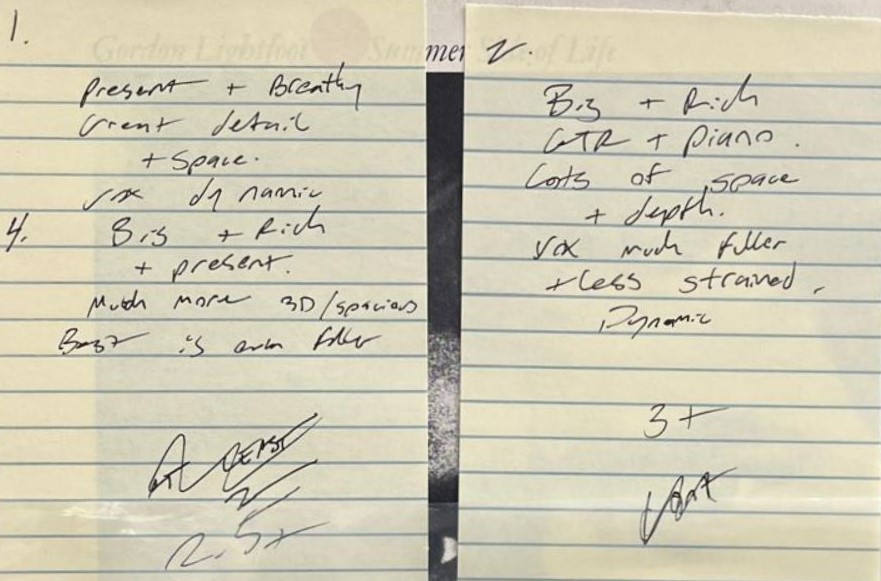
Here are the notes for the 2.5+/3+ copy we put up on the site and sold in 2025.

Side two was killer in every way, and the way we know that is we played a bunch of copies and nothing could beat it. This side two took top honors for having exactly the sound we described above.

(more…)

A Better Way to Get Rid of Grit and Grain on Jumpin’ Jive

More Records that Are Good for Testing Grit and Grain

Jumpin’ Jive is one of the clearest examples of an album where it is critically important to make sure your stereo is running on good electricity before you make any attempt to play it. This is the kind of recording — bright, full of energy — that will bring most stereo systems to their knees. Of course, when you play a good copy and it really sounds good, it’s a record that rewards all the time and effort you’ve put into your system.

So much of the aggressiveness, grit and grain that we hear in immediate, high-energy recordings such as this are really the fault of the electricity feeding the stereo, not the fault primarily of the record or even the equipment used to play it.

Now it should be noted that this recording has a ton of high frequency information that will be difficult to reproduce on most systems. If you leave a lot of appliances and electronic devices plugged in around the house when you listen to your stereo, you can forget ever hearing this record right. The grit and grunge caused by polluted electricity will make this record practically unlistenable, at the levels we listen at anyway. (At lower levels most of the garbage is masked, one reason no doubt that audiophiles rarely turn their stereos up to anything approaching live levels.) 

So do as we do: unplug everything you can get your hands on before you sit down to listen. Make sure your tubes (if you have tube equipment) are nice and warm too.

(more…)

Listening In Depth to Let It Be

Hot Stamper Pressings of the Music of The Beatles Available Now

This is the first time we’ve discussed individual tracks on Let It Be.

Our recent shootout [now many years ago], in which we discovered a mind-boggling, rule-breaking side one, motivated us to sit down and explain what the best copies should do on each side of the album for the tracks we test with. Better late than never I suppose. 

These also happen to be the ones that we can stand to hear over and over, dozens of times in fact, which becomes an important consideration when doing shootouts, as we must do them for hours on end.

On the better pressings the natural rock n’ roll energy of a song such as Dig A Pony will blow your mind. There’s no studio wizardry, no heavy-handed mastering, no phony EQ — just the sound of the greatest pop/rock band of all time playing and singing their hearts out.

It’s the kind of thrill you really don’t get from the more psychedelic albums like Sgt. Pepper’s or Magical Mystery Tour. You have to go all the way back to Long Tall Sally and Roll Over Beethoven to find the Beatles consistently letting loose the way they do on Let It Be (or at least on the tracks that are more or less live, which make up about half the album).

Side One

Two of Us

Dig a Pony

On the heavy guitar intro for Dig a Pony, the sound should be full-bodied and Tubey Magical, with plenty of bass. If your copy is too lean, just forget it, it will never rock.

What blew our minds about the Shootout Winning side one we played recently was how outrageously big, open and transparent it was. As the song started up the studio space seemed to expand in every direction, creating more height, width and depth than we had ever experienced with this song before.

(more…)

Bashin’ Is a Good Test for Setup, Tweaks, Room Treatments, etc.

Hot Stamper Pressings of Large Group Jazz Recordings Available Now

On side one of Smith’s (and Oliver Nelson’s) Masterpiece, Bashin’, the bell tree in the right channel on track one is a great test for top end extension, resolution of harmonic complexity, overall clarity and freedom from smear.

Get all the top end you can from whatever turntable adjustment, tweak or room treatment you’re messing around with, then check to make sure that all the brass instruments still sound right. If they do, you are probably good to go.

Blary, smeary, leading-edge-challenged horns are the kiss of death on this album, as are grainy, gritty, transistory ones.

When the horns have clarity, correct tonality, plenty of space around them and a solid, full-bodied sound, probably every other instrument in the soundscape will too. Other records with brass instruments that are good for testing can be found here.

(more…)

Always wanted to have a Plum and Orange pressing? Here’s your chance!

Hot Stamper Pressings of the Music of Led Zeppelin Available Now

We should have titled this one “here was your chance,” since this pressing sold very quickly.

Over the years most Plum and Orange pressings were disposed by us of on ebay for the benefit of collectors and those audiophiles who might be ill-informed enough to think that early British pressings would have the best sound for Led Zeppelin III.

They do not. They can, however, sound reasonably good in some cases with the proper cleaning.

However, they are not even Double Plus (A++) good, which sounds like something from the novel 1984 but is in fact a Very Good grade and guaranteed to trounce any and all copies of the album you have ever heard.

No, the best Zeppelin album we have played to date with the early label in this case earned a grade of Single Plus to Double Plus, which we describe as “[a] wonderful sounding side with many impressive qualities, notably better than a Single Plus copy. A big step up from the typical pressing.”


UPDATE:

We do not even offer Single Plus copies on the site anymore. Although their faults would be less obvious to anyone who went through the shootout process with the album, such faults are much too bothersome to us precisely because we did go through that process.

Once you know what is right, it’s very easy to spot what is wrong.

This is the foundational principle of Hot Stampers.

(more…)

What Is There To Say?

Hot Stamper Pressings of Vintage Columbia Albums Available Now

UPDATE 2025

We have two new lists for those who would like to know which Columbia label pressings win shootouts — one for 6-Eye winners and one for 360 Label winners.

Recordings made at their 30th Street Studio are pretty hard to beat. There is no Heavy Vinyl reissue on the planet that can compete with the sound of one of our Hot Stamper pressings of any of the albums you see available, guaranteed or your money back.


This Six Eye stereo LP put every other copy we played to shame on side one with shootout winning Triple Plus (A+++) sound. Side two earned a Double Plus (A++) grade for its explosive dynamics and rich, full-bodied, Tubey Magical sax sound. Tubier, more transparent, more dynamic, with that “jumpin’ out of the speakers’ quality that only The Real Thing ever has. Hard to imagine any reissue, vintage or otherwise, can hold a candle to the sound of this amazing record. 

Recorded at Columbia’s 30th Street studios, here is a record that sounds like Kind of Blue, Ah Um and Time Out, for the simple reason that all were recorded in the same studio using the same equipment and perhaps even the same engineers.

(more…)

On Please Please Me, Which Is More 3-Dimensional, Mono or Twin Track?

Hot Stamper Pressings of the Music of The Beatles Available Now

With all due respect to George Martin, we’ve played a number of mono pressings of Please Please Me in the past twenty or so years and have never been particularly impressed by any of them.

The monos jam all the voices and instruments together in the middle, stacking them one in front of the other, and lots of musical information gets mashed up and simply disappears in the congestion. 

But is twin track stereo any better?

Yes, when you do it the way Norman Smith did on Please Please Me.

Twin Track stereo (which is actually not very much like two-track stereo, I’m sure Wikipedia must have a listing for it if you’re interested) is like two mono tracks running simultaneously. It allows the completely separate voices to occupy one channel and the completely separate instruments to occupy another, with no leakage between them.

On some stereos it may seem as though the musicians and the singers are not playing together the way they would if one were hearing them in mono. They are in fact recorded on two separate mono tracks, the instruments appearing in the left channel and the singers in the right, separated as much as is physically possible.

Stuck in their individual stereo speakers, so far apart from one another, the members of the band don’t even seem to be playing together in the same room.

That’s on some stereos, and by some stereos I mean stereos that need improvement. Here’s why.

Three-Dimensional Mono?

In the final mixing stage, Norman Smith added separate reverb to each of the two channels, sending the reverb for the sound recorded in each channel to the opposite channel. This has the effect of making the studio, the physical space that The Beatles appear to be in, seem to stretch all the way from the right channel, where the Beatles’ voices are heard, to the back left corner of the studio, where the reverb eventually trails off.

(more…)