Test Records

More Bass or More Detail, Which Is Right?

Hot Stamper Pressings of the Music of The Who Available Now

With Doug Sax mastering from the real tape, on the best pressings of Who By Numbers you get a rock solid bottom end like you will not believe. Talk about punchy, well-defined and deep, man, this record has bass that you sure don’t hear too often on rock records. 

And it’s not just bass that separates the men from the boys, or the real thing (a vintage pressing) from the current reissues (on Heavy Vinyl) for that matter. It’s weight, fullness, the part of the frequency range from the lower midrange to the upper bass, that area that spans roughly 150 to 600 cycles.

It’s what makes Daltry’s voice sound full and rich, not thin and modern.

It’s what makes the drums solid and fat the way Glyn Johns intended.

The good copies of Who’s Next and Quadrophenia have plenty of muscle in this area, and so do the imports we played.


Want to find your own top quality copy?

Consider taking our moderately helpful advice concerning the pressings that tend to win our shootouts.

Hot Stamper shootouts for this album should be carried out:

How else can you expect to hear the recording at its best?

Based on our experience, The Who by Numbers sounds best:

What Do You Mean by “These Swan Lake Highlights Sound Like Live Music”?

Hot Stamper Pressings of the Music of Tchaikovsky Available Now

Kenneth Wilkinson engineered this album of Swan Lake Highlights for Decca in 1961 (one of the truly great years for top quality analog recordings).

Judging by the best pressings we played in our shootout, he did a great job. Knowing his work the way we do, this was to be expected. There are about 50 of his recordings for which we have done Hot Stamper shootouts, probably more than for any other engineer, and there are sure to be more added in the years to come.

It’s as wide, deep, and three-dimensional as any, which is, of course, all to the good, but what makes the sound of these recordings so special is the timbral accuracy of the instruments in every section.

Highlights of the recording include huge amounts of bass; a clear snare at the back of the hall (a good test for transparency, of both the record and of your system and room); full-bodied horns and strings, which never become blary or shrill; and of course huge amounts of space.

This is the kind of record that will make you want to take all your heavy vinyl classical pressings and put them in storage. They cannot begin to sound the way this record sounds. (Before you put them in storage or on Ebay please play them against this pressing so that you can be confident in your decision to rid yourself of their mediocrity.)

Quality record production is a lost art, and it’s been lost for a very long time.

(more…)

Julie Is Her Name – A Boxstar Bomb from Bernie

Hot Stamper Pressings of Pop and Jazz Vocals Available Now

One question: Where’s the Tubey Magic?

We would never have pointed you in the direction of this awful Boxstar 45 of Julie Is Her Name, cut by Bernie Grundman in 2009, supposedly on tube equipment. I regret to say that we actually sold some copies, but in my defense I can honestly and truthfully claim that we never wrote a single nice thing about the sound of the record. That has to count for something, right?

We found the Tubey Magic on his pressing to be non-existent, as non-existent as it is on practically every Classic Record release he cut. If you have his version you are in for quite a treat when you finally get this one home and on your table. There is a world of difference between the sound of the two versions and we would be very surprised if it takes you more than ten seconds to hear it.

(more…)

Donald Gets Dynamic on Rikki

Pretzel Logic is one knockout of a recording.

Having done shootouts for every Steely Dan title, I can say that sonically this one has no equal in their canon. (Click on that link to see two hundred others.)

Which is really saying something, since Becker and Fagen are known to be audiophiles themselves and real sticklers for sound. No effort in the recording of this album was spared, that I can tell you without fear of contradiction.

They sweated the details on this one. The mix is perfection.

But you would never know it by playing the average pressing of this album, which is dull, compressed and dead as the proverbial doornail.

(We’ve played plenty of records — actually, specific pressings of records — that were dull, compressed, and dead as a doornail. We’ve made links for them by the hundreds here so that audiophiles who do not want records with these problems can more easily avoid them.)

It’s positively criminal the way this amazingly well-recorded music sounds on the typical LP pressing. Hint: avoid all imports and anything not on ABC.) How can you possibly be expected to appreciate the music when you can’t hear it right?

(more…)

One of Our Best Sounding Pressings of Revolver Lacked Space on One Side

Hot Stamper Pressings of Revolver Available Now

On side one we played I’m Only Sleeping first, followed by Taxman.

On side two we started with And Your Bird Can Sing, followed by Good Day Sunshine.

You may notice that there seems to be a pattern in the way we pick which songs of each side to do first.

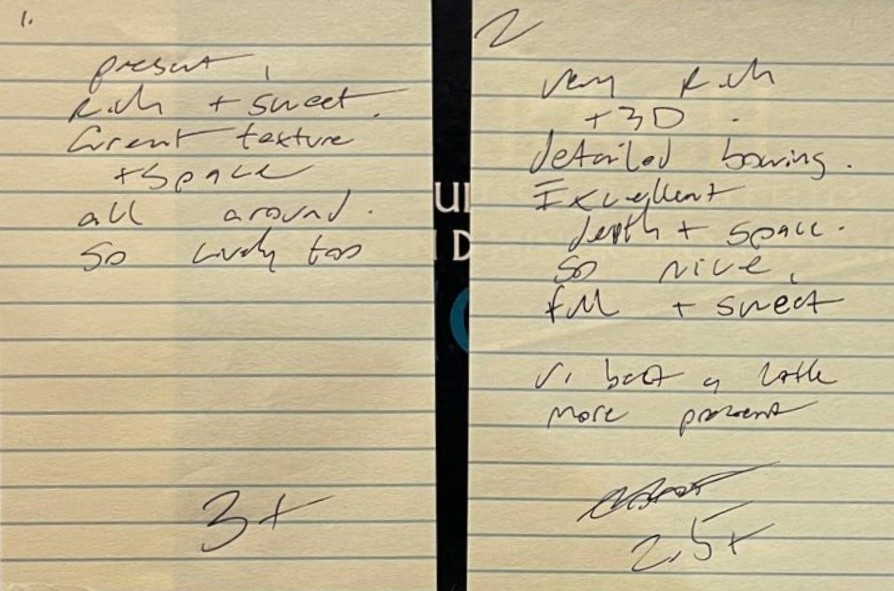
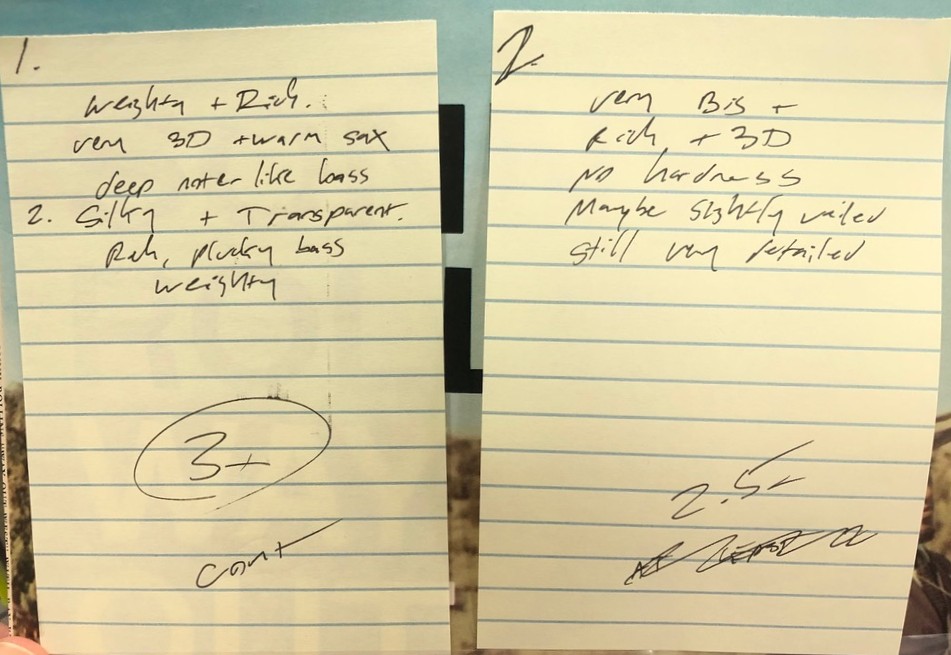
As you can see from the notes, side two of our most recent White Hot stamper Shootout Winner was doing everything right.

The second track was very tubey and present. Good Day Sunshine, the first track, was super rich and weighty, with lots of room around the vox. (I hope you can read our writing. If you can’t, just email me and I will try to find the time to transcribe the rest of the text.)

However, we had a side one that was slightly better than the side one you see here.

The Second Round

When we played the two best copies back to back, side two of this copy came out on top, earning a grade of 3+, but the side one of another pressing showed us there was even more space in the recording than we noticed the first time around.

(more…)

On First Light Listen for a Smeary Trumpet

Hot Stamper Pressings of the Music of Freddie Hubbard Available Now

UPDATE 2026

A shootout for First Light from way back in 2011 taught us a thing or two about trumpet smear.


This Hot Stamper original CTI pressing from our shootout in 2011 has a truly SUPERB side two that put to shame most of what we played.

Smeary, blurry trumpet blasts? Not here. Nope, the transient bite and energy of the trumpet is as REAL as it gets. 

Side Two

This Super Hot side earned a grade of A++ with its exceptional high end (although it doesn’t extend quite all the way, just most of the way) and its amazing transparency. It’s so clear! You really hear into this one, in the way that the best of the classic jazz recordings allow you to do, recordings such as Kind of Blue and the better Contemporaries.

And no smear. Trumpet records with no smear, by Freddie Hubbard or anyone else, or hard to come by. A bit more richness and this one would have been in White Hot Stamper territory. It is awfully close to the best we heard.

Side One

Earning a grade of A Plus, this is the side where some of that smear we discussed earlier can clearly be heard. The sound is rich, richer than side two even, with a huge stage and correctly sized instruments. It’s just that the midrange is a bit veiled and smeary, and the midrange is where the trumpet is.

Digging Creed Taylor Inc. and RVG

We’ve been really digging Creed Taylor‘s productions for years now. On the better albums such as this one, the players tend to sound carefree and loose — you can tell they’re enjoying the hell out of these songs. Don’t get me wrong — we still love the Blue Note and Contemporary label stuff for our more “hard core” jazz needs, but it’s a kick to hear top jazz musicians laying down these grooves and not taking themselves so seriously…especially when it sounds as good as this copy does.

Rudy Van Gelder gets one hell of a lively trumpet sound in this period of his career. If you have a good pressing of one of his early 70s jazz recordings, the sound can be positively explosive, with what feels like the power of live music.

(more…)

Balalaika Favorites on Classic Records Is Unpleasantly Hard and Sour

It’s been quite a while since I played the Classic pressing of SR 90310, Balalaika Favorites, but I remember it as unpleasantly hard and sour.

Many of the later Mercury reissues pressed by Columbia had some of that sound, so I was already familiar with it when Classic’s pressing came out in 1998 as part of the just-plain-awful-sounding Mercury series they released.

I suspect I would hear it that way today. Bernie Grundman could cut the bass, the dynamics, and the energy onto the record. Everything else was worse — not just worse, but wrong — 99% of the time.

The fast transients of the plucked strings of the Balalaikas was just way beyond the capabilities of his colored and crude cutting system.

Harmonic extension and midrange delicacy were qualities that practically no Classic Records Heavy Vinyl pressing could claim to have.

Or, to be precise, they claimed to have them, and whether they really believed they did or not, they sure fooled a lot of audiophiles and the reviewers who write for them.

(more…)

Expanding Space Itself on The Dark Side of the Moon

Many years ago, right around 2015 I believe, we played a copy with all the presence, all the richness, all the size and all the energy we could have ever hoped to hear on a pressing of Dark Side of the Moon.

It did it all and then some.

The raging guitar solos (there are three of them) on Money seemed to somehow expand the system itself, making it bigger and more powerful than I had ever heard.

Even our best copies of Blood Sweat and Tears have never managed to create such a huge space with that kind of raw power. This copy broke through all the barriers, taking the stereo system to an entirely new level of sound.

Listen to the clocks on Time. There are whirring mechanisms that can be heard deep in the soundstage on this copy that I’ve never heard as clearly before. On most copies you can’t even tell they are there.

Talk about transparency — I bet you’ve never heard so many chimes so clearly and cleanly, with such little distortion on this track.

One thing that separates the best copies from the merely good ones is super-low-distortion, extended high frequencies. How some copies manage to correctly capture the overtones of all the clocks, while others, often with the same stamper numbers, do no more than hint at them, is something no one can explain. But the records do not lie. Believe your own two ears. If you hear it, it’s there. When you don’t — the reason we do shootouts in a nutshell — it’s not.

The best sounding parts of this record are nothing less than ASTONISHING. Money is the best example I can think of for side two. When you hear the sax player rip into his solo as Money gets rockin’, it’s almost SCARY! He’s blowin’ his brains out in a way that has never, in my experience anyway, been captured on a piece of plastic. After hearing this copy, I remembered exactly why we felt this album must rank as one of the five best Rock Demo Discs to demonstrate the superiority of analog. There is no CD, and there will never be a CD, that sounds like this.

In fact, when you play the other “good sounding” copies, you realize that the sound you hear is what would naturally be considered as good as this album could get. But now we know better. This pressing took Dark Side to places we never imagined it could go.

(more…)

When Did You First Hear that 10k Boost on Sittin’ In?

Hot Stamper Pressings of the Music of Loggins and Messina Available Now

UPDATE 2026

It took us a long time to recognize it, I can tell you that. 30 years? Maybe even more.

And how about the boost to the low end?

This commentary is from many years ago, perhaps as far back as 2010.

Of course it could not have been written until the stereo had reached the level where these anomalies and others like them could be easily recognized, the clearest kind of evidence of progress in audio.

If you’re not noticing these kinds of things on the vintage vinyl you play, then it’s probably time for a serious upgrade or two.

The anomalies are there, of that there can be no doubt. They’re everywhere. You just need a more accurate and revealing system and room to show them to you.

In that respect, you my find our shootout notes are helpful at pointing you in the right direction as to what you should be listening for. They are especially helpful in recognizing when one side or another falls short in some specific area.

(more…)

Pros and Cons of this Copy of Swings in High Stereo

Hot Stamper Pressings of Large Group Jazz Recordings Available Now

Side One

Big and spacious, yet clear, dynamic and energetic. The brass is never “blary” the way it can be on so many Big Band or Dance Band records from the 50s and 60s. (Basie’s Roulette records tend to have a bad case of blary brass as a rule.)

Sharp transients and mostly correct tonality and timbres, powerful brass — practically everything you want in a Hot Stamper is here!

The stage is exceptionally wide on this copy.

Listen to the top end on track two — man, that is some natural sound!

This side could use a bit more weight so we feel a grade of Super Hot (A++) gets it right.

(more…)