
It’s been quite a while since I played the Classic pressing of SR 90310, Balalaika Favorites, but I remember it as unpleasantly hard and sour.
Many of the later Mercury reissues pressed by Columbia had some of that sound, so I was already familiar with it when Classic’s pressing came out in 1998 as part of the just-plain-awful-sounding Mercury series they released.
I suspect I would hear it that way today. Bernie Grundman could cut the bass, the dynamics, and the energy onto the record. Everything else was worse — not just worse, but wrong — 99% of the time.
The fast transients of the plucked strings of the Balalaikas was just way beyond the capabilities of his colored and crude cutting system.
Harmonic extension and midrange delicacy were qualities that practically no Classic Records Heavy Vinyl pressing could claim to have.
Or, to be precise, they claimed to have them, and whether they really believed they did or not, they sure fooled a lot of audiophiles and the reviewers who write for them.
The better your stereo gets, the worse those records sound, and they fall further and further behind the best vintage pressings with each passing year.
Old School
The Classic is clearly better suited to the old school audio systems of the 60s and 70s rather than the modern systems in use today. These kinds of reissues used to sound good on those older systems, and I should know, I used to have an old school stereo, and some of the records I used to think sounded good back in the day don’t sound too good to me anymore (although this one never did).
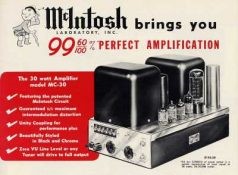 Even as late as the 90s and early 2000s, our old system was tubier, tonally darker and dramatically less revealing, which strongly worked to the advantage of leaner, brighter, less Tubey Magical titles such as this one. (Yes, I actually owned the ridiculously slow and colored Mac 30s you see here.)
Pretty much everybody I knew had a system that suffered from similar afflictions.
Like most audiophiles, I thought my stereo sounded great.
And the reality is that no matter how hard I worked or how much money I spent, I would never have been able to achieve top quality sound for one simple reason: most of the critically important revolutionary advances in audio had not yet come to pass.
It would take many technological improvements and decades of effort until we here at Better Records would have anything like the system we do now.
We play mediocre-to-bad sounding pressings so that you don’t have to, a public service from your record-loving friends at Better Records.
We have an audiophile record hall of shame for records that were marketed to audiophiles with claims of superior sound. If you’ve spent much time on this blog, you know that these records are some of the worst sounding pressings we have ever had the misfortune to play.
We routinely put them in our Hot Stamper shootouts, head to head with the vintage records we offer. We are often more than a little surprised at just how bad an “audiophile record” can sound and still be considered an “audiophile record.”
If you own any of these so-called audiophile pressings, let us send you one of our Hot Stamper LPs so that you can hear it for yourself in your own home, on your own system. Every one of our records is guaranteed to be the best sounding copy of the album you have ever heard or you get your money back.
Further Reading