Record Labels with Shortcomings

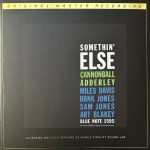
Somethin’ Else on MoFi – How Is This Company Still in Business?

Hot Stamper Pressings of Recordings by Rudy Van Gelder Available Now
For our 2023 White Hot Stamper shootout winning pressing we wrote:

A triumph for Rudy Van Gelder, a top Blue Note title, and as much a showcase for Miles Davis as it is for Cannonball Adderley.

The best sides of this album have as much energy, presence, dynamics and three-dimensional studio space as any jazz recording we’ve ever played.

When you hear it on a copy like this, it’s hard to imagine it could get much better.

We’ve heard more than our fair share of tubby, groove-damaged originals and smeary, lifeless reissues over the years, but this White Hot Stamper blew them all away.

This is a record we could play every week and never tire of. 


But this expensive ($125) MoFi pressing had us wondering what the hell we were on about, because almost nothing about it is right except for something we were not expecting: it’s actually tonally correct.

What are the chances?

With Mobile Fidelity, slim and none, but in this case they managed to pull off slim. So let’s give credit where credit is due.

But the sound is still a mess no matter how tonally correct it is.

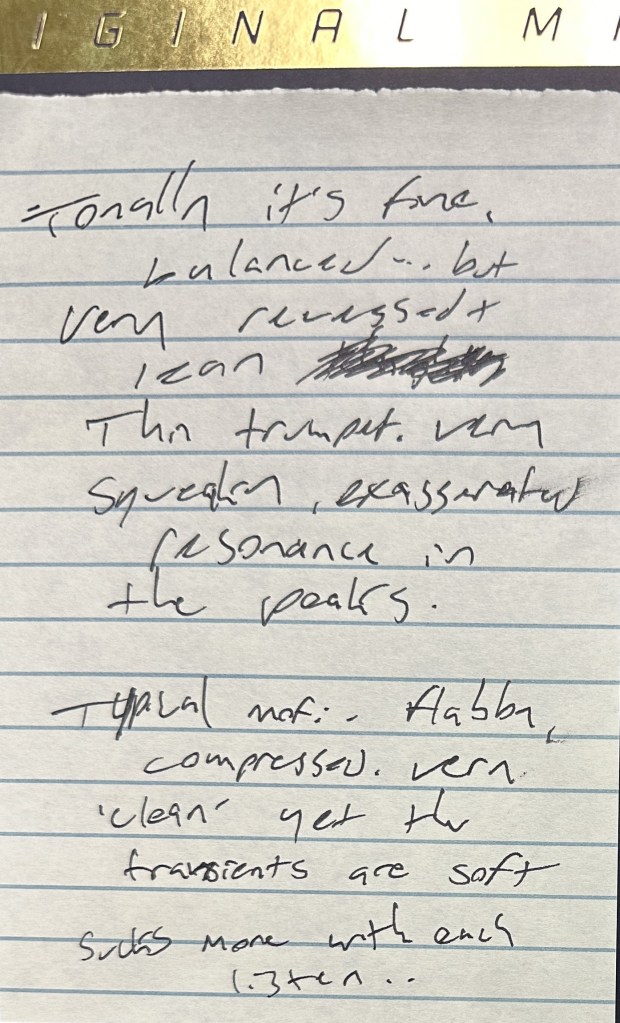
Allow me to list its faults based on the notes we took as the record was playing. The last line sums up the experience nicely.

  • 1) It’s very recessed and lean.
  • 2) The trumpet is thin and very squawky.
  • 3) There is an exaggerated resonance in the peaks.

(more…)

Driving My Car into a Ditch

Hot Stamper Pressings of the Music of The Beatles Available Now

Mobile Fidelity made a mess of Drive My Car on their Half-Speed mastered release of Rubber Soul in 1982.

Perhaps it’s more accurate to say Stan Ricker, MoFi’s go-to mastering engineer, did.

He equalized out far too much upper midrange and top end.

What fuels the energy of the song are the cow bell, the drums and other percussion. Instead of a scalpel, Mobile Fidelity took a hatchet to this slightly bright track, leaving a dull, lifeless, boring mess.

Some Parlophone copies may be a little bright and lack bass, but at least they manage to convey the musical momentum of the song.

Even the purple label Capitol reissues can be quite good. A bit harsher and spittier, yes, but in spite of these shortcomings they communicate the music, which ought to count for something.

As much as I might like some of the MoFi Beatles records [not so much anymore], and even what MoFi did with some of the other tracks on Rubber Soul, they sure sucked the life out of Drive My Car.

We all remember how much fun that song was when it would come on the radio. Playing it on a very high quality stereo should make it more fun, not less.

If you’ve got a Rubber Soul with a Drive My Car that’s no fun, it’s time to get another one.

By The Way

The best $250 — to the penny! — I ever spent on records is the price I paid for my brand new, still-in-the-shipping-carton MoFi Beatles Box. I ordered it in 1982 when I first learned of it, and it finally came the next year. I already owned all The Beatles albums MoFi had done to date, including the UHQR of Sgt. Pepper, which, like a fool, I got rid of once the set came out.

(more…)

So Long So Wrong – Still So Wrong in the Vocal Department

Hot Stamper Pressings of Jazz and Pop Vocals Available Now

Most audiophiles have a soft spot for female vocals. It’s a sound that a high end stereo — practically any high end stereo — reproduces well.

But why do some audiophiles listen to the artificial-sounding junk that Patricia Barber and Diana Krall put out on album after album?

Their recordings are drenched in digital reverb. Who is his right mind likes the sound of digital reverb?

Rickie Lee Jones may not be my favorite female vocal of all time, but at least you can make the case for it as a Well Recorded Album. It’s worlds better than anything either of the above-mentioned artists have ever done.

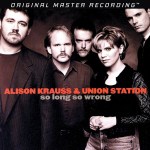
The MoFi pressing of Alison Krauss (5276) is a disaster in the vocal department too.

Audiophiles for some reason never seem to notice how bad she sounds on that record. Can’t make sense of it. Any of the good Sergio Mendes records will show you female vocals that are hard to beat. Our best Hot Stampers bring the exquisite vocal harmonies of Lani Hall (aka Mrs. Herb Alpert) and Janis Hansen (and others) right into your living room.

Why bother with trash like this Mobile Fidelity?

(more…)

Tommy on Classic Records

Hot Stamper Pressings of the Music of The Who Available Now

Sonic Grade: C

The Classic Tommy is bass shy. It could have had amazing bass, like Classic’s Who’s Next, but it doesn’t. Why, I have no idea.

The overall sound is thin, so thin that we immediately knew there was no point in carrying it (back in the old days when we carried Heavy Vinyl, pre-2008).

The only Classic Who record we ever carried was Who’s Next; the rest of them vary from mediocre to dreadful.


Remastering Out The Good Stuff

What is lost in the newly remastered recordings so popular with the record buying public these days?

Lots of things, but the most obvious and irritating is the loss of transparency.

Modern records tend to be small, veiled and recessed, and they rarely image well. But the most important quality they lack is transparency. Almost without exception they are opaque.

They resist our efforts to hear into the music and get lost in it.

(more…)

Bizet-Shchedrin / The Carmen Ballet / Rozhdestvensky

More of the Music of Georges Bizet

  • With solid Double Plus (A++) sound from start to finish, this pressing of Bizet’s Masterpiece will be very hard to beat
  • It’s also fairly quiet at Mint Minus Minus, a grade that even our most well-cared-for vintage classical titles have trouble playing at
  • Both sides are open, high-rez, and spacious, with depth like you will not believe and some of the least shrill string reproduction we have ever heard for this music (which is the main problem we run into on the album)
  • Gloriously exciting and fun music that belongs in any audiophile’s collection – side one is where the action is, and this side one had some of the better sound we heard all day
  • This spectacular Demo Disc recording is big, clear, rich, dynamic, transparent and energetic – here is the sound we love
  • We’ve recently compiled a list of records we think every audiophile should get to know better, along the lines of “the 1001 records you need to hear before you die,” with the accent on the joy these amazing audiophile-quality recordings can bring to your life.
  • This album is a good example of a record many audiophiles may not know well but would be well advised to get to know better.

(more…)

Jazz Impressions of Black Orpheus Is a Bloated Mess at 45 RPM from Hoffman, Gray and Kassem

Hot Stamper Pressings of Jazz Piano Recordings Available Now

We played an amazing Hot stamper copy that got the bottom end on this album as right as we’ve ever heard. The contribution of the bass player was clear and correctly balanced in the mix, which we soon learned to appreciate was fundamentally important to the rhythmic drive of the music.

The bass was so tight and note-like you could see right into the soundstage and practically picture Monte Budwig plucking and bowing away.

This is precisely where the 45 RPM pressing goes off the rails.

The bloated, much-too-heavy and poorly-defined bass of the Heavy Vinyl remaster makes a mess of the Brazilian and African rhythms inherent in the music. If you own that $50 waste of money, believe me, you will not be tapping your foot to Cast Your Fate to the Wind or Manha de Carnival.

Our rule of thumb: he better the system, the more second-rate Hoffman’s remastered records will sound when they aren’t just terrible.

Is this the worst version of the album ever made? That’s hard to say.

But it is the worst sounding version of the album we’ve ever played, and that should be good enough for any audiophile contemplating spending money on this kind of trash. Take our advice and don’t do it.

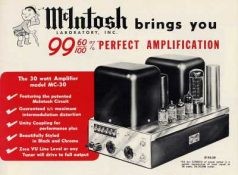
If you like the sound of old McIntosh tube equipment like the Mac 30s shown here, a sound Steve Hoffman apparently cannot get enough of, these remastered records have your name all over them.
We don’t sell junk like this, but every other audiophile record dealer does, because most of the current group of mastering engineers making records for audiophiles have somehow gotten into their heads that this is the way records should sound.

We’ve been telling them they are wrong about that for years now, that good records have never sounded this way, but the collectors and audiophiles of the world keep buying their wares, so why should they listen to us?

If you want to know what a properly-mastered, properly-pressed copy sounds like, we put the last one up in 2023.

(more…)

Half-Speed Masters – Stopgaps and Benchmarks

Hot Stamper Pressings of the Music of Joan Baez Available Now

Mobile Fidelity released a version of Diamonds and Rust on Anadisq in 1995, and if you want to hear a pressing that’s not murky, compressed and opaque, you would be wise to avoid their remastered pressing.

To be fair, MoFi has made some reasonably good sounding records too. For those of you whose budget is on the limited side, if you find an affordable copy of any of these MoFis, you are probably not completely wasting your money.

Stopgaps and Benchmarks

Our advice for the longest time has been that, while you are actively improving your stereo, room and setup, the best way to use your remastered audiophile pressings is as stopgaps and benchmarks.

As you make more and more progress, eventually you will find the vintage pressings that can show you what your audiophile pressings don’t do well, or at the very least, not as well as they should.

The unfortunate reality — considering how much money you had invested in them — is that they were falling short in many ways for all the years you had been playing them, but until you improved your playback, those problems were hidden from you.

Charting Your Success

As your stereo improves, you can actually chart your success by how many of these kinds of records you are able to eliminate from your collection. Once you can count the number of modern reissues you still own on one or two hands, there is a good chance you have reached a much higher level of playback.

(more…)

Close to You on Mobile Fidelity Vinyl – Is This the Sound Audiophiles Were Clamoring For in ’83?

Hot Stamper Pressings of the Music of Frank Sinatra Available Now

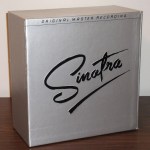
In 2024 we did a shootout for the first of Frank’s many releases from 1957, Close to You. We were fortunate to have the Mobile Fidelity pressing from the ’80s box set to play against the mostly original pressings we had accumulated since our last shootout in 2020.

It takes a long time to find enough clean copies to get a shootout going. Four years is fairly typical these days I would imagine.

As you can see from our notes, side one of this MoFi was just awful. Can you blame us if we didn’t bother to play side two?

P.S. I Love You

  • Over-textured violin
  • Spitty, gritty vocals
  • Hollow and dry

Close To You

  • Very clean
  • Bass and vocals really lacking body and warmth

Our grade, had we given it one, would have had to have been a big fat F.

Is it the worst version of the album ever made?

(more…)

Pet Sounds: Analogue Productions Takes on the Hot Stamper

Robert Brook has a blog which he calls

A GUIDE FOR THE DEDICATED ANALOG AUDIOPHILE

Below is a link to a comparison Robert Brook carried out between two pressings of Pet Sounds – the Analogue Productions pressing and one of our Hot Stampers.

We’ve written quite a bit about the album, and you can find plenty of our reviews and commentaries for Pet Sounds on this very blog.

PET SOUNDS: Analogue Productions Takes on the Hot Stamper

I have never heard the AP pressing, and have no plans at this time to get one, mostly because not a single one that I have heard on my system was better than mediocre. If your experience has been different, we have some questions for you.

(more…)

“What I’m all about is saving the world from bad sound.”

Check Out Some of Our Reviews (and Those of Our Customers’) for Albums on the Analogue Productions Label

Saving the world from bad sound you say? Hey, that’s what I’m about too!

I thought I was doing a pretty good job of it, laying out, often in great detail, exactly what’s wrong with these new Heavy Vinyl records being put out by the likes of Mobile Fidelity and Analogue Productions.

We have over 250 listings for them right here on the blog. Are there some good ones I missed?

Apparently the writer for the Times thinks there are, although some of the ones he mentions do not do much for his credibility. (Aja comes to mind, made from a copy tape — Chad goes that extra mile all right! To see what Sisario has to say about the album, with our take as well, just scroll to the bottom of this commentary.)

Let’s see what Sisario has to say about the man from Kansas and his vinyl empire.


An article about Chad Kassem and Analogue Productions has just come out, written by Ben Sisario for The New York Times.

Sisario is the guy who was as enamored with Pete Hutchison of the Electric Recording Company as he seems to be of the fellow you see pictured, a man who he has no trouble calling “The Wizard of Vinyl,” and with a straight face as far as I can tell.

Audiophiles in my experience tend to be credulous — I should know, I was as credulous as they come about everything audio back in my twenties and thirties — but it seems that writers for The New York Times will believe almost anything somebody tells them about records. (Perhaps Sisario will be taken to task in the comments section, but I’m sure not going to waste my time trying to find out.)

I would love to have him come to Westlake so we could play him some of the albums he seems to think are so great. That would be one helluva wake-up call. Not only would he have to retract this article, he would have to retract the one about Hutchison. That would be a win win in my book!

Some quotes you may find interesting, or, if you are, like me, congenitally of a more skeptical bent, absurd. At the very least, let’s just say unfounded.

Chad Kassem is on a mission — saving listeners “from bad sound” — at the rural factory where he pores over LPs from some of music’s most important artists.”

One record on the QRP production line was “Fragile,” the 1971 prog-rock favorite by Yes, in a two-disc, 45-r.p.m. edition that sells for $60, as part of a series marking the 75th anniversary of Atlantic Records. It is Analogue Productions’ third iteration of that album in two decades, while Mobile Fidelity Sound Lab, another reissue label, made a two-disc version as recently as 2019, and Rhino, Atlantic’s corporate cousin, offers its own “Fragile” vinyl. Labels know the value in feeding collectors’ endless hunt for the white whale.

“The fact that we can still beat some of the earliest, original pressings,” said Craig Kallman, a top Atlantic executive, “was the idea behind the Chad partnership.”

This is not a fact by any definition of the word that I am familiar with.  It is at best a claim, and one we had no trouble refuting when we played the flat-as-a-pancake Fragile that Rhino put out under his auspices. Maybe the new one is better. But how can you trust anyone that would put out anything as bad as that Fragile?

“I’m doing what I love for a living,” he added. “I mean, what’s more satisfying than picking your favorite childhood record, getting the master tape and getting it to sound better than it’s ever sounded before? What’s better than that?”

That would indeed be awesome if someone could do it. We know of only a couple of modern remasterings that can claim superior sound when played up against the best vintage pressings we have auditioned. You can read about one of them here. And no, it is not mastered by any engineer mentioned on any audiophile site or forum. Nobody knows who it is, not even us!

On another note, in the same article about Chad, Mobile Fidelity defends their use of digital, which strikes me as a reasonable defense as far as it goes:

In a statement, a spokesman for Mobile Fidelity defended its process, and said that its digital step (now disclosed) offers various advantages: “For example, we can endlessly tweak it for levels, alignments and adjustments. None of this is possible with original analog master tapes, whose fragile condition subjects them to potential damage with each pass. Our approach represents the best of all worlds — and allows us to continue our role as historical caretakers that safeguard, preserve and respect the irreplaceable original.”

A fellow who goes by DC Moderate wrote in to say he doubted these records are being made with an all-analog chain.

I’m a member of a Facebook group that debates these issues. Two bald-faced assertions have been made by some of the members of that group, and I welcome a reply either from Kassem or from Ben Sisario.

The first is that Kassem, Bernie Grundman and Kevin Gray do not, in fact, have access to the “original master tapes,” as these are locked away in vaults by the record companies. I’m not sure how a rebuttal could be made to such an assertion, as it is the equivalent of being asked “when will you stop beating your wife?” My response has always been that both Gray and Kassem have posted photos of the original master tapes that they utilize. What more can they say?

The second is based upon various posts on You Tube that argue that ALL of these analog mastering studios have digital equipment, and at some point in the mastering process, ALL so-called AAA records are converted to digital. Sisario’s article doesn’t explicitly respond to that allegation, and I therefore welcome a response from Sisario or Kassem. Although implicitly, Sisario and Kassem are already saying that the entire chain is analog.

Ben Sisario replies:

I can’t comment on the practices of Bernie Grundman or Kevin Gray, although I’ve spoken to both of them and they are some of the most esteemed engineers in the industry. And it’s true that some labels don’t let tapes out of the vaults. But I saw with my own eyes that Analogue Productions has access to real masters, and I witnessed their mastering setup in use; they have the old console of Doug Sax, another of the greats.

I can’t comment on the second “allegation.” But I would note that after the Mobile Fidelity fiasco a few years ago, you now see other labels being a bit more specific and clear in how they describe their sources and mastering.

Analog Shmanalog

Now it’s my turn. The following is my reply to the friend who sent me the NYT article. He had been to my studio and heard for himself the sound of the Heavy Vinyl pressings that “The Wizard of Vinyl” produces. Up against properly-mastered, properly-pressed vintage LPs, they are at best mediocre, and more often than not just plain terrible. (Aja is a good example of a cross between mediocre and terrible, see below.)

This “pure analog versus analog tainted with digital” debate needs to stop.

It completely avoids the only question worth asking: are these new records any good?

Who cares how they make them?

Only the deaf! Those who can hear know how badly they suck and could not care less.

You sat me down and we played records. They all failed.

That is the only true test.

Put all of these new records to the same test! Please, somebody!

Somebody with a top quality system can volunteer to do shootouts for any and all of them and let the chips fall where they may.

Finding such a system may be impossible, but we can at least try. This is getting us nowhere.

There is no testing going on, just claims being made with nothing to back them up.

None of this matters. Literally, none of it.

Of course, we at Better Records could volunteer to do it, publicly, with blindfolded listeners under controlled conditions.

But we need to make money and there is no money in bashing crap vinyl.

We play a few from time to time and I post the notes from the shootout on this blog, mostly as a public service.

If you have a good stereo, properly set up in a good room, you should know by now not to buy this crap. Everybody else is falling for this man’s fool’s gold and there is nothing any of us who know better can do about it.

TP

(more…)