
Hot Stamper Pressings of the Music of Mussorgsky Available Now
There is a slightly multi-miked quality to this recording. If you’ve been playing true Golden Age records all day you will notice that the instruments are more naturally and correctly spaced and sized on those recordings.
But, this is still a KNOCKOUT record which is guaranteed to bring any stereo to its knees. The dynamics, the deep bass and the sheer power of the orchestra have to be heard to be believed.
What does the typical EMI pressing of this album sound like?
Not good. Sour brass, smeary or shrill strings, lacking in bass — mid-hall dead-as-a-doornail sound is fairly typical.
Almost all the copies I’ve played are spacious, but so what?
The sound of the instruments is often wrong and in my book that trumps any benefits concerning soundstaging or depth.
But the best Hot Stamper pressings give you the presence and immediacy you need to get involved in the work.
The strings on the better copies have rosiny texture.
The brass has weight — not the full measure of an RCA or London recording, but at least you get the impression that those instruments are trying to sound correct.
And the bass drum really goes deep, unlike many of the Golden Age recordings I’ve heard.
Other Pressings and Performances
The natural question for most audiophiles is how does these pressings compare to the the Mobile Fidelity?
It’s a joke next to a properly mastered British EMI. All that phony boosted top end that makes the strings sound so funny and causes mischief in virtually every part of the orchestra is missing from the real EMIs.
While I’m in this bashing mode, let me take a shot at Classic Records, since their mastering approach is — gulp — even worse. I can play the MoFi of Pictures and enjoy it. I can’t play the Classic of Pictures at all.
The shrillness, the hardness, the sourness, the loss of texture to the strings, the phony boosted deep bass — this is the kind of sound that makes my skin crawl. After a minute or two I’ve had it.
And I don’t much care for Reiner’s performance either. I don’t think the classical critics ever had much respect for his Pictures, but audiophiles and TAS heads for some reason put up with his awkward, disjointed, unmusical approach. I’ll never understand it. And insult is only added to injury by Classic’s bad mastering.
Another performance I don’t care for is Ansermet’s with the Suisse Romande. It’s slow and ponderous.
But my God, the sound of the brass on that record is to die for. It’s without a doubt one of the most powerful classical recordings I have ever heard.
There is a blast of brass at the end of The Catacombs that is so big and real, it makes you forget you’re listening to a recording. You hear every brass instrument, full size, full weight. I still remember the night I was playing that album, good and loud of course, and that section of the work played through. It was truly startling in its power.
Some of Ansermet’s recordings with the Suisse Romande are absolutely the best I’ve ever heard. It was a magical combination of the right hall, the right engineers, the right orchestra and the right technology — the long lost, outdated but still glorious recording technology of the 50s and 60s.
(more…)
 Hot Stamper Pressings Featuring the Violin Available Now
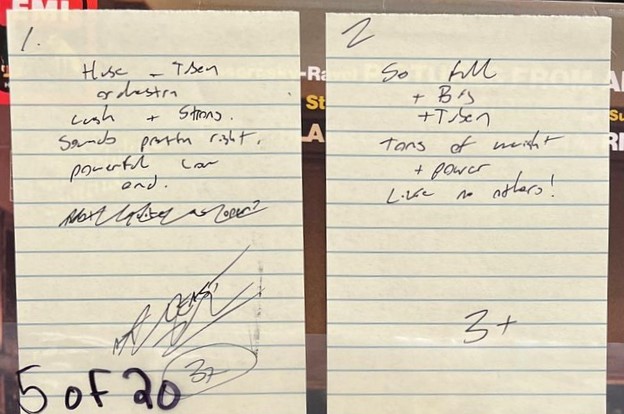
 Robert Brook runs a blog called The Broken Record, with a subtitle explaining that the aim of his blog is to serve as:


 Hot Stamper Pressings of the Music of Georges Bizet Available Now
