Asylum – Reviews and Commentaries

The DCC Pressing of Hotel California – Not Bad!

Hot Stamper Pressings of the Music of The Eagles Available Now

Side one: B+ / Side two: B-

The DCC for this album is not a total disaster. In fact, the first side of the DCC is one of the better DCC sides we’ve played in recent memory. We dropped the needle on a few copies we had in the back (pressing variations exist for audiophile records too, don’t you know) and they averaged about a B+ for sound on side one. Side two was quite a bit too clean for our tastes — no real ambience or meaty texture to the guitars, about a B- for sound.

To flip something we say often: you can do worse, but you can do a LOT better.  

Differing Grading Scales

Note that the grading scale for Hot Stampers is slightly different than the grading scale we all grew up with in school.

The best Hot Stampers receive a grade of A Triple Plus.

This DCC record for side one is three steps down from that.

Three steps down from an A+ grade in school, the highest grade one could earn, would be a B+, hence the B+ grade you see above.


Our Most Recent Commentary

  • This vintage copy was giving us the big and bold sound we were looking for, earning excellent grades from top to bottom
  • In our experience, whatever the reasons may be, finding quiet vinyl on this album almost never happens – New Kid in Town is fairly ticky on probably 80% of what we can find of the originals (which are the only ones that sound any good)
  • If you have any modern remastered pressing of the album, please order this one so you can hear what you have been missing all these years
  • A Better Records Top 100 pick – here’s a copy that’s transparent and hi-rez, with all the energy and Tubey Magic that can only be found on the right pressings of the originals
  • Speaking of the right pressings, the right stampers are ten or twenty times as rare as the run-of-the-mill stampers that show up on ebay every day, which should explain why this multi-million selling title rarely makes it to the site

We are having a devil of a time finding this album in audiophile playing condition these days, which is why you practically never see them on the site anymore, and copies quieter than Mint Minus Minus are rare indeed

We just finished a shootout for this title and this bad boy is truly a Demo Disc quality classic rock LP.

From first note to last, this pressing has superb, mind-blowing, Demo Disc Quality Sound. Drop the needle on any track on either side to hear what we’re talking about. The highs are silky and delicate, the bottom end is tight and punchy, and the vocals sound AMAZING. The bass is PERFECTION, which really brings out the feel of the song “Hotel California.” It’s so deep and loping, the effect is practically narcotic.

“Life In The Fast Lane” is possibly the toughest song on the album to get right — it tends to have that transistory, compressed sound that we’ve come to expect from Bill Szymczyk. On this copy, it REALLY ROCKS — super-punchy with amazing presence and lots of meaty texture to the guitars. It will always sound a bit harsher than ideal on any copy with real presence, texture, and energy; that’s just the sound they were going for. It is what it is, which makes it not a good track to judge the first side by.

On side two, one of the better sounding tracks is “Try And Love Again.” On a superb copy like this one, it’s off the charts. The wonderful clarity and punchy bass here take this song to a whole new level.

(more…)

Joni Mitchell – The Most Underrated Album of Her Early Period?

More of the Music of Joni Mitchell

Reviews and Commentaries for the Music of Joni Mitchell

Some current thoughts on Joni’s oeuvre have been added in brackets to this older commentary.

This is probably the most underrated Joni Mitchell album, both in terms of sonics and music. It seems that everyone wants a great copy of Blue or Court And Spark, but this album ranks right up there with them and seems to have been undeservedly overlooked.

Let’s face it, we love Blue (1971), but most pressings suffer from a raft of sonic problems, as does Ladies of the Canyon (1970).

Court and Spark (1974) is up at the top up the list as well, but Roses (1972) seems to have more recording purity. Perhaps the engineers saw this as an opportunity to address the problems with Blue, the album that preceded it.

By the time Joni had fully indulged her jazzier inclinations with Court and Spark, some of the recording quality had been lost in the quest for slicker production values for which that album is known. The complexity of the instrumentation required more multi-tracking and overdubbing, and as good as that record can sound on the best copies, in a head to head matchup with For the Roses the latter would probably win, and probably by no more than a nose.

Side One

Clear, present, breathy vocals, about as good as Joni can sound on vinyl, which is saying a lot.

The second track is a great test. Here the guitars are full-bodied, harmonically rich, with more reverb and space than practically any side one we have ever played. The Tubey Magical liquidity of the sound is what vintage analog is all about. No reissue and no CD will ever get that sound the way this copy does.

And you don’t need tubes in your system to hear it. The magic is on the tape and it was transferred beautifully to this piece of vinyl.

Side Two

Listen to how huge the piano is — no other copy could reproduce the size, weight and clarity of that piano. No two copies will show you the same piano, which makes it a great test for sound. Put this side up against the best you’ve got, it should be no contest.

Breathy, immediate vocals are key to any Joni Mitchell record and this side reproduces them as well as any we heard in our shootout.

What We Listen For on Don’t Cry Now

More of the Music of Linda Ronstadt

Hot Stamper Pressings on the Asylum Label

Linda’s vocals on both sides can be very DYNAMIC, but only the best copies will present them with no hint of STRAIN or GRAIN, two problems that make most pressings positively painful to listen to at the loud volumes we prefer.

Linda really belts it out on this album — face it, it’s what she does best — and only the rarest copies allow you to turn up the volume good and loud and let her do her thing.

Another key to recognizing the best copies is the fact that they tend to be highly resolving.

Two places to check:

  1. Note how breathy her voice is in the quiet passages. Only the least smeared, most transparent copies reproduce that breathy quality in her voice.
  2. Next check out the tambourine on Silver Threads and Golden Needles. If the sound is delicate, not gritty or transistory, you have yourself a winner in the resolution department.

Side One

The vocals on side one are often recessed and a bit dark on this album.

Linda’s Problems in the ’70s

The most common problem with these Ronstadt records from the ’70s is grainy, upper-midrangy sound. The smooth copies that still have plenty of presence, life, energy and top end extension are the ones that really get this music sounding RIGHT.

Every copy we played had problems on the last track of side one, Don’t Cry Now. Linda is singing at the top of her lungs practically from beginning to end, so both cutting the record and playing back the record would be difficult. The result is that there will usually be some coarsening of her vocal.

Some copies had the same problem on side two for I Believe in You, but not all.

(more…)

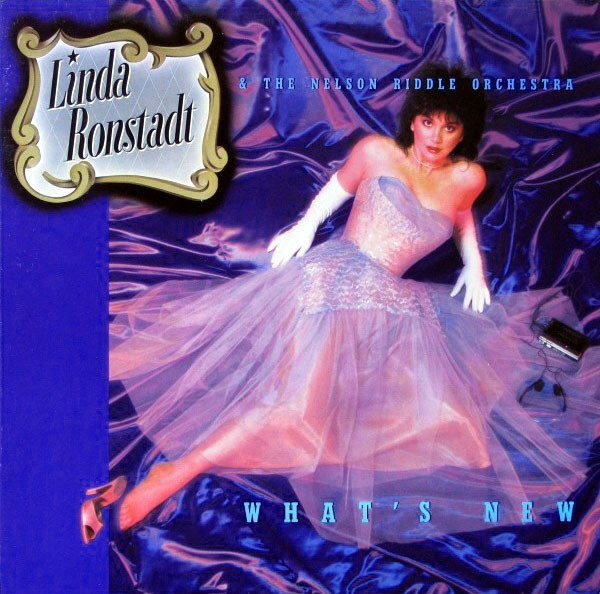
String Tone and Texture Are Key to the Best Pressings of What’s New

Hot Stamper Pressings of the Music of Linda Ronstadt Available Now

We’ve criticized the engineer George Massenburg in the past, but with this copy we almost want to take it all back.

What he gets right on this recording is the sound of an orchestra, augmented with various jazz musicians (Ray Brown, Tommy Tedesco, Plas Johnson, Bob Cooper), all performing live in a huge studio.

The sound stretches far to Linda’s left, far to her right, as well as back far behind her in a huge semi-circle. She is of course singing in a vocal booth, with her vocal placed front and center in the soundstage.

What to Listen for

That’s easy on this album: the strings. When the strings are big and rich, not shrill and thin, that’s a good thing. Rosiny texture means you have a copy with less smear and higher resolution. Harmonics up top means that the top end of your copy is extending properly.

Bottom line: If the strings are bad on this album probably everything else is too.

Here are some records that are good for testing string tone and texture.

Having said that, this is an album of standards sung by a woman with a very recognizable voice. If Linda doesn’t sound right, what’s the point of the record? To hear Nelson Riddle’s well-recorded strings?

The best copies have Linda sounding rich and breathy. Few managed to pull off that particular trick as well as we would have liked. We took major points off for those copies that had her sounding too thin or forced in her upper range.

(more…)

Can You Hear the Bloated Bass on This DCC Pressing?

More of the Music of Linda Ronstadt

This review was written many years ago, around 2004 I think. This was one of the first DCC records I did a shootout with up against run-of-the-mill Mastering Lab domestic pressings, only to find, somewhat surprisingly, at least at that time, that the DCC came up short, as you will see in the review below.


As much as I admire Steve Hoffman’s work for DCC, on this title the DCC is not as good as the best domestic copies. The best domestic pressings are just plain more fun.

The DCC sounds thick in the midrange and fat in the bass, although some of that boost in the bass could have been used to the advantage of some of the domestic pressings we played. 1 DB or so at 50-60 cycles would help, but the DCC has a boost in the middle and upper bass that causes the bass to sound bloated next to a properly mastered, properly pressed LP. 

I like rich sounding records just like Steve does, but his version of this title is too rich for my blood. If your system is lean sounding you may prefer the DCC, but we found it less than agreeable over here.

Not sure why so few reviewers and audiophiles notice these rather obvious shortcomings, but we sure do, and we don’t like it when records sound that way. These are records for those who are not sufficiently advanced in the hobby to know just how compromised and wrong they are.

(more…)

Letter of the Week – “The overall tonal balance is fantastic. Big, room filling sound.”

Hot Stamper Pressings of the Music of Jackson Browne Available Now

One of our good customers had this to say about some Hot Stampers he purchased recently:

Hey Tom, 

I am taking my time going through all my hot stampers one by one. Still waiting for my cartridge to break in so I know things will only get better!

This album is amazing. I forgot how good it was. Only had the cassette back in the day and loved playing it in the car. The overall tonal balance is fantastic. Big, room filling sound. Jackson’s voice is just so well centered in the mix. I think your rating may have been a bit conservative. Hard to believe it can sound much better. Side 2 is probably my favorite and sounds even better than side 1 to my ears–but it is close. Another winner for sure!

Thanks!

Rob

Rob,

Glad you liked it!

As for the notes about the grades, we don’t keep them around, but we liked two copies better than that one, which just goes to show you can never know how good it can get until it gets that good. That is the only way to know: to hear it for yourself. That is what shootouts are for.

This is what the forum posters fail to understand. They think they have a Hot Stamper when what they actually have (maybe!) is a good sounding record. They don’t know how amazing the record can sound — so much more amazing than the one they own, probably — so they assume they have something good, maybe even the best.

They probably do not, but who really knows? The shootout would supply the data they need to support their conclusions, and since they could not be bothered to conduct one, they have no data to back up their opinions.

The “probably” you see in the above two sentences is there for a good reason. We make a point of being clear about what we can know and we cannot know, and we cannot know what a record sounds like until we play it.

This is obviously true for those of us who try to listen as critically as possible, but we also know that it is just as important to think about records the right way.

Mistaken thinking keeps audiophiles from making progress in this hobby just as much as bad equipment and bad records do.

When it comes to stampers, labels, mastering credits, country of origin and the like, we make a point of revealing very little of this information on the site, for a number of good reasons we discuss here.

The idea that the stampers are entirely responsible for the quality of any given record’s sound is a mistaken idea, and a rather convenient one when you stop to think about it. Audiophiles, like most everybody else on this planet, want answers.

But in the world of records, there aren’t many.

There is only the hard work that it takes to come up with the best answer you can under your present circumstances, and by that we mean: your present equipment, your present tweaks, your present room, your present electrical quality, your present listening skills, your present table setup, et cetera, et cetera.

Not to mention the present condition of your ears.

With every change to your system, the record you used to like the best could turn out to be second-rate compared to the record you used to think was second-rate but has now become first-rate. What changed? Who knows?

This, of course, drives most audiophiles crazy, so they ignore or downplay their own inconvenient findings. Instead they refuse to believe their own two ears!

The Biz

Being in the shootout business means we have no way to avoid such realities, which is why it is so easy for us to accept them.

The amateurs and professionals alike who review records for audiophiles want there to be clear-cut answers for every album they write about. Uncertainty and trade-offs upset them no end.

We recognized twenty years ago that the empirical pursuit of record knowledge, practiced scientifically, must be understood as incomplete, imperfect, and provisional.

That is not going to change no matter how upsetting anyone may find it.

Thanks for writing,

Best, TP

(more…)

El Rayo X and The Last Days of Analog

More of the Music of David Lindley

More Personal Favorites

The sound on this record is so punchy and dynamic, the rest of your rock records should seem positively anemic in comparison. Most of it sounds live in the studio, and live in the studio is how you get a bunch of guys to play with this kind of enthusiasm and energy.

Engineered in 1981 by Greg Ladanyi, the very next year he would take home the Best Engineering Grammy for Toto IV (one helluva good sounding album and a former member of our Top 100).

Fortunately for us audiophiles, this album catches him before the overly-processed, digital drums and digital echo “sound of the ’80s” had gotten into his blood. (Just play any of the awful Don Henley records he made to hear what we mean.)

This record still sounds ANALOG, and even though it may be 1981 and mostly transistorized, the better copies display strong evidence of TUBES in the recording chain.

(more…)

The Glorious Sound of the SYL Pressing of On The Border

More of the Music of The Eagles

Reviews and Commentaries for the Music of The Eagles

This commentary was written about fifteen years ago, prompted by the discovery of an amazingly good sounding British original pressing. We wrote:

‘You Never Cry Like A Lover’ is breathtaking on this copy — Glyn Johns is a genius I tell you!

We’re HUGE fans of the album here at Better Records; it’s some of the most sophisticated, well-crafted, heartfelt music these guys ever made, and that’s saying a lot. Many of you have probably forgotten how good this album is (assuming you were ever familiar with it in the first place) probably because the typical domestic copy you would have played back in the day is fairly hard on the ears. Most pressings, even the British ones, barely hint at the kind of sound you’ll hear on this Hot Stamper LP!

You Never Cry Like A Lover and The Best Of My Love have SUPERB Glyn Johns Demo Disc Sound on this copy. The LIFE and ENERGY of this pressing are going to knock you right out of your seat. Most copies leave you with a headache, but this one will have you begging to turn up the volume!

Let’s talk about the Eagles’ records from an audiophile perspective.

The Last Of The Glyn Johns Eagles Records

For their debut the Eagles recorded what we consider to be one of the Ten Best Sounding Rock Records in the history of recorded media. (We sometimes have some in stock. Click here to see.)

Wait a minute, the Eagles didn’t record anything, Glyn Johns did. He deserves all the credit for turning that first album into a Demo Disc of the highest order. Partway through this album, their third, they fired him. (The British ran Winston Churchill out of office after the war, so go figure.) Johns is credited with only two tracks, and as would be expected, those two are the real Demo Disc tracks on the album.

But as I way playing various copies of these original British SYL pressings (the SYL of Desperado is the one on the TAS List, don’t you know), I could easily recognize the fully-extended, harmonically-rich, super-low distortion, Tubey Magical, Unbelievably Sweet Glyn Johns ANALOG Sound everywhere in the soundfield I happened to look.

Almost every track has some of it.

Some Is Better Than None

Maybe not the full measure you hear on You Never Cry Like a Lover, the standout track from side one, but enough to make you realize that even half of a Glyn Johns recording is quite a bit better than what was to follow.

One of These Nights, recorded by Bill Szymczyk, his replacement, is clearly a step down in sound quality, but it has some very strong material that got played on the radio incessantly. Of course it went right to Number One.

Say what you want about Hotel California — a long in the tooth FM radio staple but not a bad recording by any means — it can’t begin to compete sonically with the likes of the first three Eagles albums that Johns did. (And now that you’re familiar with the two main guys who recorded this band, check the dead wax of your Eagles Greatest Hits pressings for a laugh.)

As good as it may be sonically, Desperado is still a fairly weak concept album that lacks consistency in the songwriting department. With two good songs and lots of filler, the album bombed commercially as well as critically.

(more…)

Eagles – A Top Ten Title

Hot Stamper Pressings of the Music of The Eagles Available Now

You will be floored by the huge, rich, Tubey Magical guitars exploding out from your speakers on Take It Easy.

One of the best sounding rock records ever made, a member of our Top Ten and without a doubt Glyn Johns’ engineering (and producing) masterpiece.

A Top 100 Tubey Magical Demo Disc that is guaranteed to blow your mind on a pressing that sounds as good as this one does.

A Top Ten Title

You may have seen our Top 100 list of the best sounding rock records elsewhere on the site. We picked out a Top Ten from that list and you will not be surprised to learn that this record made the cut. (Top Two or Three is more like it.)

At one time this was my single favorite Demo Disc. A customer who bought one of these one time told me it was the best sounding record he had ever heard in his life. I don’t doubt it for a minute. It’s certainly as good as any rock record I have ever heard, and I’ve heard some awful good ones.

There’s an interesting story behind this album, which I won’t belabor too much here. Suffice it to say, one listen to some of the later reissues or — god forbid — a Heavy Vinyl pressing or Greatest Hits album and you’ll know I speak the truth when I say that the tape used to cut this pressing was not the same one that was used to cut those.

It no longer exists. It was lost a long time ago. Most copies of this album are mediocre at best, and positively painful to listen to once you’ve heard the real thing, an early pressing cut from the actual master tape.

Our Checklist

The Eagles’ first album is an album we think we know well. It checks off a number of important boxes for us here at Better Records:

(more…)

Give It Up Again For Val Garay on Prisoner in Disguise

More of the Music of Linda Ronstadt

More Records with Specific Advice on What to Listen For

The soundfield has a three-dimensional quality that was pretty much nonexistent on most of the other copies we played. Drop the needle on Many Rivers To Cross and check out the amazing sound of the organ coming from the back of the room. Only the highest resolution copies give you that kind of soundstage depth.

The piano sounds natural and weighty. The fiddle on The Sweetest Gift (played by our man David Lindley) is full of rosiny texture.

Emmylou Harris, dueting here with Linda, is SUPERB, with truly Demonstration Quality Sound on the best copies.

The acoustic guitars are tonally Right On The Money throughout — the transient information is captured perfectly. Listen to the opening guitar in the right channel of The Sweetest Gift; we used it as a test track and when that guitar is RIGHT THERE you know you have a copy with Hot Stampers.

What A Supporting Cast!

Check out all the cool cats who helped make this record: EmmyLou Harris, James Taylor, Lowell George, Andrew Gold, Peter Asher, Val Garay, Russ Kunkel, David Lindley, JD Souther and more. You see those same names all over our site! Perhaps it is time to rethink the conventional wisdom that says Linda Ronstadt’s records are not for audiophiles. Those people are involved with some of our all-time favorite records, and their contributions really help this music sound great.

Another Ignored Gem From Linda

I confess to never having taken this album seriously (much like Simple Dreams, an album I now LOVE), dismissing it as a commercial collection of pop hits with as much depth as the L.A. river, but I was wrong wrong WRONG. This is a great album on the right LP, not the compressed piece of grainy cardboard pop we’re used to. The typical pressing barely hints at the tremendous energy and top-quality musicianship that characterizes practically every track on this wonderful record.

Give It Up Again For Val Garay

Kudos must go to Val Garay, the man behind one of our favorite recordings, JT, with which this album shares much in common. That same super-punchy, jump-out-the-speakers, rich and smooth ANALOG sound is everywhere in evidence. I don’t think Mr. Garay gets anything like his due with audiophiles and the reviewers who write for them. This is a shame. The guy makes Top Quality Pop Records about as good as they can be made, and if you have the kind of Big System that can really rock out, you owe it to yourself to get to know his work.

(more…)