Half-Speed Masters

Half-speed mastered recordings.

Boston’s First Album on MoFi Anadisq

Hot Stamper Pressings of the Music of Boston Available Now

Sonic Grade: F

The MoFi Anadisc of Boston’s first album has the same problems that seem to have plagued the whole of the Anadisq 200 series. The sound was:

  • thick,
  • opaque,
  • blurry, and
  • murky.

A real slogfest. Audiophile trash of the worst kind. If this isn’t the worst version of the album ever made, I cannot imagine what would be.

Many of the worst releases from MoFi in this era were mastered by Ken Lee. If you happen to come across a record in a store with his name in the credits, or his initials in the deadwax, you are best advised to drop it back in the bin and keep moving. Anything else is just asking for trouble.

Do people still pay good money for this kind of awful sound?

Yes they do!

Go to ebay and see the high prices these kinds of records are fetching. This is in equal parts both shocking and disgusting. 

Here is what is available for the MoFi pressing on Discogs today (2/2/2022). If you have $400 you can order one there.

Marketplace 3 For Sale from $399.99

And people complain about our prices? At least we send you a great sounding record for all the money we charge.
(more…)

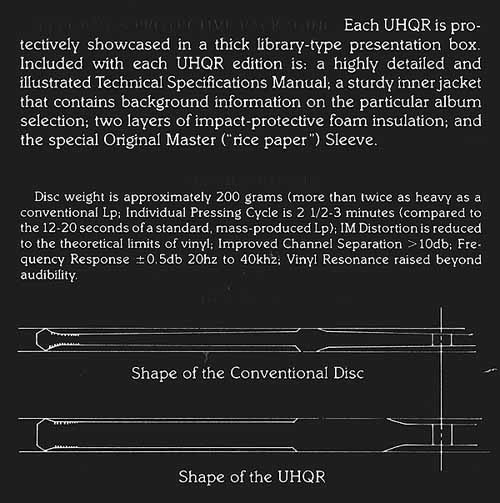
“Ultra High Quality Records” or “Lipstick on a Pig”?

Hot Stamper Pressings of Audiophile Recordings Available Now

Today’s vinyl-loving audiophile seems to be making the same mistakes I was making more than forty years ago. Heavy Vinyl, the 45 RPM 2 LP pressing, the Half-Speed Limited Edition — aren’t these all just audiophile fads, each with a track record of underperformance that seems to worsen with each passing year? Would you really want to defend this piece of junk in 2023?

In my formative years in audio, starting in the mid-70s, it would never have occurred to me to buy more than one copy of a record. I didn’t need to do a head-to-head comparison in order to find out which one sounded better. I approached the subject Platonically, not scientifically: the record that should sound better, would sound better.

uhqrb

Later on in the decade, a label by the name of Mobile Fidelity would come along claiming to actually make better sounding pressings than the ones the major labels put out, and cluelessly I bought into that nonsense too. (To be fair, sometimes they did — Waiting for Columbus and American Beauty come to mind if you don’t have properly-pressed, properly-mastered originals, but my god, Katy Lied, Year of the Cat and Sundown have to be three of the worst sounding records I’ve ever played in my life.)

And isn’t it every bit as true today as it was in the past that the audiophiles who buy these “special” pressings, like the ones I bought back in the 70s and 80s, rarely seem to notice that many of them don’t actually sound good? (Some of the worst can be found here, the worst of the worst here.)

CofAEasy Answers and Quick Fixes

Turns out there are no easy answers. There are no quick fixes. In audio there’s only hard work and more hard work. That’s what gives the learning curve its curvature — the more you do it, the better you can do it.

And if doing all that work is also your idea of fun, you just might get really good at it.

If you actually enjoy playing five or ten or even fifteen copies of the same album to find the few that really sound good, and the one that sounds amazing — because hearing your favorite music the way it was meant to be heard is a positive thrill — then you just might end up with one helluva record collection, worlds better than one filled with audiophile pressings from any era, most especially the present.


Further Reading

We Owe You a Really Big Apology

Hot Stamper Pressings of the Music of Santana Available Now

Sonic Grade: F

Santana is a record we admit to having liked when it came out back in 2007. Since then we have changed our minds. As embarrassing as it may be, and let’s be clear, this pressing is very embarrassing, We got this one wrong and there is no sense trying to deny it.

It’s just so damn compressed and lifeless.

The whomp factor on this pressing is zero. Since whomp is critical to the sound of Santana’s music, it’s Game Over for us. The review below is exactly what we wrote at the time the record came in.

We tried to like it, but it’s clear to us now that we tried to like it too hard. Please accept our apologies.

I noted in my [now discontinued] blog on the site: “But now I would have to say that the MoFi LP is far too lifeless to be acceptable to anyone, even those with the worst kinds of Audiophile BS systems.”

And I noted that the Abraxas they remastered never got past the first elimination round. It had to have been one of the worst half-speeds I have ever heard. 

We also mentioned a while back (4/29/08, time flies) on our blog how bad the latest crop of MoFi vinyl was, with the heading: “Mobile Fidelity, Ouch.” Please to enjoy:

(more…)

MoFi’s Misguided EQ Does Neil’s Voice No Favors on Hot August Night

More of the Music of Neil Diamond

The MoFi, all things considered, is not a bad record, but the phony EQ they use causes Neil’s voice to sound unnatural, and an unnatural sounding Neil Diamond record is not something that appeals to us.

If any of you out there in audio land are still buying these remastered pressings, from any era, take the advice of some of our customers and stop throwing your money away on Heavy Vinyl and Half-Speed Masters.

At the very least let us send you a Hot Stamper pressing — of any album you choose — that can show you what is wrong with your copy. And if for some reason you disagree that our record sounds better than yours, we will happily give you all your money back and wish you the best.

(more…)

We Used to Really Like The Forward Look on UHQR

Audiophile Records with Honest-to-Goodness Top Quality Sound

Hot Stamper Pressings of Live Jazz Recordings Available Now

This is a very old review, probably from 2010 or thereabouts.

Hard to say what we would think of this pressing today, what with our unwavering antipathy to Half Speed mastering. In the case of this record, you can add the consistently poor track record of the so-called UHQR to our list of reasons for suspecting that the quality would not in fact by Ultra High.

You are no doubt aware that the UHQR was recently brought back from the dead by Analogue Productions on a pressing whose packaging is quite a bit more impressive than its sound.

Our Old Review

This is a BRAND NEW UNPLAYED Reference 45 RPM Half-Speed Mastered UHQR LP. They only made 1,000 of these, so sealed or unplayed copies are virtually non-existent.

This is actually one of the best sounding Reference Records. It was recorded in the ’50s on location and has very natural sound. Half-Speed Mastered by Jack Hunt even!

I think the exceptionally natural sound found on this record is the result of two factors:

  1. It’s a live recording, meaning not everything can be controlled and the space is real, not engineered. And,
  2. This is early days in the recording history of Keith Johnson. As time went on he thought his engineering skills were improving, but I see little evidence of that in the results of his labors: the records he’s been making since 1957.

His records are as phony and weird as practically every other audiophile label of the day (M&K, Telarc, Chesky), no doubt the result of these audiophile types thinking they knew a lot more about recording music than turned out to be the case.

Play any vintage pressing from the ’50s to see exactly what they failed to accomplish.

We know of at least two releases on Reference Records with “astoundingly” bad sound.

Both figure prominently on our list of the worst kind of audiophile bullshit records.


Further Reading

If This Is Your Idea of a Reference Record, You Are in Real Trouble

Hot Stamper Pressings of TAS List Super Disc Albums Available Now

An astoundingly bad Sound Show!!

An audiophile hall of shame pressing and a Half-Speed mastered disaster if there ever was one. If this Reference LP isn’t the perfect example of a pass/not-yet record, I can’t imagine what would be. It is just awful.

Mastered by none other than Stan Ricker. RR-7 also appears to still be on Harry Pearson’s TAS List.

My recent notes can be seen below. (The 1 in the upper left hand corner is my abbreviation for side one, which seems to be the worst side of the two here.)

Track two, the Red Norvo selection, is a real mess, highlighting the problems typically caused by Half Speed Mastering, especially at the hands of one of the most notorious “Audiophile” Mastering Engineers of All Time, the late Stan Ricker. Who cut as many bad sounding records as SR/2 himself? No one I can think of comes close.

His records, with few exceptions, suffer from bad bass (probably bloated and poorly defined in this case, my notes don’t say but after playing these records for thirty years I doubt I’m very off with this guess) and phony, boosted highs, which cause the striking of the mallets to be emphasized in an especially unnatural and unpleasant way.

Arthur Lyman had dramatically better sound in the 50s.

How come none of the audiophiles at Reference Records bothered to figure out how he did it?

Can anybody take sound like this seriously?

(more…)

The Pretenders on Nautilus – Dead As a Doornail Sound

More of the Music of The Pretenders

An audiophile hall of shame pressing and another Half-Speed mastered audiophile LP reviewed and found wanting.

This pressing is completely lifeless. The brain trust at Nautilus managed to take all the rock out of this rock and roll band.

It’s yet another ridiculous joke played on a far-too-credulous audiophile public.  If this Nautilus LP isn’t the perfect example of a pass/not-yet record, I can’t imagine what would be.

But look who’s talking? I bought plenty of Nautilus pressings in the ’70s and ’80s, some good ones, some not so good. And some of them I still liked well into the 2000s. What’s my excuse?

Even as recently as, say, fifteen years ago, I still had yet to achieve much of the progress in audio I would need to achieve in order to get past the last of the audiophile pressings I still clung to.

And there’s still one that just cannot be beat, even now.

Keep in mind I had been heavily into audiophile equipment and high quality records for thirty years at that point.

(more…)

Letter of the Week – “I did not know this was a well known example of a below-standard re-issue…”

More of the Music of Paul Simon

Reviews and Commentaries for the Music of Paul Simon (and Art Garfunkel)

A new customer writes:

Tom,

I read about your experience with the re-issue of Paul Simon’s Graceland.

I did not know this was a well known example of  a below-standard re-issue, but your experience reflects my own  a few years ago,  over here in the Netherlands. Being very disappointed about the sound quality, I have returned my copy to the shop and asked my money back.  As I told you, I have done this more often, but always because of excessive surface noise – that does not belong on a new record at a price of €30+ .  This was the first and only time I have done this because of sound quality – apparently it was that obvious.

Peter

Peter,

This is NOT a well known example of a below standard reissue. We are the only critics of this record that I know of. The audiophile reviewers loved it!

A famously clueless audiophile reviewer even visited the hack who remastered it, that hack being a Mr. Ryan Smith, so he could learn more about the man’s approach to mastering.

Perhaps he wants to stop writing reviews for bad audiophile records and learn how to make them. If so, he is studying at the feet of a master.


A Short History of the Remastered Audiophile LP

Older audiophile records, typically those made by Mobile Fidelity in the ’70s and ’80s, suffered from a common group of problems on practically every record they released:

boosted top, a bloated bottom, and a sucked-out midrange.

Nowadays that phony sound is no longer in vogue. A new, but equally phony sound has taken its place.

What seems to be in vogue these days, judging by the Heavy Vinyl Reissue pressings we’ve played over the last few years, is a very different sound, with a very different suite of shortcomings.

These newer records, with few exceptions, tend to be compressedthickdullopaque, veiled, recessed and lacking in ambience.

These are currently the hallmarks of the Heavy Vinyl LP. Whether made by Speakers Corner, DCC, AP or any other label, starting at some point in the mid-’90s, the sound these labels apparently preferred had an infuriating tonal balance problem we noted in practically every record we played — sound that was just too damn smooth.

(more…)

Thoughts on MoFi’s Midrange Suckout

Our Favorite Roots Rock Albums with Hot Stampers Available Now

I was already a huge Mobile Fidelity fan in 1982 when they released Music from Big Pink, which, for some strange reason, was an album I knew practically nothing about.

I was 15 when the second album came out and I played that album all the time. For some reason the first album had eluded me. How it managed to do that I cannot understand, not at this late date anyway. A major malfunction on my part to be sure.

At some point in the early 90s I got hold of an early British pressing of the album.

Comparing it to my MoFi, I was shocked to hear the singers in the band so present and clear. Having only played MoFi’s remastered LP, I had never heard them sound like that.

The MoFi had them standing ten feet back.

The Brit put them front and center.

There was no question in my mind which presentation was right.

Around that time I was noticing that many Mobile Fidelity pressings seemed to be finding that same distant-midrange sound, and finding it on wildly different recordings. Recordings from different studios, by different engineers, in different eras.

The midrange suckout effect is easily reproducible in your very own listening room. Pull your speakers farther out into the room and farther apart and you can get that MoFi sound on every record you own. I’ve been hearing it in the various audiophile systems I’ve been exposed to for more than 40 years.

Nowadays I would place it under the general heading of My-Fi, not Hi-Fi. Our one goal for every tweak and upgrade we make is to increase the latter and reduce the former.

And note also that when you play your records too quietly, it creates an artificial sense of depth.

That’s one of the main reasons we play them loud; we want to hear the pressings that have real presence and immediacy, because they’re the ones that are most likely to win our shootouts.

(more…)

Bachelor No. 2 – MoFi Reviewed

More Rock and Pop Personal Favorites

An Audiophile Hall of Shame pressing and another Mobile Fidelity LP incompetently mastered for the benefit of those given to falling for easy answers and quick fixes.

I had not actually played the LP when I reviewed the MoFi CD, noting that the CD sounded great and that I expected the vinyl to be even better. In 2006 I should have known better but apparently I did not.

Mea culpa.

Boy, was I ever wrong. The vinyl has a bad case of sucked-out half-speed midsIt’s far too polite and lifeless to be taken seriously.

Is it the worst version of the album ever made? Since every CD I own sounds better, that would seem to be the case.

The comments about the music of course still apply — it’s brilliant — but I recommend the Gold or regular CD over this audiophile Heavy Vinyl pressing.

I used to consider this Mann’s One True Masterpiece. It’s actually her co-masterpiece, taking its place alongside the amazing I’m With Stupid, which is more of the rocker side of Mann. This is her Burt Bacharach side, prettier, sweeter and more melodic. Both are brilliant.

Aimee Mann is one of a handful of artists from the ’90s who actually makes music that can hold its own against the best popular recordings of the last forty years. There are few albums that I prize more highly or that have provided me with more musical satisfaction than those by Aimee Mann.

If you don’t know her music try one or both of the above-mentioned titles. Modern pop music just doesn’t get any better.   (more…)