Half-Speed Dstr

Linked here are more than 100 Half-Speed mastered records that have exceptionally poor sound compared to the Hot Stamper pressings we’ve auditioned, which inludes both vintage early pressings and reissues.

On this blog we detail precisely what problems Half-Speed mastering causes. These hundred or so pressings are proof of the damage it can do to perfectly good recordings.

Son of Schmilsson at 45 RPM – How Can It Possibly Sound This Bad?

Hot Stamper Pressings of the Music of Harry Nilsson Available Now

Alternately titled: Forty Five, Schmorty Five.

Recently someone loaned us a copy of the Mobile Fidelity pressing of this album, the one they put out in 2021 on two discs cut at 45 RPM, remastered by that notorious hack, Krieg Wunderlich.

Our last shootout took place all the way back in 2021. Although I listen to this title regularly,  unfortunately it does not sell all that well, so we haven’t been making the effort we should to find copies in order to offer the best of them to our customers.

Why the album is not more popular is a question we ask about a number of titles on our site. We love the music and we love the sound, as can be seen from what we (with the help of Allmusic) had to say about a very good sounding pressing back then:

  • This is one of Nilsson’s best albums, sonically and musically. (With Ken Scott at the board at Trident Studios the sound just has to be good, doesn’t it?)
  • Son of Schmilsson has more than half a dozen of the best songs Nilsson ever wrote, and should make it a Must Own for every right thinking audiophile with sophisticated tastes in popular music (we hope this means you)
  • 4 1/2 stars: “… this is all married to a fantastic set of songs that illustrate what a skilled, versatile songsmith Nilsson was. No, it may not be the easiest album to warm to — and it’s just about the weirdest record to reach number 12 and go gold — but if you appreciate Nilsson’s musicality and weirdo humor, he never got any better.”

So true!

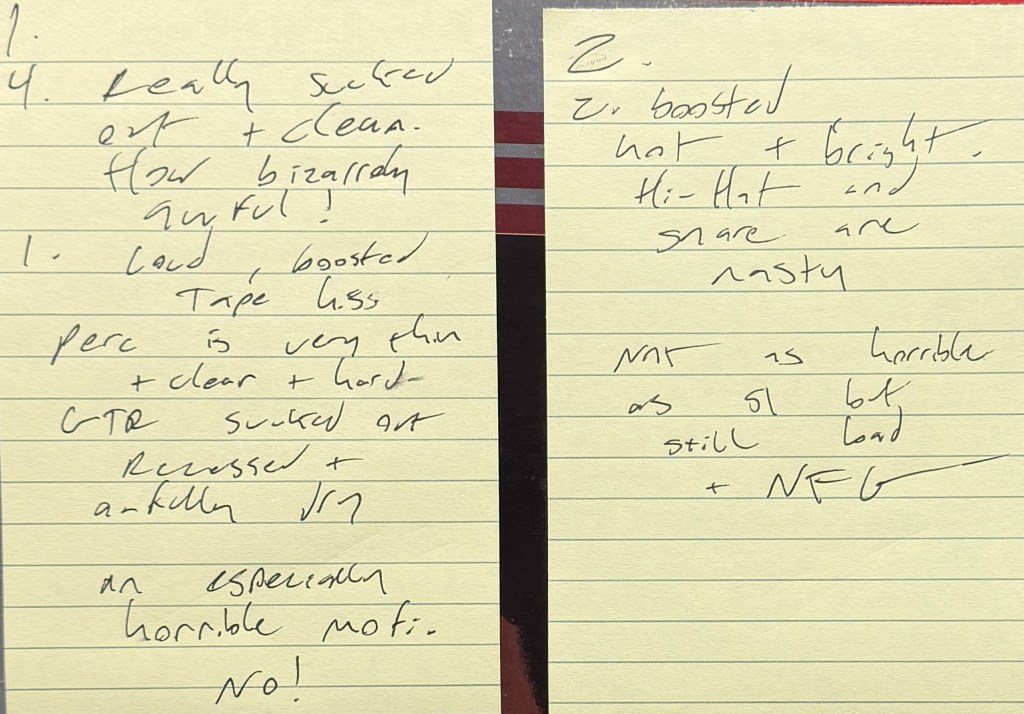
The MoFi, however, is a joke next to a properly-mastered and properly-pressed RCA vintage release. Our notes for it read:

  • Big but flat
  • Voice is recessed and lacks richness
  • Rock songs, track one in particular work OK but
  • Ballads lose all the magic

(more…)

Does Year of the Cat on Mobile Fidelity Have Audiophile Sound?

Hot Stamper Pressings of the Music of Al Stewart Available Now

Our answer, judging by the copy we played not long ago, would be solidly in the negative. The final grade we awarded both sides was No, our way of saying the record is Not Good.

Below is a description for what a top copy of the album sounds like, based on our most recent shootout:

Incredible sound throughout this vintage Janus pressing of Stewart’s 1976 Masterpiece. With engineering by Alan Parsons, the top pressings are every bit the audiophile Demo Discs you remember. The best sides have sweet vocals, huge amounts of space, breathtaking transparency, and so much more.

Tubey Magical acoustic guitar reproduction is superb on the better copies of this recording. Simply phenomenal amounts of Tubey Magic can be heard on every strum, along with richness, body and harmonic coherency that have all but disappeared from modern recordings (and especially from modern remasterings).

But if you own the wrong Mobile Fidelity pressing — this one was reissued in 1981, the original came out in 1978, so there may be some other pressings that sound better than this one — you would never know how good sounding the album can be. We put a copy we had laying around in a shootout recently and the results were, not to put too fine a point on it, pretty painful.

As the notes make clear, the Mobile Fidelity pressing, with the stampers you see on the sheet above, is:

(more…)

Diamonds and Rust – Another TAS Listed Anadisq Disaster

Hot Stamper Pressings of the Music of Joan Baez Available Now

Mobile Fidelity released their version of Diamonds and Rust on Anadisq in 1995, and if you want to hear a pressing that’s not murky, compressed and opaque, you would be wise to avoid their Heavy Vinyl Half-Speed.

Somehow it ended up on the TAS Super Disc List, but we could find nothing “super” about it. We felt it more properly belonged on our list of records that have no business being called Super Discs.

It was a real muckfest, as was to be expected from a record mastered by this awful label during the Anadisq era, the darkest chapter in the disgraceful history of Mobile Fidelity, which, considering the consistently dismal quality of their output, is really saying something.

Ken Lee Strikes Again

Many of the worst of them were mastered by a Mr. Ken Lee. If you happen to come across a record in a store with his name in the credits, or his initials in the deadwax, you are best advised to drop it back in the bin and keep moving. Anything else is just asking for trouble.

To be fair, MoFi made some reasonably good sounding records too. For those of you whose budget is on the limited side, if you find an affordable copy of any of these MoFis, you are probably not wasting your money.

Although I had a long way to go in this hobby in the early days of my audiophile record business, even then I could tell how bad the Anadisq series that Mobile Fidelity released in the 90s was. They produced one awful sounding record after another, with not a single winner that I knew of. I sold them — my bad, an ethical lapse for which I must apologize — but I sure never recommended them or had anything good to say about them.

(more…)

Imagine on Mobile Fidelity from 1984

Hot Stamper Pressings of the Music of John Lennon Available Now

This Jack Hunt-mastered Half Speed has the midrange suckout that Mobile Fidelity was notorious for.

Lennon and his piano on the first track sound like they are coming from another room.

And yet somehow there are still “audiophiles” in this day and age that defend the records put out by this ridiculous label.

Oy vey. What is wrong with these people?

I Have a Theory

Actually, I have a good idea why so many so-called audiophile records have a sucked-out midrange.

A midrange suckout creates depth in a system that has difficulty reproducing depth.

Imagine that instead of having your speakers pulled well out from the back wall as they should be, instead you have placed your speakers right up against the wall.

This arrangement, though preferable aesthetically and dramatically more family- and wife-friendly, has the unfortunate effect of seriously limiting your speakers’ ability to reproduce whatever three-dimensional space exists on your recordings.

I hinted back in 2022 that I was going to discuss this idea down the road, and like most things that I was supposed to write about down the road, we’re still waiting to see it.

The album I was going to write more about was Kind of Blue.

(more…)

Classic Records Had an Epiphany in 2007 – UHQRs Actually DO Sound Good

More Records Perfectly Suited to the Stone Age Stereos of the Past

Don’t believe your ears!

Listen to Mike Hobson. After all, he’s the expert, right?

This commentary was written in 2007 and we admit it may be a bit long in the tooth for the brave new world of Heavy Vinyl we currently find ourselves in. Classic Records has been gone for a while now and when that blessed day came we were finally able to say good riddance to their bad records.


Mike Hobson thinks he knows why his pressings often don’t sound good and/or are noisy. We’ll let him explain it. If you want the whole story (which goes on for days) you can find it on the Classic Records website, assuming it’s still active. While you’re there, remember the sound.

One day, while out for a run, I had an epiphany and rushed home to dig out a JVC pressing from the 1980’s pressed for Herb Belkin’s Mobile Fidelity. The Mobile Fidelity UHQR pressings were always revered as sounding better than the standard weight pressings from JVC [citation needed, big time] – but why I thought? To find out, I cut a UHQR pressing in half and guess what I found? First, it weighed 195 grams and IT WAS A FLAT PROFILE! I cut a 120g JVC pressing in half and found that it had the conventional profile that, with small variations, seems to be a record industry standard and is convex in it’s [sic] profile – NOT FLAT.

So, that is why the UHQR JVC pressings sounded better than their standard profile pressings and further confirmation of why our Flat Profile pressings sound better than 180g conversional pressings! [italics added]

This is a classic (no pun intended) case of begging the question, asserting the very thing that Mr. Hobson is trying to prove.

There was no need to saw up a record. Mofi actually explained in the booklet for every UHQR how its shape differed from a conventional disc.

(more…)

Gaucho According to MCA Masterphile

Hot Stamper Pressings of the Music of Steely Dan Available Now

The Masterphile Half-Speed is a pathetic shadow of the real thing, the real thing being an early Masterdisk pressing cut by Robert Ludwig.

We’ve played at least a hundred of the original pressings, and I would be surprised if every one of them did not sound better than this compressed, desiccated audiophile piece of trash.

With sound like that, the MCA Masterphile gets our vote for the worst version of the album ever made.

Of all the great albums Steely Dan released, and that means their seven original albums and nothing that came after, there are only three in our opinion that actually support their reputation as studio wizards and recording geniuses. Chronologically they are Pretzel Logic, Aja, and Gaucho.

Every sound captured on these albums is so carefully crafted and considered that it practically brings one to tears to contemplate what the defective DBX noise reduction system did to the work of genius that is Katy Lied, their best album and the worst sounding. (Those cymbal crashes can really mess with your mind if you let them. To get a better picture of the DBX sound just bang two trash can lids together as close to your head as possible.)

The first two albums can sound very good, as can Royal Scam, but none of those can compete with The Big Three mentioned above for sonics. A Hot Stamper copy of any of them would be a serious DEMO DISC on anyone’s system system.

Mistakes Were Made

If you are still buying these modern remastered pressings, making the same mistakes that I was making before I knew better, take the advice of some of our customers and stop throwing your money away on Heavy Vinyl and Half-Speed Mastered LPs.

(more…)

“There is nothing to be learned from the second kick of a mule.”

Hot Stamper Pressings of Revolver Available Now

In 2022 we finally reviewed the newly remixed Revolver.

As I was reading the newspaper today, I chanced upon Mark Twain’s famous quote and immediately recognized a way to put it to good use. I had been searching my brain for a good way to start a commentary detailing the multitudinous problems with the remixed, Half-Speed mastered Revolver LP. Kicked in the head was exactly what I needed.

In 2020 I had reviewed the Abbey Road remix and was astonished that anyone would release a record of such utter sonic worthlessness. A few choice lines:

The Half-Speed mastered remixed Abbey Road has to be one of the worst sounding Beatles records we have ever had the displeasure to play.

Hard to imagine you could make Abbey Road sound any worse. It’s absolutely disgraceful.

I will be writing more about its specific shortcomings down the road, but for now let this serve as a warning that you are throwing your money away if you buy this newly remixed LP.

Of course I never did write more about it. The thought of listening critically to the album in order to detail its manifold shortcomings was more than I could bear and onto the back burner the idea went, where it remains to this day.

In 2020 I warned the audiophile community not to go down this foolish half-speed mastered road, and now that they have been kicked in the head a second time, perhaps when they wake up they will come to their senses, although I doubt very much that they will.

Giles Martin is the guilty party here, and I hope it is clear by now that he simply has no clue as to how a Beatles record should sound. If he did have such a clue, this new Revolver would never have seen the light of day.

Getting Down to Brass Tacks

Here are the notes our crack listening panel (our very own Wrecking Crew) made as they listened to the new Revolver.

Note that they listened to side two first, playing a Super Hot stamper ’70s UK pressing head to head with the new release, so we have listed our notes for side two above those for side one.

They listened to the first two tracks on side two in this order:

Good Day Sunshine, And Your Bird Can Sing.

On side one they played the first three tracks and listened to them in this order:

I’m Only Sleeping, Taxman, Eleanor Rigby.


Some of the highlights from side two:

(more…)

The Alan Parsons Project – A MoFi Disaster

Hot Stamper Pressings of Albums Engineered by Alan Parsons Available Now

MoFi Regular LP: F / UHQR:

Two — count ’em, two — hall of shame pressings and two more MoFi Half-Speed Mastered Audiophile LPs reviewed and found wanting.

The MoFi is a textbook example of their ridiculous affinity for boosting the top end, not to mention the extra kick they like to put in the kick drum, great for mid-fi (sometimes known around these parts as stone age audio systems) but a serious distraction on a high end stereo with good low end reproduction.

If you like the album –and that’s a big if, I myself have never been able to take it seriously — try the Simply Vinyl or the Classic LP.

Even the UHQR sucks. Don’t kid yourself. They’re still mastered by Stan Ricker, and he likes plenty of top end.

Like the old saying goes, if it’s worth doing it’s worth overdoing.

(more…)

A Trick Of The Tail – A MoFi Disaster to Beat Them All

This review is fairly old, probably from 2005-2010.

Not long ago I played the MoFi pressing of Trick of the Tail and could not believe how ridiculously compressed it was.  Rarely have I heard sound as squashed as that which is heard on this LP.

On top of that, the midrange is badly sucked out (as is the case with most Mobile Fidelity pressings) making the sound as dead, dull and distant as can be.

Is it the worst version of the album ever made? Hard to imagine it would have much competition. I have the CD and it’s fine. It sounds like a digital version of the British pressings we favor (the domestic pressings having been made from dubs of course).  The MoFi is bad enough to have earned a place in our Mobile Fidelity hall of shame.

You think Modern Heavy Vinyl pressings are lifeless? Play this piece of crap and see just how bad an audiophile record can sound.

And to think I used to like this version! I hope I had a better copy back in the 80s than the one I played a few years ago. I’ll never know of course. If you have one in your collection give it a spin. See if it sounds as bad as we say. If you haven’t played it in a while (can’t imagine why, maybe because it’s just plain awful), you may be in for quite a shock.

If you are still buying these audiophile pressings, take the advice of some of our customers and stop throwing your money away on Heavy Vinyl and Half-Speed mastered records.

(more…)

This Beethoven Ninth Started Out with Two Strikes Against It

Hot Stamper Pressings of the Music of Beethoven Available Now

MoFi took the shortcomings of a mediocre-at-best Decca recording from 1972 and made them even worse by means of their ridiculously misguided mastering decisions and wacky cutting system.

They should not have chosen this performance of the Ninth Symphony in the first place, and they certainly should not have added the treble they chose to add, which they did to this title and to every classical recording they remastered without regard to whether or not the recording needed brightening. None that I know of did. Try telling that to the brain trust running MoFi.

(They hired this guy to do their one-step digitally remastered pressings and from the get-go he’s been giving audiophiles the most ridiculously phony sounding records that collectors with way too much money can buy.)

The Decca recording of the Ninth from 1972 is opaque, lacks size and space, and comes off as a bit flat and dry.

Like practically every later Decca pressing we play, it’s passable at best.

Londons and Deccas from this era (1972 in this case) rarely sound very good to us.

Here is what we specifically don’t like about their sound.

If you want to know what’s wrong with the Mobile Fidelity pressing, take the above faults and add some others to them.

Start with an overall brighter EQ, add a 10k boost for extra sparkly strings, the kind that MoFi has always been smitten with, and finish with the tubby bass caused by the half-speed mastering process itself.

Voila! You are now in the presence of the kind of mid-fi trash that may have fooled some audiophiles way back when but now sounds as wrong as the records this ridiculous label is still making today.

Here are some other pressings with bright string tone that are best avoided by audiophiles looking for top quality sound.

1981 Was a Long Time Ago

Old school audio systems are notorious for being dark, dull and lacking in transparency. They might need bright records in order to sound good, but high quality modern systems do not.

If these two MoFi pressings sounds right to you, you are very likely living with one of those old school systems and it is long past time to get rid of it.

(more…)