*Discoveries, Jazz

Records we’ve “discovered” with exceptional sound.

Charles Mingus – Pre Bird

More of the Music of Charles Mingus

  • You’ll find solid Double Plus (A++) sound or close to it throughout this original Mercury Stereo LP
  • We used to think the early Limelight pressing was impossible to beat, but this superb original Mercury showed us just how wrong we were – it takes the recording to another level (particularly on side two)
  • This copy sounds like a big room full of musicians (25 in all!) playing live, which is exactly what it was
  • The Tubey Magical richness of this 1960 recording (released in 1961, and again in 1965 as Mingus Revisited) is breathtaking (also particularly on side two) – no modern record can touch it
  • AllMusic gives it 4 stars and we think it’s maybe even a bit better than that
  • Two tracks are contrapuntal arrangements of two swing era pieces, whereby “Take the ‘A’ Train” (left channel) is paired with a simultaneous “Exactly Like You” (right channel), and likewise “Do Nothin’ Till You Hear From Me” with “I Let a Song Go Out of My Heart.”
  • An outstanding member of our Core Jazz Collection of currently available exceptional recordings.

The better copies recreate a live studio space the size of which you will not believe (assuming your room can do a good job of recreating their room). The sound is tonally correct, Tubey Magical and above all natural. The timbre of each and every instrument is right and it doesn’t take a pair of golden ears to hear it — so high-resolution too.

If you love 50s and 60s jazz, you cannot go wrong here. Mingus was a genius and the original music on this record is just one more album’s worth of proof of the undeniability of that fact.
(more…)

Jack Sheldon / Unreleased UHQR Test Pressing – Reviewed in 2007

More Hot Stamper Pressings of Digital Recordings with Audiophile Quality Sound

UPDATE

2007 was a long time ago, so please take that into condideration when reading this review.


This is a practically brand new UHQR JVC test record.

I’m SHOCKED at how good this record sounds.

It has AMAZING live jazz sound. 

(more…)

Grover Washington, Jr. – All The King’s Horses

More of the Music of Grover Washington

  • An early Kudu pressing of Washington’s sophomore release with seriously good Double Plus (A++) grades from top to bottom
  • There’s so much life in these grooves – the sound jumps out of the speakers and right into your lap
  • Credit must go to Rudy Van Gelder for recording and mastering this album so well, and to Bob James for his brilliant big group arrangements
  • We cannot recommend this album highly enough – if you have the big speakers a big group of musicians need to perform live in your listening room, his record is going to be nothing less than a thrill
  • 4 stars: “. . . this set has assumed its proper place in Washington’s catalog: as one of his more ambitious and expertly performed sessions.”
  • This is a Must Own jazz album from 1972, one that deserves a place in any audiophile’s collection

Both sides of this original Kudu pressing are OUT OF THIS WORLD. The sweetness and transparency of Grover Washington Jr.’s breathy sax went beyond any copy we’ve ever played. Who knew it could sound like this? We sure didn’t!

It’s spacious and full of life with virtually no distortion. Of special note, this copy has amazingly articulate bass which brings out the undeniable funkiness of the music in a way that no other copy did.

The early 70s were a good time for Rudy Van Gelder. All the King’s Horses from 1972 is an amazing Demo Disc for a large group. But it only sounds good on the copies that it sounds good on, on the pressings that were mastered, pressed and cleaned right, a fact that has eluded most jazz vinyl aficionados interested in good sound.

But not us. We’ve played the very special pressings that prove the album can sound amazing.

Yer Average Copy

The sound we most often find on original pressings (the only ones that ever sound any good; the later pressings are awful) is full of compression, and suffers as well from the kind of high-frequency restriction that prevents the top end from extending in a harmonically correct way. The result: Grover’s horn often will take on a somewhat sour quality. Our better Hot Stampers are both uncompressed and open up top.

I’m a Big Fan

I’ve been a big fan of this record since I first heard it all the way back in High School. I only found out later that this is not what most people would consider “real” jazz — it’s CTI jazz, more in the pop jazz or soul jazz vein. But I love the music more with each passing year and would not hesitate for a moment to recommend it to any jazz lover or audiophile. If the first track doesn’t knock you out, this album may not be for you. Without a doubt, in my book it’s the best thing Grover Washington ever did.

The really good RVG jazz pressings sound shockingly close to live music — uncompressed, present, full of energy, with the instruments clearly spread out and surrounded by the natural space of the studio.

As our stereo has gotten better, and we’ve found better pressings and learned how to clean them better, his “you-are-there” live jazz sound has impressed us more and more.

(more…)

Ben Webster – Soulville

  • A vintage Verve Two-Fer set with very good Hot Stamper sound or BETTER on all FOUR sides
  • Unlike the Speakers Corner version from a few years back, this is the real thing, mastered by real pros, not audiophiles
  • This reissue combines the albums Soulville and Ben Webster Meets Oscar Peterson
  • With rave reviews for both albums, AMG lauds Soulville as, “one of the highlights of that golden 50s run,” and notes Ben Webster Meets Oscar Peterson is “one of the jazz legend’s all-time great records.”

(more…)

Weather Report – Sweetnighter

More Jazz Fusion

  • A Sweetnighter like you’ve never heard, with an INCREDIBLE Shootout Winning Triple Plus (A+++) side two mated to a solid Double Plus (A++) side one
  • Here are just a few of the things we had to say about this killer copy in our notes: “rich and 3D”…”tubey and whomping”…”big bass and energy”…”jumping out of the speakers”…”great space and detail”
  • The sound is huge, spacious, lively, transparent and punchy – this is jazz fusion that really rocks
  • “Boogie Woogie Waltz” was one of the most mindblowing tracks found on any album from 1973
  • 4 stars: ” It is the groove that rules this mesmerizing album, leading off with the irresistible 3/4 marathon deceptively tagged as the ‘Boogie Woogie Waltz’ and proceeding through a variety of Latin-grounded hip-shakers.”
  • If you’re a fan of the adventurous funky Jazz Fusion, this is a Must Own Title from 1973.
  • This is a well recorded jazz album that should be part of any audiophile’s jazz collection

This is our favorite Weather Report album here at Better Records.

Heavy Weather is arguably a more ambitious and more accomplished piece of work, but Sweetnighter is so original and rhythmically compelling that we find ourselves enjoying it more. I don’t know of any other album on the planet like it. We only know of two Must Own Weather Report albums, this one and Heavy Weather. They both belong in your collection if you’re a fan of jazz fusion.

The top end is fully extended here in a way that most copies barely hint at, and the overall sound is amazingly transparent and three-dimensional. The brass is full and rich, the percussion lively and present, and the bass is weighty and defined. All the stuff we look for on a Classic Weather Report album is here.

Note especially that the energy is excellent, and both sides are also very high-rez; the echo trails from all the studio reverb go on for days. (more…)

Ray Charles / The Genius After Hours

More of the Music of Ray Charles

charlgenius

  • The Genius After Hours debuts on the site with INSANELY GOOD Shootout Winning Triple Plus (A+++) MONO sound from first note to last
  • Both of these sides are doing everything right – richer, fuller, better bass, more Tubey Magic, and the list goes on
  • We wasted a lot of time and money chasing after early pressings, but no matter what stampers they might have, none of them could compete with this late reissue, and it wasn’t even close
  • This collection of instrumentals gives you a taste of Ray’s prowess at the piano, with amazing sound to boot
  • 4 1/2 stars: “Taken from the same three sessions as The Great Ray Charles but not duplicating any of the performances, this set casts Charles as a jazz-oriented pianist in an instrumental setting. Fine music – definitely a change of pace for Ray Charles.”

(more…)

Cannonball Adderley – What I Mean

More of the Music of Cannonball Adderley

  • Adderley’s superb double album reissue from 1979, which includes the complete 1961 album Know What I Mean?, here with seriously good Double Plus (A++) sound or BETTER on all FOUR sides
  • Sides three and four (Know What I Mean?) were sonically very close to our Shootout Winner – you will be amazed at how big and rich and tubey the sound is
  • With outstanding presence, clarity, space and right-on-the-money timbral accuracy, these pressings are guaranteed to be one of the best sounding jazz records you’ve played in a long, long time
  • A hard record to find, and an even harder record to find with this kind of audiophile sound and playing surfaces
  • This is some of the best sound we have ever heard for this exceptional Golden Age 60s recording, and that is really saying something
  • 4 stars: “This two-LP set combines two fine sessions from 1961. The great altoist is heard with his quintet in 1961 (featuring cornetist Nat Adderley, Victor Feldman on vibes and piano and guest pianist Wynton Kelly) and in a quartet date with pianist Bill Evans.”
  • This is a Must Own album from 1961 that belongs in any jazz-loving audiophile’s collection

Sides one and two of this double LP were originally issued as The Cannonball Adderley Quintet Plus, while sides three and four were originally released as Know What I Mean?

All four sides boast excellent mastering and very good sound. The cymbals have that just right “tap” followed by an open and sweet “shimmer.”

The piano and sax, the heart of the music of course, are rendered as accurately as can be expected.

As good as the OJC sounds, and it can sound very good indeed, this Milestone reissue from the decade before is even better. It has more of a “vintage analog pressing” sound, the kind you would expect to hear on a recording from 1962. (more…)

Hampton Hawes / At The Piano

  • A huge, rich and natural Contemporary pressing boasting excellent Double Plus (A++) sound from first note to last
  • This is the last record Hawes made, and it’s one of the most deeply emotional and satisfying albums of his entire career – it may even be his best, and for a man of his talents, that’s really saying something
  • “Hampton Hawes’ final recording found him returning not only to the acoustic piano after having dabbled in electric keyboards from 1972-74, but to producer Lester Koenig and his Contemporary label, where Hawes recorded most of his classic gems of the 1950s… Teamed up with bassist Ray Brown and drummer Shelly Manne, Hawes shows that he was still in prime form.”
  • We’ve recently compiled a list of records we think every audiophile should get to know better, along the lines of “the 1001 records you need to hear before you die,” but with less of an accent on morbidity and more on the joy these amazing audiophile-quality recordings can bring to your life. Hampton Hawes last album is a good example of a record many audiophiles may not know well but should.

This is my favorite Hampton Hawes record of all time. He died less than a year after these sessions. Looking at the cover, you can almost see in his face his acceptance of the end he knew was coming. He plays with deep emotion here.

Ray Brown and Shelly Manne, the same rhythm section who back Joe Sample on my all-time favorite piano trio album, The Three, accompany Hawes beautifully here. (more…)

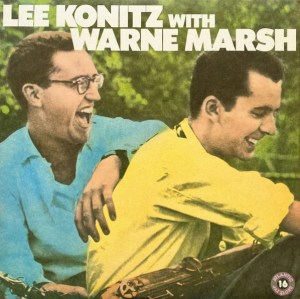
Lee Konitz With Warne Marsh in 1955

More Titles that Sound Better in Mono

  • Outstanding MONO sound throughout this reissue copy of Lee Konitz with Warne Marsh (the first to hit the site in years), with both sides earning solid Double Plus (A++) grades or close to them
  • This side one is remarkably spacious and three-dimensional, as well as relaxed and full-bodied, and side two is not far behind in all those areas
  • If you want to hear the Tubey Magic, size and energy of this wonderful session from 1955 – originally recorded by Tom Dowd and expertly remastered by George Piros – this pressing will let you do that
  • Our most recent shootout was a tough one – our top copy had too many issues to make it to the site, as did our only second-tier copy with Super Hot stampers on both sides
  • Those of you looking for top quality sound may have to wait for a while, especially if it takes us as long to get our next shootout going as it did this last one
  • 4 stars: “Altoist Lee Konitz and tenor-saxophonist Warne Marsh always made for a perfect team. Even by the mid-50s when they were not as influenced by Lennie Tristano as previously (particularly Konitz), their long melodic lines and unusual tones caused them to stand out from the crowd. This set is worth searching for, as are all of the Konitz-Marsh collaborations.”
  • This is one of those records that we’ve “discovered” with audiophile quality sound — until we came along, who knew the album could sound this good? The originals are godawful.

The 1955 mono sound by Tom Dowd is Demo Disc quality. The horns are breathy and clear, yet full and rich as can be. There may be a good reason that this pressing sounds as good as it does: it was remastered by one of the greatest mastering engineers of all time, George Piros.

Tom Dowd is the original recording engineer, and this one album should be all the proof you need that when it comes to jazz in mono, the guy is hard to beat. Rock in stereo, there his record is quite a bit more spotty (see, or better yet, listen to Cream, The Young Rascals, Delaney and Bonnie and too many others to list).

(more…)

Michel Legrand – After the Rain

More Jazz Recordings of Interest

  • After the Rain returns to the site for the first time in years, here with solid Double Plus (A++) sound throughout this original Pablo pressing
  • Both of these sides are open and spacious with real depth to the soundfield and lots of separation between the various instruments
  • Rich, solid bass; you-are-there immediacy; energy and drive; instruments that are positively jumping out of the speakers – add it all up and you can see that this copy had the sound we were looking for
  • 4 stars: “This high-quality outing features composer Michel Legrand faring quite well as a jazz pianist. He performs six of his compositions with a lyrical septet also including altoist Phil Woods (doubling on clarinet), tenor saxophonist Zoot Sims, trumpeter Joe Wilder, guitarist Gene Bertoncini, bassist Ron Carter, and drummer Grady Tate.”

This album is pure magic! I know of no other jazz album like it. It’s lyrical and moody, yet comes to life at a moment’s notice when the horn players start to feel the spirit. If you’re familiar with the music he wrote for The Thomas Crown Affair (he won an Academy Award for “Windmills of Your Mind”), you may have a good feel for subtle, impressionistic, often moody quality of After the Rain. Or check it out on YouTube (while trying to imagine the sound being at least one million times better).

Michel’s idea was to assemble a group of his favorite musicians, especially those who were ordained in the lyrical persuasion, to record his next album.

With Zoot Sims and Phil Woods trading off stylistically opposed solos within the gentle, subtly ‘French’ atmosphere, aided by guitar, trumpet, Michel’s piano, and rhythm, you have something new, even unique.

Phil Woods doubles on clarinet, and his lead work on “Martina” is the one of the finest examples of jazz clarinet I’ve ever heard. (Art Pepper is another guy who can really swing on the clarinet without sounding dated.)

(more…)