*Arcana – Country Advice

Which country produced the best sounding pressings for the albums linked below? Click on the listing to find out.

Brain Salad Surgery on Shout Heavy Vinyl

Hot Stamper Pressings of the Music of Emerson, Lake and Palmer Available Now

If you’re a fan of Emerson, Lake and Palmer’s fifth album, and you know, or at least suspect, that the British original pressings are more than likely to be better sounding than most, you might find yourself in a bit of a quandary, pocketbook-wise.

Early British pressings in audiophile playing condition aren’t easy to find, and they don’t tend to be cheap when you do find them.

Ah, but there is a fairly cheap and exceptionally easy solution: just buy the Shout Heavy Vinyl reissue from 2008.

It says it’s made from the master tape, it has a replica of the original packaging, and even comes with a poster.

What could go wrong?

The sound could be shit — NFG in our shorthand — that’s what could go wrong.

  • The top end could be overly-textured, tizzy and hot, the kind that constantly calls attention to itself.
  • The bass could be smeary and thick.
  • And the overall presentation of the music could be veiled and recessed.

Alas, the money you thought you were saving buying this potentially wonderful flat, quiet pressing made from the master tapes ends up flushed down the tubes. Now what?

Now you have to do what you should have done to begin with: find yourself a real British pressing.

(more…)

On Tons Of Sobs, the Domestic Pressings Just Don’t Make the Cut These Days

Hot Stamper Pressings of British Blues Rock Albums Available Now

Years ago — in 2011 to be exact — we wrote the following in a listing for a very good sounding domestic pressing:

Solid bass, present vocals, plenty of energy — the only thing missing here is the Tubey Magical richness and sweetness that only the British originals (in our experience) have, and in spades by the way.

But try to find one. Over the last two or three years I think we’ve managed to get hold of exactly one clean copy.

Fast forward a number of years and we’ve only had a few since then. I have seen the original Pink Label British pressing of this album sell on the web for more than 1000 dollars, which might explain why we rarely have them.

But if you want to hear this record in all of its glory, the UK Island pressings are the only game in town.

Both Pink and Sunray labels sound good, just make sure they are from the UK.

And don’t buy any later label pressing from any country if you want the best sound.

(more…)

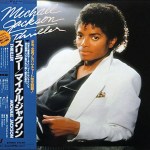
Is It Possible to Find Out Who Mastered the Japanese Thrillers?

Hot Stamper Pressings of the Music of Michael Jackson Available Now

A letter we received not long ago made the point that the Japanese pressing of Thriller the owner had been listening to for years, even decades, fell well short of the mark set by the sound of the White Hot Stamper pressing he now owned.

To think, I spent all those years playing and re-playing a record that was bright and edgy, none the wiser to matrix numbers and pressing variations.

I agreed, saying that I myself learned the hard way, having wasted some of my own money on them. that Japanese pressings were almost always a crock, writing:

Most Japanese pressings cater to what a mid-fi system would need to sound good and a hi-fi system would find ruinous. They are almost always made from dubbed tapes, which are then brightened up in the mastering phase since that is the sound that appeals to the Japanese market for some reason unknown to me. Old school audio equipment — horn speakers and vintage tube electronics — would be my guess.

A fellow who saw an opening to set me straight and take me down a peg, all without having to learn how to use that pesky shift key on his computer, left the following comment in that post:

the japanese pressings were mastered by BG. the only difference being the quality of the material. nice try though, snakeoil salesman.

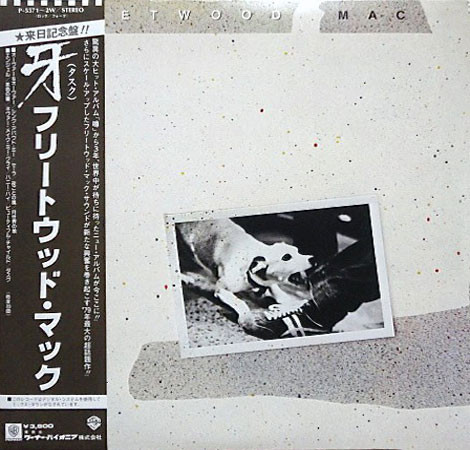
I immediately went to battle stations. I doubted whether Bernie Grundman has mastered any pressings for the Japanese market, but I couldn’t say for sure. It’s a question that had never come up. We ourselves had discovered a very good sounding pressing of Tusk that was mastered by Ken Perry and pressed in Japan, so I knew it was possible that the original mastering engineer could have sent metalwork to Japan for the Japanese to produce properly-mastered records for their market.

Fortunately, Discogs makes checking such things fairly easy. I went right up to the listing for Thriller and clicked on all the Japanese original pressings to see if there was any evidence to show that he had mastered them.

Bernie Grundman’s name was credited on the back cover as the mastering engineer, but I didn’t put much stock in that. I assumed that he did not master the album for their market, since that is hugely impractical. I surmised that removing his credit would have badly defaced the jacket, something I doubted the Japanese would have found acceptable. They seem to be very particular about these things.

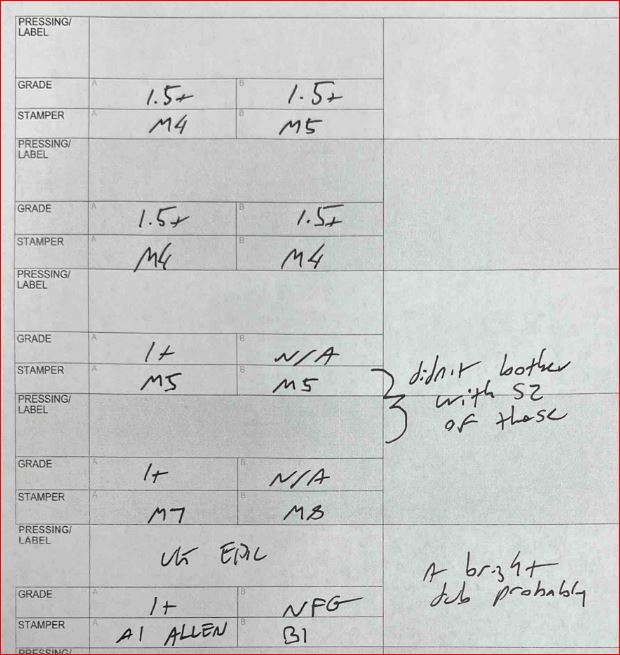
Sure enough, here is what the stampers look like for the typical Japanese pressing that supposedly would have been mastered by BG:

There are about half a dozen original Japanese pressings for the album on Discogs and all the stamper listings look like the one above.

If you know anything about records, you know that these markings could not have been created by Bernie Grundman’s mastering operation here in the states.

(more…)

Yes, We’re Getting Awfully Close To The Edge…

Hot Stamper Pressings of the Music of Yes Available Now

On the difficulty of reproduction scale, this record ranks well above most of the albums we play, in the top few percent without a doubt.

You need lots of Tubey Magic and freedom from distortion, the kind of distortion-free sound I rarely hear on any but the most heavily tweaked systems — the kind of systems that guys like me have been slaving over for more than forty years.

If you’re a weekend warrior when it comes to working on your stereo, this is not the record for you.

It took a long time to get to the point where we could clean the record properly, twenty years or so, and about the same amount of time to get the stereo to the level it needed to be, involving, you guessed it, many of the revolutionary changes in audio we tout so obsessively.

It’s also not easy to find a pressing with the low end whomp factor, midrange energy and overall dynamic power that this music needs, and it takes one helluva stereo to play one too.

If you have the kind of big system that a record like this demands, when you drop the needle on the best of our Hot Stamper pressings, you are going to hear some astonishingly good sound.

Unless your system is firing on all cylinders, even our Hottest Stamper copies can be difficult. Your electricity has got to be cooking, you’ve got to be using the right room treatments, and ideally you should be using a demagnetizer such as the Talisman on the record itself, your cables (power, interconnect and speaker) as well as the individual drivers of your speakers.

This is a record that’s going to demand a lot from the listener, and we want to make sure that you’re up to the challenge. If you don’t mind putting in the hard work, here’s a record that will reward you many times over, and probably teach you a thing or two about tweaking your gear in the process.

We’d started and abandoned this shootout multiple times before breaking through in 2008. The typical copy was just too painful to listen to, and the better pressings weren’t sounding the way we’d hoped they would.

Where was the Tubey Magical analog sound with the HUGE whomp factor that we’d been hearing on the best copies of Fragile and The Yes Album?

We just could not find that sound on Close to the Edge.

As futile as our previous attempts were, we decided in 2008 that we would take another stab at it. After all, there had been quite a few changes around here that had the stereo working really well —  the addition of the Odyssey Record Cleaning Machine and Prelude Record Cleaning System to our cleaning process, the Talisman Magnetic Optimizer, the third pair of Hallographs we added years back, tons of smaller tweaks, and a few other tricks that we’re going to leave hidden up our sleeves for now.

The Planets Align

Think about it: This is a highly COMPLEX recording, with HUGE organs, light-speed changes, lots of multi-tracking, and what amounts to an OVERLOAD of musical information. Can you imagine how irritating that would sound on a third-rate copy? We didn’t have to imagine it — we lived through it!

But that’s exactly what made the shootout so rewarding. We had finally gotten the sound we were searching for from Close To The Edge, although it was anything but easy. The toughest peaks to climb are the ones you feel the best standing at the top of, and I have no doubt that many of you will be able to get there, just as we did, as long as you’re willing to work for it. (We humbly suggest you follow our lead.)

We put a lot of time and energy into getting everything just right for our shootouts, and to hear the album sound amazing you’re going to have to do the same. If it doesn’t all come together and our Hot Stamper Close to the Edge leaves you cold, feel free to send it back for a full refund. That’s always our policy, but we wanted to stress it in regards to this album, because it is VERY difficult to reproduce. (Big speakers are pretty much a must on this one as well.)

And it should be noted that there is distortion on the tape. It’s on every LP copy and it’s on the CD too. There are cacophonous passages that have what sounds like board overload, mic preamp overload, tape saturation or some combination of all three.

(more…)
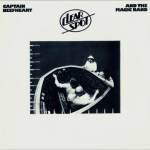
Domestic Pressings of Clear Spot? Forget ‘Em!

Hot Stamper Pressings of the Music of Captain Beefheart Available Now

We did this shootout many years ago, so many years ago that I cannot find a record of it.

I remember we thought the German pressings were perhaps a bit boosted on both ends and not as natural sounding as the domestic pressings.

After a multitude of improvements in our cleaning and playback, we would agree with our previous understanding that the German pressings are often wrong, but now we also know how right the right ones can be.

It turns out tha some German pressings are not particularly good, another piece of the puzzle that fell into place during our most recent shootout, as painful as that turned out to be considering the money wasted on them.

Did we have the bad German stamper pressings last time around? Who knows?

The producer, Ted Templeman, (Doobie Brothers, James Taylor) brought his mainstream talents to bear on this music, and when the Captain’s free-form tendencies smashed into Templeman’s conservatism, the result was this musical supernova — out there, but not too far out there.

(Play Trout Mask Replica sometime if you miss that feeling from your old hippie days of being on acid. With that music, drugs are entirely superfluous.)

I don’t know how many audiophiles like Captain Beefheart, probably not too many, but if you’re ever going to try one of his albums, this is the place to start: his masterpiece.

(more…)

Avoid M Stampers and Imports If You Want the Best Sound on Tapestry

More of the Music of Carole King

The domestic pressings with the stampers shown below, and others similar to them, have not done well in our shootouts for years now. If you own a copy with these stampers, or ones like them, the good news is that we can get you a much better sounding copy of Tapestry than you have ever heard. It won’t be cheap, but we can guarantee that it will be very, very good.

Stamper numbers are not the be-all and end-all in the world of records, a subject we discuss below, but after hearing too many copies with these stampers and decidedly mediocre sound, from now on we are going to focus our attention on the stampers that do well and leave copies with these markings sitting in the bins.

Note that the last listing is for an early UK import. I have no idea how that record got into the shootout. The chances of an import doing well up against Bernie Grundman’s brilliant mastering — from back in the good old days of the 60s, 70s and 80s when he was actually doing brilliant mastering work — is so close to zero it can’t be calculated.

Sometimes we take long shots, hoping to learn something new. In this case, we learned what we already know. Yes, there are still some audiophiles who buy imports of a record like this hoping to find better sound. I can’t imagine what kind of system it would take to hide the bright, dubby sound of the UK pressing we played, but judging from some of the foolishness I read on the Hoffman forum and others of its ilk, I know there must be plenty of them out there.

Monarch is responsible for the mediocre-at-best sound of the pressings with the stampers you see above. We tend to like Monarch pressings as a rule, but sometimes they mess up, and they messed up Tapestry compared to others who pressed the record.

We liked all the other copies with other stampers better than than these, which just goes to show you can never know how good it can get until it gets that good. That is what shootouts allow us to do.

Playing close to twenty copies of Tapestry in a shootout allows us to grade Tapestry on a scale, with the M stampers filling out most of the bottom and the other stampers — wouldn’t you like to know which ones! — occupying the middle and the top of the distribution. 

This is what the forum posters fail to understand. They think they have a Hot Stamper when what they actually have (maybe!) is a good sounding record. They don’t know how amazing the record can sound — so much more amazing than the one they own, probably — so they assume they have something good, maybe even the best.

They probably do not, but who really knows? The shootout would supply the data they need to support their conclusions, and since they could not be bothered to conduct one, they have no data to back up their opinions.

The “probably” you see in the above two sentences is there for a good reason. We make a point of being clear about what we can know and we cannot know, and we cannot know what a record sounds like until we play it.

This is obviously true for those of us who try to listen as critically as possible, but we also know that it is just as important to think about records the right way.

(more…)

Before and After Science – Rules Are Made to Be Broken

Hot Stamper Pressings of Art Rock Recordings Available Now

The domestic pressings of Before And After Science are typically grainy, low-rez and hard sounding — they’re simply not competitive with the smoother British Polydors.

But our best Hot Stamper pressing isn’t an import; it was made right here in the good old US of A.

Say what? Yes, it’s true. We were SHOCKED to find such hot stamper sound lurking in the grooves of a domestic Eno LP. It’s the One and Only.

In thirty plus years of record playing I can’t think of any domestic Eno LP that ever sounded this good.

Now hold on just a minute. The British pressings of Eno’s albums are always the best, aren’t they?

For the first three albums, absolutely. But rules were made to be broken. This pressing has the knockout sound we associate with the best British originals of Eno’s albums, not the flat, cardboardy qualities of the typical domestic reissue.

Kinda Blind Testing

Since the person listening and making notes during the shootouts has no idea what the label or the pressing of the record is that he is evaluating — this is after all a quasi-scientific enterprise, with blind testing being the order of the day — when that domestic later label showed up at the top of the heap, our jaws hit the floor.

(more…)

These Are Just Some of the Stampers to Avoid on Catch Bull at Four

More of the Music of Cat Stevens

The domestic pressings of Catch Bull at Four with the stampers shown below, and others similar to them, have not done well in our shootouts for years now. If you own a copy with these stampers, or ones like them, the good news is that we can get you a much better sounding copy of Catch Bull at Four than you have ever heard.

Stamper numbers are not the be-all and end-all in the world of records, a subject we discuss below, but after hearing too many copies with these stampers and decidedly mediocre sound, from now on we are going to focus our attention on the stampers that do well and leave copies with these markings sitting in the bins.

When it comes to stampers, labels, mastering credits, country of origin and the like, we make a point of revealing very little of this information on the site, for a number of good reasons we discuss here.

The idea that the stampers are entirely responsible for the quality of any given record’s sound is a mistaken idea, and a rather convenient one when you stop to think about it. Audiophiles, like most everybody else on this planet, want answers.

(more…)

The UK Imports of On the Third Day Are Made from Dubs

Hot Stamper Pressings of the Music of The Electric Light Orchestra Available Now

It’s obvious, or should be, that the British vinyl pressings are made from sub-generation copy tapes.

The imports make it sound as if someone threw a blanket over your speakers.

We know this because we had a bunch of them cleaned up for our shootout many years ago and they all sucked.

We tend to buy Electric Light Orchestra records on import vinyl; those are the ones that have proven themselves to have the best sound.

Most of the domestic pressings of their albums sound as though they were mastered from dub tapes.

But On The Third Day is proof that this is not always the case, just as Siren proves that the best Roxy Music albums are not always British.

(more…)

A Very Bad Porky/Pecko Cutting of My Aim Is True

Hot Stamper Pressings of Elvis’s Albums Available Now

My notes for the one and only UK pressing I’ve played in many years, the one with Porky is the dead wax, note its many weaknesses:

Really loud and full.

Too loud and hot vocal.

Strains a lot.

You know what the sound of this record reminds me of?

An old 45 RPM 7″ single. Remember those?

It’s not unusual for 45 RPM singles from back in the day to be very loud, very compressed, and they often have much-too-hot vocals designed to jump right into your lap.

Mono mixes sometimes have some of that same lowest-common-denominator sound.

This mix is stereo but it sounds like it’s coming right out of a jukebox.

No doubt Mr. Peckham was told to make the record sound that way, and he did his job very well.

But audiophiles looking for good sound should heed this warning and avoid the UK LPs of the album. It’s a joke next to the domestic pressings with the right stampers. (The right stampers are hard to find but you will never hear a good sounding early pressing unless you have a copy with the stampers that sound right, a tautology to be sure but one worth noting.)

(more…)