_Composers – Debussy

Debussy / Clair de Lune / Agoult

  • This rich, sweet and full-bodied UK pressing boasts excellent Double Plus (A++) grades or BETTER from top to bottom – fairly quiet vinyl too
  • Side one gives you not only a wonderful Clair De Lune, but a number of shorter works by Faure, Massenet and Elgar as well, with side two highlighted by meditative pieces by Bach, Tchaikovsky and others
  • We can’t imagine a more beautiful record, both in terms of the program and the sound – this record is a wonderful example of what the Decca recording engineers (Kenneth Wilkinson in this case) were able to capture on tape
  • It’s the same recording as the famous Living Stereo Clair De Lune, LSC-2326, but with a couple of extra tracks included
  • The other main difference between the Living Stereo pressing and our Decca here is that the Decca has better sound

Transparent and spacious, wide and naturally staged, clean yet rich, with zero coloration, there is nothing here to fault. So relaxed and natural you will soon find yourself lost in the music.

It’s yet another remarkable disc from the Golden Age of Vacuum Tube Recording. We were impressed with the fact that it excelled in so many areas of reproduction. The illusion of disappearing speakers is one of the more attractive aspects of the sound here, pulling the listener into the space of the concert hall in an especially engrossing way.

The 1959 master has been transferred brilliantly using “modern” cutting equipment (from 1970, not the low-rez junk they’re forced to make do with these days), giving you, the listener, sound that only the best of both worlds can offer.

(more…)

Clair de Lune – Compare and Contrast Sides One and Two

More of the Music of Claude Debussy

This Shaded Dog LP has DEMONSTRATION QUALITY SOUND, if what you’re demonstrating is not a Hi-Fi spectacular, but rather a sublime presentation of an exceptionally sweet and natural string section in an orchestra, presented here on analog disc pressed more than sixty years ago.  

I can’t imagine a more beautiful record, both in terms of the program and the sound. This record is a wonderful example of what the Decca recording engineers were able to capture on tape, and the RCA mastering engineers were able to master from that tape.

Even though the album was recorded by Decca, it’s a superb example of Living Stereo Tubey Magic at its best. There will never be a reissue of this record that even remotely captures the space, transparency, sweetness and richness of the sound here.

Side Two

A++ to A+++ or better! Without more copies in hand it’s hard to know how good the sound can get, but we found it Hard To Fault (HTF).

This side has more extension up top and down low and more texture to the strings.

Side One

A++, although it starts out a bit weaker than that and only really gets good a few minutes into the side. (We hear this effect fairly often on the records we play. Noticing things like this is what we do for a living.)

There is some smear and it is slightly opaque as well.

You will hear what we mean when you flip it over and those two problems disappear.

(more…)

Debussy / Images For Orchestra / Munch

More of the Music of Claude Debussy

  • This is one of the most magnificent Golden Age Classical titles we have played in longer than I can remember – we put it in the top 1-2% of their best sounding releases, a nice place to be
  • This spectacular Demo Disc recording combines amazing richness with transparency, and even at its loudest, it is still smooth and sweet
  • It is very unlikely that all but a few of our best customers have any records in their collections that sound as good as this one!
  • The rich, textured sheen of the strings that Living Stereo made possible in the ’50s and early ’60s is clearly evident throughout these pieces, something that the Heavy Vinyl crowd will never experience, because that sound just does not exist on modern records
  • It’s also fairly quiet at Mint Minus Minus, and for recordings of Debussy, that is quiet indeed

DEMONSTRATION QUALITY SOUND! It’s also a better performance than the famous Reiner. Munch understands this music perfectly.

(more…)

Debussy / Images Pour Orchestre – Argenta

More of the music of Claude Debussy (1862-1918)

More Orchestral Spectaculars

  • Outstanding Double Plus (A++) sound throughout this London Stereo pressing
  • Both the Ansermet on London and the Munch on RCA are better recordings, but both sell for quite a bit more money than this Stereo Treasury, so if can’t see spending the kind of bread they command, here is a much more affordable alternative that is guaranteed to satisfy
  • These sides are open, airy and sweet, with a lovely extended top end and spaciousness for days
  • You’d be hard-pressed to find a copy that’s this well balanced, yet big and lively, with such wonderful clarity in the mids and highs
  • It’s also fairly quiet at Mint Minus Minus, and for recordings of Debussy, that is quiet indeed

Argenta is the man for this music; he brings out the folky quality in the work. We much prefer Argenta’s performance to Reiner’s on LSC 2222, which was one of the early releases from Classic Records as well; poorly remastered, of course, and best avoided. The Classic may be on Harry’s TAS list — sad but true — but that certainly has no bearing on the fact that it’s not a very good record. This STS LP will show you exactly what’s missing from that Heavy Vinyl pressing.

Brilliantly performed by the L’Orchestre de La Suisse Romande under the direction of Ataulfo Argenta.

The famously huge hall The Suisse Romande recorded in immeasurably contributes to the wonderful sound to be found here and on their other recordings. The Classic of LSC 2222 with Reiner, on the other hand, is all but unlistenable on a high-resolution system. The opacity, transient smear and loss of harmonic information drives us up a wall. Who can stand that sound? All the way back in 1994, long before we had anything like the system we do now, we were disparaging the “Classic Records Sound” in our catalogs. With each passing year — nearly 30 and counting — we like it less.

(more…)

The Bloated Cello Sound Some Audiophiles Find Appealing

Hot Stamper Pressings of the Music of Claude Debussy Available Now

On this pressing we were a bit surprised at how natural the cello sounded — more like the real instrument and less like the typical recording of it. 

Normally when recording the cello, the microphones are placed fairly close to the instrument. This often results in what’s known as the “proximity effect,” which simply describes a boost in the lower frequencies relative to the more linear response of the microphone when placed at a distance.

The famous Starker cello recordings on Mercury — you know the ones, the originals and even the reissues sell for hundreds and hundreds of dollars — suffer from this effect, which audiophiles seem to prefer. (The Mercury heavy vinyl reissues, at least the ones I’ve played, were ridiculously fat and bloated in the bottom.)

Audiophiles did not seem to mind much, judging by the apparently strong sales and the rave reviews I read. Bass shy systems, and that means most of the systems owned by audiophiles, probably benefited from the bass boost.

Systems with lots of large woofers — at least in our case — would of course make the sound of these pressings positively unbearable. That indeed was our experience.

Getting back to the record at hand, it presents a more natural cello if only because the instrument has been miked from a greater distance.

Side two is a bit fuller sounding than side one, and one of them is going to sound more correct on your system than the other. I would not even want to say for sure which one actually is more correct, as the slight difference between them might be subtle enough to play into room and system non-linearities that plague all stereos and rooms.

Both sides here will sound the way these real instruments sound when played in the kinds of rooms that one might hear them in, practice rooms perhaps. That makes this recording unusual in the world of “audiophile recordings,” if I can call this one, and no less refreshing and enjoyable for it.

(more…)

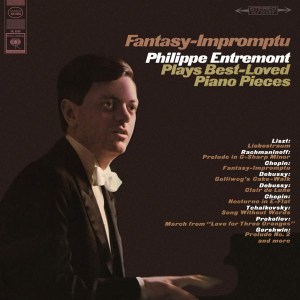
Chopin / Fantasy-Impromptu – Entremont

More of the music of Frederic Chopin (1810-1849)

More Classical and Orchestral Recordings

  • A superb Columbia Masterworks pressing with Double Plus (A++) sound or BETTER throughout
  • Performed with consummate skill and deep feeling by the legendary Philippe Entremont
  • Side one of this copy blew our minds with its Nearly White Hot Stamper sound – musically and sonically, it is nothing short of amazing.
  • A true undiscovered gem – who knew Columbia could record a piano this well?

The subtitle of the album reads Philippe Entremont Plays Best-Loved Piano Pieces. After hearing this one as well as another exceptionally good sounding copy, we would like to amend that to Philippe Entremont Plays the Hell Out of These Best-Loved Piano Pieces.

Side one of this copy blew our minds with its Nearly White Hot Stamper sound. Musically and sonically this record is nothing short of amazing. Who knew Columbia could record a piano this well? You could play fifty vintage piano recordings and not find one as good as this!

Tchaikovsky, Liszt, Debussy, Gershwin — these shorter pieces and excerpts were composed by those with the greatest gift for melody, men who have produced works that stand the test of time, enchanting audiences over the centuries with works of great beauty and charm.

(more…)

Debussy / Prelude & Ravel / Rapsodie Espagnole / Monteux

  • With two Nearly Triple Plus (A++ to A+++) sides, this original stereo copy of CS 6248 (similar to the Decca above) is hard to beat
  • This copy is HUGE, rich, clear, dynamic, with exceptionally three-dimensional hall space (the snare is WAY back there)
  • Superb 1961 All Tube recordings of groundbreaking masterpieces by Debussy and Ravel
  • The exceptionally natural recording Prelude to the Afternoon of a Faun lets you appreciate the wonder of the piece

Transparent and spacious, wide and naturally staged, clean yet rich, with zero coloration, there is nothing here to fault. Nearly Triple Plus all the way. So relaxed and natural you will soon find yourself lost in the music. (more…)

Satie, Ravel, Debussy / The Impressionists – Phase 4, its Strengths and Shortcomings

More Bernard Herrmann

Presenting an exceptionally rare and very good sounding Decca Phase IV pressing (with the textured cover, ooh!), the first to ever hit the site. We have been on the lookout for this album for years and somehow cannot find any clean copies, other than this one of course.

Not to worry; this one will do nicely. Three of the six works here have SUPERB better than Super Hot Stamper sound. We went through them one by one and were rather surprised that the sound quality varied so much from track to track.

One might conclude from the variation in the sound that the album must be a compilation — so many of Herrmann’s albums are — but that is not the case, assuming the liner notes are to be believed.

Here’s what we heard, taken directly from our notes.

Side One

Satie / Gymnopedies I & II

A++ or better. Rich, smooth, sweet, big, natural, clear and very ANALOG. I don’t know when I’ve heard these famous works sounding better than they do here.

Debussy / Clair de Lune

A+, rich but a bit smeary, strings need more texture.

Debussy / Valse ‘la Plus Que Lente

No grade – Too murky.

Ravel / Five O’Clock Fox-Trot

A++ to A+++, with Demo Disc sound! So lively and clear, the sound will jump out of your speakers when you play this track!

(more…)

Britten / Debussy / Schumann / Cello Sonatas / Rostropovich – Reviewed in 2011

Hot Stamper Pressings of the Music of Claude Debussy Available Now

Both sides of this promo London Blueback pressing (CS 6237) of piano and cello music have SUPERB sound. If you’re a fan of the cello, the piano, or chamber works in general, you will have a hard time finding a better sounding recording than this.

Notice especially that there is practically no smear on the piano — the notes are clear, with their transients fully intact, something one rarely hears anywhere but in a live setting. The tonality of the piano is also correct from top to bottom.

Lately we have been writing quite a bit about how pianos are good for testing your system, room, tweaks, electricity and all the rest, not to mention turntable setup and adjustment.

  • We like our pianos to sound natural (however one chooses to define the term).
  • We like them to be solidly weighted.
  • We like them to be free of smear, a quality that is rarely mentioned in the audiophile record reviews we read.

This is an Older Classical/Orchestral Review

Most of the older reviews you see are for records that did not go through the shootout process, the revolutionary approach to finding better sounding pressings we started developing in the early 2000s and have since turned into a veritable science.

We found the records you see in these older listings by cleaning and playing a pressing or two of the album, which we then described and priced based on how good the sound and surfaces were. (For out Hot Stamper listings, the Sonic Grades and Vinyl Playgrades are listed separately.)

We were often wrong back in those days, something we have no reason to hide. Audio equipment and record cleaning technologies have come a long way since those darker days, a subject we discuss here.

Currently, 99% (or more!) of the records we sell are cleaned, then auditioned under rigorously controlled conditions, up against a number of other pressings. We award them sonic grades, and then condition check them for surface noise.

As you may imagine, this approach requires a great deal of time, effort and skill, which is why we currently have a highly trained staff of about ten. No individual or business without the aid of such a committed group could possibly dig as deep into the sound of records as we have, and it is unlikely that anyone besides us could ever come along to do the kind of work we do.

The term “Hot Stampers” gets thrown around a lot these days, but to us it means only one thing: a record that has been through the shootout process and found to be of exceptionally high quality.

The result of our labor is the hundreds of titles seen here, every one of which is unique and guaranteed to be the best sounding copy of the album you have ever heard or you get your money back.


Side One

Britten – Sonata in C for Cello and Piano
Schumann – Funf Stucke Im Volkston

Side Two

Schumann – Funf Stucke Im Volkston
Debussy – Sonata for Cello and Piano

Benjamin Britten

Britten was an accomplished pianist, frequently performing chamber music and accompanying lieder and song recitals. However, apart from the Holiday Diary (1934), Piano Concerto (1938), Young Apollo (1939), Diversions (written for Paul Wittgenstein in 1940), Scottish Ballad (1941), he wrote relatively little music that puts the piano in the spotlight, and in a 1963 interview for the BBC said that he thought of it as “a background instrument”.

One of Britten’s best known works is The Young Person’s Guide to the Orchestra (1946), which was composed to accompany Instruments of the Orchestra, an educational film produced by the British government, narrated and conducted by Malcolm Sargent. Its subtitle is Variations and Fugue on a Theme of Purcell, the theme is a melody from Henry Purcell’s Abdelazar. Britten gives individual variations to each of the sections of the orchestra, starting with the woodwind, then the string instruments, the brass instruments and finally the percussion. Britten then brings the whole orchestra together again in a fugue before restating the theme to close the work. The original film’s spoken commentary is often omitted in concert performances and recordings.

Britten’s church music is also considerable: it contains frequently performed ‘classics’ such as Rejoice in the Lamb, composed for St Matthew’s Northampton (where the Vicar was Revd Walter Hussey), as well as A Hymn to the Virgin, and Missa Brevis for boys’ voices and organ.

As a conductor, Britten performed the music of many composers, as well as his own. Among his celebrated recordings are versions of Mozart’s 40th Symphony and Elgar’s The Dream of Gerontius (with Pears as Gerontius), and an album of works by Grainger in which Britten features as pianist as well as conductor.

Early in his career, Britten made a conscious effort to set himself apart from the English musical mainstream, which he regarded as complacent, insular and amateurish. Many contemporary critics distrusted his facility, cosmopolitanism and admiration for composers such as Mahler, Berg, and Stravinsky, not at the time considered appropriate models for a young English musician.

Britten’s status as one of the greatest composers of the 20th century is now secure among professional critics.

Wikipedia

Stravinsky / The Firebird Suite / Freccia – Our First Reader’s Digest Offering

More of the music of Igor Stravinsky (1882-1971)

Reviews and Commentaries for The Firebird

More Records on Readers Digest

This is the first time a disc from a Reader’s Digest box set has made it to the site, and we’re starting off with a bang — The Firebird Suite and La Mer are the two pieces on record 7 of the set, and both of them are knockouts. We have a devil of a time finding good recordings of either work, and to find SUPERB better than Super Hot Stamper sound (A++ to A+++) for both back to back on one disc is a surprise indeed.

You may remember that recordings from these sets were reissued by Chesky back in the ’90s, with mediocre sound of course, as all their reissues are mediocre at best. We never carried a single one of them, even when we were carrying reissues.

I remember the first time I heard some of the records from this Scheherazade set and was knocked out — here was Tubey Magical RCA Living Stereo sound at a fraction of the price the real RCAs were commanding, a price I could not begin to afford.

The problem — and it’s still a problem, though less so — is the vinyl. These sets were produced cheaply in order to be priced affordably (under $20 for 10 LPs in a box!), and that means the best vinyl was simply not part of the budget. To find pressings that play even Mint Minus Minus is not easy, even today. Back then, before the advent of modern enzyme-based cleaning fluids and expensive record cleaning vacuum machinery, there was no way to get most of the vinyl to play even that well. (more…)