*Bad Audiophile LPs

Linked below are a group of audiophile records numbering more than 275 as of 2024. Some of them have bad music, but most of them are here because these particular pressings have awful sound, awful enough to make us want to create this special list for them.

If you have any of this junk hiding in your collection, pull some of them out, play them and see if what we’ve said about them is true. If your stereo is any good at all, it should not take long to hear their many faults.

They do not deserve a place in any right-thinking audiophile’s home. Sell them to those who collect audiophile records and remain ignorant of their poor sound quality. You should have no trouble finding buyers.

Analogue Productions Fails Spectacularly Right Out of the Gate with Jazz Giant

Hot Stamper Pressings of Contemporary Albums Available Now

You may remember what a disaster the Analogue Productions version of Jazz Giant from the 90s was.

Or maybe you agree with a certain writer that they were god’s gift to the record lovers of the world in need of higher quality pressings. We thought they were crap right from the get-go and were not the least bit shy about saying so,

I haven’t heard the new 45 RPM version and don’t intend to play one, but I seriously doubt that it sounds like our good Hot Stamper pressings. We have yet to hear a single Heavy Vinyl 45 that sounds any good to us, judged by the standards we set in our shootouts.

Actually, to run the risk of sounding even more pedantic than usual, the records themselves set the standards.

We simply grade them on the curve they establish for themselves.

We guarantee that none of their LPs can hold a candle to our vintage records or your money back. If you have one of the new pressings and don’t know what’s wrong with it, or don’t think that anything is wrong with it, try one of ours.

It will show you just how much better a real record can sound, with more space, more transparency, more energy, more presence, more drive, more ambience — more of everything that’s good about the sound of music on vinyl.

It is our contention that no one alive today makes records that sound as good as the vintage LPs we sell. Once you hear one of our Hot Stamper pressings, those Heavy Vinyl records you bought might not ever sound right to you again.

They sure don’t sound right to us, but we have the good fortune of being able to play the best older pressings (vintage reissues included) side by side with the new ones, where the faults of the current reissues become much more audible — in fact, exceedingly obvious. When you can hear them that way, head to head, there really is no comparison. 

What to Listen For

As a general rule, this Heavy Vinyl pressing will fall short in some or all of the following areas:

(more…)

Kevin Gray Sacrifices Another Blue Note to the Lo-Fi Crowd

Hot Stamper Pressings of Blue Note Recordings Available Now

We did a shootout for Cornbread in 2023 and again in 2025. For our latest one, we were fortunate to be able to include both the Tone Poets pressing that came out in 2019 as well as the 75th Anniversary Blue Note pressing from 2014.

Here is the way we described a Hot Stamper that ended up being the best sounding pressing we played on one of its sides, and coming in second on the other side.

  • The sound is everything that’s good about Rudy Van Gelder‘s recordings – it’s present, spacious, full-bodied, Tubey Magical, dynamic and, most importantly, alive in that way that modern pressings never are
  • Exceptionally spacious and three-dimensional, as well as relaxed and full-bodied – this pressing was a big step up over nearly all other copies we played

After hearing a copy of the album that sounded as good as that one, the Tone Poets pressing would have had to be at least a bit of a letdown, right?

To be fair, all it really has to be is good sounding. For $30, the price of the average copy that sells on Discogs, can you really expect great?

I don’t know what any of the purchasers of these Tone Poets records — of this or any other title — are expecting for their thirty bucks, but I can tell you exactly what they are getting. We took notes while their remastered pressing played, and here’s what we heard.
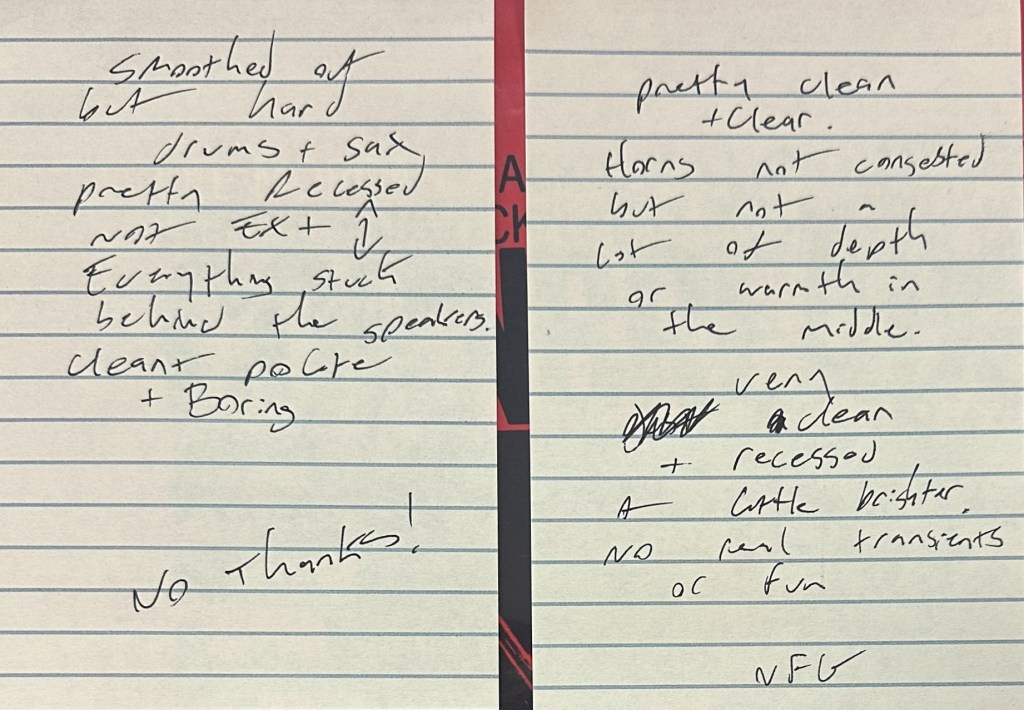
Side One

  • Smoothed out but hard drums and sax
  • Pretty recessed
  • Not extending (high or low)
  • Everything stuck behind the speakers
  • Clean and polite and boring
  • (No Thanks!)

Side Two

  • Pretty clear and clean
  • Horn not congested but
  • Not a lot of depth or warmth in the middle
  • Very clean and recessed
  • A little brighter
  • No real transients or fun
  • Our grade: NFG

Yes, that sounds like the kind of sound you can expect from a record that Kevin Gray remastered. We’ve played plenty of his Heavy Vinyl recuts and it’s hard to find one that’s not ridiculously bad.

The man’s transistory, opaque, airless, low-resolution cutting system is almost guaranteed to make even the most wonderful analog recordings sound like CDs, and sometimes, if you can wrap your head around it, even worse than a CD. I have lots of great sounding CDs in my collection. If any of them sounded as bad as this Tone Poets LP, I would have gotten rid of them years ago.

We discuss that subject in some depth here.

You can add this disastrous recut of Cornbread to the list of bad sounding Heavy Vinyl we’ve reviewed in 2024/25.

Another One?

Our review for the Blue Note 75th Anniversary pressing will be coming to the blog soon.

Is it any better?

How could it not be?

Next Question

Is the Tone Poets pressing the worst version of the album ever made?

That’s hard to say. But it is the worst sounding version of the album we’ve ever played, and that should be enough of a warning for any audiophile contemplating spending money on vinyl of such questionable quality.

The Vinyl and the Damage Done

Worse, a marketplace flooded with practically nothing but inferior remasterings, records that sound nothing like the vintage pressings whose sound quality they supposedly improve upon, may in fact be doing a great deal of harm to the folks who take pride in collecting them.

Yes, we can all agree that these are awful sounding records, something that seems obvious to those of us with good systems and lots of high quality vintage vinyl pressings to play.

But dig a little and you may discover that underneath the production of so many new titles there’s actually something potentially very damaging going on (other than the waste of good money being thrown after bad vinyl).

These records, so lacking in the analog qualities of their predecessors, may in fact be actively preventing the collectors who own them from appreciating the need to improve the playback quality of their systems.

Changes

Imagine that you have just made some changes to your system and it is now ten percent more revealing, spacious, energetic, three-dimensional, open, present, involving, musical (please feel free to insert any of a dozen other positive attributes of your choosing here) — could you even tell?

If the sound, say, on a scale of one to a hundred, goes from somewhere in the low 30s to something more like the low 40s, is that worth the effort of making large scale changes to your system, considering how expensive some of them may turn out to be, and that many of them will be immensely more time-consuming than you might have realized before starting down that road?

Add in the effects of the dreaded j curve — which predicts, with merciless statistical accuracy, that many of these so-called improvements will give the impression that the sound is actually getting worse, not better — and the barrier between the music lover and the better sound he seeks becomes even more difficult to penetrate.

This assumes that the changes he has undertaken take him in the right direction. And are even audible.

Soon enough it becomes clear that these proto-audiophiles, at least the ones who have bought into the hype behind the modern remastered LP, are really up against it in a way that those of us who grew up with vinyl in the 60s and 70s (when there was nothing else) cannot begin to imagine.

Progress

Given that so much working against the audiophile of today, can we be sure we would have succeeded in such a hostile environment?

The effect is that records that sound as bad as this Lee Morgan title may succeed in preventing you from making the progress you should be trying to make in audio.

Or seeing the need for it in the first place.

(And if you’re one of those who do not see the need to make progress in audio, you are definitely reading the wrong blog! It’s one of the main reasons this blog exists. If I can do it, so can you. Just ask Robert Brook.)


Before we go, let’s ge the producer’s take on the quality of the records he is making.

Joe Harley’s Story (emphasis added)

The LPs are mastered directly from the original analog master tapes by Kevin at his incredible facility called Cohearent Mastering. We go about it in the exact same way that we did for so many years for the Music Matters Blue Note reissues. [We’ve played some of those too.]

We do not roll off the low end, boost the top or do any limiting of any kind.

We allow the full glory of the original Blue Note masters to come though unimpeded!

Short of having an actual time machine, this is as close as you can get to going back and being a fly on the wall for an original Blue Note recording session.


That’s sure not what we heard but, hey, to each his own, right? That’s what everyone keeps telling me anyway.

(more…)

Venice on Classic Records

Hot Stamper Pressings of Classical and Orchestral Music

Classic Records remastered the tapes for LSC 2313 and even the people who like the sound of Classic’s Heavy Vinyl pressings used to complain about it, so you can imagine what we think of it.

What a piece of garbage. With smeary, shrill, screechy strings, it gives no indication of the beauty that is on the tape. 

The Victrola reissue, VICS 1119, is dramatically better sounding than any other reissue of the album we have played, including of course the Classic, and may even be better sounding that the Shaded Dog original itself.


This Heavy Vinyl reissue is noticeably lacking in a number of areas that are important to the proper presentation of orchestral music. If you own a copy of this title, listen for the qualities we identified above in the sound that came up short.

Below you will find links to other records that have the same shortcomings we heard when playing the Classic Records pressing of LSC 2313.


(more…)

Acoustic Sounds Hired Doug Sax to Ruin a Classic Chet Baker Album

Hot Stamper Pressings of Jazz Recordings Featuring the Trumpet

The less said about this awful mid-90s Doug Sax remastering for Analogue Productions the better. What a murky piece of crap it was.

Audiophile reviewers may have been impressed, but even way back then we knew a bad sounding record when we played one, and that pressing was very bad indeed.

One further note: the Heavy Vinyl pressings being made today, twenty-five thirty-one years later, have a similar suite of shortcomings, sounding every bit as bad if not worse, and fooling the same audiophile reviewers and their followers to this very day.

Nothing has changed, other than we have come along to offer the discriminating audiophile an alternative to the muddy messes these labels have been churning out for decades.

(more…)

Classic Records Had an Epiphany in 2007 – UHQRs Actually DO Sound Good

More Records Perfectly Suited to the Stone Age Stereos of the Past

Don’t believe your ears!

Listen to Mike Hobson. After all, he’s the expert, right?

This commentary was written in 2007 and we admit it may be a bit long in the tooth for the brave new world of Heavy Vinyl we currently find ourselves in. Classic Records has been gone for a while now and when that blessed day came we were finally able to say good riddance to their bad records.


Mike Hobson thinks he knows why his pressings often don’t sound good and/or are noisy. We’ll let him explain it. If you want the whole story (which goes on for days) you can find it on the Classic Records website, assuming it’s still active. While you’re there, remember the sound.

One day, while out for a run, I had an epiphany and rushed home to dig out a JVC pressing from the 1980’s pressed for Herb Belkin’s Mobile Fidelity. The Mobile Fidelity UHQR pressings were always revered as sounding better than the standard weight pressings from JVC [citation needed, big time] – but why I thought? To find out, I cut a UHQR pressing in half and guess what I found? First, it weighed 195 grams and IT WAS A FLAT PROFILE! I cut a 120g JVC pressing in half and found that it had the conventional profile that, with small variations, seems to be a record industry standard and is convex in it’s [sic] profile – NOT FLAT.

So, that is why the UHQR JVC pressings sounded better than their standard profile pressings and further confirmation of why our Flat Profile pressings sound better than 180g conversional pressings! [italics added]

This is a classic (no pun intended) case of begging the question, asserting the very thing that Mr. Hobson is trying to prove.

There was no need to saw up a record. Mofi actually explained in the booklet for every UHQR how its shape differed from a conventional disc.

(more…)

Gaucho According to MCA Masterphile

Hot Stamper Pressings of the Music of Steely Dan Available Now

The Masterphile Half-Speed is a pathetic shadow of the real thing, the real thing being an early Masterdisk pressing cut by Robert Ludwig.

We’ve played at least a hundred of the original pressings, and I would be surprised if every one of them did not sound better than this compressed, desiccated audiophile piece of trash.

With sound like that, the MCA Masterphile gets our vote for the worst version of the album ever made.

Of all the great albums Steely Dan released, and that means their seven original albums and nothing that came after, there are only three in our opinion that actually support their reputation as studio wizards and recording geniuses. Chronologically they are Pretzel Logic, Aja, and Gaucho.

Every sound captured on these albums is so carefully crafted and considered that it practically brings one to tears to contemplate what the defective DBX noise reduction system did to the work of genius that is Katy Lied, their best album and the worst sounding. (Those cymbal crashes can really mess with your mind if you let them. To get a better picture of the DBX sound just bang two trash can lids together as close to your head as possible.)

The first two albums can sound very good, as can Royal Scam, but none of those can compete with The Big Three mentioned above for sonics. A Hot Stamper copy of any of them would be a serious DEMO DISC on anyone’s system system.

Mistakes Were Made

If you are still buying these modern remastered pressings, making the same mistakes that I was making before I knew better, take the advice of some of our customers and stop throwing your money away on Heavy Vinyl and Half-Speed Mastered LPs.

(more…)

I Have to Admit: the Cisco Pressing of Home Again! Had Me Vexed

Reviews and Commentaries for the Music of Doc Watson

Folks, if you made the mistake of buying the Cisco Heavy Vinyl reissue of this album, and you manage to grab one of our Hot Stamper pressings, you are really in for a treat.

I have to confess that when this record came out in 2003 I had a hard time coming to grips with what was wrong with it. I knew I didn’t like it, but I wasn’t sure exactly why. I wasn’t sure exactly what it was doing wrong, if anything. It seemed tonally correct and natural sounding. Why didn’t I like it?

It wasn’t phony up top with sloppy bass like a MoFi.

It wasn’t hard and transistory like so many of the Classic Records pressings back then.

I didn’t know the record at all so I really had nothing to judge it by.

But there was definitely something lacking in the sound that had me confused. Eventually I figured it out. Looking back on it now, the problems with the Cisco I could not identify were these:

  • The Cisco lacks presence. It puts Doc Watson further back than he should be, assuming that he is where he should be on the good vintage pressings, which sound right to me — some better, some worse, of course. Moving him back in the sound field does him no favors.
  • The Cisco lacks intimacy, which is key to the best pressings. The shootout winners remove all the veils and put you in the presence of the living, breathing Doc Watson. The Cisco adds veils and takes the intimacy right out of the record.
  • The Cisco lacks transparency. It frustrates your efforts to hear into the recording.
  • Doc is in a studio, surrounded by the air and ambience that would naturally be found there. The Cisco is airless and ambience-free, with Doc performing in a heavily damped booth of some kind. At least that’s what it sounds like.
  • And the last thing you notice is the lovely guitar harmonics on the originals and early reissues, harmonics that are attenuated and dulled on the Cisco.

As my stereo got better and better, and my critical listening skills improved in tandem, it became more and more obvious to me what was wrong with the Cisco. When we play modern Heavy Vinyl pressings these days, especially albums we know well, it usually doesn’t take us two minutes to hear what they are doing wrong.

We go back and forth between the new pressing and one of our Hot Stampers a few times, make some notes, and proceed to put the review up on the blog, and maybe mention it in our listings for the album. A half hour or an hour is the most it takes these days. Like I say, these records are obviously doing some things poorly, and their failings are easy to spot if you know the album well — a little harder, but not that much harder, if you don’t.

(more…)

Nursery Cryme on Classic Records – What System Can Make It Sound Good?

Hot Stamper Pressings of Genesis Albums Available Now

Sonic Grade: F

The Classic Heavy Vinyl pressing from 2000 is a smeary, lifeless mess next to the best early tan label British pressings. No Classic pressing of any of the Genesis albums that we’ve played sounded right to us.

The Peter Gabriel albums they remastered were just as bad. All of them earned a grade of F. We made no effort to do listings for most of them because they all were bad sounding, and bad sounding in the same way.

If I were to try to “reverse engineer” the sound of a system that could play this record and compensate for its many faults, I would look for a system that was thick, dark and fat, with added richness and a heaping portion of euphonic tube colorations.

I know that sound. I had a stereo in the 90s with many of those same shortcomings, but of course I hadn’t a clue about any of that. Back then, I didn’t know what I didn’t know. I needed to put together a system with a lot more “Hi-fi” and a lot less “My-fi,” a process that took many years and a great deal of effort.

I’m glad to say things are different now.

What to Listen For

As a general rule, this Heavy Vinyl pressing will fall short in some or all of the following areas when played head to head against the vintage pressings we offer:


Further Reading

The sonic signature of the modern Heavy Vinyl Classical reissue in five words: diffuse, washed out, veiled, and vague.

(more…)

Steely Dan ‎on MCA Audiophile Vinyl – Sounds Like a Good CD to Me

Hot Stamper Pressings of the Music of Steely Dan Available Now

Clean and clear and tonally correct, just like a good CD should sound.

If this is what you are after, why not just buy the CD? It’s bound to be a lot cheaper.

Some songs sound better than others, but I can’t for the life of me remember which ones. I auditioned copies of this record more than twenty thirty years ago. Once I got rid of them I never bought another. Why would I?

No doubt there are still audiophiles extolling the virtues of this record on various internet threads.

One thing you can be sure of: these are people who are not serious about making progress in audio.

Some of the pressings these audiophiles like can be found in our stone age audio record section.

If you have top quality, highly-tweaked modern equipment, a good room, and the myriad other things that make exceptionally good vinyl playback possible these days — in a way that was not possible even ten or fifteen years ago — you would have no reason to keep a record of such mediocrity in your collection.

(more…)

Led Zeppelin on Prestigious Japanese Limited Edition Vinyl

Hot Stamper Pressings of the Music of Led Zeppelin Available Now

A classic case of live and learn. In 2006 I finally woke up to how ridiculously bad these Japanese pressings I was selling back in the 90s actually were.

It’s what real progress in audio is all about, in this case about ten years’ worth. Those are ten years that really shook my world, and by 2007 we had discovered much better cleaning technologies and given up on Heavy Vinyl and audiophile bullshit pressings such as these, whew!

Our story from 2006:

I used to sell the German Import reissues of the Zep catalog in the 90s. At the time I thought they we’re pretty good, but then the Japanese AMJY Series came out and I thought they were clearly better.

I couldn’t have been more wrong. I now realize those Japanese pressings are bright as bright can be. Now, not-too-surprisingly, the German pressings sound more or less right (on some of their titles).

They tend to be tonally correct, which is more than you can say for most Zep pressings, especially some of the Classics [linked here], which have the same brightness issue (as well as many other problems).


UPDATE 2024

Only one of the German-pressed Zeppelin records is good enough to win shootouts, the only title of theirs on German vinyl that we buy these days. Of course we tried them all, at no small expense I might add, because there were a great many pressings cut by many different engineers over the course of decades that were pressed in Germany, and the only way we could judge them was to buy them and have them shipped over. In the end only one had the big, bold, dynamic sound we were after.

(more…)